Is jaw pain only a joint problem, or can it keep hurting after the original strain is gone? Many people hear a click and assume a night guard is the whole answer. Pain in the TMJ often involves the hinge in front of each ear, the chewing muscles, and nearby tissues, and it can stay active through sleep loss and a nervous system that has become extra sensitive. This guide moves from symptom patterns to causes, evaluation, and care that starts with conservative steps. It is education, not a diagnosis.
Table of Contents
- Common TMJ Pain Symptoms and What They Suggest
- What Causes TMJ Pain and Why It Can Persist
- How Clinicians Diagnose Jaw Pain and Its Sleep Link
- Conservative Steps to Try First
- Treatment Options When Conservative Care Is Not Enough
- Get an Evaluation for Jaw Pain
Common TMJ Pain Symptoms and What They Suggest
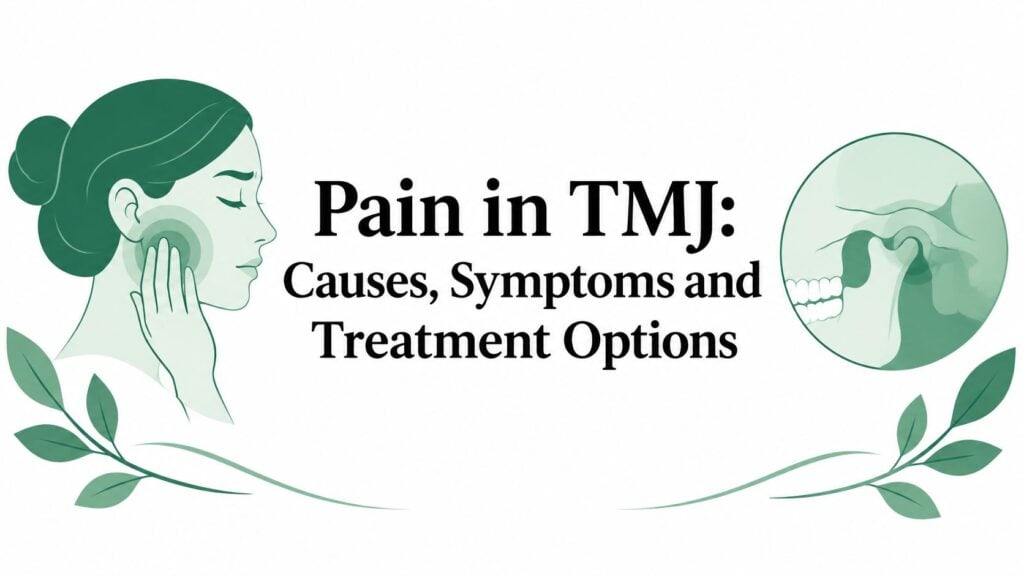
The temporomandibular joint (TMJ) is the hinge just in front of each ear. It connects the lower jaw to the skull and lets you chew, talk, and yawn. Temporomandibular disorders (TMDs) are an umbrella of more than 30 conditions affecting the jaw joints, chewing muscles, and surrounding tissues, and the National Institute of Dental and Craniofacial Research estimates that about 5% of U.S. adults have one.
Jaw and face pain is reported more often by women than by men, a gap that large national surveys have found consistently. Different studies use different time windows, so the exact percentages shift, but the pattern itself is steady. This is a common problem.
Chronic headaches, jaw pain, facial pain, and clicking or popping can all belong to the same picture. A thorough evaluation looks for root causes instead of treating one symptom in isolation. Treat these patterns as a reason to book that visit.
| Symptom | What It May Suggest | When to Seek an Evaluation |
|---|---|---|
| Jaw pain when chewing or yawning | Chewing muscles or the joint under strain | Pain lasts more than a few weeks |
| Clicking or popping | Change in disc position or joint movement | Clicking comes with pain or limited motion |
| Locked or restricted jaw opening | Disc displacement or joint restriction | Opening the mouth feels blocked or uncomfortable |
| Morning headache or temple ache | Clenching or grinding during sleep | Headaches recur several times a week |
| Ear pain or fullness with no infection | Referred pain from the nearby joint | Ear symptoms persist and no ear cause is found |
| Neck and shoulder tension | Muscle guarding and posture changes | Tightness continues alongside jaw symptoms |
| Facial pain that spreads | Sensitized pain pathways | Pain spreads or stays for weeks |
A click without pain is common and usually harmless. Pain, locking, or a jaw that opens only partway sends a different signal. And when pain spreads or lingers long after an old strain has healed, the nerves carrying those signals may have grown more sensitive, which is one reason symptoms can outlast their original trigger. If the jaw catches or stays stuck, a focused look at causes of jaw lock can help you describe the pattern before an exam.
A symptom list points toward an evaluation. The exam that follows is what names the condition and shapes the treatment.
What Causes TMJ Pain and Why It Can Persist
A calf muscle can stay sore for days after a long hike, well after the walk that overloaded it has ended. The jaw works the same way. Chewing muscles stay "on" through clenching or grinding, and the overload can also come from a displaced disc, arthritis or another joint change, an old jaw or neck injury, or stress that never lets the muscles rest.
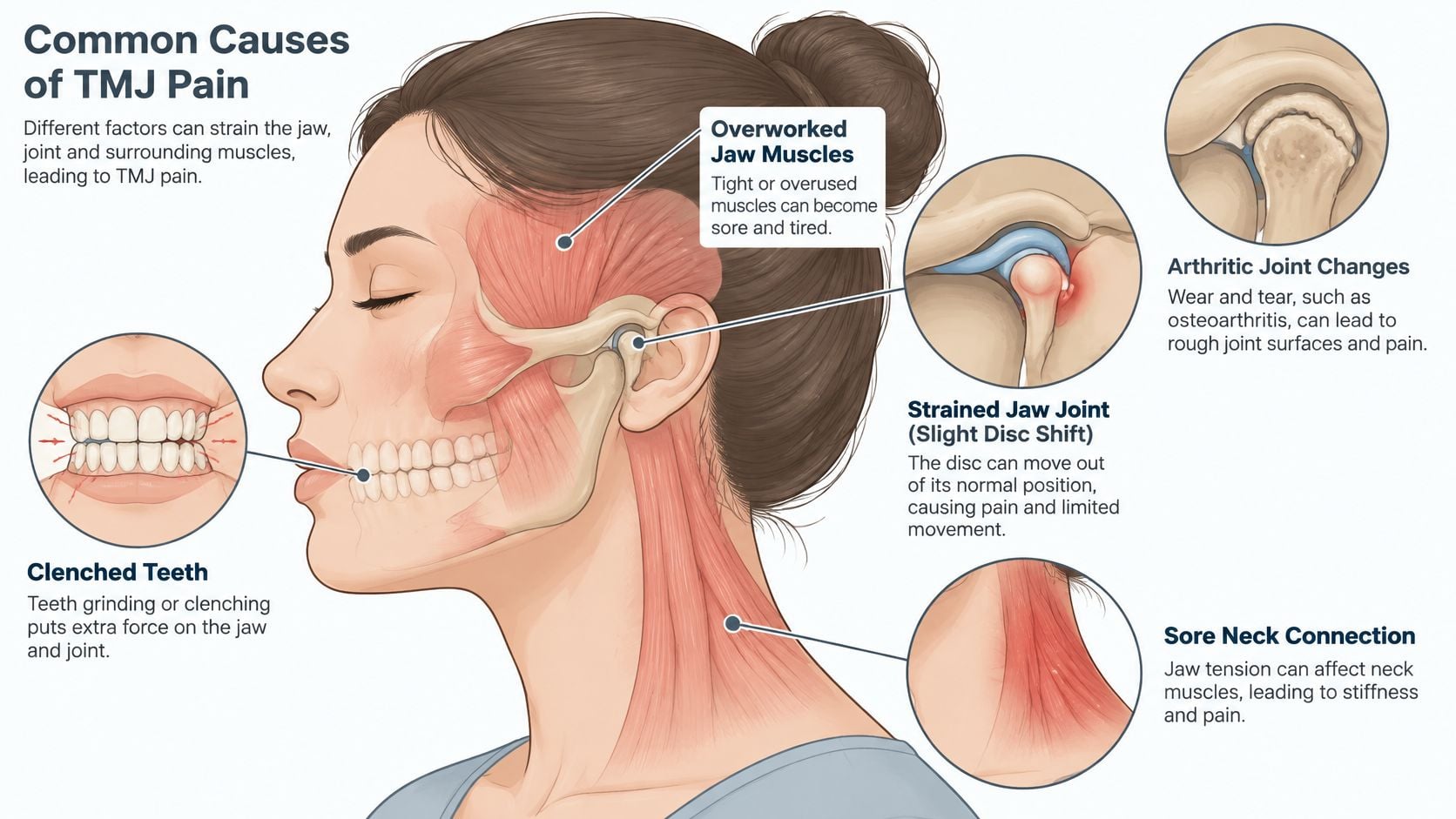
When the alarm stays on
Repeated overload, reduced blood flow, or inflammation can activate trigeminal nociceptors, the nerve endings that carry pain signals from the jaw. Those endings release glutamate, substance P, and calcitonin gene-related peptide (CGRP). A clinical review indexed on PubMed Central ties CGRP inside the joint capsule to neurogenic inflammation and lower pain thresholds, so the tissue becomes easier to irritate. With ongoing input, trigeminal neurons become hyperexcitable. A small chew or a light press can then hurt more than the movement seems to deserve, and pain can spread.
That shift explains why pain can outlast the original trigger. The same review lists clinical clues that point to a sensitized system: familiar pain on exam, local tenderness, allodynia (pain from a light touch), hyperalgesia (an exaggerated pain response), pain beyond the face, poor sleep, or several pain complaints at once.
Stress and sleep are part of the same picture
Anxiety, short sleep, and fear of moving the jaw can turn the volume up on an already sensitized system. Joint wear on a scan can look mild even when the pain feels severe, because sensitized nerves amplify the signal. Planning maps where the pain sits and separates a local tissue driver from pain the nervous system is maintaining. Both the physical driver and the amplifying factors belong in the plan.
How Clinicians Diagnose Jaw Pain and Its Sleep Link
A useful visit follows a sequence. Skipping a step is how jaw pain gets blamed on the wrong structure.
- History first. Onset, what makes pain worse, headaches, diet, daytime habits, and how you sleep.
- Hands-on exam. Range of motion, joint sounds or vibrations, and palpation of the chewing muscles.
- Pain map. Where it sits, what provokes it, and whether a distant body site is also tender.
- Sleep and stress screen. A structured approach such as DC/TMD pairs a physical diagnosis (Axis I) with disability and psychosocial factors (Axis II).
- Imaging only when it answers a question. Bone and soft tissue are not the same test.
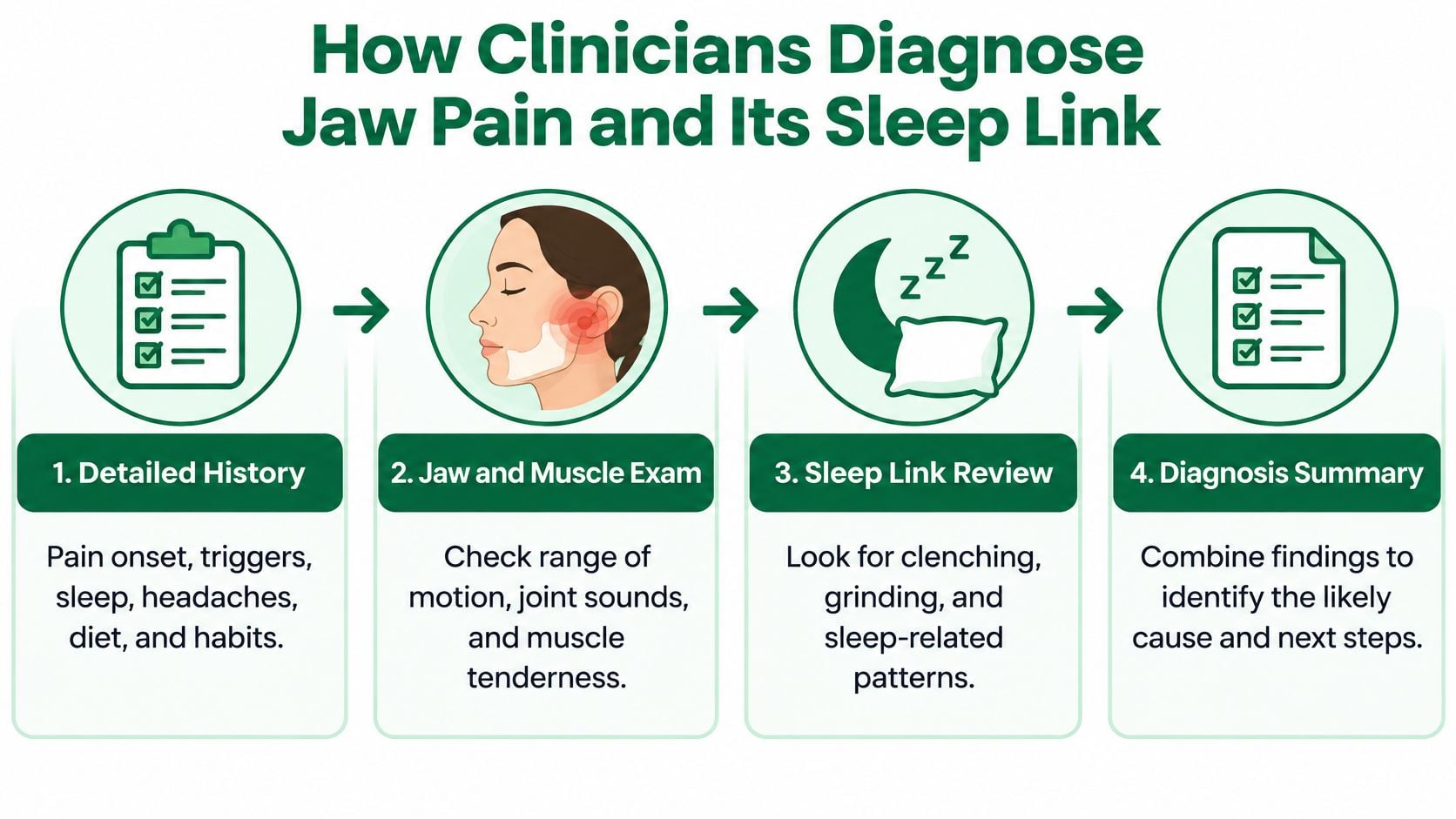
TMJ disorders are sorted through physical examination, range of motion, joint sounds, hard-tissue images, history, and sometimes sleep testing plus hospital-based soft-tissue imaging. A 3D CBCT (cone beam) scan of the jaw joint is frequently needed to see bone detail, and patients may be referred to a diagnostic imaging center to complete it. MRI is the better look at the disc and other soft tissue inside the joint. CT fits when degenerative bone change is the question. Images are read next to symptoms. A clear joint on a scan can still hurt, and a finding on a scan may not be the reason for the pain.
| Test or Assessment | What It Shows | When It Is Used |
|---|---|---|
| Clinical exam and palpation | Muscle tenderness, joint sounds, and range of motion | Every evaluation, as the first step |
| 3D CBCT scan | Detailed bone structure of the jaw joint | Often needed to assess the bony joint |
| MRI | Soft tissue, including disc position | When a disc or other intra-articular problem is suspected |
| CT scan | Bone changes and degenerative change | When bone change is the main question |
| Sleep study | Breathing and oxygen levels during sleep | When sleep apnea is suspected |
The sleep pattern to check
A jaw that clenches at night and an airway that narrows during sleep can travel together. Greater than 60% of patients with TMJ issues have obstructive sleep apnea (OSA), so a sleep study may be suggested during TMJ therapy. The clinician asks about snoring, morning headaches, unrefreshing sleep, and witnessed pauses in breathing. Those clues are not proof.
The American Academy of Sleep Medicine states that polysomnography, an overnight study that records breathing and related body signals, is the standard test for adults when OSA is suspected after a full sleep evaluation. Diagnosis belongs to a qualified physician plus objective testing. A home sleep test may be chosen in some settings. Treatment choices, including a custom oral appliance as an alternative for selected adults who prefer it to CPAP, cannot tolerate CPAP, or do not respond to it, come only after that medical diagnosis and professional fitting. Follow-up sleep testing is suggested after an appliance is fitted. The link between snoring and TMJ is a pattern to investigate, not a conclusion you reach from tired mornings alone.
A good evaluation ends with a written plan and a date to reassess, not a single image and a guess.
Conservative Steps to Try First
Start with the least invasive plan and give it enough time to show a pattern. An NIH-indexed clinical review reports that conservative care can reduce symptoms in approximately 50% to 90% of patients. That range is an aggregate estimate, not a promise for any one person; diagnosis, habits, and other conditions change the result.
Care begins with education, because pain often eases when the jaw stops doing extra work. A softer diet and jaw rest during flares cut daily load. Warm compresses settle guarding muscles. Gentle passive stretching, only as guided, keeps motion without forcing a lock. Physical therapy may add soft-tissue or joint mobilization, muscle conditioning, light resistance, and neck posture work for the structures sharing the strain. Daytime habits carry equal weight: notice clenching, skip gum, and avoid forcing a wide yawn. Nutrition counseling may use a food journal to find triggers adding to chronic pain or inflammation. Sleep and stress strategies matter because a tired nervous system can keep muscles switched on after the original irritant has faded.
Splint treatment stays controversial and is not strongly supported for every patient, so an appliance is an individual decision rather than an automatic first step. More invasive care is generally reserved for failed conservative care or a severe acute flare. Conservative plans usually need several weeks, after which you should reassess.
How stress-focused care still treats the jaw
Stress, anxiety, poor sleep, and fear of jaw movement can amplify symptoms by keeping the alarm system sensitive. In that state, normal chewing can feel threatening the way a smoke alarm reacts to toast. A 2025 systematic review found that cognitive-behavioral therapy (CBT) can reduce pain and psychological impairment, with limited evidence that CBT is better than other treatments on its own. The strongest fit is skills care added to standard treatment: track triggers, practice paced jaw movement, calm breathing during flares, set steadier sleep habits, and reduce fear of motion. For a clear look at how the nervous system keeps a signal going, explore how pain perception works. Keep the exam as the anchor for the plan.
Treatment Options When Conservative Care Is Not Enough
When weeks of self-care still leave the jaw sore, the next step is rarely a single procedure. It is a better-matched plan: reduce the load that keeps muscles guarding, calm nerves that may have become sensitized after the original trigger faded, and protect sleep so the system can settle overnight. Each option below has a job and a limit, and each can have side effects, including changes to the bite or the joint even when precautions are taken. The plan should be reviewed, not set once and forgotten.
| Option | What It Involves | When It Is Considered | Key Limit |
|---|---|---|---|
| Custom oral splint or orthotic | Appliance worn over the teeth, often at night | Pain linked to clenching or grinding after conservative care | Does not solve every headache; design and fit matter |
| Cold laser therapy | Light-based treatment applied to painful tissue | As an adjunct to other care | Works alongside other care, not as a standalone fix |
| Joint or muscle injections | Local injection into the joint or jaw tissue, including PRF or a single Wharton's Jelly injection in selected cases | Selected cases where pain persists | Benefit varies by patient and diagnosis |
| Nerve blocks | Anesthetic delivered near nerves linked to jaw pain, such as an SPG block with a thin applicator | Short-term management of severe facial pain, cluster headache, or migraine | Relief is usually temporary |
| Medications | Used to support more definitive treatment | During active pain or inflammation | Used only to improve outcomes of definitive care |
| Surgery | Procedures on the joint for structural damage | When conservative care has failed or damage is severe | Reserved for last-resort cases after a full evaluation |
A nighttime appliance is a hallmark maintenance therapy for TMJ. If it is not made to control sleep apnea, it can double the severity of a patient's sleep apnea. That is why a sleep evaluation belongs in the decision before the device is already in use. Headache occurrence frequently improves with therapy, but appliances are not guaranteed to solve headache issues.
Drugs are used only to improve the outcomes of more definitive TMJ treatments. Drugs alone cannot solve TMJ issues. Injections and nerve blocks work best as part of a plan that also changes load, sleep, and muscle habits. Surgery stays last, after structural damage is confirmed and conservative care has not been enough. Newer noninvasive choices are outlined among TMJ treatment approaches that still start from the diagnosis, not from a device.
Oral appliances and diagnosed sleep apnea
These are separate from a basic TMJ night appliance. The AASM oral appliance review supports oral appliances especially for adults with mild to moderate OSA who prefer them to CPAP or cannot use it, and it reports that people with mild to severe OSA had about a 52% chance of controlling apnea with an oral appliance, with less predictable results in severe disease. For severe OSA, CPAP remains the preferred treatment whenever possible. That figure describes study groups, not a personal promise. Follow-up sleep testing may be needed to verify that the appliance is working, including if symptoms return.
Get an Evaluation for Jaw Pain
Jaw pain that fades within days rarely needs a specialist. Pain that lingers for weeks, or keeps returning long after the original trigger has passed, usually means the nerves and muscles around the joint have become sensitized, and that pattern is easier to unwind earlier than later. Book a prompt visit when jaw pain lasts for weeks, the jaw locks or will not open comfortably, pain follows an injury, or headaches and unrefreshing sleep keep returning.
Seek urgent medical care for a different set of signals: sudden severe swelling, fever with jaw pain, or a sudden inability to open or close the mouth. Those are not "wait and stretch" problems.
A first evaluation at Pain and Sleep Therapy Center may include a detailed history and interview, a physical exam with range-of-motion testing and joint sound assessment, and imaging or a sleep study when they are needed. Sleep screening often becomes part of that workup rather than a side note, because more than 60% of patients with TMJ issues also have Obstructive Sleep Apnea, and a nighttime appliance that ignores the airway can make apnea worse. The team is led by Dr. Ryan Robinson, a triple board-certified specialist in craniofacial pain and dental sleep medicine, and care is coordinated with other providers rather than kept in a silo. The practice serves patients in Newark, Delaware, and Bryn Mawr, Pennsylvania.
If snoring or unrefreshing sleep is part of your jaw story, you can Take our Sleep Quiz. If the jaw itself is the reason you are reading, Request an Appointment.
Pain and Sleep Therapy Center focuses on root-cause evaluation for jaw, head, and facial pain, with sleep and stress treated as part of the same picture rather than separate complaints. If pain in the TMJ is limiting how you eat, sleep, or get through the day, schedule a visit at Pain and Sleep Therapy Center to sort the muscle, joint, and airway findings before more involved treatment.