
Why do jaw pain, clicking, or morning headaches keep returning even after someone tries a mouthguard and follows the usual advice? Often the missing piece is a clearer picture of where the symptoms start: the jaw joint itself, the chewing muscles, daily habits, sleep problems, or several of these at once.
The temporomandibular joint (TMJ) connects the lower jaw to the skull. Temporomandibular disorders (TMD) are conditions affecting that joint and the muscles that move it. People often use "TMJ" as shorthand for both.
So what counts as a new TMJ treatment? A scoping review of emerging TMD treatments groups the newer options into three categories: conservative therapies, minimally invasive procedures, and combined approaches, with surgery generally reserved for severe cases.
The options below include light therapy, joint lavage, muscle injections, platelet treatments, digital splints, behavioral care, physical therapy, and sleep-informed treatment. That last category matters more than many people expect. Jaw health and sleep health often overlap, and more than 60% of patients with TMJ issues also have obstructive sleep apnea, so sleep screening belongs in TMJ conversations.
Each treatment is graded on three practical axes:
- Evidence strength describes how confidently research supports an option.
- Invasiveness distinguishes external treatments and removable devices from needles and procedures.
- Best fit identifies the symptom pattern that may make an option reasonable.
For adults seeking care near the Pain and Sleep Therapy Center offices in Newark, Delaware, and Bryn Mawr, Pennsylvania, the starting point remains a professional evaluation. Each option suits a different symptom pattern, so treatment decisions should rest on a proper diagnosis rather than self-assessment.
Table of Contents
- 1. Low-Level Laser Therapy (Cold Laser / Photobiomodulation)
- 2. Arthrocentesis with Hyaluronic Acid Injection (Minimally Invasive Joint Lavage)
- 3. Botulinum Toxin (Botox) Injections for Jaw Muscle Pain and Clenching
- 4. Platelet-Rich Plasma (PRP) Injections for Joint Support
- 5. Custom Digital and 3D-Printed Stabilization Splints
- 6. Pain Neuroscience Education and Cognitive Behavioral Therapy (CBT)
- 7. Structured Jaw Exercise and Manual Therapy (TMD Physical Therapy)
- 8. Sleep-Informed TMJ Care Through Home Sleep Testing and Oral Appliance Therapy
- New TMJ Treatments at a Glance
- Finding the Right TMJ Treatment for You
1. Low-Level Laser Therapy (Cold Laser / Photobiomodulation)
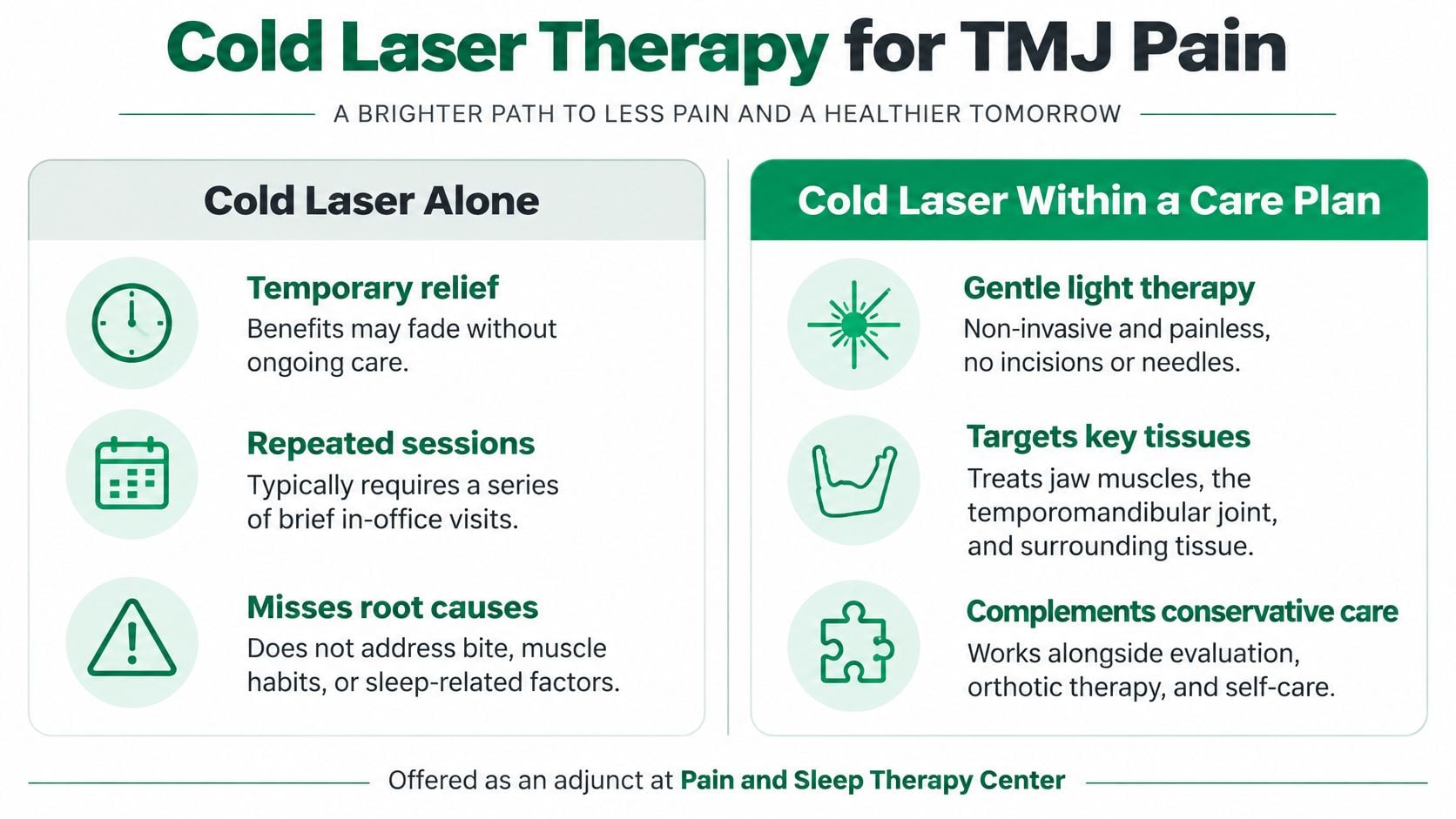
Cold laser therapy uses low-power light over selected areas of the jaw and face. Also called photobiomodulation, it differs from a surgical laser because it isn't used to cut tissue.
Researchers are investigating whether this light can influence cellular activity and inflammation in ways that may ease pain. The proposed effects don't establish that laser treatment repairs a damaged joint or resolves the underlying cause of TMD.
Where Cold Laser May Fit
A typical use case is muscle-related jaw soreness that makes chewing uncomfortable while a patient works on clenching habits and guided rehabilitation. Laser treatment may serve as an adjunct, meaning an addition to the main treatment plan rather than a replacement for it.
- Evidence strength: Developing and variable. Short-term symptom relief is a more cautious expectation than lasting structural change.
- Invasiveness: Non-invasive, with light applied externally and appropriate eye protection.
- Best fit: Selected patients seeking an additional pain-management approach within conservative care.
Pain and Sleep Therapy Center offers cold laser as an adjunct for pain modulation and tissue healing within a root-cause care plan. Its cold laser therapy overview provides additional context for this approach.
A useful progress record includes chewing comfort, headaches, jaw soreness, and whether relief lasts between appointments. Treatment should be reconsidered when those daily functions aren't improving.
Practical rule: Temporary relief matters most when it helps a patient return to comfortable movement and participate in the rest of treatment.
Gentler habits still matter. Avoiding gum chewing and extreme mouth opening may reduce unnecessary strain while the broader plan addresses the source of symptoms.
2. Arthrocentesis with Hyaluronic Acid Injection (Minimally Invasive Joint Lavage)
Arthrocentesis means washing out a joint through small needles. A trained clinician places fluid into the TMJ to flush the joint space, sometimes followed by an injection of hyaluronic acid, a substance naturally present in joint fluid that helps with lubrication.
This approach targets the joint itself. It isn't the same as injecting a tight chewing muscle, and it's less invasive than open joint surgery.
Joint Symptoms Matter More Than Treatment Novelty
A typical candidate might have persistent joint pain, locking, or restricted opening despite an appropriate trial of non-surgical care. By contrast, someone whose main problem is sore cheek muscles from daytime clenching may need a different approach.
A systematic review of arthrocentesis agents included 40 randomized controlled trials involving 1,904 temporomandibular joints and compared treatments including hyaluronic acid, platelet-rich plasma, corticosteroids, and other injectables. The varied preparation methods, patient groups, and follow-up periods prevent a simple conclusion that one agent is best for everyone.
- Evidence strength: A substantial clinical research base, but uncertainty remains about the best added injection and which patients benefit most.
- Invasiveness: Minimally invasive, involving needles placed into the joint, generally with local anesthesia.
- Best fit: Selected joint-based problems that remain troublesome after conservative care.
Before proceeding, the clinician should explain the diagnosis, expected benefit, alternatives, and procedure-specific risks. The discussion should also distinguish reduced pain from improved opening, since those outcomes don't always change together.
Recovery instructions may include softer foods, temporary activity changes, and guided movement. The treating clinician's instructions should determine the timing rather than a generic recovery schedule.
3. Botulinum Toxin (Botox) Injections for Jaw Muscle Pain and Clenching
A sore chewing muscle and an inflamed jaw joint can feel similar, but they aren't interchangeable treatment targets. Botulinum toxin, commonly known by the brand name Botox, temporarily reduces activity in injected muscles.
For jaw symptoms, injections may target the masseter, the large chewing muscle along the cheek, or the temporalis, the broad muscle at the side of the head. The intended effect is less muscle force, which may help selected patients with persistent muscle-based pain.
A Selective Option, Not a Routine Starting Point
Botulinum toxin use for TMD is off-label, meaning it isn't specifically approved for that indication. The National Institute of Dental and Craniofacial Research's TMD guidance explains that evidence for botulinum toxin in TMD remains limited and recommends starting with conservative, reversible treatment.
- Evidence strength: Limited and uncertain for routine TMD care.
- Invasiveness: Needle injections into muscles, with effects that aren't immediately reversible.
- Best fit: Carefully selected patients with persistent muscle-dominant symptoms after other approaches have been evaluated.
For example, someone with marked masseter tenderness and repeated daytime clenching may have a different treatment discussion from someone with joint locking. Neither finding alone establishes that injections are appropriate.
Possible downsides include chewing weakness, soreness, facial asymmetry, and uncertainty about repeated treatment's effects on nearby tissues. Reducing muscle force also doesn't necessarily stop the habit or address disrupted sleep.
An explanation of what trigger point therapy involves can help distinguish muscle-focused approaches, although trigger point treatment and botulinum toxin aren't interchangeable.
Less muscle activity isn't the same as identifying why the muscles stay active. Habit awareness, rehabilitation, and sleep assessment may still be needed.
4. Platelet-Rich Plasma (PRP) Injections for Joint Support
Platelet-rich plasma (PRP) begins with a sample of the patient's own blood. The blood is processed to concentrate platelets, which contain substances involved in the body's repair response, before the preparation is injected into the treatment area.
PRP belongs to regenerative medicine, a field studying ways to support tissue repair. That label describes the treatment concept, not proof that an injection regrows TMJ cartilage.
Promise Needs to Be Matched with Realistic Expectations
A typical use case is a patient with confirmed degenerative joint changes, sometimes called osteoarthritis, whose symptoms remain limiting after conservative treatment. PRP is less logically matched to pain driven mainly by muscle tension or heightened nervous-system sensitivity.
A systematic review of orthobiologics for advanced degenerative TMJ disease rated the evidence low to very low certainty and found that improvements compared with hyaluronic acid fell below clinically important thresholds. It didn't support choosing one orthobiologic over another.
- Evidence strength: Emerging, with substantial uncertainty about meaningful benefit and durability.
- Invasiveness: Blood collection and injection into the joint or surrounding treatment area.
- Best fit: Selected patients with a clearly established joint diagnosis, not unexplained facial pain.
The distinction between a statistically detectable change and a noticeable daily improvement matters. Easier meals and less pain interference are more useful goals than a vague promise of healing.
This explanation of how PRP injections work describes the preparation process, but the clinical decision still depends on TMJ-specific evidence.
Platelet-rich fibrin (PRF) is a related preparation, not another name for PRP. Treatment discussions should identify the actual product, explain why it fits the diagnosis, and set a point for reassessment if function doesn't improve.
5. Custom Digital and 3D-Printed Stabilization Splints
Digital scanning can replace a traditional impression when creating a custom oral appliance. A clinician uses the scan to design a stabilization splint, also called an occlusal splint or orthotic, that fits over the upper or lower teeth. It works like a precisely fitted mouthguard, except each contact point is planned rather than generic.
Depending on its design, the appliance may distribute contact forces, protect teeth, or support more comfortable jaw function. Digital fabrication changes the manufacturing step only. Diagnosis, fitting, and follow-up still determine whether the appliance may help.
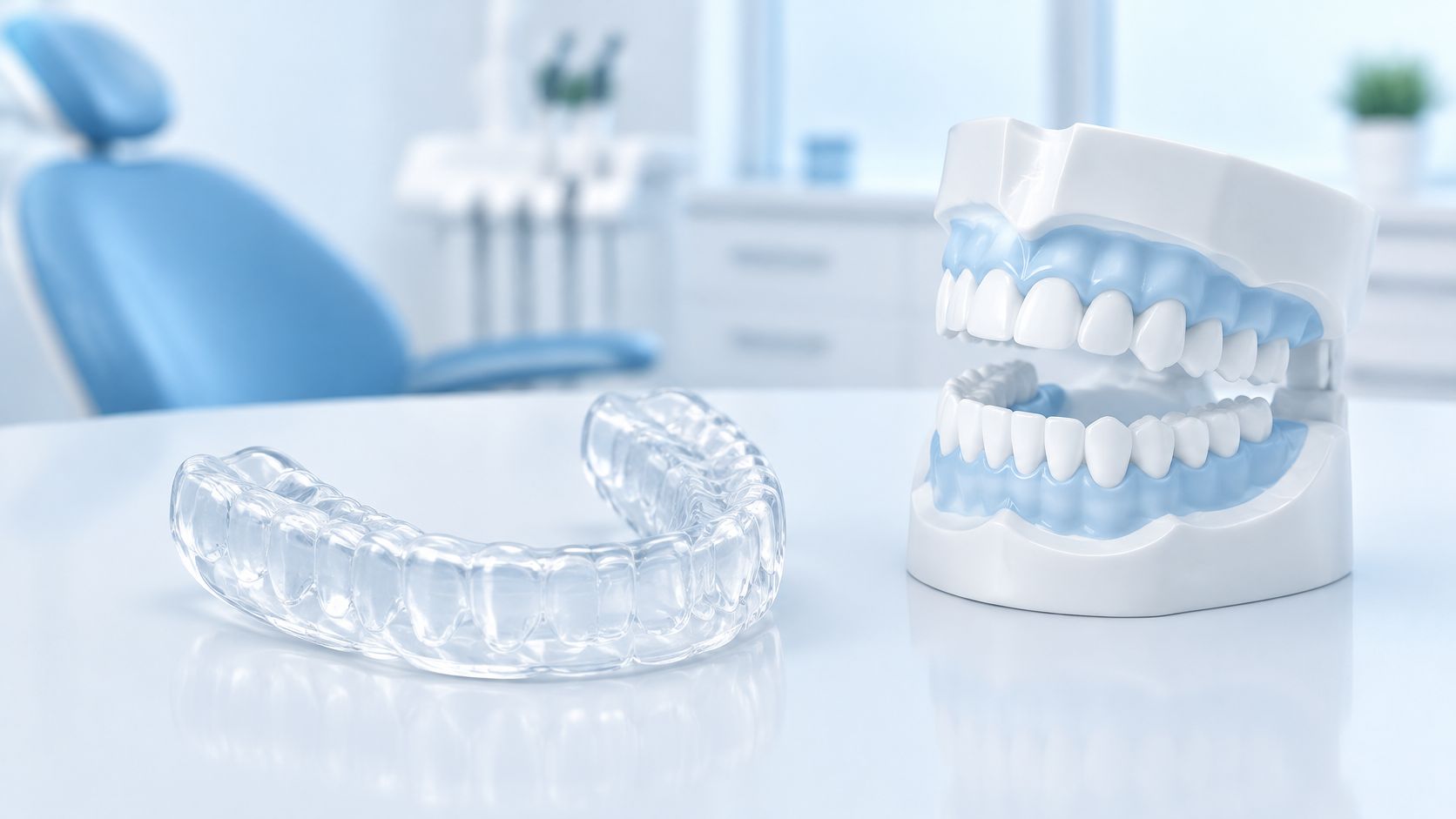
The clear tray shown is a general dental appliance, while a prescribed TMJ splint has its own design goals. An orthodontic aligner, stabilization splint, and sleep-apnea appliance serve different purposes.
Better Fabrication Doesn't Guarantee Better Relief
A review of digital TMD care and splint comparisons describes comparable pain relief, mouth opening, and satisfaction with digitally and conventionally made splints. Digital fabrication therefore shouldn't be presented as more effective.
- Evidence strength: Mixed for splints across TMD conditions; digital manufacturing hasn't established superior clinical outcomes.
- Invasiveness: Non-surgical and removable, though tooth discomfort or bite changes can occur.
- Best fit: Selected patients whose examination supports a monitored appliance trial.
A patient with tooth wear and morning jaw soreness, for example, may benefit from an appliance that reduces nighttime loading. If snoring or suspected sleep apnea enters the picture, the sleep-focused guidance later in this article applies.
Information about jaw alignment and treatment evaluation can help separate supportive appliance care from attempts to permanently change the bite.
Wear instructions should be individualized. New tooth pain, worsening jaw symptoms, or a bite that feels different after removing the device deserves prompt review rather than continued use without assessment.
6. Pain Neuroscience Education and Cognitive Behavioral Therapy (CBT)
Persistent pain doesn't always track neatly with tissue damage. The nervous system can become more sensitive over time, so ordinary movement may hurt more than expected.
Pain neuroscience education explains that process in plain language. Cognitive behavioral therapy (CBT) teaches practical skills for changing unhelpful thought patterns, stress responses, and habits that can increase pain-related distress or disability.
This doesn't mean jaw pain is imaginary. It means treatment can address both painful tissues and the way the nervous system responds to them.
Skills That Support Physical Recovery
A scoping review of TMD management trials identifies education, behavioral therapy, and exercise as first-line approaches that can improve pain and jaw function. These approaches can accompany physical treatment rather than compete with it.
- Evidence strength: Supportive for education and behavioral approaches within conservative, combined care.
- Invasiveness: Non-invasive.
- Best fit: Persistent pain, stress-linked clenching, fear of movement, or difficulty returning to normal activities.
A typical example is someone who avoids nearly all chewing because of fear that movement will damage the joint. After an appropriate examination, education and gradual activity may help that person rebuild confidence without ignoring symptoms.
An overview of how cognitive behavioral therapy works explains the skills-based approach. For TMD, useful goals might include noticing clenching earlier, reducing constant symptom checking, and responding more calmly to a flare.
A helpful distinction: Stress can influence real physical pain without being its only cause.
A simple record of sleep quality, stress, chewing comfort, and pain interference may reveal patterns. Progress can mean fewer disrupted meals or less fear of movement, even before pain fully settles.
7. Structured Jaw Exercise and Manual Therapy (TMD Physical Therapy)
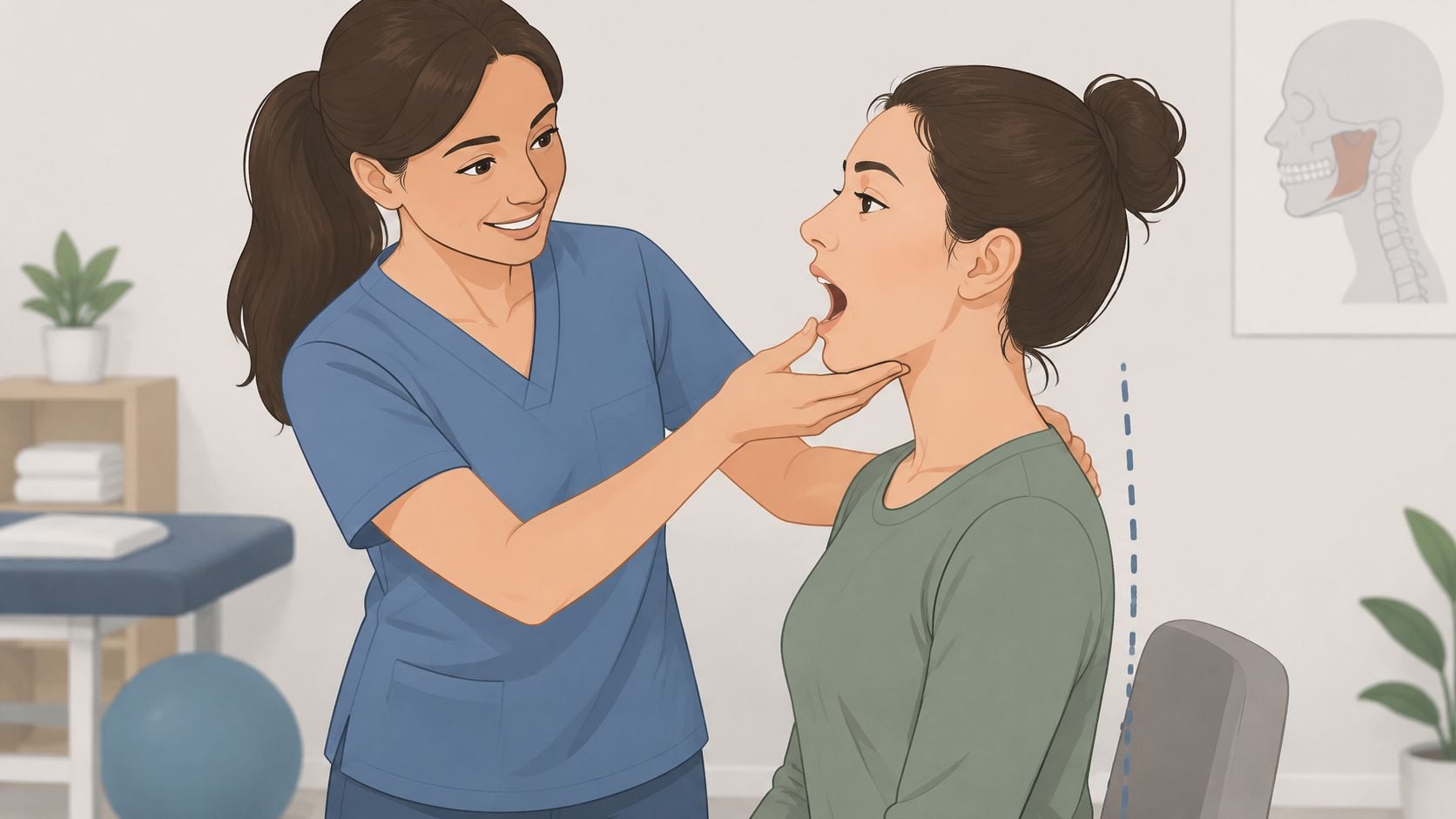
Treatment can begin with learning how to move the jaw comfortably again. TMD physical therapy uses guided exercises, movement retraining, and hands-on care to improve function without a procedure.
Manual therapy means hands-on techniques, such as soft-tissue work or gentle joint mobilization. A therapist may also address neck movement, posture, and muscle coordination when the examination identifies relevant limitations.
A Gradual Plan Beats Forceful Stretching
A meta-analysis of TMJ mobilization found a mean pain reduction of 2.90 points and a 10.76 mm improvement in mouth opening versus control at four weeks. Those findings describe the analyzed studies, not a guaranteed response for an individual patient.
- Evidence strength: Supportive for appropriately selected exercise and manual therapy, especially within conservative care.
- Invasiveness: Non-invasive.
- Best fit: Movement restriction, muscle tenderness, coordination problems, or jaw symptoms accompanied by relevant neck limitations.
For example, a patient who opens unevenly and tightens the jaw during desk work may practice controlled opening while adjusting work habits. Someone with painful locking may need a different plan before beginning stretches.
Useful home instructions are specific:
- Movement quality: Practice the demonstrated motion slowly, without forcing the jaw wider.
- Symptom response: Stop an exercise that causes sharp pain, new locking, or clear worsening.
- Daily loading: Avoid repeatedly testing the widest possible opening.
- Screen posture: Keep the head comfortably balanced rather than held forward for long periods.
A therapist should demonstrate each exercise and watch the patient repeat it. More repetitions or stronger pressure aren't automatically better; the aim is comfortable, useful movement that carries over into eating and speaking.
8. Sleep-Informed TMJ Care Through Home Sleep Testing and Oral Appliance Therapy
Morning jaw soreness, headaches, snoring, and daytime fatigue deserve a conversation about sleep as well as the jaw. Screen for sleep apnea when jaw pain comes with snoring or fatigue, because the two areas overlap more than many patients expect: greater than 60% of patients with TMJ issues have Obstructive Sleep Apnea (OSA), so a sleep study may be suggested during TMJ therapy.
Obstructive sleep apnea (OSA) occurs when the upper airway repeatedly narrows or closes during sleep, fragmenting rest and straining the body night after night. A home sleep apnea test records selected breathing signals, while an overnight laboratory study provides a broader assessment.
Testing Comes Before Treatment Selection
The American Academy of Sleep Medicine's diagnostic guidance identifies laboratory polysomnography as the diagnostic gold standard and home testing as appropriate for selected adults. A physician confirms the diagnosis through a sleep study; symptom checklists serve only to identify who needs that testing.
A typical use case is a patient seeking help for morning jaw pain whose partner also reports loud snoring. That combination supports discussing a sleep evaluation before assuming every symptom traces back to clenching or grinding.
- Evidence strength: Established for diagnosing OSA and using oral appliances in selected adults, but not as a universal treatment for TMD.
- Invasiveness: Home testing is non-invasive; oral appliance therapy uses a removable device.
- Best fit: Patients with relevant sleep symptoms and, for treatment, a confirmed diagnosis and individualized plan.
An oral appliance commonly holds the lower jaw forward to help maintain airway space during sleep. The AASM's oral-appliance guidance supports custom, adjustable devices for selected adults who prefer an alternative to continuous positive airway pressure (CPAP) or cannot tolerate it, with dental oversight and follow-up testing.
CPAP remains an important treatment option. Appliance design matters as well: a nighttime appliance is a hallmark maintenance therapy for TMJ, yet one that is not made to control sleep apnea can double the severity of a patient's sleep apnea. That risk is the practical reason sleep screening belongs in the TMJ conversation before any device is prescribed.
Information about at-home sleep apnea testing can help patients understand the evaluation process before an appointment.
New TMJ Treatments at a Glance
Use this table as a map. The same jaw symptom can come from the joint, the chewing muscles, sleep-related breathing, or a nervous system that has become protective, so the best starting point is the option that matches the main driver and can be checked against daily function.
| Treatment | Invasiveness | Evidence Level | Best For | Main Reassessment Trigger |
|---|---|---|---|---|
| Low-Level Laser Therapy (Cold Laser / Photobiomodulation) | Non-invasive | Developing; possible short-term pain relief | Adjunctive relief for jaw muscle or joint pain | Pain or function stays flat during a monitored conservative trial |
| Arthrocentesis with Hyaluronic Acid Injection (Minimally Invasive Joint Lavage) | Minimally invasive; needle-based procedure | Recognized option for selected joint conditions | Persistent joint pain, locking, or limited opening despite conservative care | Findings point more toward muscle or sleep drivers than a joint problem |
| Botulinum Toxin (Botox) Injections for Jaw Muscle Pain and Clenching | Minimally invasive; injections | Limited evidence; off-label for TMD | Selected cases of chronic muscle pain or clenching | Clenching or muscle pain continues without easier eating or movement |
| Platelet-Rich Plasma (PRP) Injections for Joint Support | Minimally invasive; injection using patient's blood | Preliminary and limited | Some joint pain cases seeking a non-surgical option | Joint pain is no longer the dominant problem, or goals are not being met |
| Custom Digital and 3D-Printed Stabilization Splints | Non-invasive; removable oral device | Mixed evidence; used in conservative care | Clenching, grinding, muscle strain, and tooth protection | Snoring, witnessed pauses, or daytime fatigue appear, since a splint not built for apnea can worsen it |
| Pain Neuroscience Education and Cognitive Behavioral Therapy (CBT) | Non-invasive; education and therapy | Supported for chronic pain | Pain affected by stress, sleep, mood, or fear of movement | Fear of movement, stress, poor sleep, or mood keeps limiting progress |
| Structured Jaw Exercise and Manual Therapy (TMD Physical Therapy) | Non-invasive; exercise and hands-on care | Supported by guidelines and reviews | Improving jaw movement, comfort, posture, and muscle coordination | Gains in jaw motion, coordination, or posture stall |
| Sleep-Informed TMJ Care: Home Sleep Testing and Oral Appliance Therapy | Non-invasive; home test and oral device | Recognized option for selected sleep apnea patients | Jaw symptoms alongside suspected sleep-disordered breathing | Testing or appliance goals are not met, or symptoms point back to joint or muscle causes |
Jaw health and sleep health often overlap. New snoring, morning headaches, or fatigue during any TMJ plan is a reason to screen sleep early rather than treat it as a footnote.
Finding the Right TMJ Treatment for You
The right starting point is the treatment that matches the reason for your symptoms, weighed against its evidence, its invasiveness, and how well it fits your situation.
Joint degeneration, disc problems, muscle-dominant pain, and persistent nervous-system sensitivity can overlap, but they behave differently. An injection aimed at the joint may miss the main problem when pain comes mostly from the chewing muscles. Matching the option to the cause matters more than matching it to a trend.
A thorough evaluation brings those differences into focus. Pain and Sleep Therapy Center's diagnostic process considers patient history, physical examination, jaw range of motion, joint sounds or vibrations, and imaging such as a 3D CBCT scan of the jaw joint when needed, with sleep diagnostics in selected cases.
Measure Daily Function, Not Just Pain
A useful treatment plan starts with a clear baseline and a reassessment point. It should also explain what would justify continuing, changing, or stopping an approach.
Meaningful outcomes include:
- Eating: More comfortable chewing without increasingly restricting food choices.
- Movement: Easier opening and less interference from stiffness or locking.
- Daily life: Fewer interruptions to speaking, work, and normal activities.
- Sleep: Better understanding of snoring, fatigue, or morning symptoms, with objective testing when indicated.
There is no single waiting period that fits every diagnosis. Conservative care deserves a fair, monitored trial, but worsening symptoms or a poor response call for reassessment rather than automatic repetition of the same treatment. When an oral appliance does not meet treatment goals, the next step is another effective therapy, not more of the same.
Persistent locking, new swelling, fever, recent trauma, or difficulty eating and drinking warrants timely clinical attention. Breathing or swallowing difficulty requires urgent medical assessment.
A Conservative, Coordinated Starting Point
Pain and Sleep Therapy Center was founded by Dr. Ryan Robinson, triple board-certified in craniofacial pain and dental sleep medicine, with offices in Newark, Delaware, and Bryn Mawr, Pennsylvania.
Jaw health and sleep health overlap more than many patients expect. Greater than 60% of patients with TMJ issues have obstructive sleep apnea, a condition where breathing repeatedly pauses during sleep, so a sleep study may be suggested during TMJ therapy. Screening matters practically, too: a nighttime appliance that is not designed to control sleep apnea can double its severity.
Personalized plans may include orthotic therapy, cold laser therapy, lifestyle modifications, and collaborative care with healthcare professionals. The aim is the least invasive, least expensive option that is effective and realistic for a patient to follow. No single device or procedure can be guaranteed to resolve every symptom.
Adults considering new TMJ treatments can Request an Appointment for a professional evaluation. Those with snoring, fatigue, or morning symptoms can Take the Sleep Quiz as a starting point for discussion, keeping in mind that a quiz does not diagnose sleep apnea.
Pain and Sleep Therapy Center offers root-cause evaluation for jaw, head, and facial pain, with dental sleep medicine care when sleep concerns overlap. Visit Pain and Sleep Therapy Center to Request an Appointment or Take the Sleep Quiz.