If two sleep apnea appliances look like mouthguards, does that mean they work the same way, or put the same strain on the jaw? Not necessarily. The important differences aren't just the names on the box, but how each appliance fits, whether it adjusts, and which structure it holds forward.
Understanding the types of oral appliances for sleep apnea can make treatment feel less overwhelming. A good decision considers breathing, jaw comfort, dental health, and whether the treatment can be used consistently, not whether a device reduces snoring.
Table of Contents
- The Main Types of Oral Appliances at a Glance
- How Mandibular Advancement and Tongue Retaining Devices Work
- How a Qualified Clinician Fits an Oral Appliance
- Jaw Health and Why Adjustable Designs Matter
- What Long Term Use Really Looks Like
- Which Type Fits Your Situation
- Request an Appointment or Take Our Sleep Quiz
The Main Types of Oral Appliances at a Glance
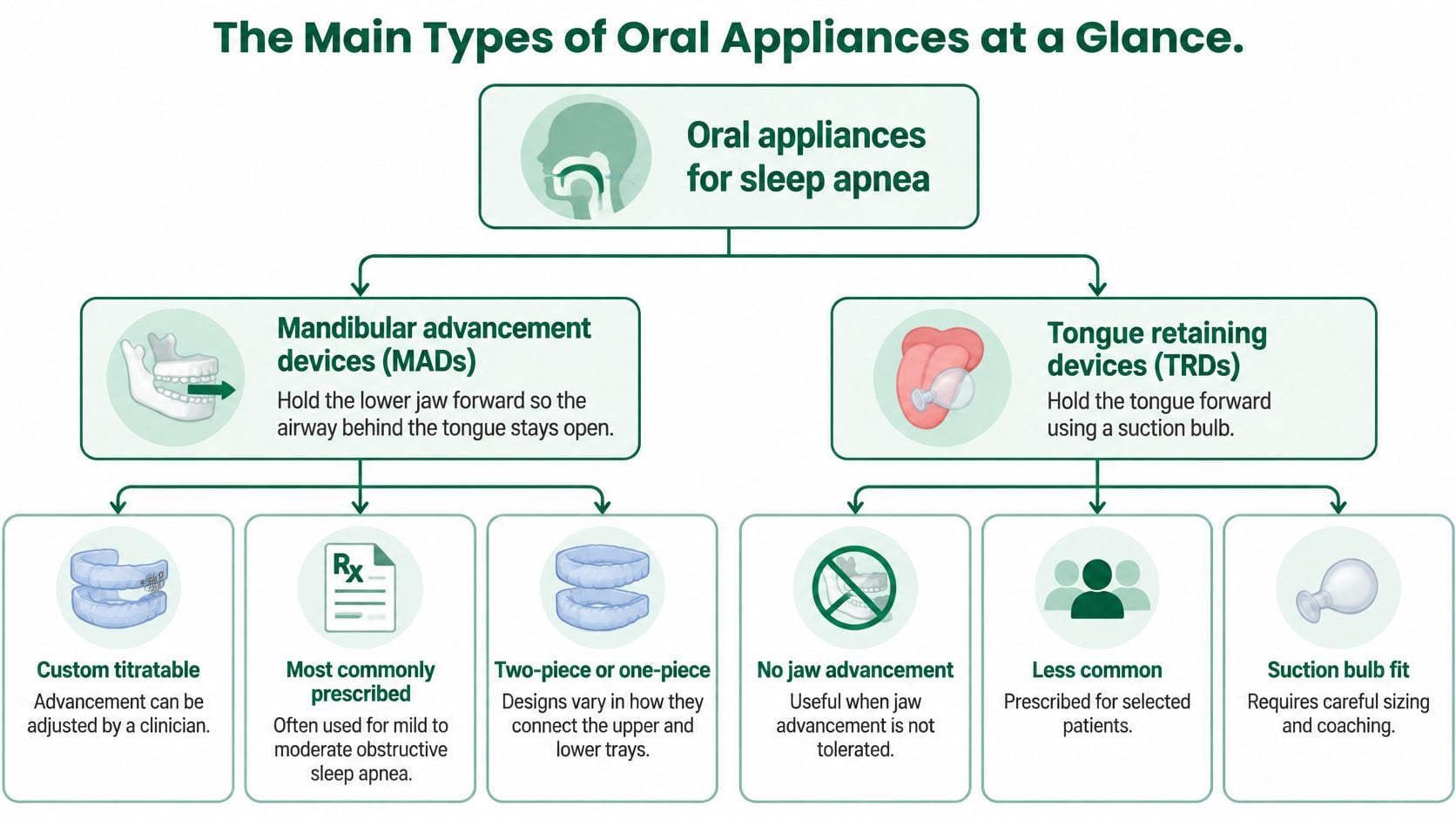
Oral appliances fall into families with different fitting and treatment features. Most hold the lower jaw forward; others hold the tongue forward directly. Both aim to protect the space behind the tongue during sleep.
The four design categories in the joint AASM/AADSM clinical practice guideline reflect two separate questions: Is the appliance custom-made, and can its treatment position be adjusted? Custom fabrication and adjustability are separate features. A custom appliance may have a fixed position, while a commercially manufactured appliance may allow adjustment.
How oral appliances for sleep apnea are classified
The table separates those design features from the structure each device holds forward.
| Type | How it is made | Can it be adjusted | Mechanism | Who may be suited |
|---|---|---|---|---|
| Custom titratable MAD | Made from impressions of the teeth | Yes, gradual clinician-directed advancement | Advances the lower jaw | Adults selected for oral appliance therapy, including those with mild-to-moderate OSA or CPAP intolerance; guideline-preferred design |
| Custom non-titratable MAD | Made from impressions of the teeth | No, fixed advancement | Advances the lower jaw | Selected patients prescribed a fixed position; less flexibility if jaw symptoms develop |
| Non-custom titratable MAD | Commercially manufactured standard sizes | Yes, through its adjustment mechanism | Advances the lower jaw | Selected supervised use; less individualized fit than a custom appliance |
| Non-custom non-titratable MAD | Commercially manufactured standard sizes | No, fixed position | Advances the lower jaw | Limited role because fit and advancement control are restricted |
| Custom tongue-retaining device | Individually fabricated to oral anatomy and tongue fit | Suction fit is set to individual tongue and bulb dimensions; no jaw advancement adjustment | Uses a suction bulb to hold the tongue forward | Selected patients unable to tolerate jaw advancement; adult OSA evidence is less established |
| Non-custom tongue-retaining device | Commercially manufactured | Selected by tongue and bulb fit; no jaw advancement adjustment | Holds the tongue forward | Selected use with professional guidance; less established than MAD therapy |
MAD means mandibular advancement device. The mandible is the lower jaw. Tongue-retaining devices, or TRDs, are also called tongue-stabilizing devices, or TSDs.
Why the categories matter
Custom fabrication concerns fit, like making a mouthpiece to match the teeth. Adjustability concerns treatment position: it gives the clinician room to change advancement without immediately remaking the appliance. These features affect different parts of the patient experience.
Jaw comfort deserves its own consideration. A fixed device offers less flexibility when discomfort develops, while an adjustable design allows changes to the prescribed position. Comfort also matters for consistent wear. A generic snoring product should therefore be distinguished from a prescribed sleep apnea appliance.
Custom titratable MADs are the usual clinical starting point when oral appliance therapy is appropriate.
Tongue-retaining devices offer an alternative mechanism, but evidence for their efficacy in adults with OSA remains insufficient. Holding the tongue rather than advancing the jaw changes the trade-offs; breathing benefit and overall comfort still need individual assessment.
How Mandibular Advancement and Tongue Retaining Devices Work
The airway behind the tongue behaves more like a soft tube than a rigid pipe. During sleep, relaxed tissues can narrow that space or allow it to collapse. Obstructive sleep apnea, or OSA, occurs when repeated upper-airway obstruction interrupts breathing.
Consider an adult whose lower jaw and tongue settle backward during sleep. A mandibular advancement device holds the lower jaw farther forward. That movement also creates tension through connected muscles and soft tissues.
Moving the jaw also influences the tongue
The genioglossus, a major tongue muscle, helps explain why jaw position matters. Advancing the mandible can pull the tongue forward and influence the soft palate and other throat structures, increasing the functional space for airflow, as described in this peer-reviewed review of mandibular advancement therapy.
The appliance doesn't wedge the mouth open. Its purpose is to stabilize a prescribed forward jaw position while the patient sleeps. More advancement isn't automatically better, particularly if the added movement causes pain or makes regular wear difficult.
Holding the tongue directly
A tongue-retaining device takes another route. A bulb-like component uses suction to hold the tongue forward without advancing the lower jaw, according to Cleveland Clinic's oral appliance therapy overview.
This may be considered when jaw advancement isn't tolerated. However, the tongue must remain comfortably seated in the bulb, so avoiding jaw movement doesn't eliminate fitting challenges.
MADs are the more established option, particularly for suitable adults with mild-to-moderate OSA or difficulty tolerating continuous positive airway pressure, or CPAP. CPAP uses air pressure to keep the airway open and remains an important treatment, not a treatment that every appliance can replace.
Wearing an appliance isn't proof that apnea is controlled. The treatment must also be fitted appropriately and checked objectively.
A quieter night can be encouraging, but reduced snoring alone doesn't show whether breathing interruptions have adequately improved.
How a Qualified Clinician Fits an Oral Appliance
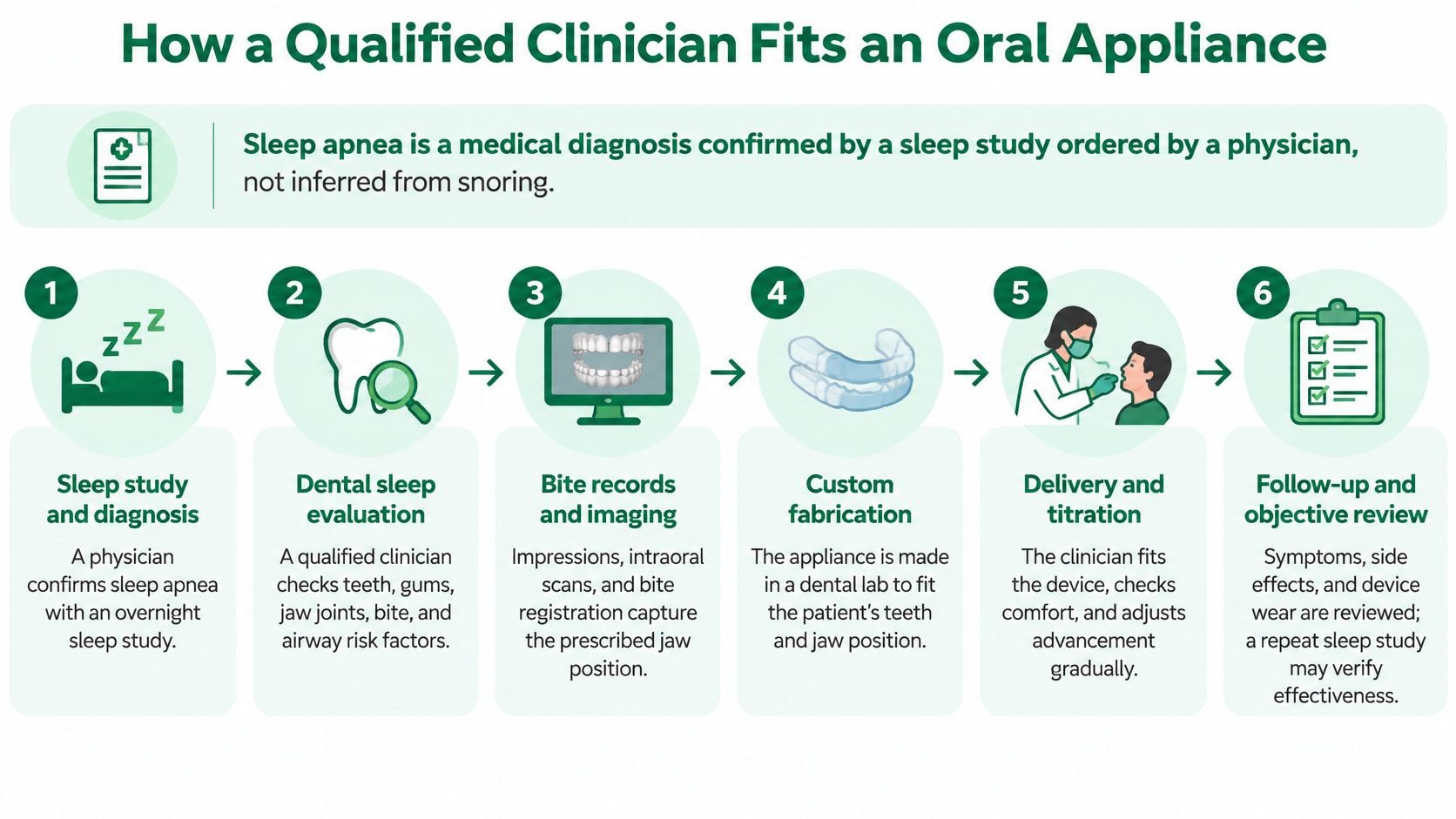
Sleep apnea is a medical diagnosis confirmed through a sleep study and a physician's evaluation. Snoring, fatigue, and jaw symptoms can raise concern, but they can't establish the diagnosis by themselves.
Fitting therefore involves more than taking an impression and handing over a mouthguard. Each stage answers a different question about safety, comfort, or breathing.
From diagnosis to a working treatment position
Establish the diagnosis. A physician determines which sleep study is appropriate. At Pain and Sleep Therapy Center, home sleep test sensors monitor airflow, respiratory effort, blood oxygenation, movement patterns, and snoring.
Check dental and jaw suitability. The dental sleep clinician reviews the sleep findings and examines the teeth, gums, bite, jaw movement, and tongue function. A loose tooth, limited opening, or painful joint may change the treatment plan.
Record the mouth accurately. Physical impressions or digital scans capture the teeth and oral structures. Bite records help communicate the prescribed jaw position for custom fabrication.
Fit the appliance. At delivery, the clinician checks retention, pressure points, comfort, and the starting advancement position. The patient also learns insertion, removal, cleaning, and the prescribed adjustment procedure.
Titrate gradually. Titration means adjusting treatment toward an effective, tolerable position. The AASM/AADSM oral appliance guideline describes an adjustment standard of 1 millimeter or less per increment, with at least a 5-millimeter protrusive adjustment range.
Verify breathing improvement. Follow-up sleep testing checks treatment effectiveness. Pain and Sleep Therapy Center also uses simple tests to help determine advancement needed to prevent snoring, but adjusting to the best position can take time.
Monitor the mouth and device. Follow-up checks include the bite, teeth, gums, jaw joints, appliance fit, and wear.
Routine dental care still matters
Sleep treatment doesn't replace preventive dentistry. A resource such as Oak Star Dental's Milford dentist for routine checkups explains the general dental care that continues alongside appliance monitoring.
Pain and Sleep Therapy Center anticipates appliance replacement in 5 to 7 years, sometimes sooner for heavy grinders or clenchers and people who don't maintain the appliance. Its guide to working with a sleep apnea mouthguard dentist offers additional context about professional care.
Useful appointment questions include whether the prescribed device is custom and titratable, and how effectiveness will be checked after fitting.
Jaw Health and Why Adjustable Designs Matter
Can an oral appliance worsen jaw pain? It can cause short-term jaw or muscle discomfort, particularly as the mandible adapts to a new position. That possibility deserves attention, but it doesn't mean every patient with jaw symptoms must avoid treatment.
The temporomandibular joints, or TMJs, connect the lower jaw to the skull. Temporomandibular disorders, or TMD, include problems involving those joints and the chewing muscles.
What adjustability changes
A 2025 systematic review and meta-analysis found that adjustable MADs had less impact on the TMJ and chewing muscles than nonadjustable MADs, without establishing one universally superior custom design. The broader evidence also distinguishes early discomfort from long-term injury: short-term symptoms don't by themselves establish lasting joint harm.
An adjustable design gives the clinician room to slow advancement, reduce the setting, or reassess the balance between breathing benefit and comfort. A monobloc, or fixed one-piece appliance, doesn't offer the same straightforward position changes.
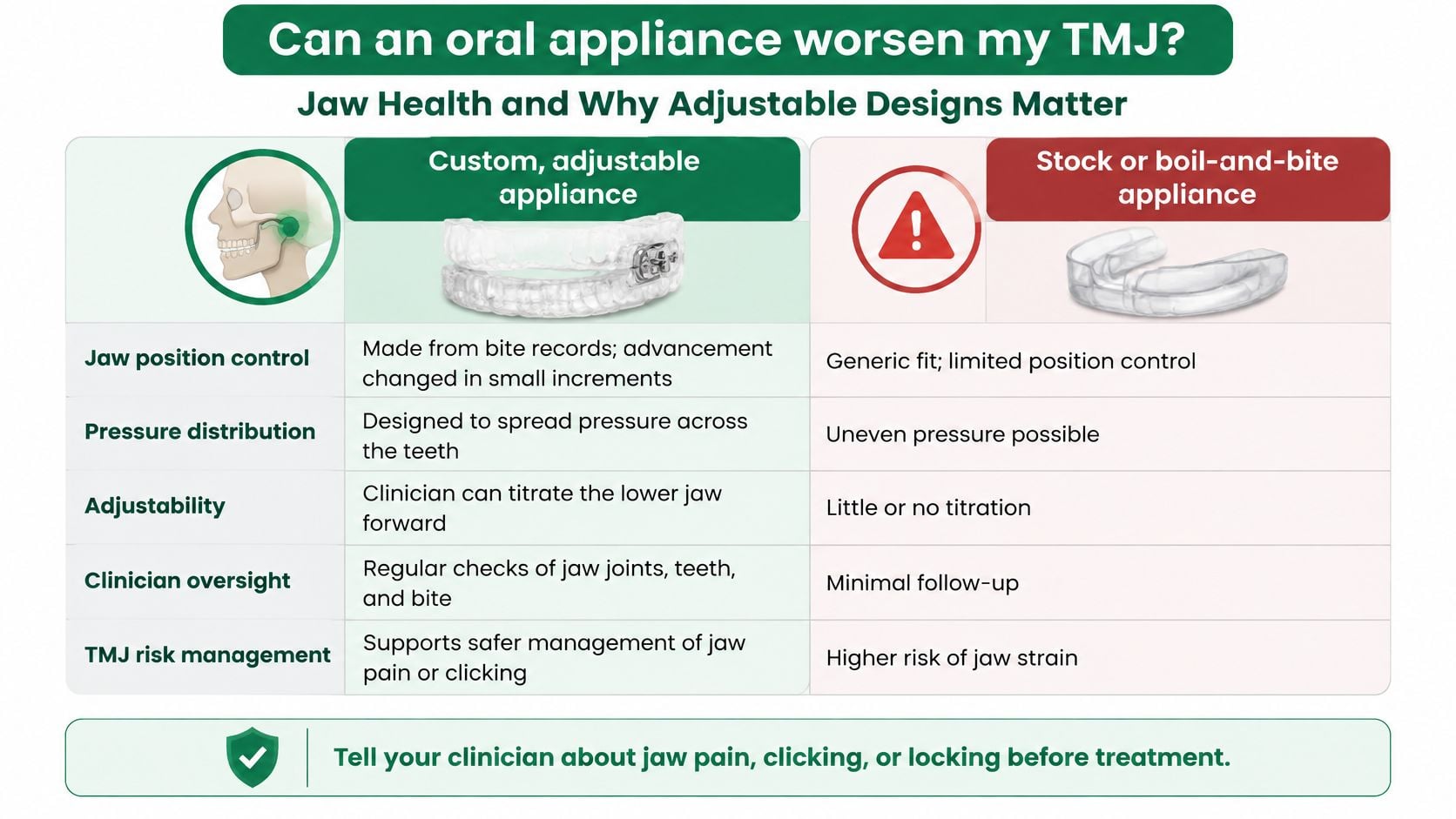
Adjustability supports risk management, but it isn't a guarantee against TMD symptoms. Custom fit, baseline jaw function, and professional follow-up also matter. Nor is every stock appliance fixed; construction and adjustability remain separate questions.
Symptoms that deserve a call
- New or worsening pain: Persistent joint or muscle soreness warrants review rather than continued self-advancement.
- Changed clicking or locking: A new mechanical symptom should be reported, especially with pain.
- Difficulty opening: Morning restriction that persists or worsens needs assessment.
- A lasting bite change: Teeth that no longer meet normally should be checked.
Practical rule: Pain isn't a signal to keep advancing. The clinician should decide whether adjustment, a pause, or another treatment is appropriate.
Pain and Sleep Therapy Center's mandibular advancement device side-effects guide addresses these concerns. For background on bite and joint relationships, Mulberry Dental's resource on treating misaligned bites in Surrey explains why bite assessment belongs in a jaw evaluation.
The trade-off is practical: adjustable treatment requires follow-up, but gives the clinician more control when balancing airway goals against jaw comfort.
What Long Term Use Really Looks Like
A new appliance often feels fine in the first few weeks. The harder test comes later: whether it is still being worn every night a year on, and whether breathing remains adequately treated while it is worn. Those are two separate questions, and long-term success depends on both.
Reported oral appliance adherence in the research
| Study type | Finding | Context |
|---|---|---|
| One-year longitudinal study | Adequate adherence in 49% at 3 months, falling to 44% at 12 months, in a review of long-term adherence | Follow-up ended at one year |
| Long-term observational study | 45.5% discontinued MAD therapy over about 4.5 years, in the same long-term adherence review | Many later transitioned to CPAP |
| NIH-indexed review | Regular use in 22 of 69 patients, or 32%, after 4 to 11 years | Mild-to-moderate OSA, summarized in an NIH-indexed review |
| Adherence review, oral appliances | 76% to 95% adherence in the NIH-indexed review | Shorter follow-up; 30% to 80% for CPAP in the same review |
| Usage threshold review | 76% of oral-appliance users met 4 or more hours nightly in the review data | 43% of CPAP users met that threshold |
Each of these numbers measures something different. Stopping treatment altogether differs from missing a nightly hours threshold, and a three-month follow-up says little about decade-long use. Before comparing percentages, compare study design, follow-up length, and the definition of regular use. A row that looks discouraging may reflect a longer, more honest observation window.
Building a sustainable routine
Adherence works like any nightly habit: it holds up better when it is anchored to something that already happens. A consistent bedtime cue, a clean appliance stored in its usual place, reminders, counseling, and support from a partner may help maintain use. Mobile self-monitoring can also help identify missed nights and the reasons behind them, which gives the clinician something concrete to problem-solve rather than a vague sense that use has slipped.
Pain and Sleep Therapy Center's appliance instructions call for use every night for 6 to 8 hours. A study's adherence threshold, often 4 hours, describes a research cutoff rather than the prescribed amount of treatment.
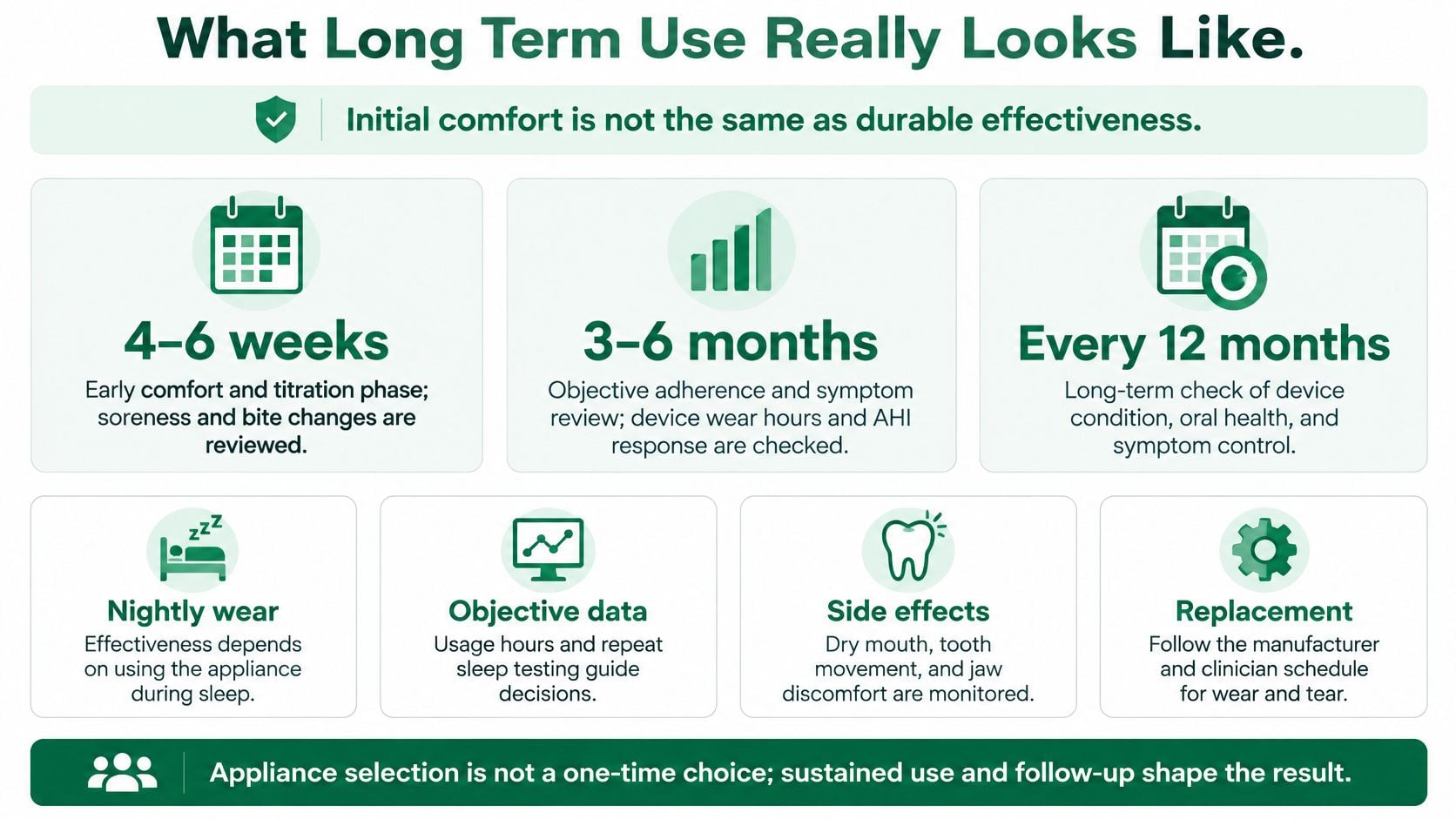
Follow-up timing should be individualized rather than treated as a universal calendar. Useful questions concern whether another sleep test is needed, whether fit has changed, and whether discomfort or renewed fatigue requires reassessment. The appliance itself is anticipated to need replacement in 5 to 7 years, sooner for heavy bruxers and clenchers or for people who do not take care of their appliance, so its condition belongs in that same conversation.
When an oral appliance does not meet treatment goals, Pain and Sleep Therapy Center actively supports patients in obtaining other effective therapies, including coordination with medical providers. Switching treatments is a clinical decision, and the next step is already planned for rather than left to the patient alone.
Which Type Fits Your Situation
Two design choices change daily life more than the name on the box: whether the device moves the lower jaw or holds the tongue, and whether that position can still be changed after you start wearing it. Match those choices to the sleep study, the airway, jaw comfort, and your ability to keep the device in through the night.
Choose the device after the sleep study, not after the convenience of the design. A small, quiet appliance can still be the wrong tool when the jaw will not tolerate forward movement, or when the airway needs a different kind of support.
Matching common situations to next steps
Confirmed mild-to-moderate OSA with CPAP difficulty. Mild obstructive sleep apnea means 5 to 15 events per hour, and moderate means 16 to 30. When CPAP is hard to use in that range, a custom titratable mandibular advancement device is the option to evaluate first. Titratable means the jaw position can be changed in small steps, the way a tailor lets out a seam instead of cutting a new garment. The center's oral appliance versus CPAP guide sets out how the two treatments differ so the discussion starts from the study, not from a claim that one is always better.
Loud snoring without a diagnosis. Book the sleep evaluation before anyone picks an appliance. A partner's report of the noise helps the physician. Sleep apnea cannot be diagnosed from symptoms alone. It is determined either by an overnight PSG at a facility designed to monitor sleep or by a home sleep study.
Jaw pain or limited opening. Examine the joint and the muscles before any advancement. An adjustable design lets the clinician start with less jaw movement and pause if pain rises. Record the pain, then select the device only after the joint exam and the sleep study point the same way.
Jaw advancement that can't be tolerated. If a forward jaw position hurts, or you cannot keep that device in, ask about a tongue-retaining device. It holds the tongue forward rather than moving the jaw. That different mechanism has to be weighed against thinner evidence for adult OSA than mandibular advancement devices have.
An existing grinding or TMJ guard. A nighttime appliance is a hallmark maintenance therapy for TMJ. If it is not made to control sleep apnea, it can double the severity of a patient's sleep apnea. Bring the current guard so it can be checked against the sleep findings instead of kept in use by habit.
Restricted tongue movement. In adults, tongue ties can cause sleep-disordered breathing, snoring, sleep apnea, and head, neck and shoulder pain. Include tongue mobility in the exam. Surgery stays a separate medical decision, made after the sleep study and a physician's plan.
An appointment checklist
- Sleep study: Bring the report and the physician's interpretation.
- Jaw and bite history: Include pain, locking, limited opening, and existing guards.
- Device construction: Clarify whether the appliance is custom-made, and whether it advances the jaw or retains the tongue.
- Adjustment plan: Confirm who changes advancement and how jaw symptoms will be monitored.
- Verification plan: Establish how breathing improvement will be assessed.
A conservative plan should address the likely sources of obstruction and discomfort, not add a second appliance without first checking the sleep study and bite.
With those records in the room, name the treatment: a custom titratable MAD, a tongue-retaining device, CPAP, or combined care directed by the physician. The visit is where those findings pick the path, rather than how convenient a device looks on the tray.
Request an Appointment or Take Our Sleep Quiz
Choosing an oral appliance starts with understanding your sleep concerns and jaw health. What a device repositions and whether it can be adjusted are separate questions. Both matter, alongside comfort, nightly use, and follow-up.
Taking the Sleep Quiz offers a low-pressure starting point if you are unsure about snoring or unrefreshing sleep. This screening tool can help identify reasons to seek a medical evaluation. A diagnosis requires a sleep study.
A coordinated evaluation
At Pain and Sleep Therapy Center, patients see a dentist with advanced training in treating sleep apnea. The practice is led by Dr. Ryan Robinson, triple board-certified in craniofacial pain and dental sleep medicine, with an emphasis on root-cause evaluation and conservative care before invasive options.
Request an Appointment: Use the visit to discuss sleep concerns, jaw symptoms, and existing treatment, with coordination involving the physician who diagnoses sleep apnea.
Choose a convenient location: The practice has offices in Newark, Delaware, and Bryn Mawr, Pennsylvania.
Treatment may combine a custom oral appliance with lifestyle adjustments and specialist care. If an appliance falls short of treatment goals, the center helps patients obtain other effective therapies. The aim is a workable approach that supports breathing and accounts for jaw function.
Visit Pain and Sleep Therapy Center to Request an Appointment or Take our Sleep Quiz and explore an appropriate starting point for care.