Does a comfortable sleep appliance mean the teeth and jaw aren't changing? Not necessarily. Mandibular advancement device side effects include early symptoms that patients can feel, such as soreness or dry mouth, and slower bite changes that may develop without obvious discomfort.
The useful distinction isn't just mild versus severe. Timing, persistence, and changes in function help a dental sleep clinician decide whether an appliance needs a fit adjustment, a different setting, or a broader treatment review. Patients shouldn't have to choose between tolerating pain and leaving sleep apnea untreated.
Table of Contents
- Side Effects at a Glance and Why They Happen
- Early Side Effects and How to Manage Them
- Long-Term Bite Changes and What Studies Show
- Jaw Pain and TMJ Symptoms to Report Early
- Adjustable and Nonadjustable Devices Compared
- Build Your Monitoring Plan and Book a Review
Side Effects at a Glance and Why They Happen
A mandibular advancement device (MAD) is a dental appliance worn during sleep that gently holds the lower jaw forward to help keep the airway open. That forward position also places pressure on the teeth and supporting tissues and changes the resting position of the chewing muscles.
Two dental measurements help explain the possible effects. Overjet is the horizontal overlap of the upper front teeth over the lower front teeth. Overbite is the vertical overlap of those teeth. A change in either measurement can alter how the teeth meet, even if chewing still feels comfortable.
Reported side effect prevalence and usual timing
A systematic review of oral-health outcomes reported the following weighted average prevalences across studies: 33.3% for excess saliva, 30.2% for bite changes, 22.9% for muscle pain, 20.2% for tooth discomfort, and 18.3% for dry mouth.
| Side effect | Reported prevalence | Usual timing |
|---|---|---|
| Excess saliva (hypersalivation) | 33.3% | Early in treatment |
| Bite or tooth changes (occlusal changes) | 30.2% | Builds with long-term use |
| Jaw or chewing muscle pain | 22.9% | Early in treatment |
| Tooth discomfort or pain | 20.2% | Early in treatment |
| Dry mouth (xerostomia) | 18.3% | Early in treatment |
These are averages across studies, not a prediction for an individual patient. The studies used different appliances, follow-up periods, and methods of recording symptoms. The timing column describes the usual pattern, not a deadline for symptoms to start or disappear.
Individual experience also reflects the device design, how far the jaw is advanced, and the condition of the teeth and jaw joints. A patient with a stable bite may need different monitoring from someone with loose teeth, extensive dental work, or existing jaw pain.
Why these effects happen
Appliance contact can stimulate saliva production because the mouth responds to a new object. Other patients notice dryness instead. Excess saliva and dry mouth therefore aren't contradictory findings, and neither symptom alone establishes whether the appliance fits correctly.
Forward positioning also loads the temporomandibular joints (TMJs), the hinges on each side of the jaw, and the muscles used for chewing. Meanwhile, an appliance edge can rub the gums or cheek lining. A localized sore spot calls for a different response from broad muscle fatigue.
Practical distinction: A rubbing edge is a fit problem to examine. A lasting change in tooth contact requires a bite assessment, even when nothing hurts.
The degree of advancement and cumulative wear influence the forces involved. More forward positioning isn't automatically better, and patients shouldn't shorten wear or move the setting on their own to reduce pressure.
For additional background on how these appliances work, Eric Wiitala DDS provides an explanation of oral appliance therapy for sleep apnea. Understanding the appliance's purpose helps separate expected adaptation from symptoms that deserve reassessment.
Many patients find early symptoms manageable with professional guidance. Slow changes in tooth position deserve a different kind of attention: measurement rather than reassurance based only on comfort.
Early Side Effects and How to Manage Them
Early discomfort deserves a clear response, not an instruction to endure it. The most helpful information is specific: where the symptom occurs, when it appears, and whether eating, opening the mouth, or returning to the usual bite has become harder.
A symptom record can be brief. An entry such as “right cheek rubbed after insertion” gives a clinician more useful information than “the appliance feels wrong.”
A practical adjustment routine
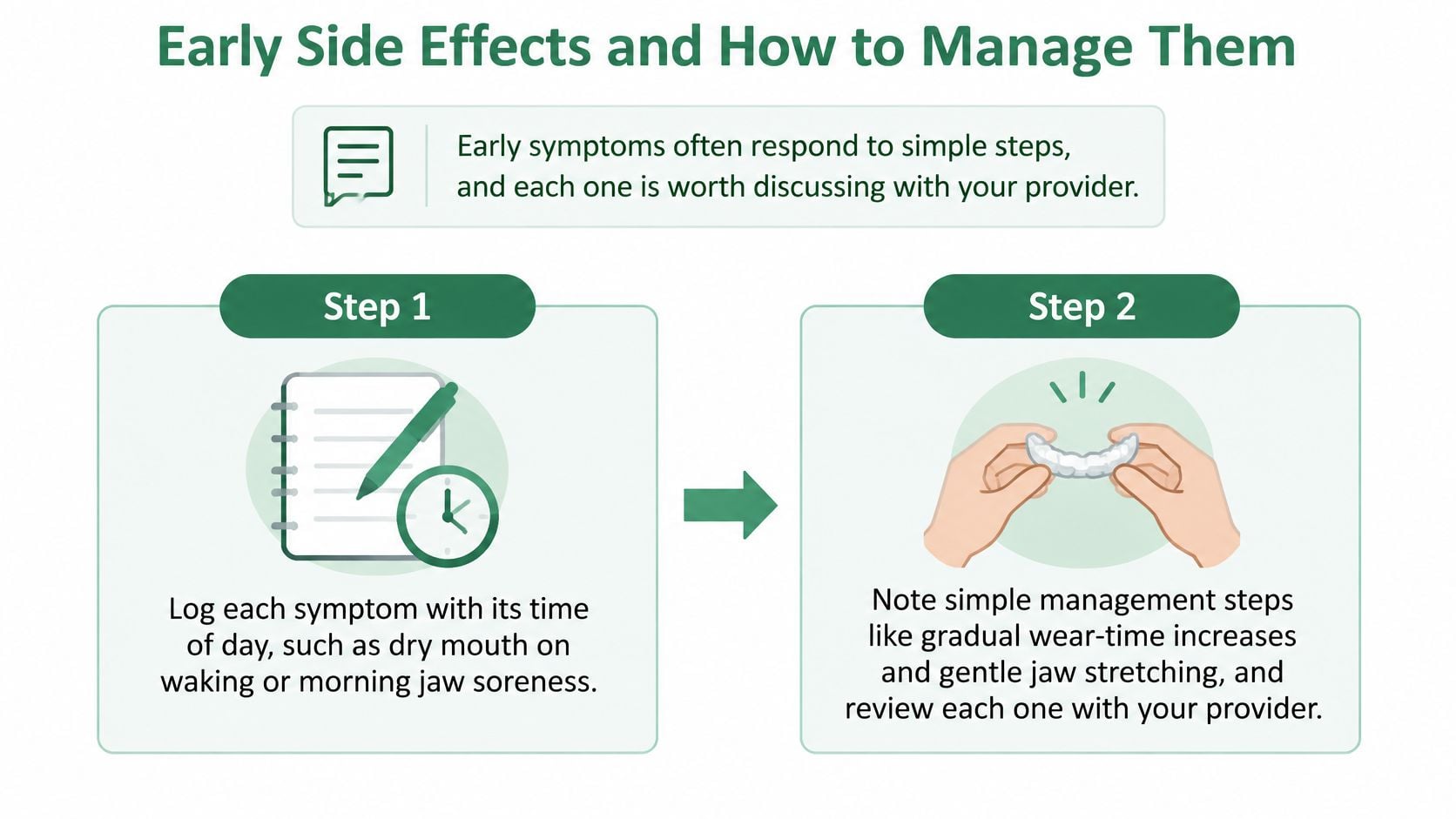
Log symptoms and their timing. Record dry mouth on waking, tenderness after removal, or soreness during breakfast. Note whether the symptom followed a professional adjustment, since that connection can help identify the next step.
Have the fit checked. A loose appliance or rough contact point can irritate the cheeks and gums. The prescribing dental team should examine the edges and pressure points rather than having the patient file, bend, or trim the appliance.
Clean the appliance and mouth each morning. Follow the device-specific cleaning instructions and use the recommended cleaning method. Residue can add to irritation, while unsuitable cleaners or hot water may damage some appliance materials.
Discuss gradual advancement. Titration means changing the forward position in controlled steps. If soreness is significant, a clinician may consider a temporary reduction or a slower progression while protecting the sleep treatment plan.
Check whether morning exercises are appropriate. Gentle jaw movements or a prescribed bite-repositioning routine may help selected patients. Forceful stretching or repeatedly clenching the teeth together isn't a substitute for an examination.
Agree on an early reassessment. A symptom check after one to two weeks can be a practical arrangement with the prescribing team, rather than a universal recovery deadline. Patients should record whether symptoms are easing, staying unchanged, or worsening, and seek earlier review for concerning changes.
The visual guide summarizes symptom tracking and clinician-guided management.
Improvement matters more than endurance
The timing evidence supports monitoring rather than assuming that every painful start means treatment failure. Short-term pain-related jaw symptoms can increase, while longer-term joint and muscle pain may be less common. That pattern doesn't establish the cause of an individual patient's pain.
A systematic review of mandibular advancement appliance side effects likewise found that reported effects were generally not serious and that the long-term risk of clinically important jaw-joint pain or impaired function appeared limited. Persistent pain still needs attention, particularly when it affects chewing or mouth opening.
A symptom that becomes harder to tolerate shouldn't be treated as a test of commitment to sleep apnea care.
Dryness that interferes with comfort, recurring cheek sores, or tenderness focused on a particular tooth should be reported rather than concealed by skipping nights. The prescribing team needs to know when discomfort is reducing actual appliance use.
Patients shouldn't stop wearing the appliance or change its setting without speaking with the prescribing team. If symptoms make continued wear difficult, prompt contact allows the team to give individualized instructions and discuss how sleep apnea will remain treated.
Long-Term Bite Changes and What Studies Show
The most predictable long-term concern is a change in tooth position and the way the teeth meet, also called dental occlusion. Sustained forces can tip the upper front teeth backward and the lower front teeth forward.
An anterior crossbite occurs when an upper front tooth sits behind a lower front tooth. A posterior open bite means the back teeth don't meet when the jaw closes into its bite. Retroclination means backward tipping of a tooth; negative overjet describes a reversed horizontal relationship between the front teeth.
Measured long-term dental changes in published studies
The long-term evidence summarized in a peer-reviewed study of oral-appliance dental effects includes the cohort measurements below, including about 11 years of follow-up in 77 patients, an average of 12.6 years in 62 adults, and a separate analysis reporting negative overjet in 44% of participants.
| Measure | Reported change | Follow-up |
|---|---|---|
| Overbite (vertical overlap) | Decreased 2.3 ± 1.6 mm | About 11 years (77 patients) |
| Overjet (horizontal overlap) | Decreased 1.9 ± 1.9 mm | About 11 years (77 patients) |
| Anterior crossbite | Developed in 62% of patients | About 11 years (77 patients) |
| Posterior open bite | Developed in half of patients | About 11 years (77 patients) |
| Upper-incisor position | About 6 degrees of retroclination | Average 12.6 years (62 adults) |
| Negative overjet | Developed in 44% of participants | Latest follow-up in a separate long-term analysis |
The plus-or-minus values describe the spread around an average, not a guaranteed range for every patient. The rows also come from different analyses, so they shouldn't be combined into a single estimate of personal risk.
These findings show the direction and potential size of change. They don't mean every appliance user will develop a severe bite problem or need corrective dental treatment.
Why comfort doesn't replace measurement
Some patients notice little despite measurable movement. Others become aware that a back tooth no longer touches or that chewing pressure feels concentrated toward the front.
Longitudinal findings in a study indexed by the National Library of Medicine indicate that dental changes can continue rather than stopping at a predictable point. A comfortable appliance therefore still needs periodic assessment.
Monitoring principle: Absence of pain doesn't establish that the bite is unchanged.
Duration matters, but stopping treatment doesn't guarantee a return to the starting bite. A systematic review of long-term dental and skeletal effects describes duration-related changes that may persist after treatment.
The practical response is comparison with starting records, not guessing from memory. A dentist should assess any lasting inability to close into the habitual bite and determine whether appliance adjustment, a revised treatment approach, or further dental care is appropriate.
If treatment ends, the bite may still need reassessment. Repair, adjustment, and eventual replacement of the appliance also belong in ongoing care planning, rather than being treated as unexpected exceptions.
Jaw Pain and TMJ Symptoms to Report Early
Jaw discomfort doesn't automatically mean the appliance is failing. It does mean the cause deserves attention, especially when symptoms persist or interfere with daily activities.
In a five-year observational study of sleep-apnea patients, the prevalence of temporomandibular disorder (TMD), a group of conditions affecting the jaw joints and chewing muscles, didn't change significantly during treatment, although overjet, overbite, and tooth contacts decreased. Joint symptoms and dental changes therefore shouldn't be treated as interchangeable problems.
Symptoms, possible meaning and when to contact a provider
| Symptom | What it may suggest | Contact a provider when |
|---|---|---|
| Mild jaw soreness in the first weeks | Early muscle adaptation | Pain persists, worsens, or limits chewing |
| One-sided or worsening jaw or joint pain | Excessive advancement, poor fit, or TMJ strain | Pain is persistent or affects function |
| Bite feels different on waking | Dental or bite change | The change persists or the usual bite cannot be reached |
| Loose or sensitive teeth | Tooth mobility or gum stress | Any new tooth mobility or gum bleeding occurs |
| Headaches or facial pain | TMJ or muscle involvement | Headaches recur often or don't improve |
| Snoring or daytime fatigue returns | Sleep apnea control may be changing | A sleep study review should be scheduled |
This table guides contact, not diagnosis. A sensitive tooth may have a dental cause unrelated to the appliance, and headaches can have causes beyond the jaw.
Sudden jaw locking, marked swelling, or severe pain warrants prompt professional assessment. Patients shouldn't force the jaw open or repeatedly bite down to try to restore tooth contact.
A root-cause evaluation matters
Jaw pain, facial pain, clicking or popping, and headaches can occur together. Pain and Sleep Therapy Center evaluates these patterns to identify contributing factors rather than assuming the appliance explains every symptom.
Its educational resource on jaw pain after wearing a night guard offers related context, although a night guard and a sleep apnea appliance aren't interchangeable devices.
Conservative decisions may include checking fit, reviewing advancement, and reassessing jaw function alongside sleep-apnea control. Pain and Sleep Therapy Center doesn't guarantee that TMJ appliances will resolve headache issues, although headache occurrence frequently improves with therapy.
The center also notes that greater than 60% of patients with TMJ issues have obstructive sleep apnea (OSA), which is why a sleep study may be suggested during TMJ care. That association doesn't diagnose sleep apnea in any individual.
Only a clinician can determine the cause of jaw symptoms. Sleep apnea requires a sleep study and physician evaluation, not a diagnosis based on snoring, jaw pain, or an online questionnaire alone.
Adjustable and Nonadjustable Devices Compared
| Design | Overjet and overbite change | Jaw joint and muscle load | How advancement is set |
|---|---|---|---|
| Adjustable device | Greater average reduction | Lower reported impact | Changed gradually by a provider |
| Nonadjustable device | Smaller average reduction | Higher relative impact | Fixed at the time of fitting |
A 2025 systematic review and meta-analysis comparing appliance designs found that adjustable devices produced greater average reductions in overjet and overbite but had less impact on the jaw joints and chewing muscles. These are comparative findings, not a ranking of which design is safest for every patient.
Different designs have different trade-offs
Adjustable devices allow a clinician to change advancement incrementally. That flexibility can help balance comfort with treatment response, but it doesn't remove the possibility of cumulative dental movement.
Nonadjustable devices maintain a position selected during fitting. The smaller average dental changes in the comparison don't mean these appliances are free of side effects, especially when a patient's jaw doesn't tolerate the selected position.
The review also found no significant differences in several skeletal measurements and no observed periodontitis, meaning destructive gum disease, or bone resorption with adjustable appliances. Those observations shouldn't be interpreted as proof that gum and bone monitoring is unnecessary.
For a plain-language overview of appliance categories, the Winn Smiles sleep apnea appliance guide provides additional context. A separate comparison of oral appliance therapy and CPAP can help patients understand broader treatment choices without assuming either approach suits everyone.
At Pain and Sleep Therapy Center, simple tests help determine the advancement needed to prevent snoring, and finding the best position can take time. Snoring response alone doesn't confirm adequate sleep-apnea control; physician-directed sleep testing helps assess effectiveness.
If physical airway barriers prevent CPAP and oral appliances from helping, the center works with the appropriate physician to develop a coordinated plan.
Questions that clarify the choice
- Gradual changes: Can the device be titrated in small steps?
- Treatment target: How is advancement selected and checked against sleep-study results?
- Personal risk: Do existing bite relationships, dental restorations, bruxism, meaning tooth grinding, or jaw history change the recommendation?
Self-adjustment isn't recommended. Temporary soreness alone doesn't establish failure, and greater adjustability doesn't automatically establish greater safety.
Build Your Monitoring Plan and Book a Review
Side effects are easier to manage when someone is looking for them on a schedule. A monitoring plan tracks three things together: dental health, jaw function, and whether sleep treatment is still working. A comfortable appliance does not prove the airway is controlled, and quiet nights do not prove the bite is stable.
The joint clinical practice guideline for oral-appliance therapy supports dental oversight for side effects and periodic follow-up. Patients benefit from knowing who will review the appliance, how often reviews happen, and how concerns reach the prescribing team between visits.
An ongoing care checklist
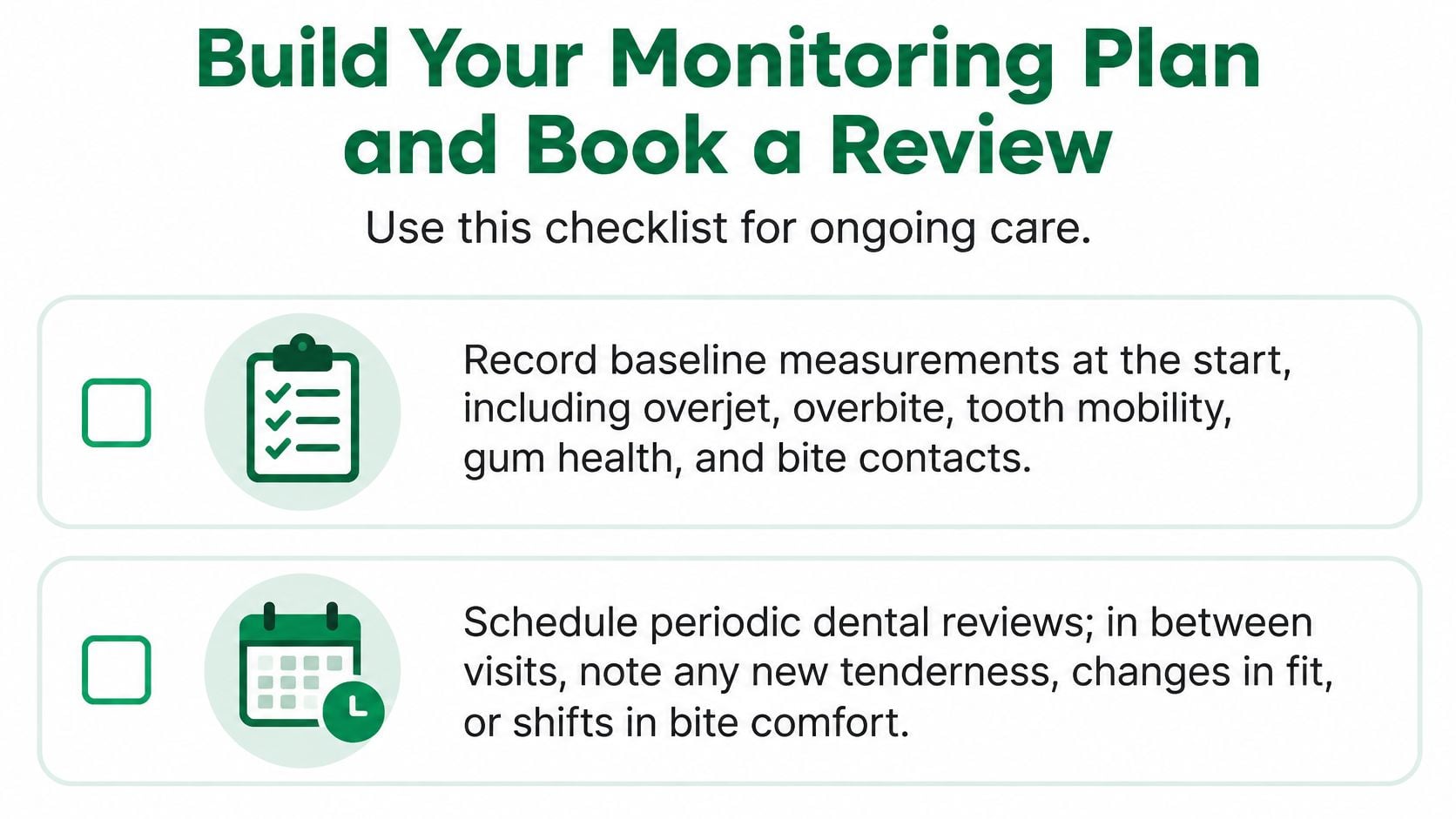
Keep starting records. Baseline measurements should include overjet, overbite, tooth mobility, gum health, and bite contacts. Dental photographs, scans, or models give the clinician a fixed reference point for later comparisons.
Schedule periodic dental reviews. Set the review schedule with the treating dentist instead of waiting for discomfort. Between visits, write down new tenderness or any change in how the teeth meet.
Inspect fit and condition. Report cracks, loosening, and new rubbing, and bring the appliance to each review appointment. Pain and Sleep Therapy Center anticipates replacement in 5-7 years, sooner for heavy grinders or clenchers and for appliances that have not been properly cared for.
Track sleep symptoms. A brief log of recurring snoring, morning headaches, or daytime fatigue gives the sleep team more to work with than memory alone. Objective sleep testing, arranged through the physician, confirms whether treatment remains effective.
Keep alternatives available. When an oral appliance does not meet treatment goals, Pain and Sleep Therapy Center actively supports patients in obtaining other effective therapies.
Bringing these records to a review turns vague impressions into measurable changes.
Pain and Sleep Therapy Center serves patients from its Newark, Delaware clinic and its Bryn Mawr, Pennsylvania office. Led by Dr. Ryan Robinson, triple board-certified in craniofacial pain and dental sleep medicine, the practice emphasizes root-cause evaluation and conservative, non-invasive care before surgical options.
Patients are seen by a dentist with advanced training in treating sleep apnea. The center's page on finding a dentist for a sleep apnea mouth guard explains how dental sleep care fits into a coordinated treatment plan. Because obstructive sleep apnea is a medical condition, only medical insurance covers its treatment with a dental device, subject to the patient's annual medical insurance deductible.
Pain and Sleep Therapy Center offers evaluation of jaw pain, bite concerns, and sleep-appliance side effects, with attention to both comfort and effective sleep treatment. Visit Pain and Sleep Therapy Center to Request an Appointment or Take our Sleep Quiz for an initial screening. To arrange a review, call the Newark office.