“Keep wearing it until the jaw gets used to it” isn't safe blanket advice for jaw pain after wearing a night guard. A new appliance can feel unfamiliar, but pain that starts or grows deserves a check, not an assumption that treatment is working.
A night guard is only one variable in a system that includes the bite, chewing muscles, jaw joints, and sleep breathing. Finding which part of that system needs attention is more useful than choosing a softer, thicker, or more expensive guard.
Table of Contents
- Why Jaw Pain Starts After a Night Guard and When to Act
- What Research Says About Guard Thickness and Results
- What Happens During a TMD Evaluation
- Why Sleep Apnea Changes the Guard Decision
- Non-Guard Options That May Help Jaw Pain
- Talk With a Specialist About Your Jaw Pain
Why Jaw Pain Starts After a Night Guard and When to Act
A night guard separates the upper and lower teeth, which can help protect them from damage caused by bruxism, the dental term for clenching and grinding. However, putting material between the teeth also changes how the jaw closes and where biting forces land. A device can protect tooth surfaces without keeping the muscles or joints comfortable.
The temporomandibular joints, or TMJs, connect the lower jaw to the skull. Temporomandibular disorders, or TMDs, affect these joints, the chewing muscles, or both. Symptoms can include jaw pain, facial pain, chronic headaches, clicking or popping, and difficulty moving the jaw.
According to MedlinePlus, guards and splints help some people, but others experience worse pain while wearing them. It also advises stopping appliance use and seeking dental guidance when the bite changes. New pain isn't proof that the jaw is adjusting normally.
Possible causes of jaw pain after a night guard
The pattern of symptoms offers clues, but it doesn't establish a diagnosis. Several causes can overlap, including a poorly balanced appliance and an existing muscle or joint problem.
| Possible cause | Typical signs | Next step |
|---|---|---|
| Uneven bite contacts | Pain on waking, teeth feel high or uneven | Stop wearing it and ask a dentist to check the contacts |
| Guard too thick, too thin or poorly fitted | Sore jaw muscles, pressure spots on teeth or gums | Clinician checks fit, thickness and pressure points |
| Continued or stronger clenching or grinding | Morning jaw fatigue, tooth tenderness | Bruxism evaluation with a dental professional |
| Flare of an existing TMD | Clicking, locking, pain when chewing or opening wide | Full TMD exam, with imaging if needed |
| Sleep-related breathing problem | Loud snoring, unrefreshing sleep, morning headache | Sleep evaluation with a physician |
| Guard design does not match its purpose | Pain that differs from the original reason for the guard | Clinician reviews appliance type against the diagnosis |
Uneven contact means some teeth meet the guard before others. For example, a person might notice that a back tooth seems to hit first on waking. That sensation deserves a contact check rather than an attempt to bite harder until everything feels even.
A peer-reviewed review available through PubMed Central describes how premature contacts, unbalanced contacts, excessive thickness, or a changed lower-jaw position may increase chewing-muscle activity and joint loading. It describes flat-plane stabilization appliances with approximately 2 mm of thickness in the molar region, while emphasizing adjustment and reassessment. That is guidance for a particular design, not a measurement every guard should meet.
Fit also matters beyond the chewing surface. A guard might press against a gum margin, grip a tooth uncomfortably, or fail to seat fully. Those problems require an inspection of the whole appliance, not just its most visibly worn area.
Continued clenching can cause confusion. A guard can separate the teeth while the muscles still contract strongly, leaving morning fatigue or tenderness. More wear on the guard doesn't necessarily mean that jaw pain is being treated.
An existing TMD may also flare around the time a guard is introduced. Clicking alone doesn't identify the source of pain, and a headache doesn't automatically come from the jaw. A thorough evaluation checks whether muscles, joints, teeth, or another condition best explain the symptoms.
Sleep symptoms add another reason to investigate rather than guess. Loud snoring and unrefreshing sleep don't prove that a guard caused a breathing problem, but they change the questions a clinician should ask. Similarly, an appliance made for tooth protection shouldn't automatically be treated as a joint-treatment device.
When symptoms need attention
Practical rule: A guard that causes new or increasing pain needs reassessment, not an open-ended adjustment period.
The following timing guide helps distinguish a routine appliance review from a more urgent concern:
- Pain that begins or grows after the guard: Stop wearing it and arrange a prompt dental or TMD evaluation. The clinician can decide whether use should resume after examination.
- A different bite after removal or new tooth tenderness: Contact a dentist the same week. A persistent change in how teeth meet shouldn't be ignored.
- Limited mouth opening or locking: Arrange a prompt evaluation of the jaw joints and muscles. Forceful stretching or repeatedly trying to make the joint click isn't a substitute for care.
- Mild soreness lasting beyond a few days: Have it checked rather than continuing to wait. A mild symptom can still signal a fit or loading problem.
- Sudden severe pain, facial swelling, fever, or trouble swallowing or breathing: Seek urgent medical or dental care. Trouble breathing calls for emergency assistance.
The guard should never be ground down, heated, or reshaped at home to treat pain. Removing material can change contacts elsewhere, and home adjustments may hide the original problem.
Useful notes for the appointment include the start date, nights worn, whether the guard is custom or over-the-counter, and whether symptoms disappear after removal. Snoring, morning headaches, and changes noticed by a bed partner belong on that list, too.
What Research Says About Guard Thickness and Results
Thickness changes how far the jaw stays open during sleep, and that single measurement is easy to shop by. The result a guard produces depends on more than bulk: its shape, the balance of its tooth contacts, its intended purpose, and how carefully it is adjusted all shape the outcome just as much.
The broader evidence does not establish a dependable benefit for every person with TMD. A 2024 Cochrane review assessed 57 randomized trials involving 2,846 participants and found insufficient evidence to determine whether occlusal splints reliably improve TMD symptoms. Adverse effects were poorly reported, so the review could not fully characterize safety either.
Guard thickness and reported outcomes
A review published through Universiti Teknologi MARA reported poorer functional or comfort outcomes at the thinnest and thickest ends of the appliances it examined, with a mid-range thickness appearing more suitable in many cases. The underlying evidence was low quality, so those patterns work better as a starting point for a clinical conversation than as a sizing chart.
| Thickness or design | Reported pattern | What the clinician checks |
|---|---|---|
| 2 mm or less | Associated with poorer functional or comfort outcomes in one low-quality review | Contact balance across the biting surface |
| 3 to 5 mm | Appeared more suitable in many cases | Muscle tenderness and comfort during follow-up |
| More than 6 mm | Associated with poorer functional or comfort outcomes | How far the jaw is held open during sleep |
| Flat-plane stabilization design | Expert guidance describes a relatively thin molar-region design | Whether opposing teeth meet an even surface |
| Repositioning design | Requires particular caution | Where the jaw is guided and how it responds over time |
The apparent tension between the thickness findings and the broader review does not establish a contradiction. The studies and recommendations concern different designs, diagnoses, and treatment conditions. A measurement without that context can't show whether a particular appliance is appropriate.
Design matters more than a shopping rule
A stabilization splint generally provides a controlled surface for the opposing teeth to contact. It is usually a conservative, reversible treatment, although follow-up remains important because the bite and symptoms can change.
A repositioning appliance intentionally guides the lower jaw toward a different position. That purpose requires particular caution and professional supervision, rather than unsupervised long-term wear.
When a clinician weighs a stabilization splint against a repositioning appliance for the same diagnosis, the real comparison is between two different jobs: giving the teeth an even surface to meet versus guiding the jaw to a new position. Thickness is only one input in that decision.
An over-the-counter guard can't answer that question by itself. When pain develops, the next step is an examination and a decision about adjustment, replacement, or discontinuation, not a search for a thicker version of the same device.
What Happens During a TMD Evaluation
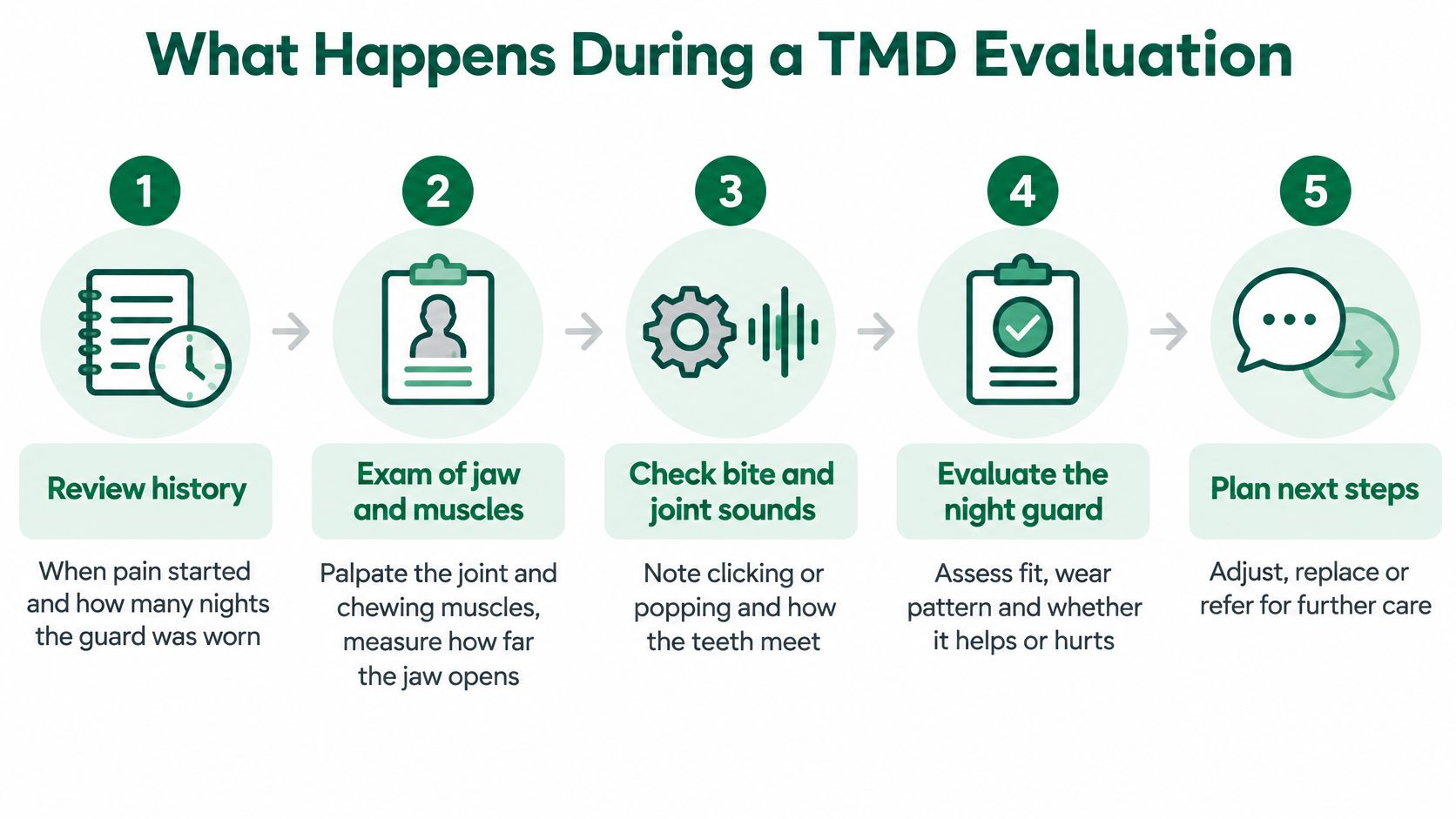
A TMD evaluation is a structured conversation and physical examination, not just a quick look at the guard. The aim is to identify the source of pain and determine whether the appliance is contributing, coincidental, or still useful with changes.
The process includes history, jaw movement, joint sounds, bite assessment, and diagnostic testing when appropriate.
The examination sequence
- Review history. The clinician asks when pain started, how many nights the guard has been worn, and what type it is. Bite changes and symptoms present before treatment help shape every later step.
- Examine the jaw. Mouth opening, range of motion, and pain during movement are checked. Gentle examination of the chewing muscles helps distinguish muscle tenderness from joint-area pain.
- Listen and feel for joint sounds. The clinician checks for clicks, popping, and vibrations during movement. Sounds are interpreted alongside pain and function rather than treated as a diagnosis by themselves.
- Inspect the guard and bite. Fit, pressure points, contact balance, and lower-jaw position are assessed. Wear marks can help explain where forces are landing.
- Assess bruxism and existing diagnoses. Questions about clenching, grinding, tooth tenderness, and morning fatigue help clarify muscle activity. Previous muscle or joint diagnoses are reviewed rather than assumed to explain every new symptom.
- Obtain imaging when needed. At Pain and Sleep Therapy Center, a 3D cone beam CT scan of the jaw joint is frequently needed, and patients may be referred to a diagnostic imaging center. Selected cases may also require hospital-based soft-tissue imaging.
- Screen sleep when indicated. Snoring, unrefreshing sleep, or morning headaches may lead to sleep diagnostics. Sleep apnea is diagnosed through a sleep study with a physician, not from jaw symptoms or a dental examination alone.
- Decide the plan. Findings guide whether the guard should be adjusted, changed, paused, or replaced by another approach. Referral may be appropriate when another condition needs attention.
Preparing for the visit
Pain and Sleep Therapy Center's information about pain in the TMJ offers context for the relationship between symptoms and assessment. The evaluation itself is what identifies the likely cause and appropriate next steps.
The most useful items to bring are:
- The appliance: Include the guard even if use has stopped.
- A short symptom log: Note location, timing, chewing difficulty, and changes after removal.
- A medicine and supplement list: Include current prescription and nonprescription products.
Why Sleep Apnea Changes the Guard Decision
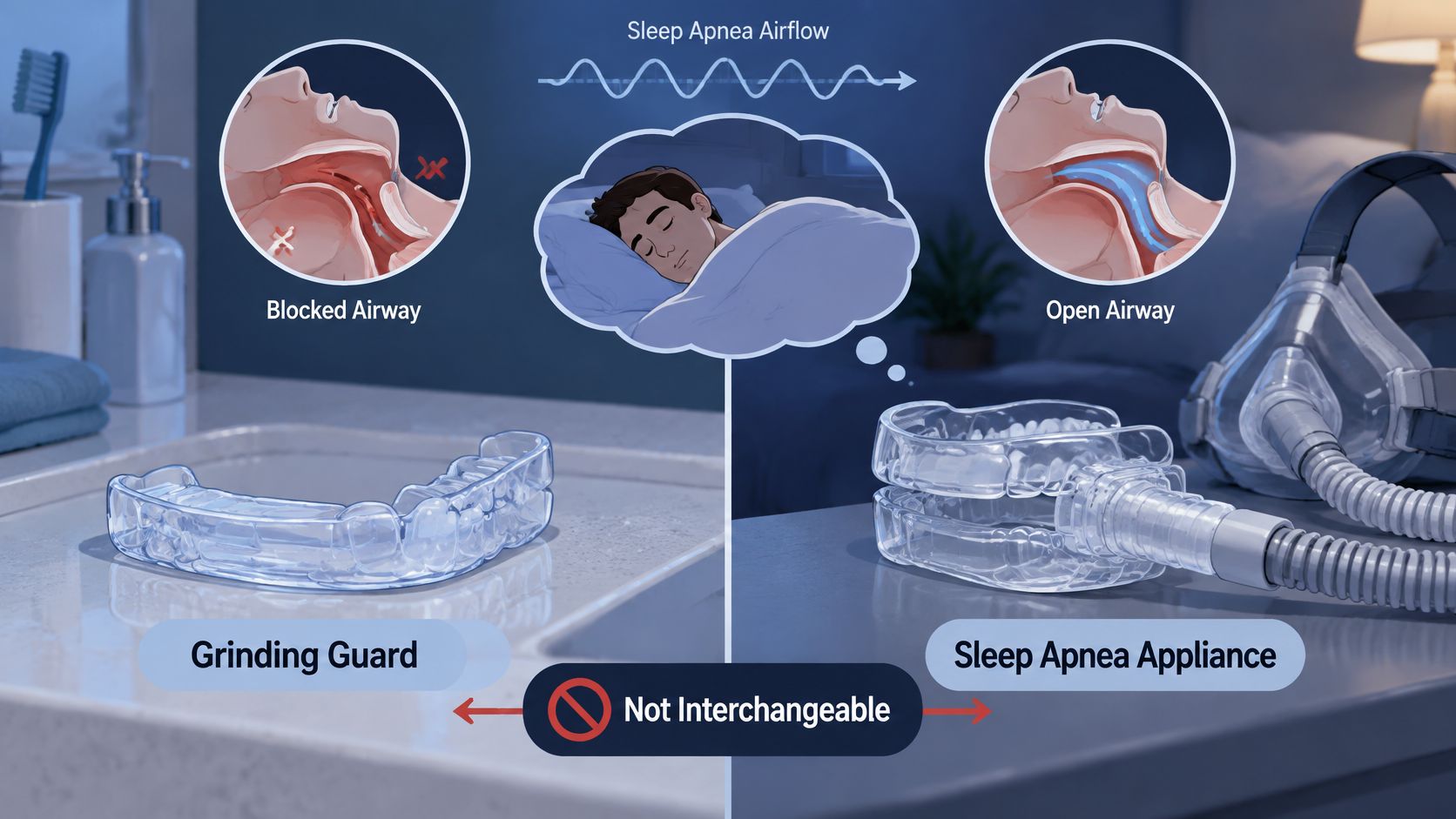
A grinding guard and an appliance for sleep apnea aren't interchangeable. They may look similar, but their treatment goals differ: one protects teeth or supports a jaw-treatment plan, while the other is designed to help maintain an open airway during sleep.
Obstructive sleep apnea, or OSA, involves repeated upper-airway blockage during sleep. A guard made without an airway-treatment goal shouldn't be assumed to manage that condition, even if it reduces tooth wear or feels comfortable.
Symptoms that change the conversation
A sleep assessment becomes particularly relevant when a person or bed partner notices:
- Loud snoring: Especially when it occurs alongside disturbed sleep.
- Gasping or witnessed pauses: A bed partner may notice these before the sleeper does.
- Unrefreshing sleep: Enough time in bed doesn't necessarily mean restorative sleep.
- Daytime fatigue or morning headaches: These symptoms have several possible causes and deserve assessment.
These signs aren't a diagnosis. They are reasons for coordinated medical and dental assessment rather than months of appliance use without a clear treatment goal.
Restricted tongue movement from an adult tongue tie may also contribute to snoring or sleep-disordered breathing. Head, neck, or shoulder discomfort may be part of the history, but none of these symptoms alone establishes that a tongue tie needs treatment.
Matching treatment to the breathing problem
Dental sleep medicine clinicians work alongside physicians, consistent with the collaborative approach described by the American Academy of Sleep Medicine and American Academy of Dental Sleep Medicine. A physician interprets sleep testing and helps guide treatment decisions.
CPAP, which supplies pressurized air through a mask, is an established treatment. Oral appliance therapy is another option for selected patients, with dental fitting and medical follow-up; Pain and Sleep Therapy Center's oral appliance and CPAP comparison explains those different approaches without making either a universal choice.
For general background on bedtime habits, Protect-A-Bed's simple ways to stop snoring may provide a starting point for discussion. Snoring advice doesn't replace evaluation when breathing pauses, gasping, or persistent fatigue are present.
Before continued wear: A person prescribed a guard for grinding or TMD should have the prescriber confirm whether sleep apnea screening is appropriate and whether the appliance matches the treatment goal.
Non-Guard Options That May Help Jaw Pain
A night guard is one tool, not a complete explanation or treatment for every painful jaw. Protecting teeth from grinding doesn't necessarily address the reason the muscles or joints hurt.
Mayo Clinic notes that soft or firm oral splints may help some people, but the reasons they help aren't fully understood. Its conservative treatment guidance also includes physical therapy, education, and changes in habits, depending on the clinical findings.
Conservative care matched to the diagnosis
A clinician may consider several options together rather than replacing one isolated treatment with another:
- Home care. Softer foods, smaller bites, and avoiding very wide yawns may reduce strain during a flare. Gentle jaw routines should follow a clinician's instructions rather than forceful stretching.
- Physical therapy. Treatment may address chewing-muscle tension, neck involvement, and jaw-joint mobility. The approach should reflect whether the main problem involves muscles, joints, or both.
- Behavioral measures. Noticing daytime clenching can help a person interrupt it. Resting with the teeth apart and relaxing the face may reduce unnecessary muscle work.
- Sleep and stress habits. A clinician may review sleep routines and stress-related tension when these appear relevant. Such measures support care without implying that pain is psychological.
- Coordinated care. Another dental or medical condition may require its own treatment. Referral keeps jaw care from becoming a substitute for addressing that condition.
For broader background on movement-based care, patients can explore rehabilitation and recovery options from Longevity Medical Institute. That general resource doesn't replace a jaw-specific assessment or establish which exercises are appropriate.
Medicines support care rather than replace it
Medicines are sometimes used to ease symptoms alongside more definitive TMJ treatment. At Pain and Sleep Therapy Center, drugs support the outcomes of other therapies; drugs alone cannot solve TMJ issues.
The center's overview of non-surgical TMJ treatment provides additional context for conservative care. When an oral appliance doesn't meet treatment goals, the center supports patients in obtaining other effective therapies.
Many patients may benefit from a combination of measures, but no single approach works for everyone. The right mix follows the diagnosis, with conservative, non-invasive options considered before surgery when clinically appropriate.
Talk With a Specialist About Your Jaw Pain
A night guard that leaves your jaw hurting is giving you information, not a reason to push through. Pain that appears or worsens after a new appliance deserves a real look, because the guard is only one variable in a system that includes your bite, jaw muscles, joints, and nighttime breathing. Swapping products or waiting it out rarely explains why the pain started.
A useful appointment starts with specifics. Bring the guard itself, a short log of when symptoms appear and how strong they feel, and notes about your sleep, including snoring or morning fatigue a partner may have noticed. You do not need to arrive with a diagnosis or a theory about whether the bite, the muscles, or the joints are responsible. Sorting that out is the point of the visit.
Root-cause care close to home
Dr. Ryan Robinson, a triple board-certified specialist in craniofacial pain and dental sleep medicine, leads Pain and Sleep Therapy Center, with offices in Newark, Delaware, and Bryn Mawr, Pennsylvania. The practice evaluates TMJ, head and facial pain, sleep-disordered breathing, and tongue ties, looking for root causes rather than treating the appliance as the whole story. That breadth matters here: a nighttime appliance that ignores the airway can double the severity of an undiagnosed sleep apnea problem.
A clear next step
A focused consultation can answer the practical questions a sore jaw raises:
- Appliance use: whether the current guard should stay paused, be adjusted, or be remade.
- Further assessment: whether imaging, a sleep study, or another referral fits the findings.
- Treatment direction: which conservative options match your symptoms and goals.
Certain signs argue for booking sooner rather than later: jaw locking or catching, pain that interferes with eating or sleep, or symptoms that keep building week after week. Patients can Request an Appointment or Take our Sleep Quiz as a starting point. An evaluation can bring clarity without assuming every painful jaw needs the same treatment.