A jaw that has clicked for years suddenly aches, and the ache arrives behind the eye rather than at the joint. What changed?
That question trips up a lot of people, because the usual story about jaw problems gets the order wrong. The click gets treated as the warning sign and the pain as proof that damage has been done. In practice, a click often means very little on its own, and the pain is what deserves attention. The signal that matters is a change in function: chewing that tires the jaw, a mouth that won't open all the way, a joint that catches mid-yawn.
A TMJ flare-up is a temporary worsening of jaw, face, or joint symptoms after a calmer stretch. It describes timing, not a diagnosis.
Table of Contents
- What a TMJ Flare-Up Is and How Common It Is
- Common TMJ Flare-Up Symptoms and What They Feel Like
- Red Flags That Need Prompt Medical Care
- How Flare-Up Symptoms Change Over Time
- Triggers and the Sleep and Stress Connection
- How a Clinician Evaluates Flare-Up Symptoms
- Decide Whether to Request an Appointment
What a TMJ Flare-Up Is and How Common It Is
The temporomandibular joint (TMJ) is the hinge just in front of each ear that connects the lower jaw to the skull. Everyone has two, and they move thousands of times a day during speech, chewing, and swallowing. That constant use is why a problem there can spread into so much of daily life so fast.
When patients say they have TMJ, they usually mean temporomandibular disorder (TMD), an umbrella term for conditions affecting the jaw joints, the chewing muscles, and the structures around them. A flare-up is the acute chapter of that longer story.
The numbers here are fuzzy, and the fuzziness tells you something. The National Institute of Dental and Craniofacial Research reports that approximately 5% of adults have TMD, while broader estimates place prevalence between 5% and 12% of the population. A 1993 National Health Interview Survey of 42,370 U.S. adults, cited in the same NIDCR summary, found that 5.3% reported jaw-joint or preauricular pain more than once in the previous six months, with 6.9% of women and 3.5% of men affected. The spread reflects differences in who was surveyed, how the question was worded, and which diagnostic standard was applied.
Two practical points follow. Recurring jaw and facial pain is common, and it isn't a sign of something exotic. Common also doesn't mean trivial. Pain that keeps returning, stiffness that limits chewing, or a jaw that restricts opening deserves structured assessment instead of being filed under dental discomfort.
If the vocabulary is where confusion starts, what TMD disorders actually mean walks through the joint-versus-disorder distinction in plain terms.
One distinction outweighs every statistic above. Clicking alone does not define a flare. Plenty of people have a painless pop and no disease at all. The pattern a clinician finds most useful is pain combined with a change in how the jaw works: difficulty chewing, limited opening, locking, or pain when the jaw moves.
Common TMJ Flare-Up Symptoms and What They Feel Like
Most symptom lists mention jaw pain and stop. In reality a flare is a cluster, and knowing which cluster fits helps a clinician work out whether the problem sits mainly in the muscles, the joint, or both.
| Symptom | What it may feel like | How it tends to behave |
|---|---|---|
| Jaw or chewing-muscle pain | Dull or sharp ache, sometimes spreading to the face or neck | Worse with chewing, yawning or clenching |
| Jaw stiffness | Tight or heavy feeling in the jaw, especially on waking | Often eases with rest and may return with use |
| Limited mouth opening | Difficulty opening wide, for example for a sandwich or a dental visit | A progressive limit is more concerning than a stable one |
| Locking | Jaw catches or sticks in an open or closed position | Warrants prompt evaluation when it persists |
| Clicking or popping | Sound during opening or closing | Painful clicking or popping is a warning feature; painless noise on its own usually is not |
| Headache or temple pain | Ache in the temple, forehead or behind the eye | Can be the only sign for some patients |
| Ear pain or fullness | Aching or stuffy feeling near the ear | Can occur without an ear infection |
| Neck or shoulder discomfort | Tension in the neck and upper back | Often rises alongside jaw muscle pain |
The National Institute of Dental and Craniofacial Research identifies pain in the chewing muscles or the jaw joint as the most common symptom, with possible radiation into the face or neck, and lists jaw stiffness, limited movement or locking, and painful clicking, popping, or grating among the other warning features.
How often each symptom shows up varies widely between surveys and between men and women, with women consistently reporting pain and joint sounds at higher rates. The gaps say more about questionnaires than anatomy. Different sampling and different definitions produce those differences, and one population is not built differently from another. The takeaway is simpler: if your pattern combines pain with a change in jaw function, you fit the picture these surveys describe, whatever your exact percentages would be.
Why a Headache Can Be the Main Event
Headache is the symptom people least expect to trace back to the jaw. A peer-reviewed clinical review reports that symptoms recur in about 65% of patients and that 23% present with headache alone, according to the clinical review on TMD presentation. Pain can radiate from the joint or chewing muscles to the temple, the ear, the angle of the jaw, and the neck. That is why a flare sometimes registers as a tension headache with no obvious jaw component at all.
When head pressure and jaw tension arrive together, anxiety often sits in the middle of the picture. Florida telepsychiatry for anxiety and headaches describes how stress responses generate head pressure, which is useful context for anyone whose flares cluster during difficult weeks.
The Sound Versus the Catch
The useful distinction with joint noise is pain. A click that hurts during opening or closing points toward the joint itself and belongs on the symptom list you describe at an evaluation. A click without pain is noise, and the table above reflects that difference.
Locking is a separate matter entirely, because locking is a movement problem rather than a sound. It runs in two directions: a jaw that will not open fully, and a jaw that will not close. Both deserve evaluation when they persist. A single episode that releases on its own is worth a mention at the next dental visit. A pattern that repeats is worth booking for.
Ear Fullness Without an Ear Infection
Ear symptoms confuse people because the ear itself is usually healthy. The joint sits immediately in front of the ear canal, so pain and fullness can be referred there with no infection present. TMJ and ear fullness explains the anatomy behind that referral and why an ear exam so often comes back clear.
The same caution runs across this whole list. A symptom pattern is a reason to talk with a clinician, not a self-diagnosis. Headache, ear pressure, and neck tension each carry their own differential, and several can coexist. TMJ and facial pain can show up as chronic headaches, jaw pain, facial pain, and clicking or popping sounds, and at Pain and Sleep Therapy Center a thorough evaluation is used to identify root causes rather than assume the jaw explains everything.
Red Flags That Need Prompt Medical Care
A flare usually behaves like a bruise: it hurts, then it quiets down. The signs below break that pattern. They are reasons to get care instead of waiting for an easier day.
| Sign | Why it matters | Suggested action |
|---|---|---|
| Unable to eat or drink | Suggests a serious jaw restriction or another cause | Seek prompt medical care |
| Sudden or progressive loss of mouth opening | May indicate infection, injury or another joint problem | Arrange urgent assessment |
| Locking that does not release | May suggest a disc or joint movement problem | Book a prompt evaluation |
| Severe or frequent headache | Can suggest a different diagnosis | Seek prompt medical evaluation |
| Vision changes, weakness or hearing loss | Can signal neurologic or cranial-nerve involvement | Seek urgent medical care |
| Fever, facial swelling or trauma | May point to infection or injury | Seek same-day medical care |
| Persistent or worsening pain | Flares usually fluctuate rather than climb steadily | Schedule a clinical assessment |
Guidance from the NHS names inability to eat or drink, severe or frequent headaches, vision changes, and restricted opening or locking as reasons to seek urgent help. A muscular flare tends to rise after extra load and then ease. Pain that keeps climbing, a mouth that will barely open (trismus), fever, facial swelling, recent trauma, or a new change in vision, strength, or hearing needs a different visit. Those patterns are checked for infection, injury, or a nerve problem, which is a different plan from resting a sore chewing muscle.
When a Headache Suggests Another Diagnosis
A headache that follows the jaw is the familiar version of this pain. It tends to sit in the temple, shows up after chewing or clenching, and can be stirred up by pressing the chewing muscles. Severe or frequent headache still belongs in the table above, even when it seems to track with the jaw.
A headache that ignores the jaw is its own problem. Pain that is new, sudden, or unusually severe, or that arrives with a vision change, weakness, or fever, does not read like muscle referral. How fast it appeared decides whether that visit is the same day or prompt.
Hearing has a similar split. Loss of hearing, new ringing in one ear, dizziness, or a spinning sensation is not a stuffy feeling in front of the ear. Those symptoms belong in a medical appointment.
How Little Opening Is Too Little
No single number defines normal mouth opening for every adult, and one measurement during a bad week proves little. The trend carries the information: a jaw that opens less than it did a month ago, that no longer fits a normal sandwich, or that needs a warm-up before it moves. A drop that stays is the finding to report, along with a lock that does not release on its own.
How Flare-Up Symptoms Change Over Time
A flare has a shape. Written down, it looks less like a straight line and more like a wave, and that shape is often what tells a clinician the most.
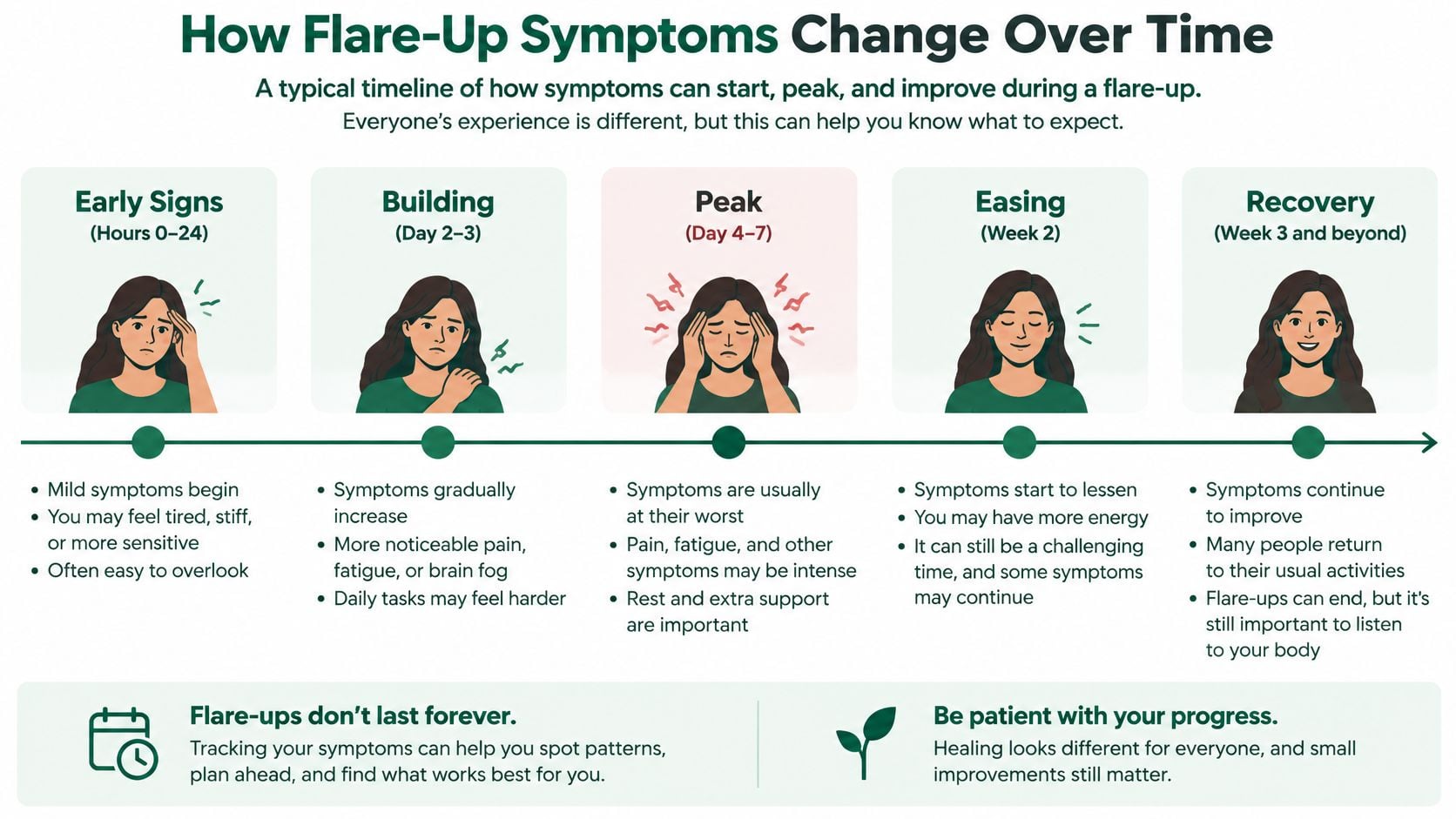
Symptoms typically move in cycles, with relatively low-pain intervals broken by short acute exacerbations, according to guidance on acute temporomandibular disorder. The cycle isn't random. Increased mechanical loading, whether from clenching, chewing tough foods, prolonged mouth opening, or habitual bracing, aggravates joint and muscle tissue and amplifies pain on movement.
- The loading day. A long dental appointment, a chewy meal, an hour of yawning through a dull meeting, or an evening of clenched concentration.
- The first day or two. Pain peaks, chewing feels effortful, and the jaw may feel tight or unfamiliar on waking.
- The easing phase. As load drops, soreness fades and range of motion returns, usually unevenly, better in the morning than after dinner.
- The return to baseline. Symptoms settle back to their usual level, which for some people means no symptoms and for others means an occasional click.
No single duration applies to every patient, so the shape of the pattern matters more than the calendar. As a general guide, subjective symptoms improve within 30 to 60 days at Pain and Sleep Therapy Center. A flare that breaks the pattern, returns despite lower load, or climbs steadily instead of easing is a reason to schedule an evaluation rather than wait out another cycle. How long TMJ pain lasts looks at the range in more detail.
While a flare is active, load reduction is the sensible first move. Many patients find these steps help:
- Soften the diet for a few days. Soup, eggs, yogurt, pasta, and cooked vegetables. Cut food small. Skip gum and anything that demands serious chewing.
- Cap the opening. Support the chin during a yawn and don't test the jaw by seeing how wide it goes.
- Rest between efforts. Short breaks from talking and chewing do more than long stretches of total silence.
- Keep a light hand with stretching. Gentle movement is fine if it doesn't increase pain afterward. Anything that leaves the jaw sorer an hour later was too much.
Triggers and the Sleep and Stress Connection
Stress and teeth grinding get blamed for flares so often that the explanation has stopped being useful. The relationship is real, but it runs in both directions and rarely involves one factor alone.
A 2025 systematic review and meta-analysis found that psychological factors, particularly stress, were associated with the development and severity of TMD, according to the published review in PubMed. Sleep belongs in the same conversation. That review reports poor sleep quality in roughly 40% to 75% of people with TMD and links poorer sleep with greater pain severity.
A range that wide is a reminder that these are group-level associations, not predictions about one person. What it does support is treating sleep quality and psychological load as clinically relevant, and asking what else is in the mix: daytime stress, sleep-related grinding, fragmented sleep, airway-related sleep problems, medication effects, or several at once.
What a Morning Flare Is Telling You
A jaw that aches on waking narrows the field without settling it. Overnight grinding is the first suspect and a reasonable one. Fragmented sleep, breathing-related sleep disruption, and a tense evening can produce identical morning soreness. Snoring and witnessed breathing pauses push the list toward sleep-disordered breathing, which is diagnosed through a sleep study and a physician rather than by symptoms alone. At Pain and Sleep Therapy Center, greater than 60% of patients with TMJ issues have obstructive sleep apnea, so a sleep study may be suggested during TMJ therapy.
| Trigger | How it may aggravate symptoms | What to track |
|---|---|---|
| Wide yawning or biting hard foods | Increases load on the joint and chewing muscles | Foods eaten, bite size and pain afterward |
| Daytime clenching or bracing | Sustains muscle tension through the day | Times of day and any jaw fatigue |
| Teeth grinding during sleep | May cause morning jaw soreness or headache | Waking jaw pain and observations from a sleep partner |
| Poor or fragmented sleep | Can heighten pain sensitivity | Number of awakenings and total sleep time |
| Stress and anxiety | Associated with more severe TMD in research | Stressful events and flare dates |
| Snoring or witnessed breathing pauses | May point to sleep-disordered breathing | Frequency of pauses and daytime sleepiness |
| Caffeine or medication changes | May alter sleep, muscle tension or pain perception | Dose changes and timing relative to flares |
A flare that only ever shows up after short nights is a sleep question as much as a jaw question.
A pattern is something to hand to a clinician for interpretation, not something to solve alone. Bruxism doesn't automatically damage the joint, and stress isn't the sole explanation for anything. When stress and jaw tension keep reinforcing each other, structured talk therapy for negative thinking describes how cognitive behavioural approaches can interrupt that loop. For the grinding side, causes of grinding teeth in sleep covers why the habit is more complicated than willpower.
How a Clinician Evaluates Flare-Up Symptoms
An evaluation is a structured conversation plus a hands-on exam, not a single scan. No one test confirms every TMD diagnosis, so a clinician assembles a picture from several sources and rules out the mimics along the way.
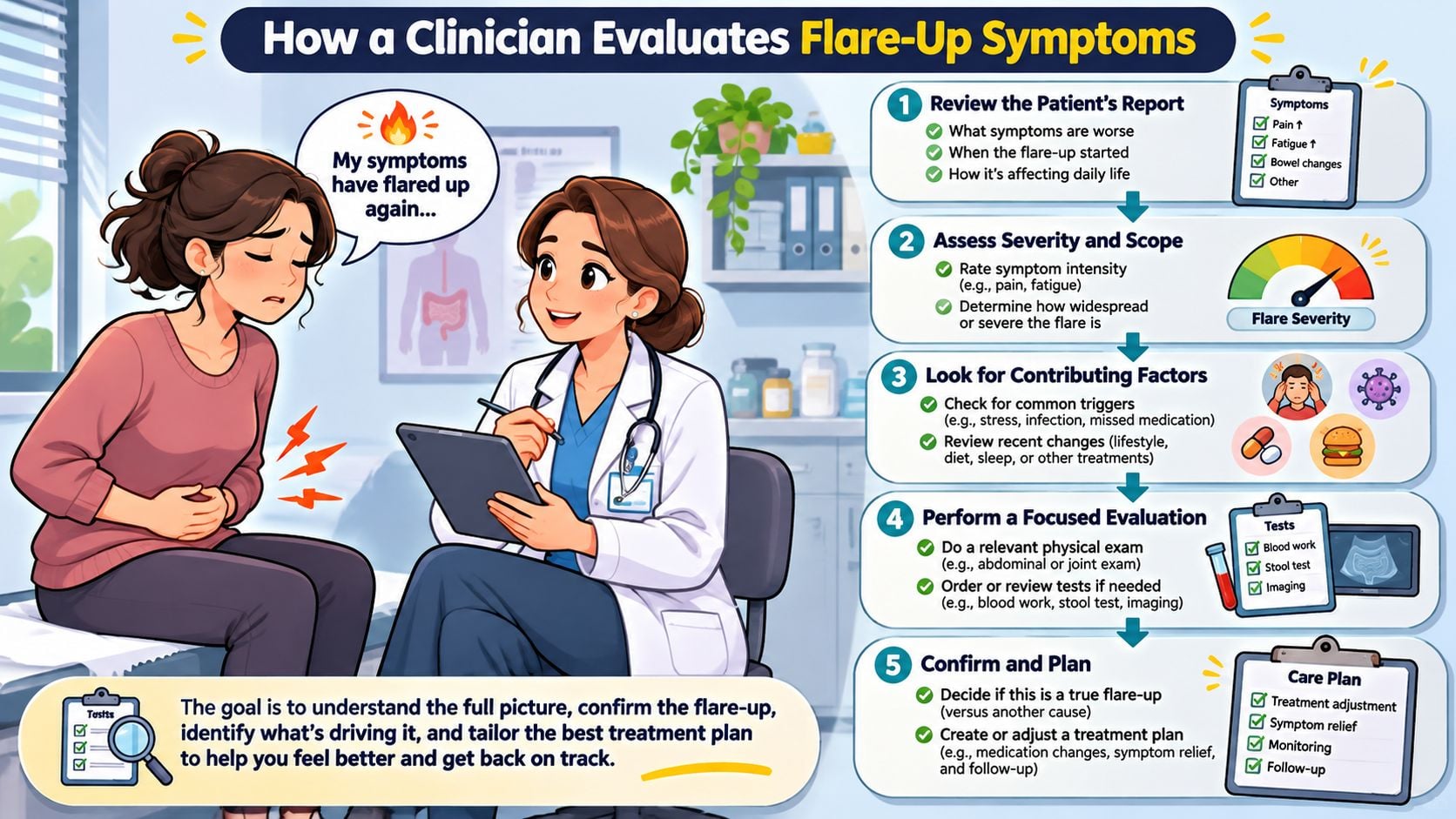
- History first. When did symptoms start, what makes them better or worse, what has already been tried, and how sleep and stress have tracked alongside.
- A hands-on exam. The head, neck, face, jaw muscles, and jaw joints are palpated for tenderness and checked for asymmetry. TMJ disorders are diagnosed through physical examination, range of motion, joint sounds and vibrations, joint hard tissue images, patient history and interview, and in some cases sleep diagnostics and hospital-based soft tissue diagnostics.
- Range of motion. Maximum comfortable opening, any deviation to one side, and how far the jaw moves in each direction.
- Joint sounds, characterized. Not just whether the joint clicks, but whether the click hurts and where in the movement it lands.
- Imaging when it earns its place. X-rays, CT, or MRI are ordered only when findings call for them. A 3D CBCT (Cone Beam) scan of the jaw joint is frequently needed, and patients may be referred to a diagnostic imaging center to have it completed.
- A sleep question. Where snoring, unrefreshing sleep, or witnessed pauses are part of the story, a sleep study is how sleep apnea gets diagnosed, and that runs through a physician.
What to Bring to the Appointment
Preparation shortens the path to an answer.
- A symptom diary covering one to two weeks. Note pain intensity, triggers, maximum comfortable opening, locking episodes, and any ear symptoms.
- A medication and supplement list. Including doses, timing, and anything started recently.
- Notes from a sleep partner. Snoring volume, witnessed pauses, and how rested the morning feels.
- Dental and medical history. Recent fillings or crowns, past jaw injury, and any previous treatment for the same problem.
The purpose of all this is to rule out other causes and identify contributing factors. It isn't a guarantee of any particular outcome, and a good clinician will say so plainly.
Decide Whether to Request an Appointment
The decision rule is simple enough to apply without second-guessing. Book an evaluation if a flare lasts longer than expected, keeps coming back, limits eating or sleep, or arrives with any sign from the red-flag list above. Add one more trigger: a flare that recurs despite careful eating and over-the-counter relief, because that pattern suggests the driver hasn't been found yet.
Think of the decision like a smoke alarm that keeps sounding after the toast is cleared. A single beep is an event. A repeating one is a pattern, and patterns are what a clinician can work with.
A thorough evaluation at Pain and Sleep Therapy Center looks for root causes and builds a plan around the individual. Depending on what the evaluation finds, that plan may include orthotic therapy to stabilize the joint, cold laser therapy for pain and tissue healing, lifestyle modifications such as nutrition counseling, and coordinated care with other healthcare professionals. Medication, when used at all, supports these more definitive treatments rather than standing alone, because drugs on their own cannot solve TMJ issues. Conservative, non-invasive options come before surgical ones, and subjective symptoms generally improve within 30 to 60 days of starting care.
One safety note worth repeating at every visit: a nighttime appliance is a hallmark maintenance therapy for TMJ, but if it isn't made to control sleep apnea it can double the severity of a patient's sleep apnea. Ask a clinician before wearing any appliance bought or borrowed for jaw symptoms.
Pain and Sleep Therapy Center serves patients in Newark, Delaware and Bryn Mawr, Pennsylvania. A primary care physician or dental provider is a fine starting point, and red-flag signs call for medical care first rather than a routine appointment booked for next month. To arrange an evaluation, choose Request an Appointment or Take our Sleep Quiz on the center's website.
Pain and Sleep Therapy Center evaluates jaw, head, and facial pain with an eye on the whole picture, including the sleep and airway factors that keep some flares returning. Led by Dr. Ryan Robinson, the team builds conservative, root-cause plans for patients in Newark, Delaware and Bryn Mawr, Pennsylvania. To take the next step, visit Pain and Sleep Therapy Center to Request an Appointment or Take our Sleep Quiz.