If misaligned teeth were the main reason people grind at night, straightening a bite would stop the habit for good. Yet many adults with straight teeth, braces history, or brand-new dental work still wake up with sore jaws and worn enamel. That gap raises a much better question: what are the causes of grinding teeth in sleep, and why does the jaw keep working while the rest of the body tries to rest?
For decades, patients heard two simple answers: stress or a bad bite. Modern sleep medicine paints a clearer, more useful picture. Nighttime grinding rarely comes from one isolated dental flaw. Instead, it reflects how the brain, airway, nervous system, daily habits, and health history interact during sleep.
Separating why grinding happens from what it does to your teeth changes how you handle it. A mouthguard can shield enamel from wear, yet it can't tell you whether disrupted breathing, a prescription change, or nighttime awakenings set your jaw in motion in the first place. Understanding each contributor helps you walk into an appointment with sharper questions and a clearer plan.
Table of Contents
- Causes of Sleep Grinding at a Glance
- Why Grinding Is About Arousals, Not Just Your Bite
- How Sleep Apnea and Grinding Connect
- Medications, Reflux and Insomnia as Hidden Triggers
- What Grinding Can Do Over Time
- Signs That Point Toward Different Causes
- How Clinicians Evaluate Grinding Step by Step
- Request an Evaluation for Nighttime Grinding
Causes of Sleep Grinding at a Glance
Sleep bruxism is repeated jaw-muscle activity during sleep that leads to clenching or grinding the teeth. Clinicians no longer view it as a single-cause dental quirk. Instead, they look at a mix of sleep-related, biological, and lifestyle factors that raise a person's chances of grinding overnight.
How common is the habit? A foundational 2001 adult population study in Chest found that 8.2% of adults reported grinding their teeth during sleep at least once a week. Among those weekly grinders, about half experienced meaningful effects: jaw-muscle discomfort on waking, grinding loud enough to disturb others, or a need for dental care.
Measured Factors Linked to Nighttime Grinding
The same 2001 study weighed specific health and lifestyle factors against sleep bruxism using an odds ratio (OR). An odds ratio above 1 means a factor appeared more often among people who grind than among people who don't. That signals a statistical link rather than proof of cause, yet it lets you rank suspects by strength instead of guessing.
| Factor | Link to Sleep Bruxism | Odds Ratio (OR) |
|---|---|---|
| Obstructive sleep apnea | Higher odds | 1.8 |
| Heavy alcohol consumption | Higher odds | 1.8 |
| Loud snoring | Higher odds | 1.4 |
| Caffeine use | Higher odds | 1.4 |
| Smoking | Higher odds | 1.3 |
| Highly stressful life | Higher odds | 1.3 |
| Anxiety | Higher odds | 1.3 |
| Moderate daytime sleepiness | Higher odds | 1.3 |
| Family history of grinding or clenching | Higher odds | Not measured in 2001 study |
| Certain depression, seizure or ADHD medicines | Possible contributor | Not measured in 2001 study |
Breathing-related factors sit at the top. Obstructive sleep apnea (repeated pauses or drops in breathing during sleep) tied for the highest odds ratio at 1.8, meaning it showed up nearly twice as often among grinders, and loud snoring followed at 1.4. Heavy alcohol use matched apnea's 1.8, caffeine measured 1.4, and smoking, high daily stress, anxiety, and moderate daytime sleepiness each came in at 1.3.
Read together, these numbers show breathing disruption and sleep-disrupting habits linked to grinding as strongly as daily stress, and in several rows more strongly.
A pattern runs beneath the figures: nearly every high-odds factor either disrupts breathing during sleep or lightens and fragments it. That shared thread explains why apnea and snoring outrank emotional factors like stress and anxiety on this chart.
The final two rows lack odds ratios because the 2001 study didn't measure them. A family history of grinding or clenching still raises a person's odds, and certain medicines prescribed for depression, seizures, or attention deficit can contribute to nighttime jaw activity. Two practical steps follow. First, scan the table and mark every row that fits your routine or health history. Second, bring that short checklist to your appointment: it gives a dentist or physician a concrete starting point instead of guesswork.
Why Grinding Is About Arousals, Not Just Your Bite
Many adults still assume their teeth grind at night because two surfaces don't meet evenly, so the jaw tries to "file down" the high spot. Current research challenges that idea. A 2025 clinical review in the Journal of Oral & Facial Pain and Headache describes sleep bruxism as a centrally mediated sleep-related movement disorder, meaning signals from the central nervous system drive the jaw muscles rather than a crooked tooth.
Think of the sleeping brain like a sensitive smoke detector. During the night, small shifts in brain chemistry, noise, heart rate, or breathing can trip that alarm for a few seconds. Those brief shifts into lighter sleep are called micro-arousals, and most sleepers never remember them in the morning.
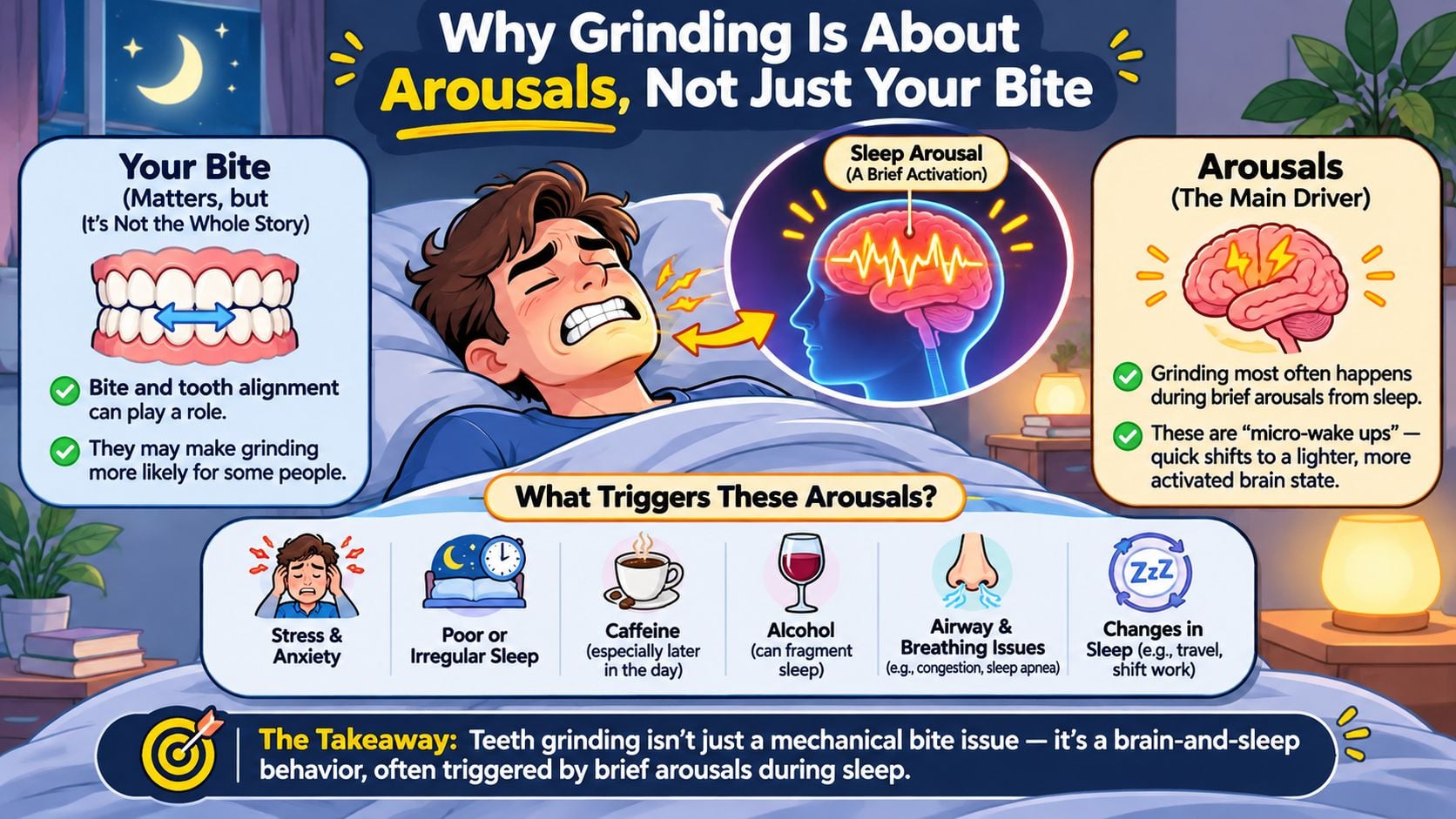
When a micro-arousal fires, the brain sends a quick surge through the autonomic nervous system, the network that controls automatic body functions like heart rate and breathing. That surge can switch on the masseter (cheek) and temporalis (temple) muscles, producing rhythmic grinding or steady clenching. Brain-chemical pathways involving dopamine, serotonin, and opioid receptors appear to shape how easily that reflex triggers, and researchers have studied gene variants tied to serotonin and dopamine without finding one single causal mutation.
Stress, Genetics and Daily Habits
Arousal sensitivity doesn't happen in a vacuum. According to the National Institutes of Health (NIH) overview on bruxism, psychosocial factors like stress, mood changes, emotional distress, nervousness, and low mood can all play a role. Family history matters too: having a close relative who clenches or grinds raises a person's likelihood of doing the same, pointing toward a genetic influence.
Stress rarely acts as the sole trigger on its own. Instead, a tense nervous system lowers the threshold for micro-arousals, making the sleeping brain's alarm trip more easily. Daily habits add fuel to the same fire:
- Tobacco use: Nicotine acts as a stimulant and disrupts steady sleep stages, keeping the nervous system more alert overnight.
- Alcohol intake: Even if an evening drink helps someone fall asleep quickly, alcohol breaks up sleep cycles later in the night and increases arousals.
- Heavy caffeine consumption: Late-day coffee, energy drinks, or strong tea can linger in the bloodstream and heighten muscle reactivity during lighter sleep.
Adjusting evening habits and calming jaw tension before bed can make a practical difference for some sleepers. Readers looking for everyday wind-down routines can explore jaw relief tips for restless sleepers from SleepHabits as a helpful starting point alongside professional guidance.
Because no single factor explains every case, the most helpful question isn't "Is my bite crooked?" It's "Which combination of arousal triggers, genetics, and daily habits is nudging my jaw muscles awake at night?"
How Sleep Apnea and Grinding Connect
Among the medical conditions linked to nighttime grinding, obstructive sleep apnea (OSA) draws the most attention from sleep clinicians. OSA happens when soft tissues in the throat relax and partially or fully block airflow during sleep. Clinicians grade it by how many breathing events occur each hour: mild at 5 to 15 events per hour, moderate at 16 to 30 events per hour, and severe above 30 events per hour.
Sleep labs have traced a step-by-step sequence showing how a breathing dip can lead straight into jaw movement:
- Airflow drops during an obstruction. As the upper airway narrows or closes, oxygen levels dip, carbon dioxide rises, and the chest works harder to pull air through.
- A micro-arousal ends the pause. The brain triggers a brief awakening paired with an autonomic surge so the sleeper resumes normal breathing.
- Jaw muscles fire right afterward. Sleep-lab recordings show rhythmic chewing-muscle activity shortly after an apnea or hypopnea (a partial airflow drop) ends. In a 2019 lab study in Sleep and Breathing of 110 adults at increased apnea risk, sleep bruxism correlated with mild-to-moderate OSA.
Why would the jaw move at that exact moment? One leading hypothesis is partly protective: tightening or shifting the lower jaw forward may stiffen and reopen the upper airway after a collapse. A direct cause-and-effect link in adults remains unproven, though, and findings differ across patient groups. Treat the correlation as a strong lead rather than a settled verdict.
How Often the Two Conditions Overlap
Even without a proven cause, the two conditions turn up in the same patients remarkably often. A 2019 review in the Journal of Clinical Medicine estimated that OSA affects 9% to 38% of the general population, while sleep bruxism occurs in roughly 13% of adults. In patients already diagnosed with OSA, a 2024 clinical study in BMC Oral Health recorded sleep bruxism in 37.1% of participants, and a larger 2023 polysomnographic study in the Journal of Clinical Sleep Medicine found it in 49.7% of adults with OSA, with male sex, lower body mass index, and more time in light sleep raising the odds.
The overlap runs both ways. A TMJ evaluation may prompt a sleep study when a patient's history and symptoms point toward disordered breathing, and a sleep evaluation may surface jaw complaints the patient never connected to their nights. Readers dealing with daytime exhaustion alongside jaw tension can explore how sleep apnea and chronic fatigue overlap.
Clinical boundary: Nighttime grinding alone cannot diagnose sleep apnea, and researchers have not settled whether treating OSA reliably stops bruxism. When apnea is present, clinicians treat the breathing disorder for its own health risks rather than promising it will silence the jaw.
Only a physician can diagnose obstructive sleep apnea, either through an overnight study at a sleep facility or a home sleep test. If jaw symptoms show up alongside red flags like loud snoring or daytime sleepiness, bringing both concerns to a physician ensures nothing important gets missed.
Medications, Reflux and Insomnia as Hidden Triggers
Stress and caffeine usually top the list of suspected causes of grinding teeth in sleep, yet some of the most common triggers sit in the medicine cabinet or the digestive tract. Several everyday medical factors disturb sleep architecture and trigger jaw activity without drawing attention to themselves.
Prescription Medications That Affect Jaw Activity
Certain prescription drugs alter the brain chemicals that regulate both sleep depth and muscle tone. A 2025 review in the Journal of Oral Rehabilitation links medicines used for depression, seizures, and attention-deficit/hyperactivity disorder (ADHD) with nighttime clenching or grinding, and it also notes associations with antidepressant and sleep-medication use in adults with overlapping sleep problems.
The pattern makes sense once you see grinding as an arousal problem. Anything that changes the brain's sleep depth or how tightly it holds muscle tone changes how often the jaw gets a chance to fire.
A link between a prescription and sore morning jaws is worth reviewing, but stopping the medicine on your own carries real risk. Schedule a medication review with the prescribing clinician, who can check timing, dosage, or safe alternatives if appropriate.
Nighttime Reflux, Insomnia and Overlapping Health Factors
Prescriptions are only part of the picture. The same clinical review notes links between sleep bruxism and gastroesophageal reflux (stomach acid moving up into the food pipe), insomnia, chronic pain, and upper-airway disease. Each condition works the same way: it keeps pulling the brain into lighter sleep, and each partial awakening gives the jaw muscles one more opening.
Spotting these hidden triggers starts with clues that happen outside the mouth:
- Nighttime acid reflux: Waking with heartburn, a sour taste, a dry cough, or repeated throat clearing can signal reflux-driven arousals during the night.
- Insomnia and fragmented sleep: Lying awake for long stretches or waking several times a night creates repeated transitions through light sleep, and every transition is another chance for jaw-muscle activity.
- Chronic pain or nasal congestion: Persistent neck, back, or joint discomfort, along with a stuffy upper airway, fragments deep sleep and keeps the nervous system on edge.
A simple symptom timeline can reveal patterns that memory alone misses. Write down roughly when your grinding or morning jaw soreness started, then list any new prescriptions, dose changes, heartburn flares, or stretches of poor sleep from those same weeks. Handing that one-page timeline to your dentist or physician helps them connect dots across specialties quickly.
What Grinding Can Do Over Time
Once people learn they grind their teeth at night, their next question is usually straightforward: is this hurting me? The honest answer depends on how hard you grind, how often it happens, and whether another sleep condition is riding along. Many adults grind lightly for years without lasting harm, while others develop steady wear or daily discomfort.
Four Ways Persistent Grinding Shows Up
When nighttime jaw forces build up over months or years, clinicians watch for four main effects:
- Progressive tooth wear: Repeated friction can flatten biting surfaces, chip edges, or shorten front teeth. A dentist can measure wear facets and compare photos or scans over regular checkups to see whether damage is active or old.
- Jaw-muscle fatigue and joint strain: Overworked chewing muscles often feel tight, tender, or tired at breakfast. In some people, ongoing strain overlaps with temporomandibular joint (TMJ) disorders, bringing jaw clicking, pain, or brief locking on waking.
- Morning headaches and unrefreshing sleep: Tense temple muscles can feed dull morning headaches. Readers wondering about that link can explore why clenching teeth can trigger headaches, though headaches and grogginess can also signal an underlying breathing issue rather than grinding alone.
- Disrupted rest for bed partners: Loud grinding noises can wake a partner repeatedly, turning one person's sleep movement into two people's fatigue.
No clinician can predict an exact future path for an individual patient, because tissue resilience and grinding intensity vary widely from person to person. Routine dental monitoring tracks whether enamel is staying stable or needs conservative protection.
Looking strictly at tooth edges can still miss the bigger health picture. The Mayo Clinic guide to bruxism symptoms and causes lists sleep apnea among the sleep-related disorders associated with bruxism. Because untreated sleep apnea affects heart health, blood pressure, and daytime alertness far beyond the jaw, checking on breathing quality can matter even more than repairing a chipped molar.
Signs That Point Toward Different Causes
Every physical sign gives a clue, yet no single clue delivers a diagnosis on its own. Two patients can walk in with identical worn molars: one might clench during stressful workdays, while the other might grind after breathing pauses at 2 a.m. Matching each sign to the right professional keeps care focused on root causes instead of quick patches.
| Sign | What It May Point To | Where to Look |
|---|---|---|
| Worn, flattened or chipped tooth edges | Long-term grinding, sleep or awake | Dental exam for a wear pattern |
| Grinding sounds reported by a bed partner | Sleep bruxism, possibly with arousals | Sleep history and partner report |
| Morning jaw soreness or tired chewing muscles | Jaw-muscle overactivity during sleep | Clinical jaw and muscle exam |
| Loud snoring, witnessed pauses or gasping | Possible sleep-disordered breathing | Sleep testing ordered by a physician |
| Morning headaches or daytime sleepiness | Breathing problem or poor sleep quality | Sleep evaluation |
| Teeth clenched during the day | Awake bruxism or a stress-related habit | Daytime habit review |
| New antidepressant, ADHD or seizure medicine | Medication-associated grinding | Discussion with the prescribing clinician |
| Heartburn or reflux at night | Reflux-related arousals | Reflux review with a physician |
Notice the distinction between awake bruxism (habitual daytime clenching, often during deep focus or stress) and sleep bruxism. Daytime clenching responds well to awareness cues and muscle relaxation, whereas nighttime grinding requires looking at sleep depth, breathing, and overnight triggers.
Why Self-Reporting Often Misses the Mark
Relying only on what you feel in the morning can be surprisingly misleading. A 2025 evidence review published through PubMed Central highlighted a population study where 17.1% of adults self-reported sleep bruxism, 30.5% showed it during overnight polysomnography, and only 7.4% were identified when both methods agreed. People who sleep alone often miss grinding sounds entirely, while people with jaw soreness sometimes assume they grind when they clench during the day.
"Keep a two-week notebook of partner observations, morning jaw stiffness, headaches, reflux, and any medication shifts before your appointment."
That short log helps bridge the gap between what happens while you're asleep and what a clinician sees in the chair. Pay special attention when symptoms cluster together. Loud snoring paired with witnessed breathing pauses, morning headaches, or daytime sleepiness deserves a prompt conversation with a physician, who will decide whether formal sleep testing is the right next step.
How Clinicians Evaluate Grinding Step by Step
A thoughtful evaluation doesn't jump straight to expensive laboratory tests or aggressive dental reconstruction. According to the American Academy of Sleep Medicine (AASM) scoring and practice guidelines, uncomplicated, noninjurious sleep bruxism can usually be diagnosed through a careful clinical exam and history.
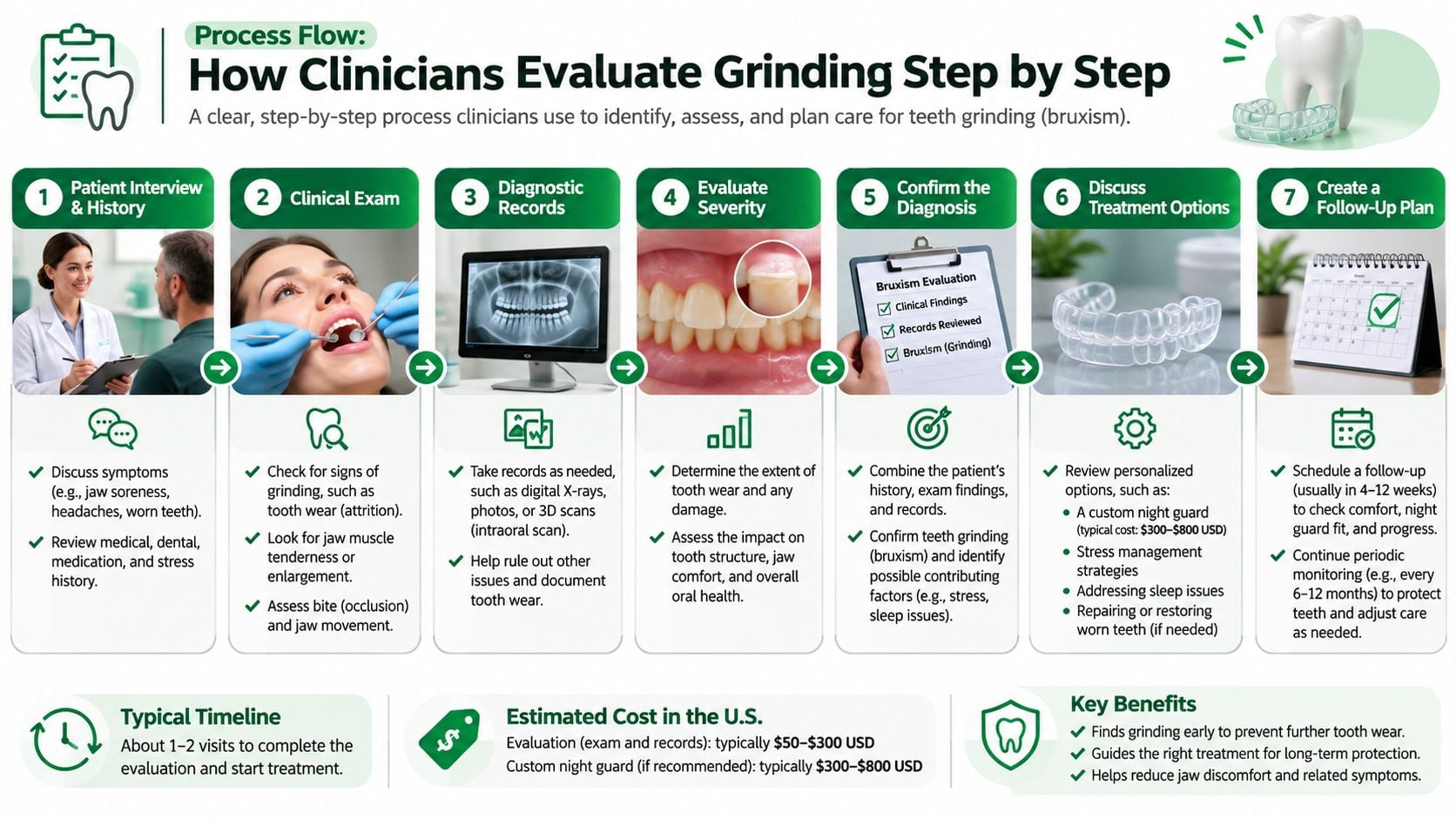
Understanding what happens during an appointment takes away the mystery. Clinicians typically move through five structured steps so they treat the actual driver rather than guessing.
Clinical History and Physical Exam
- Gather a full sleep and health history. The clinician asks about recent grinding sounds heard by a partner or parent, bedtime routines, caffeine and alcohol timing, acid reflux, daytime fatigue, and current prescriptions. Mapping these habits reveals which arousal triggers deserve attention first.
- Examine the teeth, jaw muscles, and joints. Expect a close look for abnormal tooth wear, enlargement of the masseter muscles (the main chewing muscles along the cheeks), jaw tenderness, and pain or locking on waking. When TMJ disorders are suspected, diagnosis draws on physical examination, jaw range of motion, joint sounds or vibrations, joint hard-tissue images, patient history and interview, and in some cases sleep diagnostics or hospital-based soft-tissue imaging.
- Rule out look-alike conditions. Jaw or ear pain doesn't automatically mean grinding. A dental and craniofacial exam checks for dental decay, cracked teeth, temporomandibular joint inflammation, reflux, insomnia, and airway obstruction so overlapping problems aren't lumped under one label.
Sleep Testing and Coordinated Care
- Decide whether sleep testing makes sense. Sleep apnea cannot be diagnosed from symptoms alone; it requires either an overnight polysomnography (PSG) at a sleep facility or a home sleep study. A boarded sleep physician reads and interprets the raw data from both types of tests. When a bruxism diagnosis is uncertain, symptoms are severe, or another sleep disorder is suspected, the AASM scoring framework notes that laboratory confirmation uses in-lab polysomnography with jaw-muscle recordings (electromyography) to separate repetitive grinding from other nighttime movements. Patients scheduled for testing can review how to prepare for a sleep study ahead of time.
- Build a conservative, coordinated plan. Rather than rushing toward surgery or irreversible bite changes, clinicians start with non-invasive steps matched to the root findings. That may combine tooth protection, habit adjustments, medical referrals for reflux or prescriptions, or airway-focused therapy when a physician diagnoses sleep apnea, followed by periodic check-ins to see how both jaw comfort and sleep quality respond.
Request an Evaluation for Nighttime Grinding
Occasional clenching during a rough week rarely calls for urgent care. Certain patterns, though, deserve a closer look sooner rather than later. Consider scheduling a professional evaluation if you notice any of the following:
- Persistent grinding: Nighttime sounds or tension continue even after trimming late caffeine, alcohol, and evening screen habits.
- Morning jaw symptoms: You wake with jaw pain, stiffness, chewing fatigue, or brief locking.
- Visible tooth changes: Teeth look flatter, chipped, or newly sensitive to hot and cold drinks.
- Headaches or fatigue: Morning headaches or unrefreshing sleep linger week after week.
- Recent prescription shifts: Symptoms began shortly after starting or adjusting a medication.
- Breathing signs: Any of the airway clues from the symptom table appear alongside your jaw symptoms.
Seek emergency medical care right away for sudden or severe symptoms such as chest pain, trouble breathing, or fainting.
Root-Cause Care Across Delaware and the Main Line
Grinding sits at the meeting point of jaw mechanics and sleep physiology, so the most useful evaluation examines both. At Pain and Sleep Therapy Center, patients are seen by a dentist with advanced training in treating sleep apnea. Led by Dr. Ryan Robinson, a triple board-certified specialist in craniofacial pain and dental sleep medicine, the practice evaluates TMJ disorders, head and facial pain, sleep-disordered breathing, and tongue ties, with an emphasis on root causes and conservative, non-invasive options before surgery.
When a physician diagnoses obstructive sleep apnea, care can include a custom sleep appliance worn nightly, lifestyle adjustments, and coordination with medical specialists. Because sleep apnea is a medical condition, treatment with a dental device is billed through medical insurance rather than dental coverage, subject to the patient's annual deductible. A sleep appliance is generally expected to last 5-7 years, and heavy bruxers and clenchers may need a replacement sooner, which is one reason periodic follow-up matters.
The team sees patients at locations in Newark, Delaware, and Bryn Mawr, Pennsylvania. No evaluation or therapy can guarantee a specific outcome, but identifying what drives nighttime grinding tends to bring clearer direction and steadier relief. Readers ready for a next step can select "Request an Appointment" to schedule a thorough evaluation, or try "Take our Sleep Quiz" as a quick screening tool (not a medical diagnosis) to organize symptoms before talking with a clinician.
Pain and Sleep Therapy Center focuses on root-cause, non-invasive care for TMJ pain, craniofacial discomfort, and sleep-disordered breathing in Newark, Delaware, and Bryn Mawr, Pennsylvania. Whether nighttime grinding points toward jaw strain, disrupted sleep, or an airway concern that calls for coordinated medical testing, a thorough evaluation helps map out conservative options suited to your needs. Explore symptoms, take the screening quiz, or request an evaluation by visiting Pain and Sleep Therapy Center.