
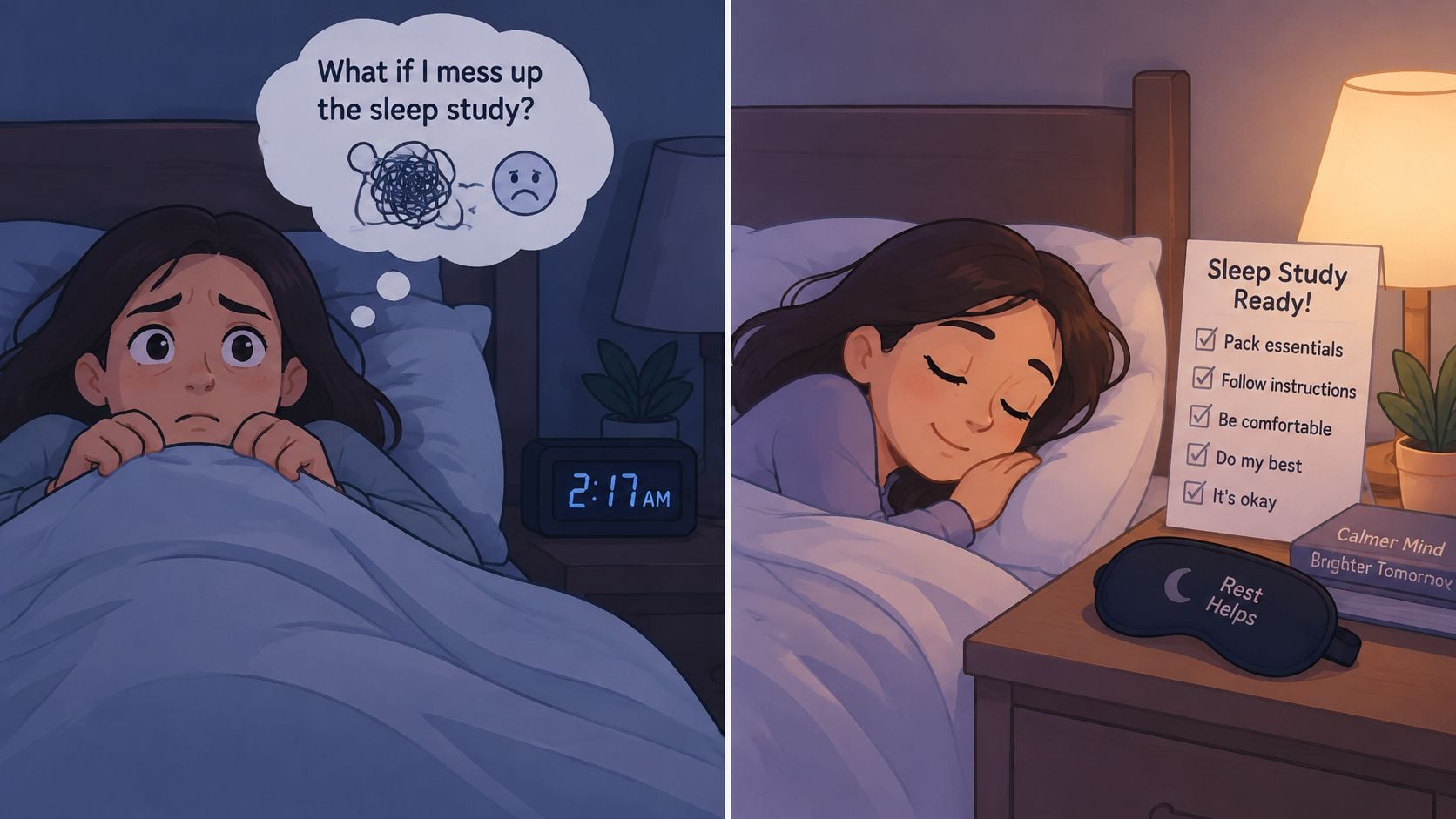
The appointment is scheduled, but bedtime suddenly feels like a test to pass. A person preparing for a sleep study may worry about lying awake, moving a sensor, or having a night that doesn't look anything like sleep at home. A more helpful approach is to prepare for an ordinary night, keep the recording equipment working, and know what happens if the results don't explain the symptoms.
Table of Contents
- Why Sleep Study Preparation Protects the Recording
- Choosing an In-Lab Study or a Home Test
- Medications Caffeine and the Day Before Testing
- What to Pack and Expect at an In-Lab Study
- Setting Up a Home Sleep Apnea Test Correctly
- When a Negative or Failed Test Still Needs Follow-Up
Why Sleep Study Preparation Protects the Recording
Someone facing a first sleep study may feel tempted to stay up late beforehand or change a bedtime routine to guarantee sleep. That adds pressure to a night that already feels unfamiliar. A sleep study is meant to capture usual sleep, not an artificially perfect night.
Polysomnography is an overnight recording of sleep and body signals. An attended laboratory study is generally scheduled during a person's habitual sleep period, usually starting in the evening, and generally requires at least two hours of actual sleep for the recording to be considered valid, according to clinical guidance on polysomnography. That threshold isn't a target for patients to manage themselves, and it doesn't mean every short recording answers every clinical question.
What happens before the sensors
Before setup, patients commonly complete sleepiness questionnaires, such as the Epworth Sleepiness Scale or Stanford Sleepiness Scale. These forms help describe daytime sleepiness. The care team also reviews medications so the recording can be interpreted with the patient's usual treatment in mind.
For example, a patient may remember a prescription medicine but forget an occasional sleep aid or herbal supplement. A written list makes that conversation more complete. Reporting an adhesive allergy ahead of time also gives the team an opportunity to discuss sensor attachment rather than discovering the concern at bedtime.
Useful preparation includes:
- A complete medication list: Prescriptions, over-the-counter medicines, supplements, and occasional bedtime products all belong on it.
- Advance notice of adhesive allergies: The testing team needs this information before attaching sensors.
- No last-minute self-changes: Attempts to force sleep or independently alter treatment can make the night less representative.
Preparation supports interpretation, not diagnosis
Readers exploring what sleep-disordered breathing means may already recognize concerns about nighttime breathing. Preparation helps the team collect useful evidence about those concerns; it doesn't establish the diagnosis.
Practical perspective: The patient's job is to follow the testing instructions and report anything unusual, not to produce perfect sleep.
Sleep apnea is diagnosed through a sleep study interpreted by a physician. Clean signals and an honest account of the night give that physician a stronger basis for deciding what the recording does, and doesn't, explain.
Choosing an In-Lab Study or a Home Test
The first preparation question is which test has been ordered. An attended laboratory study and a home sleep apnea test, often shortened to HSAT, aren't interchangeable. They collect different amounts of information and fit different clinical situations.
A laboratory study records a broader set of sleep and body signals with a sleep technologist present. Home testing uses portable equipment and fewer measurement channels, mainly when symptoms and a clinical evaluation suggest obstructive sleep apnea, a condition involving repeated upper-airway blockage during sleep.
In-Lab Polysomnography Versus a Home Sleep Apnea Test
| Question | In-lab polysomnography | Home sleep apnea test |
|---|---|---|
| Where does testing happen? | In a sleep laboratory with a technologist present | At home with portable recording equipment |
| What does it capture? | A broader picture of sleep and body signals | A more limited set of signals focused on breathing |
| Who may it fit? | Patients needing a more comprehensive evaluation | Appropriately selected adults with suspected obstructive sleep apnea |
| What does a weak result mean? | The physician reviews whether enough useful information was collected | A negative or poor-quality result may require laboratory testing |
| What preparation matters most? | Following the laboratory's arrival and bedtime instructions | Correct placement and continued operation of the supplied equipment |
Accuracy depends on the test and patient
A Medicare evidence review reported approximately 95% sensitivity and 91% specificity for one portable-monitoring approach at home, while another in-home ARES testing summary reported 85% sensitivity and 91% specificity, illustrating variation by device, scoring, and patient selection in the CMS portable-monitoring evidence review. Sensitivity describes how well a test identifies disease when it is present; specificity describes how well it identifies people without the disease.
The same review reported correct-prediction rates of 0.64 for home monitoring and 0.61 for polysomnography in one analysis, with no statistically significant difference. These findings support carefully selected home testing, not the assumption that every home device can answer every sleep question.
Pain and Sleep Therapy Center serves Newark and Wilmington, Delaware, and Bryn Mawr and the Philadelphia Main Line. Its dental sleep medicine team, led by Dr. Ryan Robinson, triple board-certified in craniofacial pain and dental sleep medicine, uses at-home testing to reduce barriers within physician-ordered care. After physician interpretation, appropriate discussions may include conservative options such as oral appliance therapy, a dental device used as a CPAP alternative for suitable patients.
Patients wondering whether snoring is a sign of sleep apnea can bring that concern to the evaluation rather than choosing a test on convenience alone. Before testing, useful questions include which study was ordered, what instructions apply, and which findings would lead to a laboratory study.
Medications Caffeine and the Day Before Testing
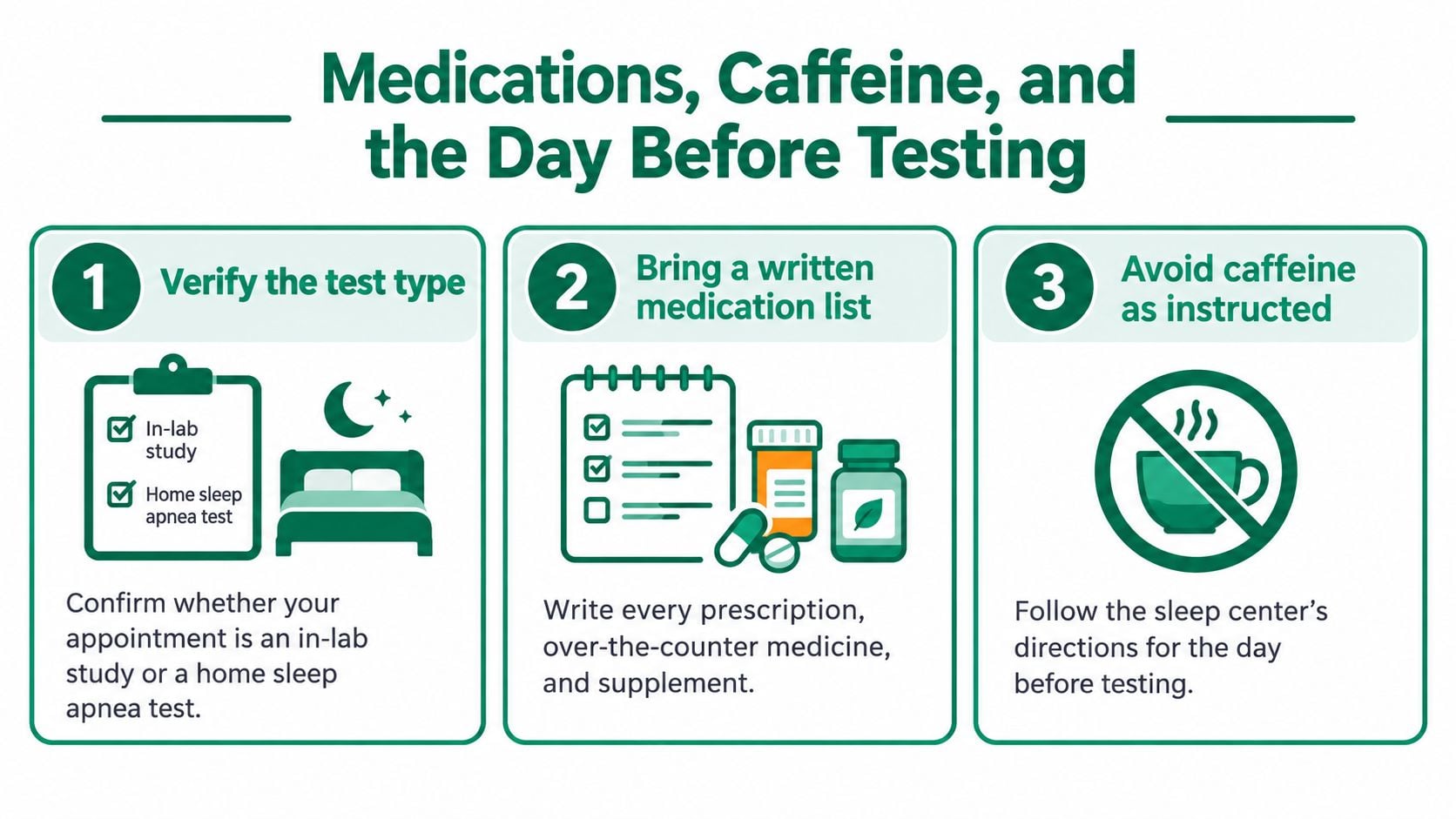
Medication preparation begins with a phone call, not an empty pill organizer. Patients should confirm the test type and provider instructions 24–48 hours beforehand, while raising medication questions earlier whenever possible, as outlined in UCLA Health's sleep-study preparation guidance.
A written list should include every prescription, nonprescription medicine, supplement, and sleep aid. The ordering clinician should specify which products to take, hold, or bring.
Why medicine instructions vary
Some patients may be instructed to stop selected medicines at least 14 days before testing, but that decision belongs to the treating provider, according to Cleveland Clinic's sleep-testing instructions. That isn't a blanket rule for routine overnight studies.
Sedatives, including benzodiazepines, as well as opioids, stimulants, antidepressants, and decongestants may affect alertness, breathing, or sleep architecture, meaning the pattern of sleep stages. Stopping a medicine without guidance can introduce a greater clinical risk than ordinary variation in a recording.
Patients shouldn't independently stop medicines for seizures, mood conditions, blood pressure, pain, or other chronic illnesses. Melatonin and herbal products also belong on the list, even when they're described as natural.
The ordering clinician's protocol takes priority over general internet advice.
Afternoon choices that support ordinary sleep
Caffeine can delay sleep onset. Alcohol may initially make someone sleepy, but it can fragment sleep and worsen upper-airway obstruction. Preparation guidance therefore includes avoiding alcohol and caffeine during the afternoon and evening and skipping daytime naps.
A patient who feels unusually keyed up after coffee may find Refresh Psychiatry & Therapy's resource on recognizing anxiety after drinking caffeine useful background for a conversation about symptoms. That resource doesn't replace the sleep center's directions about caffeine timing.
A practical call-and-check list keeps the day manageable:
- Medicines to confirm: Regular prescriptions, occasional pain medicines, decongestants, sleep aids, melatonin, and herbal supplements.
- Drinks and foods to check: Caffeinated products and alcohol, following the testing provider's cutoff instructions.
- Rest to avoid: A daytime nap or deliberate sleep deprivation intended to force sleep later.
- Unclear directions to resolve: Any disagreement between written instructions and the patient's usual treatment plan.
The rest of the day should stay close to normal. Preparing for a sleep study isn't a reason to exhaust the body or create a stricter routine than the patient ordinarily follows. When instructions remain unclear, a same-day call is safer than guessing.
What to Pack and Expect at an In-Lab Study
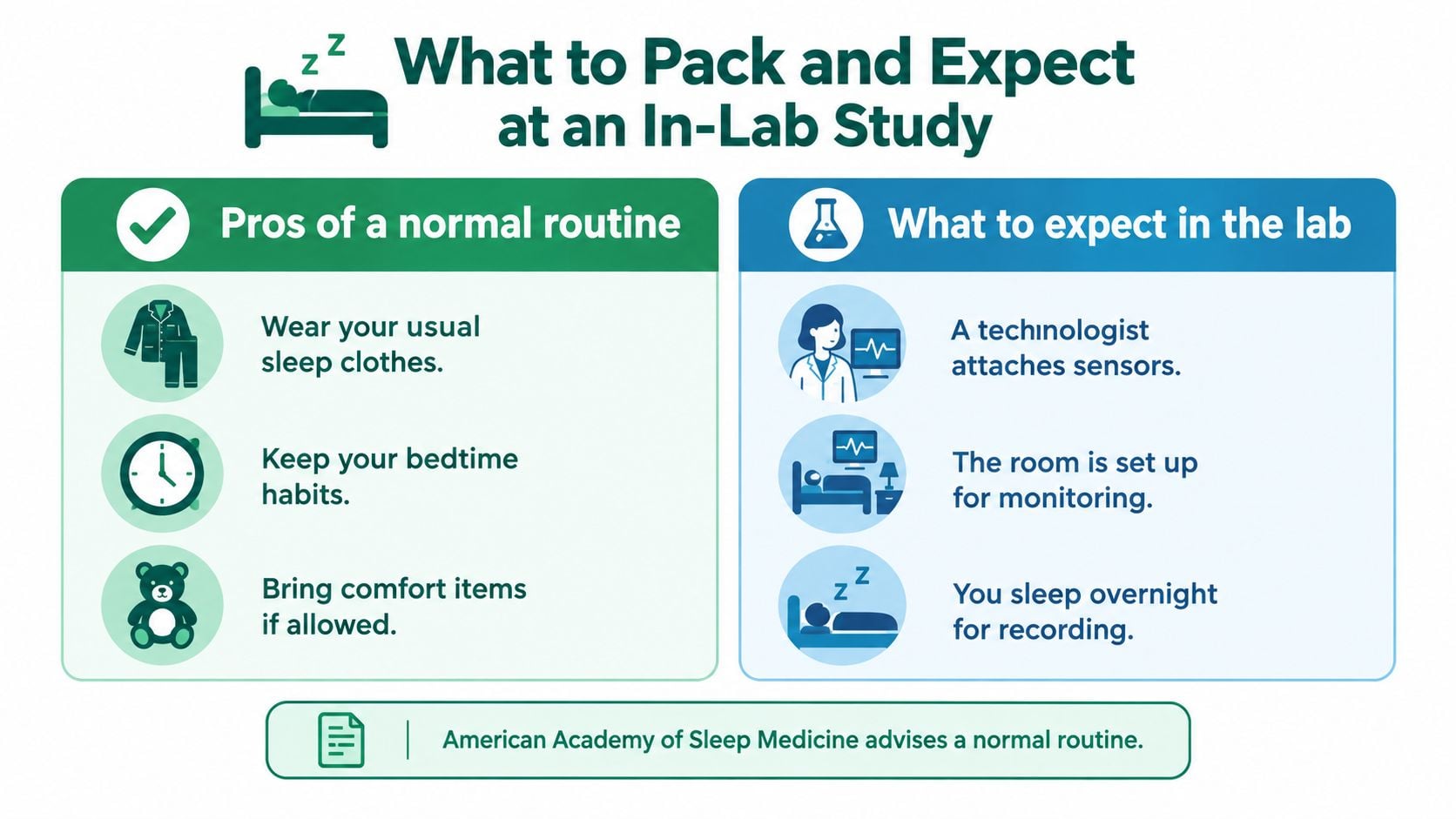
A small overnight bag can make the laboratory visit feel more manageable. Comfortable pajamas, a toothbrush and toothpaste, next-morning clothing, approved bedtime equipment, and any medicines the clinician has instructed the patient to bring are practical essentials.
The American Academy of Sleep Medicine advises a normal daytime routine, no nap and no caffeine after lunch, in its patient guide to an in-lab sleep study. The laboratory's written instructions remain the reference for the appointment.
Pack for comfort and clean sensor contact
Patients may be asked to shower or bathe before arrival. Skin and hair should be clean and dry, without products that make sensor attachment more difficult. Mayo Clinic's polysomnography preparation guidance advises avoiding lotions, gels, colognes, and makeup because they can interfere with electrodes, the sensors placed on the skin to record biological signals.
Hair spray and hair gel should also be left out of the bedtime routine. Nail polish or artificial nails may interfere with the pulse oximeter, a finger sensor that estimates blood oxygen, so patients should ask the laboratory what it requires.
| Do | Don't |
|---|---|
| Pack familiar, comfortable sleepwear | Choose unfamiliar clothing just for the test |
| Bring approved comfort items or bedtime equipment | Assume every item can be used without checking |
| Arrive with clean skin and hair | Apply lotions, oils, makeup, or styling products afterward |
| Raise attachment or comfort concerns with staff | Adjust sensors without asking for help |
The overnight routine and laboratory expectations are summarized below.
An unfamiliar room doesn't mean a failed night
After the questionnaires and medication review, a sleep technologist attaches sensors that record sleep-related signals. The equipment means the night won't feel exactly like home. That difference is expected, and patients can describe discomfort or concerns rather than trying to ignore them.
A useful arrival conversation might include whether a familiar comfort item is allowed, how to request help with an uncomfortable sensor, and whether the usual bedtime routine needs any adjustment. Staff can explain what fits the laboratory's monitoring setup.
If the laboratory's written directions differ from general guidance, patients should follow the laboratory and clarify any uncertainty. Anyone unsure about next-morning alertness should also plan transportation in advance. That practical step removes the pressure to make a driving decision while tired.
Setting Up a Home Sleep Apnea Test Correctly
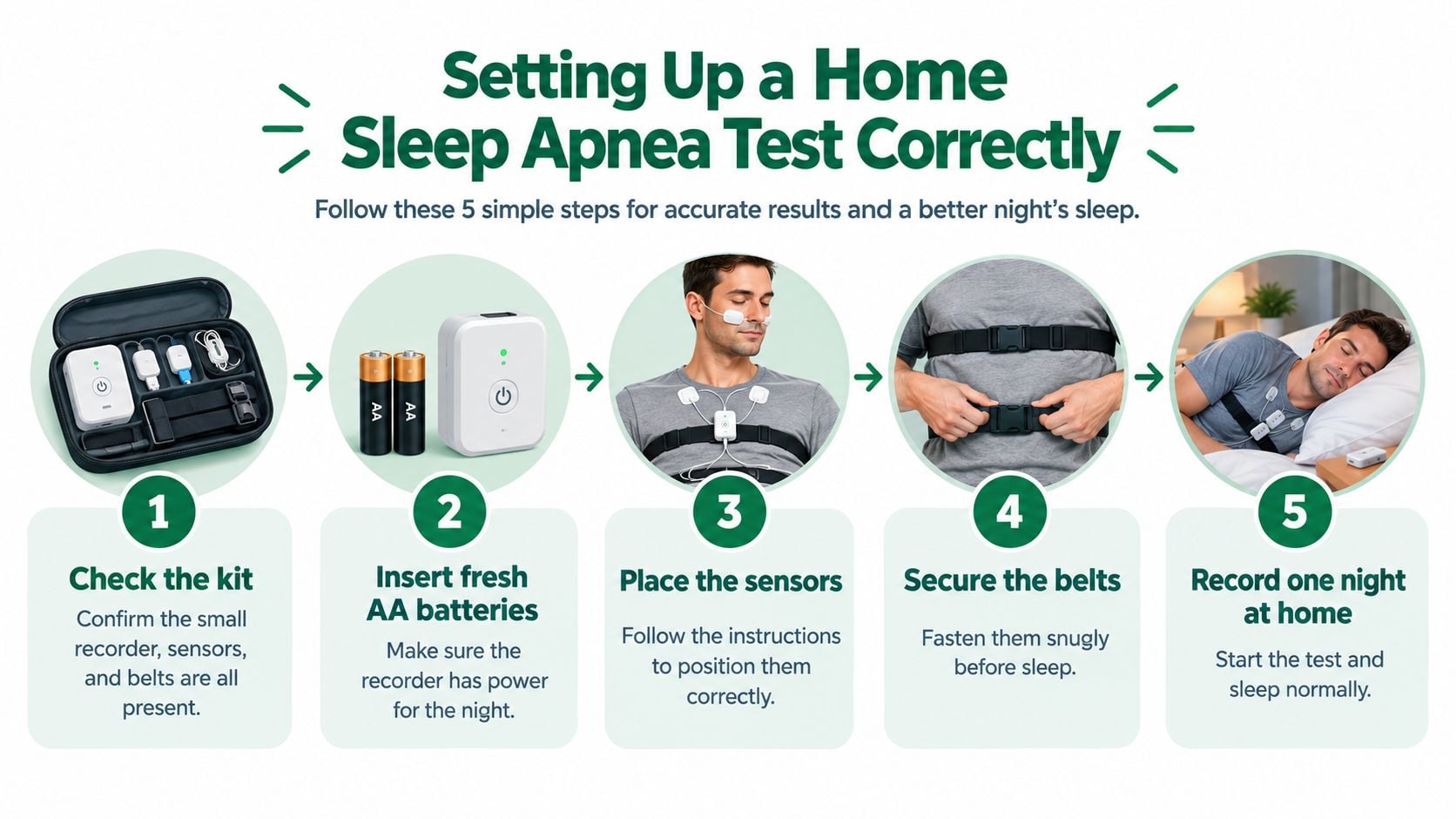
A home study replaces the laboratory setting with a portable kit, not with a self-diagnosis. A qualified physician must order and interpret the test. A typical system includes a recorder, sensors, and belts that measure airflow, breathing effort, blood oxygen, and snoring.
The recorder commonly uses AA batteries, is worn for one night, and is generally returned the following day, according to Cleveland Clinic's description of home sleep apnea testing. Power supplies and return procedures vary, so the supplied instructions should determine what happens with the actual kit.
Follow the supplied sensor sequence
The setup should be checked before the patient is ready to fall asleep. A demonstration or telephone support, when provided, is preferable to improvising after a device fails to start.
- Check operation: Confirm that the recorder has power and that the required parts are present.
- Position the nasal cannula: Place the small nasal-pressure tubing securely at the nostrils as demonstrated.
- Fit the effort belts: Position the chest and abdominal belts according to the supplied instructions.
- Attach the oximeter: Secure it to the designated finger without excessive tightness.
- Start and verify recording: Check the device's indicators for active signals before settling down.
The supplied device's instructions take priority if its configuration differs from a conventional kit.
Readable signals matter more than elapsed time
A conventional technically adequate HSAT uses nasal pressure, chest and abdominal respiratory-inductance plethysmography, meaning belts that track breathing movements, and oximetry, the measurement of blood oxygen. Another validated configuration uses peripheral arterial tone, a signal from blood vessels in a finger, together with oximetry and actigraphy, a movement recording.
At least one night of recording is recommended, but the recording must contain interpretable signals, according to the AAST technical guideline for home sleep apnea testing. A device being switched on doesn't prove that all required signals were captured.
A loose or disconnected oximeter is a common reason for home-test failure. Patients shouldn't tape it so tightly that comfort or circulation suffers, or invent replacement sensors. If a sensor detaches, the testing provider's troubleshooting directions should guide the response; equipment should remain on for the full requested night.
Signal check: Recording time is useful only when the clinician can read the required signals.
For readers who also track sleep habits, Lila's resource to compare iPhone sleep apps for perimenopause offers a separate consumer topic, not instructions for operating a prescribed test. Patients arranging a sleep apnea test at home should keep device-specific setup and physician follow-up at the center of the process.
When a Negative or Failed Test Still Needs Follow-Up
A result marked negative can feel reassuring, while an inconclusive result can feel frustrating. Neither should be interpreted without considering symptoms, recording quality, and the reason testing was ordered.
Home testing is mainly an alternative for appropriately selected adults with a high suspicion of obstructive sleep apnea. It can approach laboratory accuracy in otherwise uncomplicated patients with likely moderate-to-severe disease, but it isn't the right sole test when significant heart, lung, or neurological disease, or another sleep disorder, is suspected. The VA/DoD guidance on insomnia and obstructive sleep apnea emphasizes patient selection and the more detailed information available from laboratory polysomnography.
Different results need different conversations
Negative means the test didn't establish the condition being assessed. Inconclusive means the findings didn't provide a clear answer. Technically inadequate means the recording lacked sufficient usable information, for example because a required sensor signal was lost.
These distinctions matter because a technically poor recording isn't the same as convincing evidence that breathing was normal. If a home test is negative, inconclusive, or technically inadequate while obstructive sleep apnea remains suspected, follow-up polysomnography is recommended, as described in the home-testing technical guidance.
The convenient test shouldn't become the final step merely because it was easier to arrange.
Help the clinician connect the result with the night
A short written account can make the follow-up discussion more useful:
- Describe persistent symptoms: Loud snoring, witnessed breathing pauses, excessive sleepiness, morning headaches, or hard-to-control high blood pressure deserve continued discussion.
- Record sleep position: Note the position or positions remembered during the testing night.
- Report an atypical night: Mention substantially unusual sleep or equipment problems rather than assuming they won't matter.
- Ask about usable data: The key question is how much technically readable information was obtained.
- Confirm the next step: If symptoms and results disagree, ask whether laboratory testing or another evaluation is appropriate.
A patient who remembers a detached finger sensor should report that even if the recorder appeared to run all night. Likewise, continued breathing pauses reported by a bed partner remain relevant after a negative home result. These details help the physician decide whether the evaluation is complete.
Connect findings with appropriate care
A dental sleep visit can connect sleep symptoms with jaw function, airway concerns, and conservative treatment planning. The practice's broader services include temporomandibular joint, or TMJ, jaw, head, and facial pain care; oral appliance therapy; Snorelase for selected snoring concerns; cold laser therapy; and tongue-tie evaluation, including laser frenectomy for infants, children, and adults when indicated.
Those services aren't interchangeable treatments for sleep apnea. A root-cause approach means evaluating the individual problem and coordinating care, with conservative, non-invasive options considered before surgery when appropriate. A physician makes the sleep apnea diagnosis, and later care may help address the findings without any promise of a particular outcome.
For patients in Newark and Wilmington, Delaware, and Bryn Mawr and the Philadelphia Main Line, Pain and Sleep Therapy Center offers sleep-testing guidance and evaluation that connects sleep symptoms with jaw, airway, and conservative treatment planning. Readers can Request an Appointment or Take our Sleep Quiz to begin discussing their concerns, and can call the Newark office at (302) 239-1757 for help planning the next step.