You can spend eight hours in bed and still wake up tired, with a dry mouth, a sore jaw, or a partner saying you snored all night. That pattern often leaves people blaming stress, age, or a bad pillow, when the actual issue may be sleep-disordered breathing, a group of conditions that disrupt breathing again and again during sleep.
At its core, this is a breathing problem during sleep, not just a snoring problem. In plain terms, the airway may narrow, close, or fail to get the right breathing signal at night, and that interruption can affect how rested, alert, and clear-headed a person feels the next day. For a broader plain-language overview, the article on sleep disordered breathing explained offers a helpful starting point.
Table of Contents
- Understanding the Sleep Disordered Breathing Spectrum
- Types of Breathing Disruptions During Sleep
- Recognizing the Nighttime and Daytime Warning Signs
- How Physicians Diagnose Airway Resistance
- Comparing Treatment Options and Oral Appliance Therapy
- The Long-Term Health Benefits of Restoring Sleep Quality
- Taking the Next Steps Toward Better Sleep
Understanding the Sleep Disordered Breathing Spectrum
A person can lie down exhausted, fall asleep quickly, and still spend the night fighting for steady airflow. That's one reason what is sleep disordered breathing matters so much, because the problem is often hidden from the person who has it. The body may be trying to rest while the airway keeps getting interrupted.
More than loud snoring
Sleep-disordered breathing is a spectrum, not a single diagnosis. It includes obstructive and non-obstructive patterns, and major reviews describe it as repeated narrowing or closure of the upper airway during sleep, or abnormal breathing control during sleep (JACC review). That means one person may snore loudly, another may wake gasping, and another may only feel unrefreshed with no clear idea why.
Practical rule: if sleep feels broken, shallow, or effortful, the airway deserves a closer look.
The condition is common enough that it shouldn't be treated like a rare specialty problem. Large population studies have estimated sleep-disordered breathing at about 34% of men and 17% of women ages 30 to 70 when AHI is greater than 5 events per hour (JACC review). Earlier U.S. data found 24% of men and 9% of women at that same threshold in 1993, showing how estimates have shifted as methods changed (NEJM study).
That broad picture matters in the consultation room. A patient usually wants one clear answer, but airway problems can show up in different forms and at different severities. Sleep-disordered breathing is often the first sign that the body's nighttime recovery is being interrupted.
Types of Breathing Disruptions During Sleep
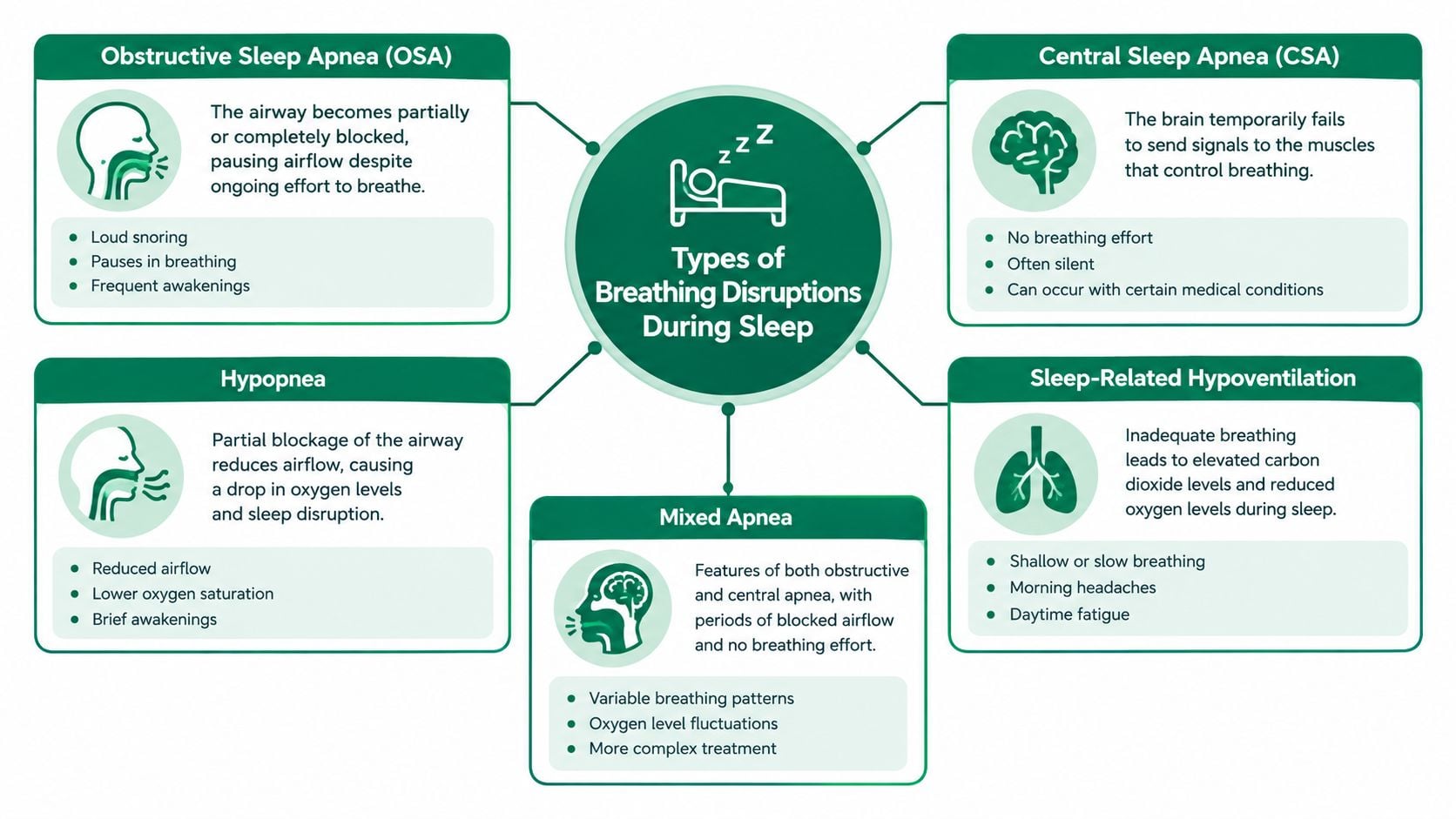
A kinked garden hose still has water behind it, but the flow becomes weak and unstable. A faulty water pump is different, because the signal itself is the issue. Those two images help separate the most common breathing patterns seen during sleep, especially obstructive and central events.
Obstructive, central, and related patterns
Obstructive sleep apnea happens when soft tissues crowd or collapse the airway during sleep. The person is trying to breathe, but the passage narrows enough to interrupt airflow. In adults, a sleep study can support the diagnosis when there are at least 5 predominantly obstructive respiratory events per hour with symptoms, or 15 or more events per hour even without symptoms (PMC guideline summary).
Central sleep apnea works differently. The brain fails to send the right breathing signal, so the problem isn't a blocked passage alone, it's the control of breathing itself. Sleep-related hypoventilation and upper airway resistance also sit within the wider spectrum, which is why a simple label like “snoring” can miss the underlying mechanism.
For a broader patient-friendly overview of why these breathing problems happen during sleep, the article on why breathing problems during sleep is a useful companion piece.
Why the type changes the treatment path
The type of disruption matters because the root cause changes the plan. A person with a crowded airway needs a different approach than someone with abnormal ventilatory control, and that's where careful evaluation becomes essential. This is also why sleep-disordered breathing can't be treated as one-size-fits-all.
Another useful way to think about it is this, the airway problem is often anatomical, but the breathing pattern is functional.
The airway tells part of the story, the sleep study fills in the rest.
For families looking at children as well as adults, the affiliated resource on pediatric sleep-disordered breathing awareness can help connect airway signs across age groups.
Recognizing the Nighttime and Daytime Warning Signs
A lot of people expect sleep-disordered breathing to announce itself with obvious choking or dramatic pauses. In real life, the signs are often quieter. Snoring, waking unrefreshed, and dry mouth can seem ordinary until they start repeating night after night.
Clues at night and clues in the daytime
Nighttime signs often include loud snoring, gasping, pauses in breathing, restless sleep, and frequent awakenings. Daytime clues can look unrelated at first, such as chronic fatigue, morning headaches, brain fog, mood changes, or a feeling that sleep never fully restores the body. Those daytime symptoms matter because the airway problem doesn't stop when the person wakes up, it leaves a residue of poor recovery.
Physical anatomy can point in the same direction. A narrow jaw, a crowded tongue space, or a restricted tongue tie can reduce room in the oral airway and make collapse more likely. In a dental sleep medicine setting, that's one reason the exam looks beyond teeth and bites, and pays attention to the entire jaw, tongue, and throat relationship.
- Night sounds: loud snoring, gasping, choking, or frequent position changes.
- Morning complaints: dry mouth, headache, or a sense of unrefreshing sleep.
- Daytime pattern: fatigue, trouble focusing, and a heavy, foggy feeling that doesn't match the amount of time spent in bed.
- Structural clues: a narrow jaw, tongue restriction, or other features that leave less room for airflow.
Those clues can show up together. A patient may come in for jaw pain, another for snoring, and another for constant exhaustion, yet the underlying airway question is the same. That's why a root-cause evaluation matters more than treating each symptom in isolation.
Clinical insight: symptoms that seem separate often become clearer when the airway is examined as one connected system.
How Physicians Diagnose Airway Resistance
Diagnosis should move from suspicion to objective data. That starts with a sleep study, because the body's breathing pattern during sleep has to be measured rather than guessed. In adults, the Apnea-Hypopnea Index, or AHI, counts breathing events per hour of sleep and helps classify severity (NCBI Bookshelf).
Reading the AHI in plain language
AHI gives a simple snapshot of how often breathing is interrupted. AHI of 5 or fewer is considered normal, 5 to 14 is mild, 15 to 30 is moderate, and over 30 is severe (NCBI Bookshelf). That score doesn't tell the whole story, but it does help clinicians and physicians judge how much the airway is being disrupted.
| AHI Score (Events per Hour) | Severity Classification | What This Means for Your Airway |
|---|---|---|
| 0 to 5 | Normal | Breathing interruptions are not in the diagnostic range |
| 5 to 14 | Mild | The airway is being disrupted, and symptoms may still matter |
| 15 to 30 | Moderate | Breathing disruption is more frequent and deserves treatment planning |
| Over 30 | Severe | Airflow is being interrupted often, and the airway needs prompt attention |
Home testing and in-lab testing
An in-lab overnight polysomnogram is widely described as the gold standard for diagnosing obstructive sleep apnea (Mayo Clinic CE). A home sleep apnea test is also accepted for adults with a high pretest probability of obstructive sleep apnea, and it usually tracks airflow, breathing effort, oxygen saturation, heart rate, and snoring (MedlinePlus).
Home testing can be the right fit when the picture strongly suggests obstructive sleep apnea. In-lab testing is more useful when the case is mixed, severe, or less typical, since it captures more of the sleep picture and can better sort out central events, comorbid insomnia, or other sleep disorders (MedlinePlus). The point is not to choose the easiest test first, it's to choose the test that fits the clinical question.
Comparing Treatment Options and Oral Appliance Therapy
Treatment should match the cause, not just the symptom. Some patients do well with standard breathing support, while others need an option that addresses jaw position, tongue space, or snoring from a different angle. The right plan depends on the airway, the diagnosis, and how the person responds to the first-line approach.
The main treatment pathways
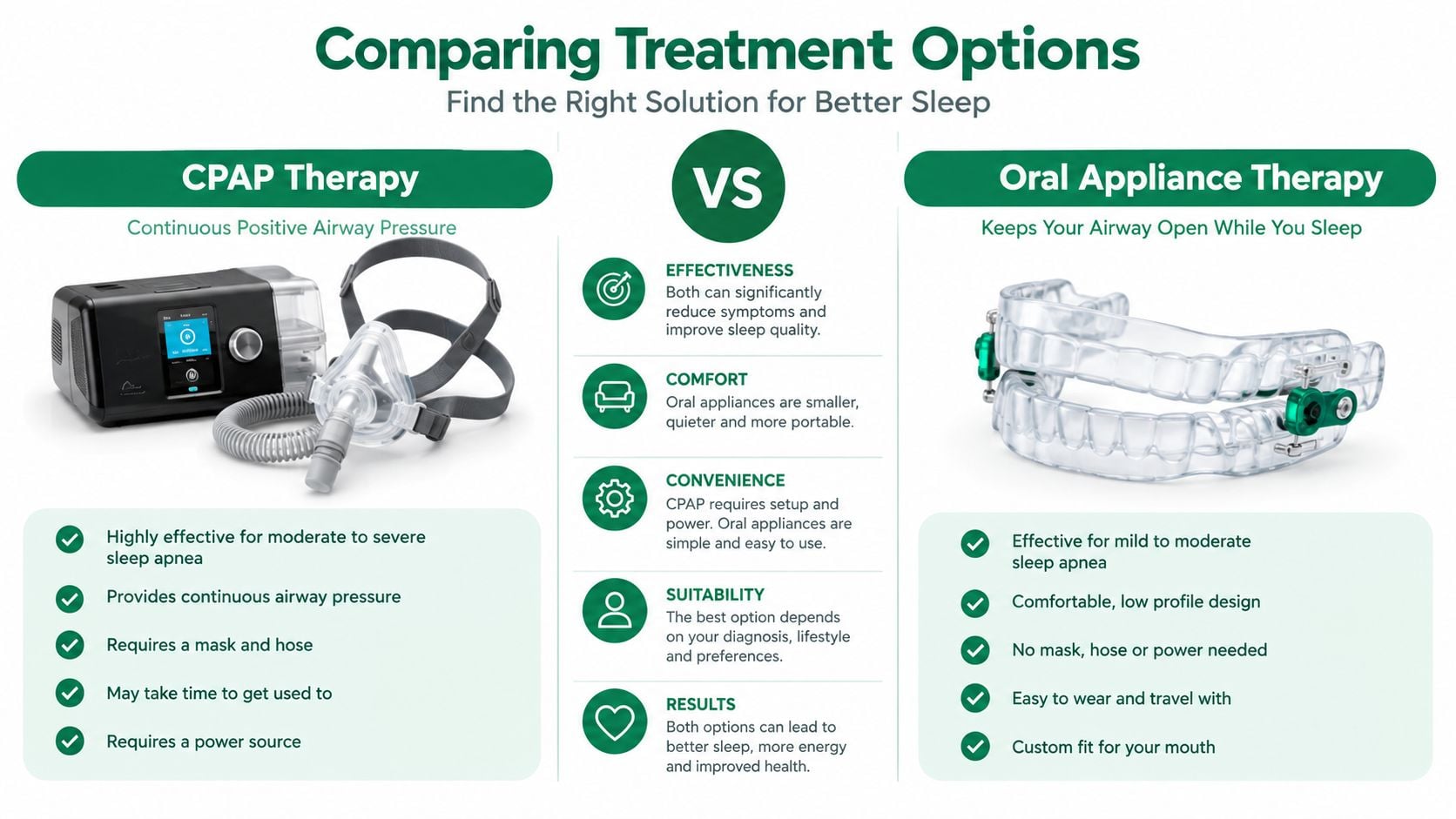
CPAP is a standard treatment for obstructive sleep apnea, and it uses positive air pressure to help prevent airway collapse during sleep. Many people benefit from it, and it remains an important option. Some patients, though, have trouble tolerating the mask or the nightly routine, which is why other therapies are also part of modern care.
Oral appliance therapy is a recognized option for some people with mild to moderate obstructive sleep apnea, and it may also help some patients with severe sleep apnea who can't use CPAP (Mayo Clinic). These custom devices move the jaw forward to help keep the airway open and may also reduce snoring (Mayo Clinic).
That anatomical idea matters in dental sleep medicine. If the jaw sits too far back, the tongue and soft tissues can crowd the airway more easily during sleep. Repositioning the jaw may create more room without relying on a pressurized mask.
Adjunctive care can also support the airway when appropriate. For some patients, snoring therapy, tongue-tie assessment, cold laser therapy, and coordinated oral function work may fit into a conservative plan. Pain and Sleep Therapy Center in Newark and Bryn Mawr provides dental sleep medicine services, including oral appliance therapy and home-based sleep testing, as part of that kind of root-cause evaluation.
Practical rule: the best treatment is the one that matches the airway problem and that the patient can actually use consistently.
The Long-Term Health Benefits of Restoring Sleep Quality
Good sleep is more than comfort. When breathing stays steady through the night, the body gets a better chance to recover, regulate, and reset. That matters for energy, thinking, mood, and the systems that depend on consistent nighttime repair.
Why airway health affects the whole body
Sleep-disordered breathing has been linked to broader health concerns, which is one reason it's treated as more than a snoring issue. Chronic airway disruption can interfere with restorative sleep and stable oxygenation, and that can affect cardiovascular health, metabolism, and daytime function. For a deeper look at the metabolic side, this article on the link between OSA and type 2 diabetes gives more context.
The jaw and face matter here too. Patients who live with TMJ pain, head pain, or facial pain often clench or strain at night, and that tension can overlap with airway problems. A careful airway evaluation may help connect symptoms that seemed unrelated at first.
Whole-body care often works best when sleep, bite, tongue posture, and breathing are all reviewed together. That's the logic behind a multidisciplinary, conservative approach, especially for patients in Newark and Wilmington, Delaware, and Bryn Mawr and the Philadelphia Main Line who want a root-cause evaluation before considering more invasive paths. Better airway function may support better rest, and better rest often makes daily life feel more manageable.
Taking the Next Steps Toward Better Sleep
A person doesn't need to wait until symptoms become severe to ask better questions about sleep. Loud snoring, unrefreshing sleep, morning headaches, and jaw pain are all reasons to look more closely at the airway, especially when the pattern keeps repeating. An evaluation that looks at the jaw, tongue, and breathing together can make the picture much clearer.
For a simple first step, the sleep quiz can help patients think through common warning signs before an appointment. That kind of screening doesn't replace diagnosis, but it can make the next conversation more focused and productive.
People in Newark, Wilmington, Bryn Mawr, and the Philadelphia Main Line can seek a specialized evaluation that brings dental sleep medicine and craniofacial pain together under one roof. The goal is to find the cause, review the airway carefully, and build a practical plan that respects conservative, non-invasive options first.
Pain and Sleep Therapy Center evaluates sleep apnea, snoring, TMJ-related pain, and tongue-tie concerns with a root-cause approach that looks at the airway, jaw, and oral structures together. If sleep feels broken or unrefreshing, visit Pain and Sleep Therapy Center to Request an Appointment and take the next step toward clearer breathing and better rest.