Can a jaw click for years without being locked, while another jaw suddenly won't open after a yawn? Yes. “Jaw lock” describes a movement problem, not one diagnosis, and the cause depends partly on what the jaw is doing: getting physically blocked, tightening, becoming inflamed, or moving in response to abnormal muscle signals.
Some causes are temporary, while others need prompt evaluation. A brief catch that releases is different from a jaw that stays stuck open or closed, and neither pattern can be diagnosed reliably by sound or sensation alone.
Table of Contents
- Five Cause Groups Behind Jaw Lock
- How a Catch, Click and True Lock Differ
- Mechanical Causes in the Joint Itself
- Muscular and Habit-Related Causes
- Dental and Procedure-Related Causes
- Inflammatory, Infectious and Neurologic Causes
- When Jaw Lock Needs Urgent Care and Your Next Step
Five Cause Groups Behind Jaw Lock
What is stopping the jaw from moving: a physical block, tight muscles, inflamed tissue, or abnormal movement signals? These patterns group the possible causes, but they do not identify a diagnosis. A clinician considers how the jaw moves along with pain, swelling, and changes in the bite.
| Cause group | What may be happening | Common examples |
|---|---|---|
| Mechanical | Something in or around the joint blocks or shifts its movement, like a door catching on its frame. | Disc displacement without reduction, condylar erosion, dislocation, ankylosis |
| Muscular | Chewing muscles tighten or spasm, much like a hand gripping too firmly and struggling to relax. | Clenching, grinding, muscle spasm, heavy habitual chewing |
| Dental | Pain, swelling, or stretching near a tooth or gum makes opening uncomfortable, as tenderness can limit movement around a sore area. | Partially erupted wisdom tooth, third-molar extraction, anesthetic injection, long dental procedures |
| Inflammatory and infectious | Inflammation or infection affects the joint or nearby tissues, like swelling that leaves less room for movement. | Inflammatory arthritis, lupus, systemic sclerosis, peritonsillar abscess, tetanus |
| Neurologic | Disrupted movement-control signals can trigger clenching or spasm, like a muscle receiving a mistaken command. | Oromandibular dystonia, medication-related movement disorders |
These groups can overlap. An infected, swollen area may cause nearby muscles to tighten protectively, while a joint problem can also leave muscles sore. The same symptom can therefore arise through different pathways, and matching a pattern does not confirm its cause.
A brief catch that releases is different from movement that stays restricted. A jaw that remains stuck open, symptoms after an injury, or swelling with fever calls for prompt attention rather than further pattern-matching. The next step is to describe what the jaw is doing and have a clinician assess the cause.
How a Catch, Click and True Lock Differ
Is your jaw making a sound, briefly sticking, or staying stuck? Those patterns describe different kinds of movement, much like a door that squeaks, catches for a moment, or will not open. They can help you explain what you notice, but a clinician needs to assess the cause.
A click is a sound during jaw movement. A cushioning disc may shift as the joint moves, but clicking without pain or restricted opening does not necessarily mean the jaw is locked. A catch is a brief sticking sensation that releases on its own, allowing the mouth to open fully again. A true lock keeps movement restricted; opening may also pull the jaw toward one side. For more on sounds without lasting restriction, read why a jaw may keep popping.
| Pattern | What you notice | Often points toward | Next step |
|---|---|---|---|
| Brief click or catch | A sound or short sticking sensation that clears, followed by full opening | Disc movement or a painless click | Track how often it happens and whether it changes |
| Closed lock | Opening stays limited, often with pain and a pull toward one side | Disc displacement without reduction | Clinical examination, sometimes with imaging |
| Progressive, painless restriction | Opening gradually becomes smaller, with little pain | Ankylosis or advanced structural disease | Prompt imaging-based evaluation; ankylosis may limit opening to below about 3 cm |
| Sudden stuck open | Jaw remains wide open after a yawn, large bite, or dental visit | Mandibular dislocation | Urgent care; don't force the jaw back yourself |
| Painful restriction with swelling or fever | Increasing swelling, warmth, fever, or tenderness | Infection, abscess, or inflammation | Same-day care; emergency care for fever with facial or neck swelling or trouble swallowing |
| Tight jaw with sore muscles | Tender chewing muscles, morning soreness, or symptoms that worsen with tension | Muscle spasm or clenching | Routine evaluation |
| Involuntary clamping or spasm | Jaw clamps or twists without chewing, sometimes alongside other movements | Neurologic causes such as dystonia | Medical or neurology evaluation |
A clinician may ask how long the restriction lasts, how far the mouth opens, and whether it shifts to one side. They may also ask about pain, swelling, warmth, fever, injury, a recent dental visit, a bite change, numbness, or involuntary movements. If it feels comfortable, you can note the gap between your upper and lower front teeth with a ruler or stacked fingers. Do not force your mouth wider.
The Population Study of Jaw Catching and Locking reported annual rates of 1.1% in women and 0.5% in men, and found TMD was most common among adults aged 20 to 50. The population study of jaw catching and locking examined catching and locking over time. These group patterns cannot identify the cause for an individual, and jaw restriction should not automatically be attributed to stress.
Practical rule: Notes about when and how your jaw moves can help you describe symptoms to a clinician. They cannot determine the diagnosis. Do not force the joint or try to pop it back into place.
Mechanical Causes in the Joint Itself
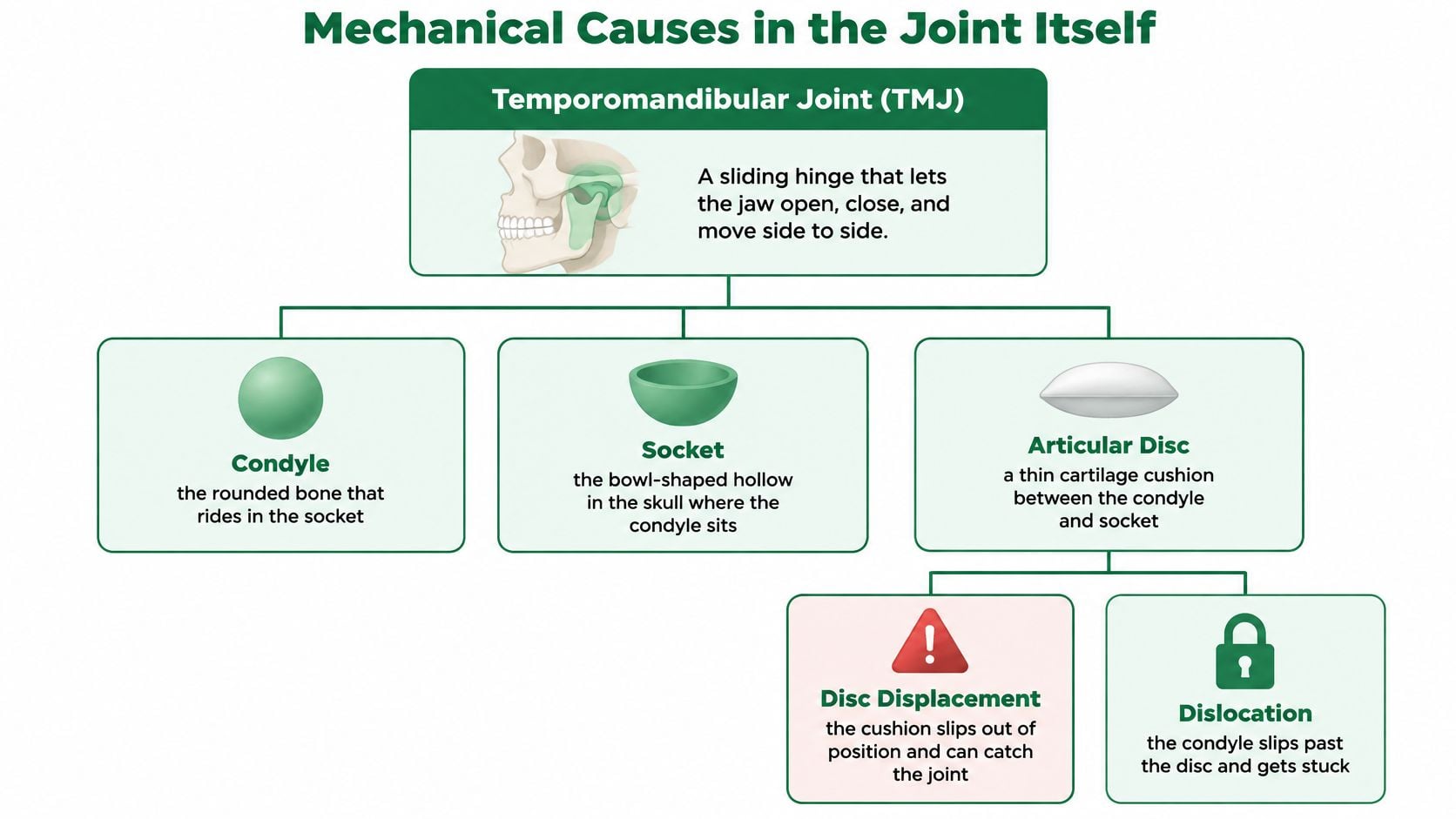
Could a physical change inside the jaw joint be limiting its movement? The TMJ contains a rounded bone, the condyle, and a thin cartilage cushion called the disc. As the mouth opens, the condyle glides forward and the disc moves with it. A problem in this motion can block opening, while changes to bone or joint structure can make movement stiff.
When the disc blocks movement
If the disc slips forward and does not return as the mouth opens, it may obstruct the condyle like a doorstop. This is disc displacement without reduction, also called a closed lock. Opening may stop partway, the jaw may shift toward the affected side, or movement may feel stiff and painful.
The clinical study on disc displacement describes jaw locking related to a displaced disc and discusses possible contributors, including clenching or grinding, repeated joint loading, ligament strain, trauma, and age-related tissue changes. The clinical study and background on disc displacement Clicking alone does not necessarily mean the jaw is locked. The key difference is whether movement is actually restricted. Several factors can overlap, and a single cause may not be identifiable.
When bone or joint structure changes
Osteoarthritis can wear down the surfaces that bear force in the joint. The resulting changes may make movement less smooth, and imaging research links condylar erosion with painful closed-lock presentations.
Ankylosis is a different structural problem. Fibrous or bony fusion can make the joint progressively stiff, often with relatively little pain. Mouth opening may become markedly restricted. When fusion is present, forcing the mouth open generally will not resolve the restriction and may cause harm.
When the jaw gets stuck open
A dislocation occurs when the condyle moves out of its usual socket. It can happen after a wide yawn, a large bite, vomiting, or a dental procedure. The mouth may remain open and be difficult or impossible to close. A suspected dislocation needs prompt professional assessment.
A clinician may use imaging to investigate structural causes. MRI can evaluate disc position and movement; other imaging may be chosen when bone changes or injury are concerns. A catch or click without restricted opening is different from a true lock, and an examination helps distinguish them.
Muscular and Habit-Related Causes
Could muscle tension make the jaw feel locked even when the joint is not physically blocked? Yes. The chewing muscles work like a clenched fist: when they remain tight or spasm, opening can feel restricted, much like a hand that has not relaxed.
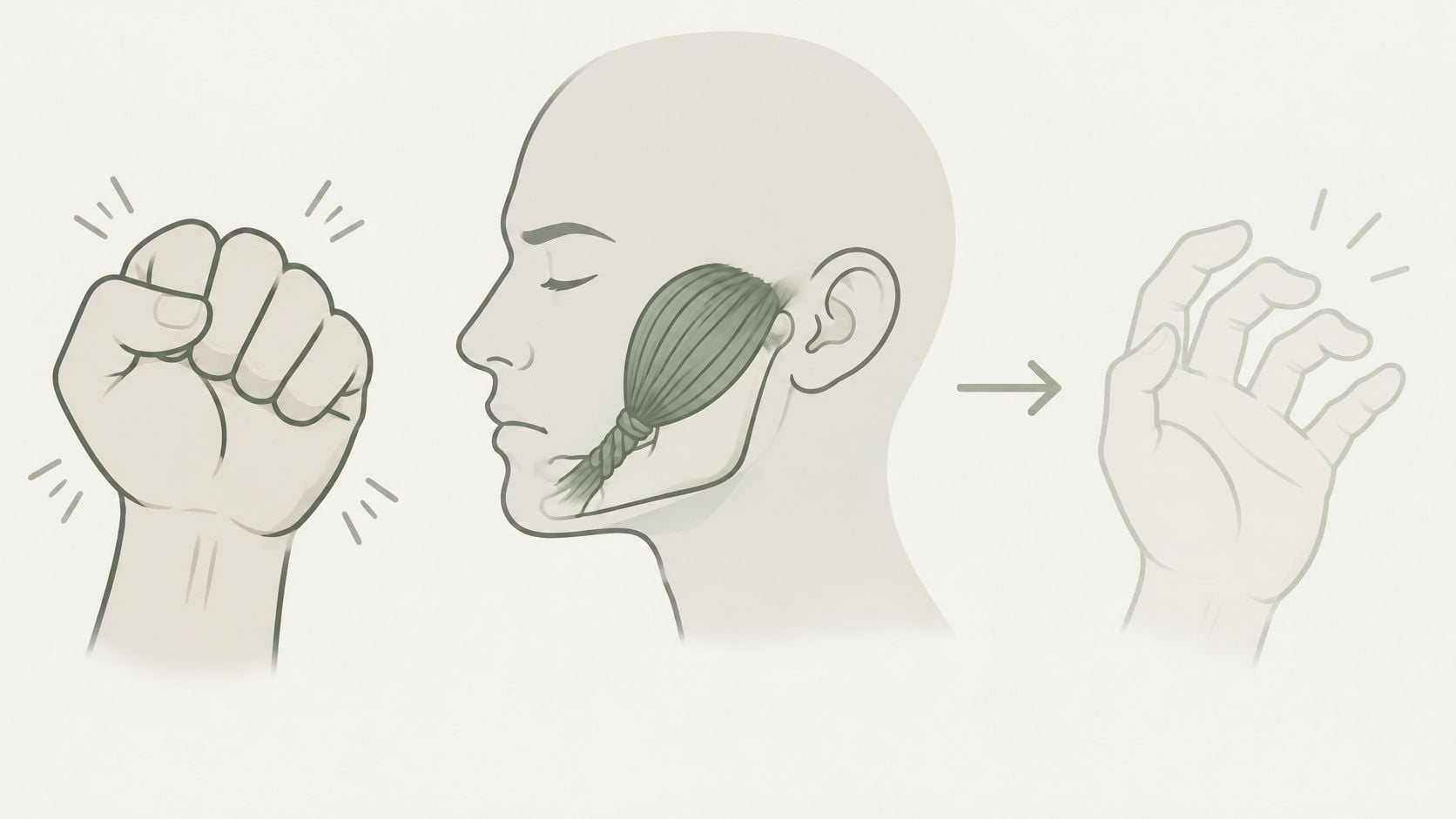
Repeated clenching or grinding, gum chewing, nail biting, and stress can overwork the muscles around the jaw. Muscle strain and spasm can accompany TMJ symptoms, and extended use may leave the muscles tired and sore. This tightness can feel like a blockage, though the cause may be muscular rather than a joint physically stopping movement.
Muscles can also tighten to protect a painful joint, a response called guarding. The jaw's restriction may then involve muscle tension, a joint problem, or both. Clinicians assess how the joint moves alongside muscle tenderness, rather than relying on one symptom to identify the cause.
Clues that can help describe muscle symptoms
Tender cheek or temple muscles, soreness on waking, and headaches near the temples can occur with muscle-related symptoms. Notice whether the jaw feels tired when you wake, or more uncomfortable after periods of clenching. These patterns can help a clinician understand what you have been experiencing, but they do not establish the cause on their own.
A normal-looking bite does not rule out muscle involvement. The relationship between bite position and TMD is weak and inconsistent, so an uneven bite should not automatically be treated as the explanation for a jaw catch or lock.
A clinician can assess whether reducing jaw-straining habits or using stress-management approaches may help. If you clench at night, read these ways to address jaw clenching at night. Avoid forcing the mouth open or relying on self-stretching to decide whether the problem is muscle tightness or a joint blockage.
Dental and Procedure-Related Causes
Dental problems can make opening painful or restricted when tissue is inflamed, swollen, or irritated. The jaw may feel tight because the muscles are guarding a sore area, much like they brace around an injury. A dental cause and a procedure-related cause can produce similar symptoms, though the underlying problem may differ.
A partially erupted wisdom tooth can leave a gum flap where food and bacteria collect. The resulting inflammation, called pericoronitis, may make opening difficult or painful. A dentist can examine the tooth and nearby gum to identify inflammation or infection.
After a procedure
Trismus means difficulty or inability to open the mouth. It can follow a third-molar extraction, an anesthetic injection into a muscle, or irritation from other dental treatment. In many cases, post-procedure trismus eases over time. More severe tissue injury can leave restriction lasting longer. Persistent limitation may also have causes such as infection, surgery, tumors, radiation treatment, or connective-tissue disease, as described in the review of trismus causes.
A long dental visit with the mouth held open can tire or stretch jaw muscles and ligaments, much like holding any joint in one position. If the joint moves too freely, opening very wide may also contribute to dislocation. A clinician can assess whether the jaw is tight from muscle strain or appears stuck open.
Tooth infection may spread into surrounding tissue, with pain and swelling that limit movement. The key dental-specific clue is the area around the tooth: a clinician can check for infection and determine whether swelling is restricting the jaw.
A change in the bite after dental work matters when the teeth no longer meet as before, such as a new open bite, or when the jaw shifts to one side during opening. These changes need assessment alongside the treated area, tooth position, and jaw movement. New or worsening restriction, especially after recent trauma, should also be evaluated rather than tested by repeated stretching.
Inflammatory, Infectious and Neurologic Causes
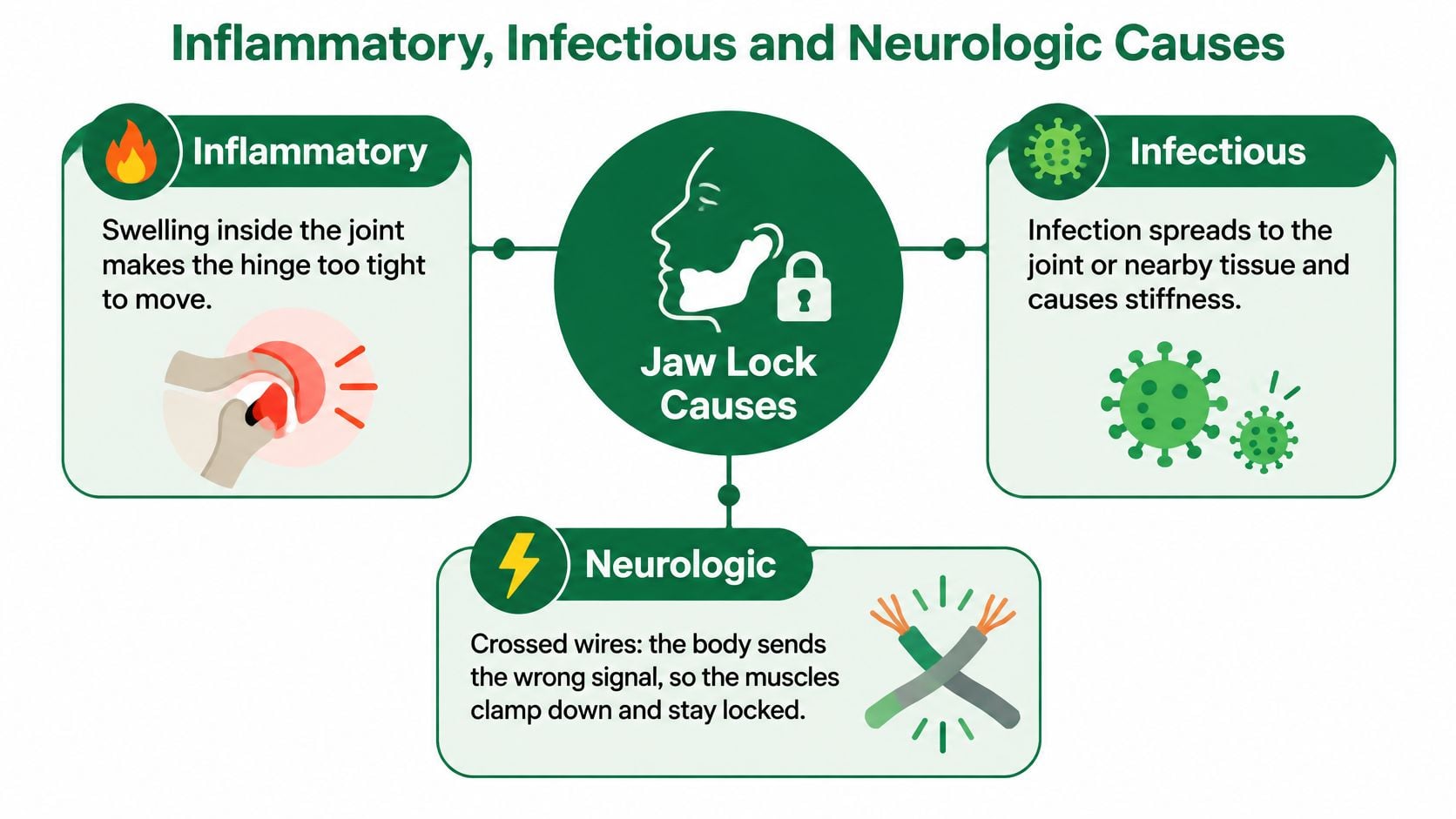
Could a jaw that feels tight or stuck be inflamed, infected, or having trouble coordinating movement? These causes affect the jaw in different ways. Inflammation can make movement sore and restricted, infection may irritate nearby tissues, and neurologic conditions can trigger involuntary muscle activity.
Inflammation and infection
Rheumatoid arthritis and other forms of arthritis can affect the jaw joint. Lupus and systemic sclerosis may affect tissues throughout the body and sometimes limit jaw movement. Other symptoms, such as pain in other joints or changes in the skin, may occur too. These patterns can give a clinician useful context, but they cannot identify the cause on their own.
Infection can make opening the mouth difficult as nearby tissues become irritated or swollen. A peritonsillar abscess, a collection of pus near a tonsil, may restrict opening. Tetanus is a bacterial illness that can cause muscle stiffness and spasms. Its common name, “lockjaw,” reflects one possible effect, and suspected tetanus needs emergency care. Infection around a partially erupted wisdom tooth is discussed in the dental section above.
Movement-control problems
Oromandibular dystonia is a movement disorder that can cause involuntary jaw clenching, opening, or shifting. Some medication-related movement disorders can also trigger unusual jaw movements or spasms. The jaw may move without a person intending it to, sometimes alongside other involuntary movements. In this pattern, the difficulty is less about a physical blockage and more about the muscles receiving or responding to movement signals.
Genes, stress, and differences in pain perception can affect whether symptoms develop or continue, but they do not establish the cause of an individual episode. Facial pain may also come from a different source, such as trigeminal neuralgia. Read about how TMJ symptoms differ from trigeminal neuralgia to understand how the symptoms can overlap and differ. A clinician can assess the pattern and consider the possibilities without expecting you to diagnose yourself.
When Jaw Lock Needs Urgent Care and Your Next Step
Could a jaw that catches need urgent care, or can it wait for a routine appointment? The key is what else is happening and whether the jaw remains stuck. Trouble breathing or swallowing, fever with facial or neck swelling, suspected tetanus, or a locked jaw after a fall or injury calls for immediate medical attention. A stiff jaw with spreading muscle spasms or a stiff neck is urgent, particularly after a wound.
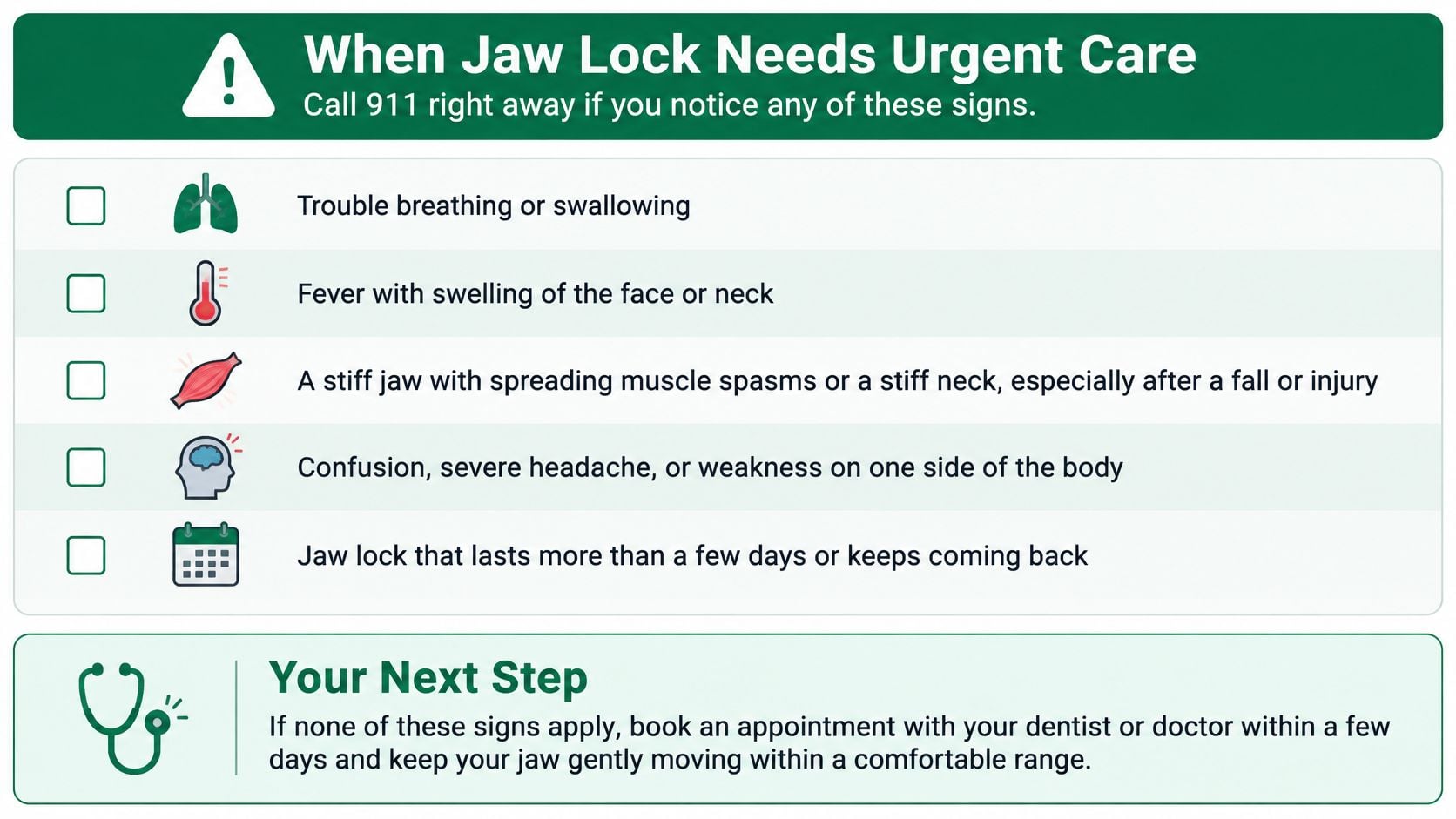
Use this guide to choose where to seek help. It cannot identify the cause; a clinician can assess what is keeping the jaw from moving.
| Situation | Where to go | How soon |
|---|---|---|
| Trouble breathing or swallowing, fever with facial swelling, or suspected tetanus | Emergency department or emergency services | Immediately |
| Jaw remains stuck open, or suddenly locks after a fall or injury | Dentist, oral surgeon, or physician; use emergency care for severe symptoms | Same day |
| Recurrent closed lock or clicking that starts to limit opening | TMJ-trained clinician | Schedule a visit soon |
| Gradual, painless loss of opening over weeks or months | Clinician for evaluation, with imaging if needed | Schedule promptly |
| Brief catch that fully resolves, with no other symptoms | Track it and mention it at a dental visit | Routine |
A brief catch is like a door that sticks momentarily but opens again. A true lock remains restricted, or the jaw stays open, and needs assessment. If the pattern changes, lasts longer, or begins interfering with eating or speaking, arrange a visit rather than trying to force the jaw into position.
Pain and Sleep Therapy Center has offices in Newark, Delaware, and Bryn Mawr, Pennsylvania, and evaluates TMJ and craniofacial pain.
For help discussing jaw locking and conservative options, Pain and Sleep Therapy Center offers assessment at its Newark and Bryn Mawr offices. Request an Appointment or Take our Sleep Quiz, or call the Newark office at (302) 239-1757.