The first sign is often small. A jaw pops during lunch, clicks on a yawn, or makes a sound that turns a normal bite into a moment of worry. That sound can feel alarming, but it doesn't automatically mean something is wrong, and it also shouldn't be brushed off without looking at the rest of the pattern.
Why does my jaw keep popping is a question that needs a symptom-by-symptom answer, not a guess. Some jaw sounds are common and painless, while others point to irritation, overload, or a temporomandibular disorder, often called TMD. The useful question is not only, “What does the sound mean?” It's also, “What else is happening with the jaw, the bite, and the muscles around it?”
Table of Contents
- A Familiar Moment With Your Jaw
- How the Jaw Joint Actually Works
- Common Reasons Your Jaw Keeps Popping
- Symptoms That Change the Answer
- What an Evaluation With a TMJ Clinician Looks Like
- Conservative Care Options Worth Considering First
- Your Next Step Toward Answers and Relief
A Familiar Moment With Your Jaw
A person is chewing, talking, or opening wide for a bite of food, and a sharp little pop interrupts the moment. Maybe it happens once and fades. Maybe it keeps coming back at dinner, during a yawn, or when the jaw shifts from one side to the other.
That kind of experience deserves a calm look, not a panic. The same sound can mean simple joint motion in one person and a broader jaw problem in another, so the pattern around the sound matters more than the sound by itself.
Why the same pop can mean different things
A painless pop that doesn't change how the jaw moves often behaves like a joint noise. A pop with tenderness, stiffness, locking, or pain tells a different story. The distinction is important because the jaw is a moving joint system, not a single hinge that either works or fails.
Practical rule: if the jaw still opens, closes, and chews normally, the pop is often less concerning than the symptom cluster around it.
The rest of the picture is what readers usually need most. That includes whether the jaw feels tired, whether chewing is harder, whether the bite seems different, and whether the sound is getting more frequent or more forceful. Those details help separate monitoring, routine evaluation, and prompt care.
The goal is simple, to help a reader sort a jaw pop into the right bucket without guessing. That means learning how the joint works, what usually causes the noise, and which changes mean the jaw needs a professional look sooner rather than later.
How the Jaw Joint Actually Works
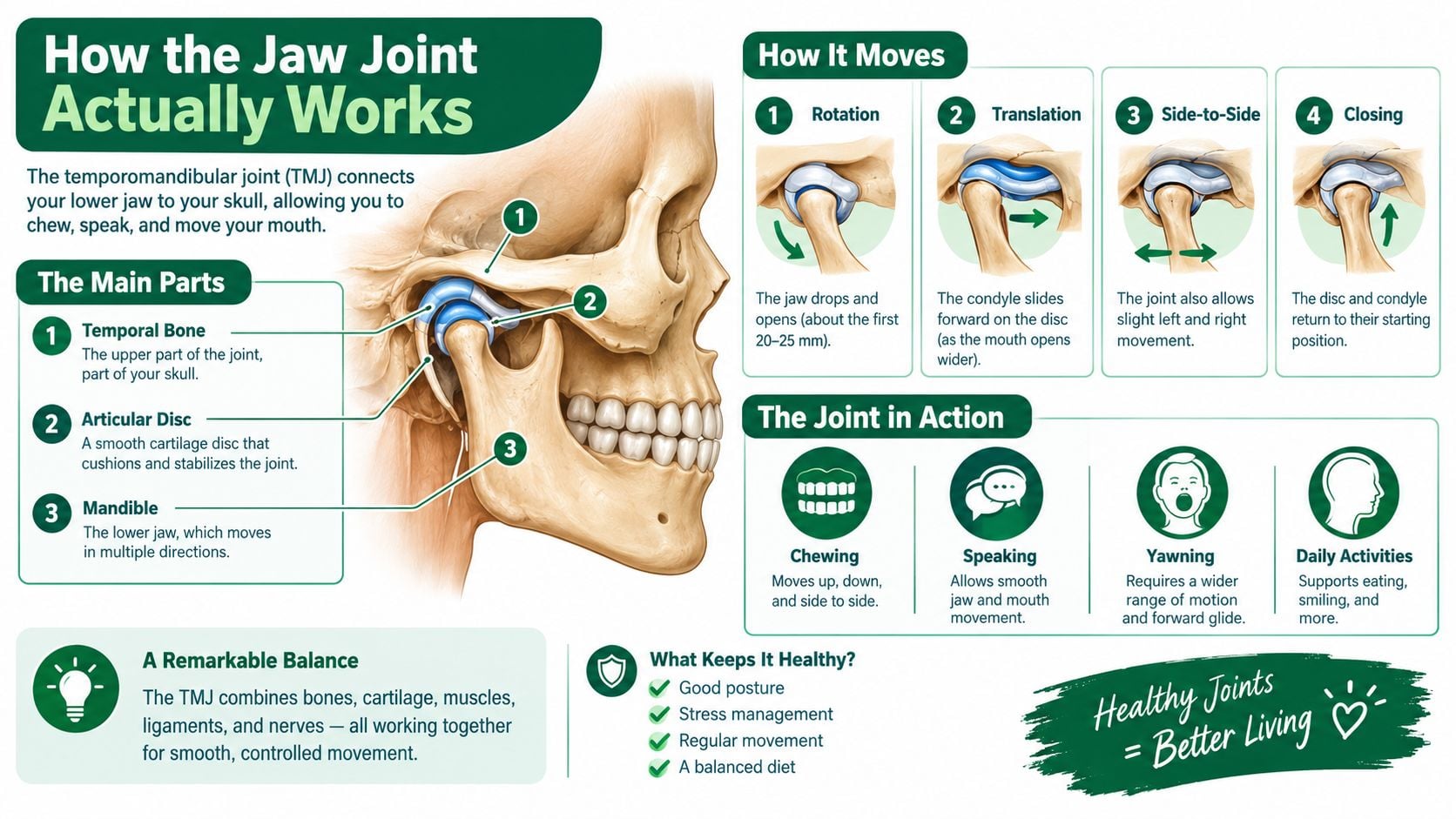
The temporomandibular joint, or TMJ, is the joint that connects the lower jaw to the skull. It doesn't work like a simple door hinge. It also glides, which is why chewing, speaking, and yawning can happen smoothly when everything is coordinated.
The moving parts in plain language
Inside the joint is a small cushion called the articular disc. It acts as a padded washer between two moving parts. The lower jaw's rounded end is called the mandibular condyle, and the disc helps that round end move without rubbing in the wrong place.
A click often happens when the disc is slightly out of sync and then slips back into position during opening or closing. That brief recapture is one of the most common mechanical explanations for jaw popping, and it helps explain why a person can hear a pop even when there's no obvious injury.
Clicking, popping, and crepitus
People use different words for jaw sounds, but the terms matter. Clicking usually means a sharper single sound. Popping is similar and often used in everyday speech. Crepitus is different, it sounds more like grinding or crackling and can suggest rougher joint movement.
A jaw that makes a sound but still moves normally can be a benign joint noise, especially when it's painless. NIDCR says painless clicking or popping in the temporomandibular joints is common and generally considered normal, and it usually doesn't require treatment (NIDCR TMJ information).
A joint sound is not the same thing as joint damage.
That's the central idea. The body can make noise without being broken, but the sound becomes more meaningful when it comes with pain, locking, limited opening, or chewing trouble.
Common Reasons Your Jaw Keeps Popping
Repeated popping often starts with disc displacement with reduction, which is a clinical way of saying the disc shifts out of place and then slips back into place as the jaw opens or closes. That motion can make one or even two distinct sounds, and it fits the classic “pops but still moves” pattern.
Disc movement is common, but not the whole story
Disc motion explains a lot of jaw popping, but it doesn't explain every case. Bruxism, which means teeth grinding or clenching, can add pressure to the joint and make sounds more frequent. So can long chewing sessions, repeated gum chewing, or opening very wide during a yawn or large bite.
A simple analogy helps here. If a drawer rail is slightly off track, it may still open, but it won't feel smooth every time. The jaw can act similarly when the disc and condyle are not gliding in perfect sync.
Overload, injury, and wear can add noise
Clenching and grinding can overload the joint. Trauma can disturb the disc or the condyle. Degenerative change, including osteoarthritis, can roughen the joint surfaces and create more crepitus than a clean click. Those causes don't always happen alone, either, because jaw symptoms are often multifactorial.
That matters because many people want one simple culprit, like a bad bite. Current evidence does not support the idea that bite alignment by itself explains most TMD, so irreversible treatments based only on tooth position can miss the driver behind the symptoms. Conservative thinking is safer than assuming the teeth are the whole story.
For readers looking for another plain-language overview of TMJ patterns, Winn Smiles TMJ treatment guide gives a straightforward overview of jaw symptoms and common management ideas.
There's also a practical reason to pay attention to habits. One common trigger can be simple jaw overuse, including wide opening and repeated chewing motions. For readers who notice a pop during yawning or opening wide, the topic of jaw locking when yawning is worth understanding because a pop that stays painless is a different issue from a jaw that begins to catch or lock.
Symptoms That Change the Answer
Jaw popping becomes more important when the symptom pattern changes. A painless, stable pop is one thing. A pop with pain, stiffness, or locking is another. The most useful way to think about it is in three tiers.
Tier 1, monitor
This is the pattern many hope for. The jaw pops or clicks, but it opens and closes normally, chewing still works, and there's no pain or locking. That pattern often fits a benign joint sound and can be watched over time.
Tier 2, schedule an evaluation
This tier includes popping with tenderness, chewing discomfort, morning stiffness, headaches, ear-area fullness, or occasional catching. The sound may still come and go, but the jaw is no longer just making noise, it's starting to act irritated or overworked. For a broader look at overlapping jaw pain patterns, TMJ or trigeminal neuralgia can help readers understand why facial pain sometimes gets mistaken for a joint-only problem.
Tier 3, seek care soon
This tier includes sudden locking, inability to open or close normally, severe restriction, swelling, fever, numbness, post-traumatic onset, or a rapidly changing bite. Those changes deserve prompt assessment because they suggest more than a harmless click.
| Jaw Popping Symptom Tiers at a Glance | ||
|---|---|---|
| Tier | Examples | Typical Next Step |
| Monitor | Painless clicking, full opening, no locking | Watch for changes |
| Schedule an evaluation | Tenderness, chewing pain, headaches, intermittent locking | Book a routine visit |
| Seek care soon | Sudden lock, trauma, swelling, numbness, major bite change | Prompt professional assessment |
NHS-style referral guidance and patient education often separate stable clicking from function-limiting symptoms for this reason. The sound alone doesn't predict the future, but changing function tells a clearer story.
What an Evaluation With a TMJ Clinician Looks Like
A TMJ evaluation usually starts with the story behind the popping. A clinician asks when it began, whether it hurts, what foods make it worse, whether the jaw locks, and whether headaches, clenching, or sleep problems are part of the picture. That history matters because the same sound can come from different kinds of strain.
What gets checked in the room
The next step is usually a hands-on exam. The clinician watches how the jaw opens and closes, checks whether the movement is even, feels the joint and chewing muscles, and looks for tenderness or tightness. Range of motion is measured, and bite changes or bruxism signs may be checked as well.
A good TMJ exam treats the noise as a clue and searches for the driver behind it.
If the diagnosis is unclear or conservative care is not helping, imaging may enter the picture. AAFP guidance notes that MRI is the imaging method better suited to evaluating the disc when the diagnosis is uncertain or conservative care fails (AAFP on temporomandibular disorders).
Why the evaluation goes beyond the joint sound
A clinician trained in craniofacial pain often looks at overlapping contributors, not only the jaw joint. Headaches, sleep quality, muscle tension, and daytime clenching can all feed the same symptom pattern. In a practice setting like Pain and Sleep Therapy Center, that broader evaluation can be part of the workup when jaw symptoms sit next to sleep or facial pain concerns.
The value of this visit is that it creates a baseline. It shows whether the jaw sound is likely a stable joint noise, a muscle overload issue, or a problem that needs more structured care.
Conservative Care Options Worth Considering First
A jaw that pops often makes people jump straight to treatment, but the first question is simpler. Does the joint sound seem linked to strain, or has it started to affect comfort and function? Conservative care starts with reversible steps because irritated muscles, habits, and overworked joints often calm down when the load is reduced.

Daily habits that can calm the joint
During a flare-up, smaller bites, softer foods, and avoiding very wide opening can give the jaw a break. Keeping the teeth slightly apart when you are not eating may also reduce clenching. Mild heat or gentle stretching can help some people feel less tight, as long as it stays pain-free.
These changes work like lowering the volume on a noisy speaker. They do not fix every cause, but they can reduce repeated stress enough for the tissues to settle.
Professional conservative care
If symptoms keep returning, a clinician may suggest a stabilization orthotic, physical therapy, or other pain-modulation strategies. Some care plans also include cold laser therapy, depending on the findings and the treatment goal. The point is to match the approach to the pattern, not to guess.
For readers who want a closer look at stepwise management, restorative care for TMJ offers another overview of conservative treatment ideas. Inside Pain and Sleep Therapy Center, how to treat TMJ explains how a root-cause approach may look in practice.
NIDCR recommends starting with simple approaches and discussing risks and alternatives before irreversible TMD interventions. That conservative-first approach fits the logic of jaw popping: begin with the least aggressive option that can reasonably reduce strain, then reassess if the sound continues or the symptoms change.
Your Next Step Toward Answers and Relief
The simplest way to use this information is to sort the jaw pop into one of three buckets. If it's painless and stable, monitor it. If it comes with tenderness, headaches, chewing trouble, or intermittent locking, schedule an evaluation. If there's sudden locking, swelling, trauma, numbness, or a changing bite, seek care soon.
What to notice today
A useful note list is short and specific. Record when the jaw pops, whether it hurts, whether it locks, whether chewing feels off, and whether mornings are worse than afternoons. Then add anything else that seems linked, such as headaches, tiredness, snoring, mouth breathing, or disturbed sleep.
Those extra details matter because jaw symptoms don't always live alone. A craniofacial and dental sleep evaluation can sometimes uncover clenching, airway strain, or sleep-disordered breathing patterns that make jaw loading worse over time. For adults in Newark, Wilmington, Bryn Mawr, and along the Philadelphia Main Line, that broader picture can help guide the next step instead of chasing the sound alone.
Pain and Sleep Therapy Center provides TMJ and facial pain evaluation, oral appliance therapy for sleep apnea and snoring, tongue-tie care, and conservative options such as cold laser therapy. For a reader who wants root-cause care rather than guesswork, the next step is to get the symptom pattern reviewed by a clinician who can sort the jaw sound from the problem driving it.
Pain and Sleep Therapy Center helps patients in Newark, DE and Bryn Mawr, PA look at jaw popping, facial pain, and sleep-related concerns through a conservative, root-cause lens. If the jaw sound is starting to change how eating, speaking, or sleeping feels, Pain and Sleep Therapy Center can help guide the next step, whether that's a routine TMJ evaluation or a sleep-focused assessment. Readers can also Request an Appointment or Take our Sleep Quiz, and Newark patients can call (302) 239-1757 for direct scheduling.