
A person can go years thinking their tongue is just “how it is.” Maybe the tip never quite reaches the roof of the mouth, maybe licking an ice cream cone takes a small head tilt, or maybe certain sounds still feel awkward on the first try. Those everyday moments are often what bring adults to ask about tongue tie in adults symptoms, because the problem is usually not how the frenulum looks, it's how the tongue works.
Adult tongue-tie, also called ankyloglossia, is a functional restriction caused by an unusually short, tight, or poorly positioned lingual frenulum, the small band of tissue under the tongue NIH reference. In adults, the key question is not, “Does it look tight?” The better question is, “What can the tongue do, and what can't it do without compensation?”
Table of Contents
- When a Small Band of Tissue Changes Daily Life
- What Adult Tongue-Tie Means
- Everyday Tongue-Tie Symptoms Adults Notice
- How Clinicians Measure Restricted Tongue Mobility
- Where Tongue-Tie Meets Sleep, Breathing, and Posture
- Myths Worth Letting Go Before Deciding Anything
- What a Thoughtful Adult Evaluation Looks Like
- Questions Adults Ask and Where to Go Next
When a Small Band of Tissue Changes Daily Life
A lot of adults never remember a moment when the tongue “became” a problem. They just notice a pattern, certain foods feel awkward, speech takes more effort, or the jaw keeps doing extra work to help the tongue out. That pattern can stay hidden for years because people adapt without thinking about it. A small head tilt, jaw thrust, or lip bracing can mask the restriction long enough that nobody questions it early.
Adult tongue-tie often shows up as a string of small frustrations instead of one dramatic symptom. A person may avoid licking the lips in public, have trouble reaching the back teeth with the tongue, or feel worn out after a long conversation because the tongue is working harder than it should. Some adults also notice soreness under the tongue or repeated cuts where the lower teeth rub the area. NIH reference
One adult may only learn about the issue during a dental cleaning, when the dentist asks them to lift the tongue and the motion looks limited.
Practical rule: if the tongue can only do its job by borrowing help from the jaw, neck, or lips, function deserves attention.
Why it often goes unnoticed
Children and adults can compensate in different ways, but the result is the same, the restriction can stay hidden. Some people never develop obvious speech issues. Others only feel “normal” because they have always used workarounds.
That is why this topic needs a functional lens, not a selfie or a quick glance in a mirror. The rest of this guide uses that same standard, measured movement first, symptoms second, and appearance last.
What Adult Tongue-Tie Means
Adult tongue-tie means the tongue cannot move normally because the lingual frenulum limits motion. The frenulum is the small band of tissue under the tongue. If it is short, tight, or attached in a way that reduces elevation, protrusion, or side-to-side movement, the tongue cannot do its job with ease.
That point matters because a visible frenulum is not the same as a functional problem. Some adults have a noticeable frenulum and normal tongue movement. Others have a less obvious restriction and still struggle with tongue lift, palate contact, or moving food around the mouth. A diagnosis should document what the tongue can do, not only how the tissue looks.
Why adults are different from infants
In infants, tongue-tie often first shows up during feeding. Adults usually describe a mechanical limit instead. They may notice trouble lifting the tongue, licking the lips, or keeping food clear of the mouth. Those complaints can feel small one by one, but together they point to a tongue that is not moving as freely as it should.
Function over looks is the better frame here. A prominent frenulum with good mobility may cause no problem. A subtle restriction with real symptoms may deserve evaluation.
A helpful exam asks what the tongue can lift, reach, and stabilize, not just what the frenulum looks like in a photo.
Adults planning an evaluation often also want to understand how a dental office visit is organized. A guide to dental operations and billing explains what happens behind the front desk. The clinical point stays the same, though, appearance alone never proves the diagnosis.
Everyday Tongue-Tie Symptoms Adults Notice
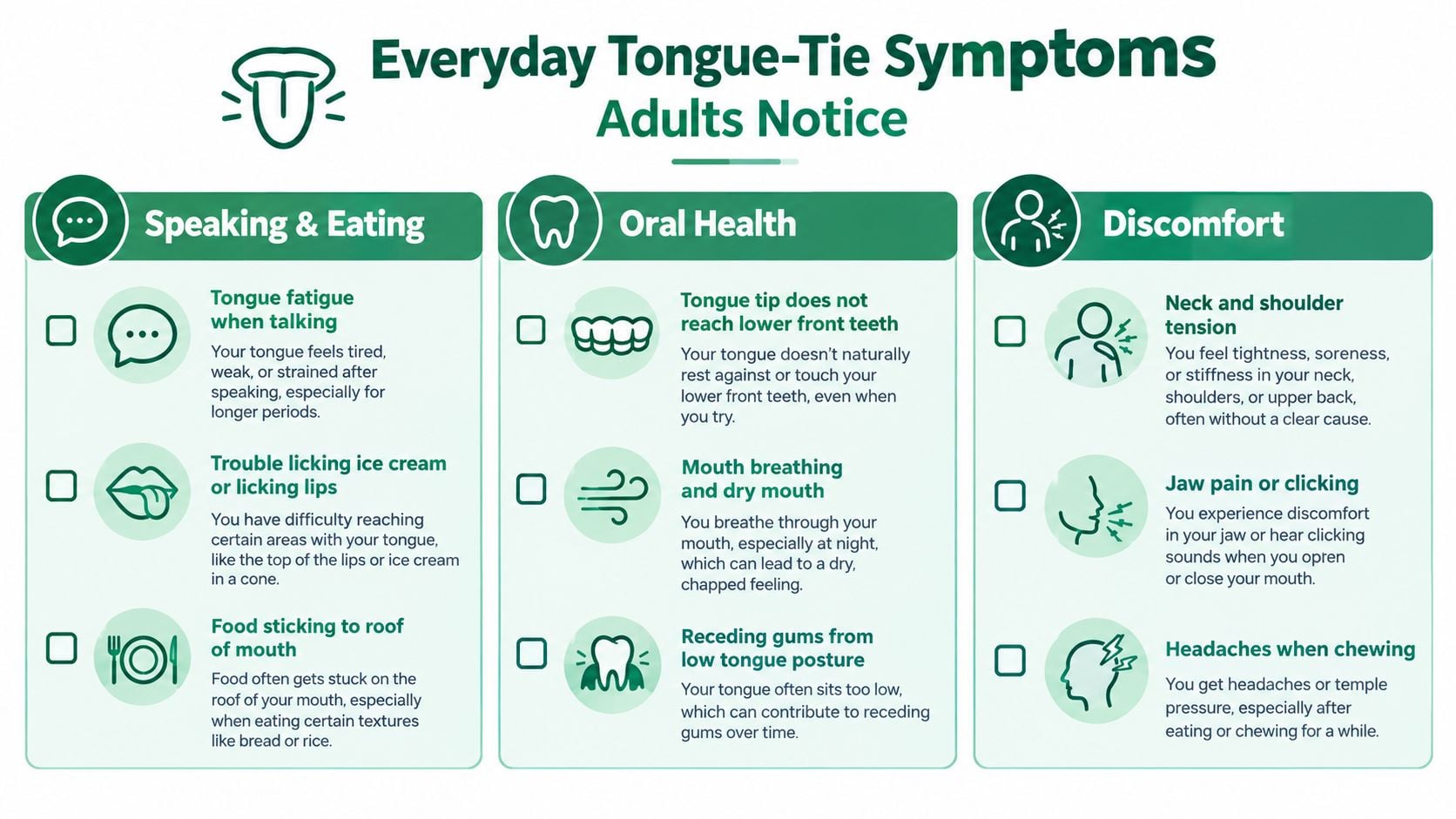
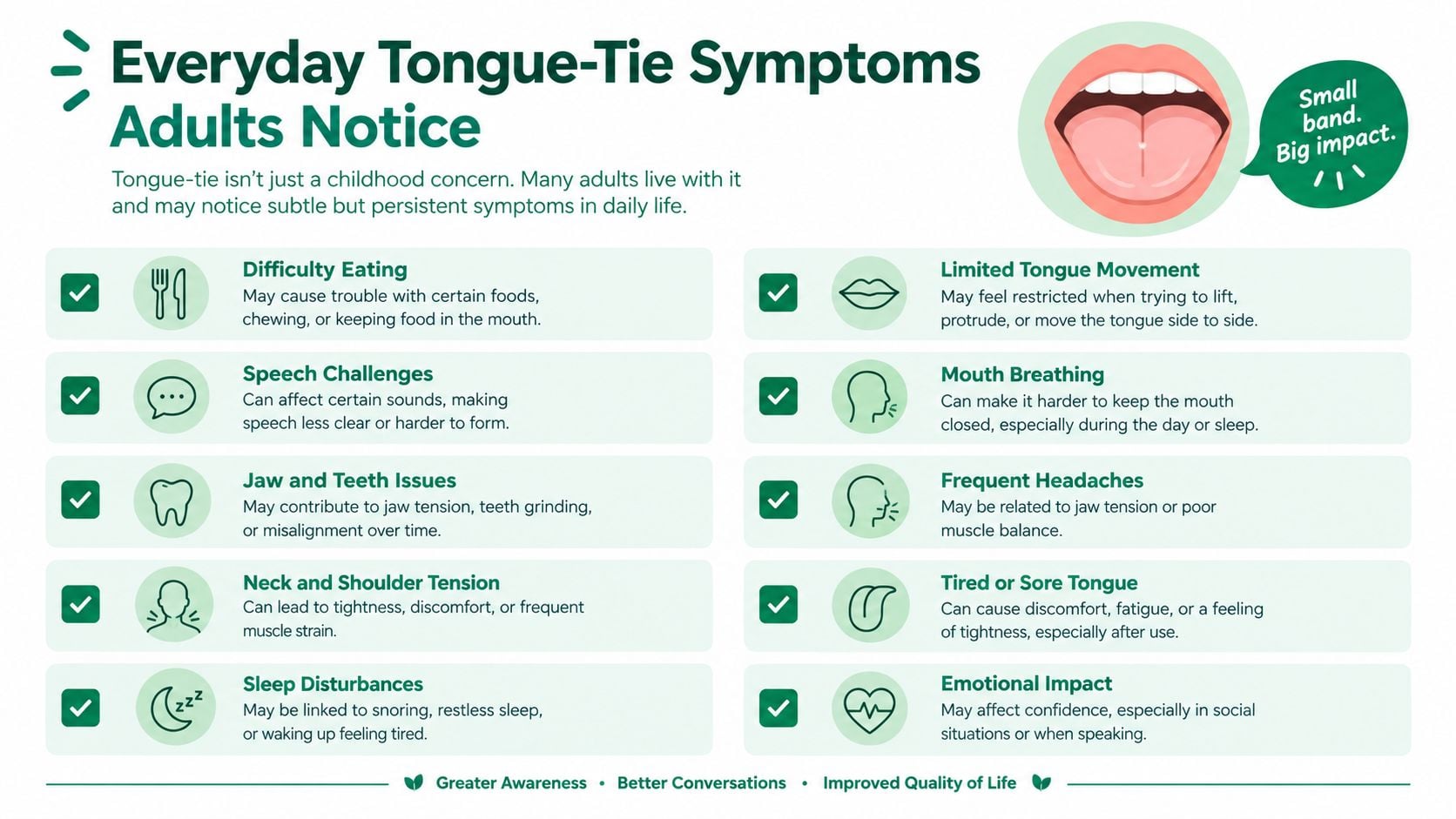
Adults usually notice tongue-tie through ordinary tasks that suddenly take more effort. A meal feels messier than it should. Speech may seem less precise. The tongue can tire before the rest of the mouth does. Those signs are useful clues, but they are not specific, since similar complaints can appear with TMJ disorders, breathing problems, or oral-motor issues.
Meals, speech, and mouth care
A restricted tongue may have trouble lifting to the palate, sweeping food from the mouth, or reaching the lips. That can make sticky foods, ice cream, or simple mouth cleaning feel awkward. Some adults also notice that certain sounds need more effort, especially when they are tired or speaking quickly.
Oral hygiene can change too. If the tongue rests low, it may not help move saliva and debris the way it should. The front of the mouth can then feel dry or less clean than expected.
Discomfort that points to compensation
Some adults notice soreness under the tongue, tension that seems to spread into the jaw, or swallowing awkwardness, especially with foods that need more tongue control. These symptoms do not prove tongue-tie on their own. They do fit a pattern of a tongue that is not moving freely and is asking other structures to do extra work.
Rule of thumb: a symptom list can start the conversation, but it cannot settle the diagnosis.
Adults often ask whether these signs prove tongue-tie. They do not. They are clues that should be checked alongside speech, swallowing, breathing, dental, and jaw findings.
How Clinicians Measure Restricted Tongue Mobility
A careful exam starts with movement, not appearance. One practical measure is the Tongue Range of Motion Ratio, or TRMR, which compares tongue elevation with comfortable mouth opening TRMR protocol. Clinicians first measure how wide the mouth opens comfortably, then measure opening again while the tongue tip reaches the incisive papilla, the small raised area just behind the upper front teeth. A second measure can look at tongue body suction against the palate.
Reading the numbers without overreading them
TRMR bands help describe mobility, but they do not prove a diagnosis by themselves. Function and symptoms still have to be checked alongside the numbers.
| TRMR Band | Numeric Range | What It Means in Practice |
|---|---|---|
| Grade 1 | Greater than 80% | Tongue motion is usually near normal range |
| Grade 2 | 50 to 80% | Mild to moderate restriction that can surface in daily tasks |
| Grade 3 | Less than 50% | Clear restriction often affects tongue elevation and control |
| Grade 4 | Less than 25% | Severe restriction may limit several oral functions |
What a solid exam should include
A clinician should also document mouth opening, protrusion, lateral movement, palate contact, and compensatory jaw or neck movement. A visual check alone can miss posterior restriction, where the tongue body struggles to lift even if the tip looks decent.
Anatomy alone never settles the question. The meaningful issue is whether the tongue can do its job in speech, swallowing, oral hygiene, and comfort.
A practical charting system also helps teams communicate findings clearly, especially in settings that need consistent records, like the guide to dental operations and billing. The clinical takeaway stays the same, measurable function comes before any procedure discussion.
Where Tongue-Tie Meets Sleep, Breathing, and Posture
Tongue mobility can matter for sleep and airway comfort because the tongue's resting position helps shape airflow. If the tongue cannot rest well against the palate, some adults notice mouth breathing, dry mouth, or snoring concerns. That said, a low tongue posture is not the same as a sleep apnea diagnosis, and it does not automatically explain restless sleep.
What the evidence suggests, and what it doesn't
Adults with restricted tongue mobility sometimes also report jaw tension, neck strain, or shoulder tightness, especially if they have spent years compensating. That pattern is plausible, but plausibility is not proof. A 2025 adult study found TMD in 49.1% and ankyloglossia in 46.7% when TRMR was used, but it did not find a significant association for anterior or posterior restriction under that measure 2025 adult study. The same study found an association only when Kotlow anatomy grading was used, which shows how measurement choice can change the conclusion.
That is why jaw pain should never be pinned on tongue-tie alone. Clinicians should also look at muscle tenderness, parafunction, bite factors, cervical strain, nasal breathing, and sleep-disordered breathing. If sleep apnea is a concern, diagnosis comes from medical evaluation and a sleep study, not from tongue appearance.
A cautious clinical lens
Important distinction: association is not causation, and a visible restriction is not proof of the cause.
Adults who want to reduce mouth breathing habits often need breathing retraining and root-cause care, not quick assumptions. A useful starting point is this guide on how to stop mouth breathing, especially when symptoms overlap with dryness, snoring, or poor sleep.
Myths Worth Letting Go Before Deciding Anything
A visible frenulum, the small fold of tissue under the tongue, does not automatically explain symptoms. Clinicians are advised to combine history, objective tongue-function testing, and the actual functional problem before calling it symptomatic tongue-tie consensus statement.
Another common myth is that release will fix jaw pain or sleep problems on its own. That promise goes too far. A systematic review found major variation among common tools such as Coryllos, Kotlow, and Hazelbaker, and it did not find reliable evidence that severity scores predict who will benefit from frenectomy systematic review.
Myth 3: A restricted-looking tongue means a simple fix
Adult care is rarely that simple. Headaches, jaw tension, and sleep disruption can share more than one cause, so a tight-looking tongue is only one piece of the exam.
The better question is what else should be checked before any procedure is considered. That keeps the focus on function, not appearance, and helps avoid blaming the tongue for problems that may come from the jaw, airway, muscle tension, or sleep patterns.
Before weighing a procedure, it helps to understand what a release involves and what it costs. This overview of tongue-tie laser surgery cost breaks down the factors that drive price and coverage. For readers comparing procedures, recovery expectations, and next steps, this overview on tongue-tie surgery recovery in adults offers a practical lens without promising a cure. A mature decision comes from the full picture, not from one grade, one photo, or one symptom.

What a Thoughtful Adult Evaluation Looks Like
A good adult evaluation starts by mapping symptoms to function. The clinician should look at jaw motion, TMJ signs, muscle tenderness, tongue lift, tongue protrusion, palate contact, and any jaw or neck compensation. Breathing patterns, oral dryness, sleep concerns, dental wear, and chewing comfort should also be part of the conversation.
Conservative care comes first
Not every adult needs a procedure. Some need breathing retraining, oral appliance therapy for sleep-related concerns, myofunctional or functional therapy, or treatment of related dental and jaw problems. That matters because an adult can have tongue restriction and still have more than one reason for pain or sleep disruption.
If sleep apnea is suspected, a physician and sleep study are part of the diagnosis. A frenectomy is not a substitute for that process. Any provider who promises a permanent fix without looking at the bigger picture is skipping steps that matter.
Pain and Sleep Therapy Center, with offices in Newark, DE and Bryn Mawr, PA, evaluates TMJ and craniofacial pain, sleep-disordered breathing, and tongue-tie concerns using a root-cause approach. That kind of multidisciplinary thinking is especially useful when symptoms overlap, because the exam needs to sort out what tongue restriction is doing, and what it is not doing.
What patients should expect to leave with
A clear exam should end with a working explanation, not a guess. Adults deserve to know whether the tongue restriction is clinically meaningful, whether conservative care makes sense first, and whether release is even worth discussing. That sequence keeps the plan grounded and avoids unnecessary procedures.
The right next step should make the problem more understandable, not more mysterious.
Questions Adults Ask and Where to Go Next
An adult may first notice tongue-tie during a long conversation, a meal, or a dental visit. The frenulum, the small band under the tongue, is only the starting point. What matters is whether it limits motion enough to affect speaking, eating, cleaning the mouth, or comfort. Anatomy alone never proves a diagnosis.
Can tongue-tie develop or get worse in adulthood? The restriction is usually present for years, but symptoms can become more obvious when compensation no longer holds up. Pain, dental changes, stress, or breathing problems can make the limitation feel harder to manage.
How long does conservative care take? It depends on what is driving the symptoms. Some adults notice better awareness and control fairly quickly, while others need longer retraining and coordination.
Does laser release change the outcome? The tool may differ, but diagnosis, function, and aftercare still guide the result. The method does not replace a careful exam or a realistic plan. If release is being discussed, tongue-tie surgery recovery for adults should also be part of the conversation.
Is evaluation always covered the same way? Coverage varies by plan and by how the visit is coded, so ask the office for a benefits check before scheduling. Clear patient communication also matters for practices that serve adults with complex symptoms, as how allied health practices grow depends in part on explaining care clearly.
Adults in Newark, Wilmington, Bryn Mawr, or the Philadelphia Main Line who want a coordinated evaluation can request an appointment and bring questions about tongue mobility, jaw pain, or sleep concerns. A focused exam can sort out whether tongue restriction is part of the picture and what to do next.
Pain and Sleep Therapy Center helps adults sort out tongue mobility, TMJ discomfort, and sleep-related concerns with a root-cause approach. If tongue-tie may be part of the story, visit Pain and Sleep Therapy Center to Request an Appointment or Take our Sleep Quiz, and call Newark at (302) 239-1757 if scheduling by phone feels easier.