Most advice about how to stop mouth breathing starts in the wrong place. Taping the lips shut may look like a simple fix, but mouth breathing is often the body's backup plan when nasal airflow is limited, and blocking that backup without checking the airway can miss the underlying problem.
A 2025 systematic review examined 10 studies involving 213 participants and found limited evidence of benefit for mouth taping, with only two studies suggesting possible improvement in people with mild obstructive sleep apnea and several raising safety concerns. The authors concluded that existing data do not support mouth taping as a sound intervention for the general population with sleep-disordered breathing (PLOS One review).
Table of Contents
- Why Quick Fixes Like Mouth Taping Fall Short
- Identifying the Root Causes of Restricted Airflow
- Conservative Steps to Support Nasal Breathing
- When to Seek Professional Sleep and Airway Evaluation
- Clinical Therapies for Long-Term Airway Health
- Taking the Next Step Toward Restful Sleep
Why Quick Fixes Like Mouth Taping Fall Short
Mouth breathing is often a signal, not a bad habit
When the mouth stays open at night, the problem is usually not willpower. It often means the nose is too congested, too narrowed, or too inflamed to support breathing safely through sleep. Closing the lips before checking the airway can hide the underlying issue and create new risk.
That concern is greater in people who already snore, gasp, feel sleepy during the day, or wake up unrefreshed. In those cases, the right question is why nasal breathing is failing, not which tape to use. A careful airway check should come first.
Practical rule: if breathing feels easier with the mouth open, investigate the airway before trying to seal the mouth.
The evidence supports that caution. A 2025 systematic review of mouth taping found minimal benefit outside a narrow group with mild sleep apnea, and it did not support mouth taping as a general treatment for sleep-disordered breathing (PLOS One review).
A safer first question is what is blocking the nose
If congestion, allergy, or structural narrowing is limiting nasal airflow, closing the mouth removes the backup route. That matters more during sleep, when airway tone naturally changes and the body cannot consciously adjust. The better sequence is to identify the cause, then decide whether nasal care, airway therapy, or sleep testing is needed.
For a related overview of why loud nighttime breathing deserves evaluation, see the practical guide on what can cause loud snoring in adults. In infants and children, airway and feeding issues can look different, which is why a resource such as lactation help for tongue tie babies can be useful when tongue mobility and oral function are part of the picture.
Identifying the Root Causes of Restricted Airflow
Mechanical and inflammatory blockage are common
Mouth breathing often reflects persistent mechanical or inflammatory nasal resistance. A deviated septum, enlarged turbinates, and congestion can all limit airflow, and each one points to a different evaluation and treatment path. That is why daytime mouth breathing, dry mouth on waking, and sleep-related obstruction should not be treated as the same problem. A more descriptive systematic review of mouth breathing and orofacial development supports that distinction.
Nasal obstruction is one of the main reasons people struggle to breathe through the nose at night. Mayo Clinic recommends conservative measures such as saline nasal spray to help keep the nasal passages open and support a root-cause approach to airway health (Mayo Clinic).
Daytime habit and nighttime obstruction are not the same
A daytime open-mouth posture can come from habit, posture, or low tongue tone. Nighttime mouth breathing raises a different set of questions, because sleep-related obstruction can show up as dry mouth, sore throat, loud snoring, restless sleep, fatigue, or witnessed pauses. The symptom cluster matters more than the symptom alone.
If you are experiencing symptoms of obstructive sleep apnea, a sleep apnea mouth guard consultation from a dentist can help determine whether therapy is needed.
A person can feel a little better and still have clinically relevant sleep-disordered breathing. That is why someone who has already tried allergy care, nasal sprays, or breathing drills but still wakes with dry mouth should not assume the airway is fine. For practical self-care ideas around sleep posture and breathing habits, a helpful starting point is the guide on exercises to reduce snoring. For infants and children, airway and feeding issues can look different, which is why a resource such as lactation help for tongue tie babies can be useful when tongue mobility and oral function are part of the picture.
Conservative Steps to Support Nasal Breathing
Start with nasal comfort and the sleep environment
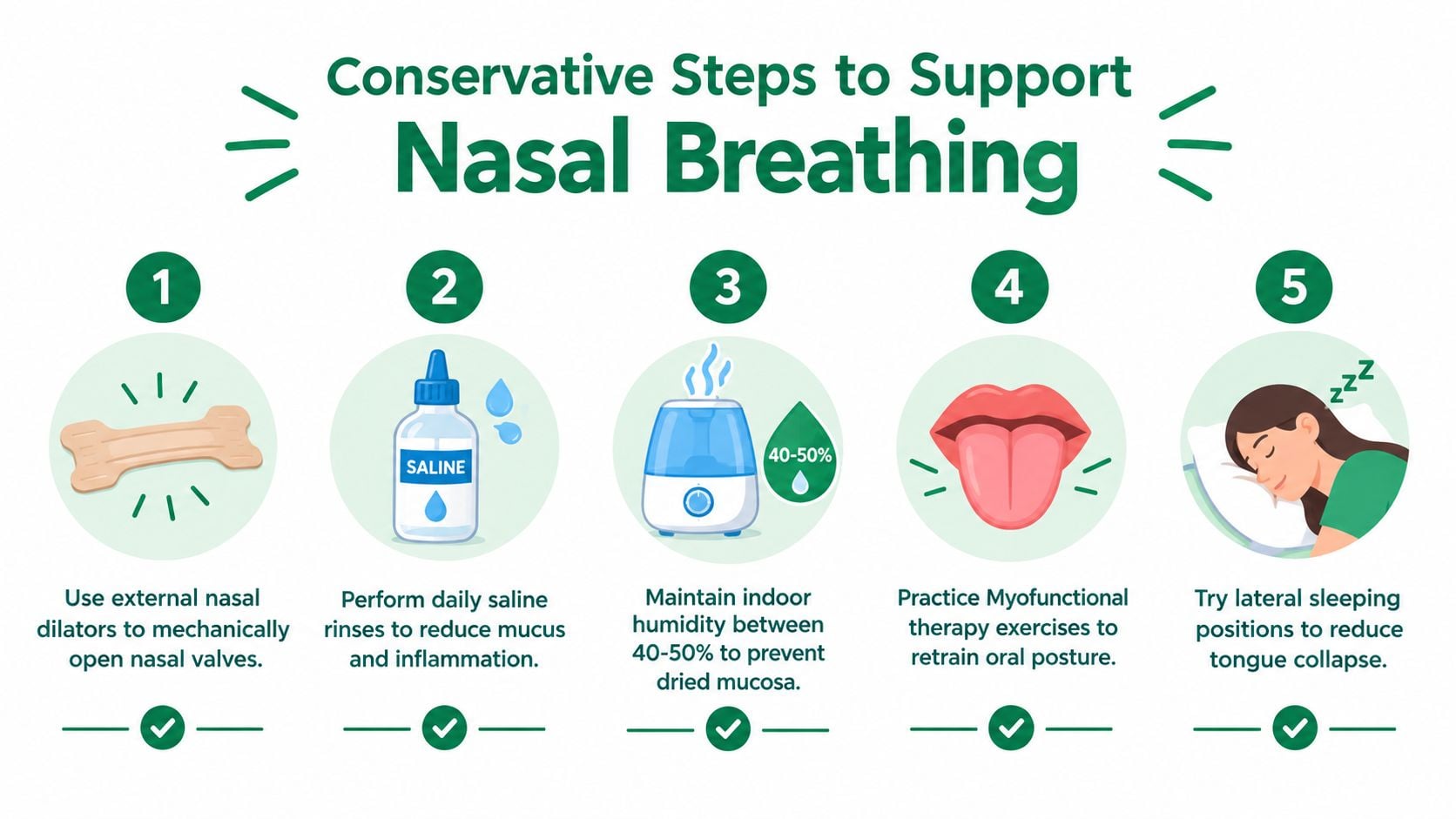
Saline nasal spray or saline rinses can help keep the passages moist and clearer, especially when congestion is part of the problem. A bedroom humidifier may also help if dry air seems to aggravate nighttime symptoms. These steps do not force a change, they lower resistance so nasal breathing has a better chance of happening naturally.
Daytime awareness matters too. Gentle lip closure at rest, the tongue resting on the roof of the mouth, and quiet nasal breathing during calm activities can reinforce better oral posture without strain. The goal is comfort first, then consistency.
A short home routine can keep the focus practical:
- Use saline regularly: Keep the nasal passages cleaner and less irritated.
- Support room humidity: Reduce dryness that can make breathing feel harsher at night.
- Check lip seal at rest: Let the lips meet lightly when the face is relaxed.
- Rest the tongue high: Place it gently against the roof of the mouth, not pressing hard.
- Sleep on the side when possible: Side positioning may reduce tongue collapse during sleep.
- Try posture and breathing drills: Exercises to reduce snoring can support nasal breathing habits and sleep posture.
Conservative care helps, but it is not a diagnosis
These steps can make breathing easier, but they do not explain why mouth breathing started. If symptoms improve a little and then return, the airway still needs a closer look. That is especially true when mouth breathing is paired with loud snoring or unrefreshing sleep.
Simple test: if a child, adult, or partner notices persistent mouth opening despite good nasal care, deeper evaluation is warranted.
The current caution around mouth taping fits here too. Mouth breathing is often a compensatory response to hidden nasal obstruction or sleep apnea, so a simple habit fix can miss the actual problem. Clinical guidelines recommend saline nasal spray to help keep nasal passages open and support a root-cause approach to airway health.
When to Seek Professional Sleep and Airway Evaluation
Red flags mean the issue may be sleep apnea
Persistent mouth breathing during sleep can be a sign of obstructive sleep apnea, or OSA, which is a condition where the airway repeatedly narrows or collapses during sleep. Loud snoring, witnessed pauses, gasping, morning headaches, dry mouth, and daytime sleepiness are all reasons to get checked rather than self-treat.
The American Academy of Sleep Medicine recommends objective testing, such as an attended polysomnogram or a technically adequate home sleep apnea test, as part of a thorough sleep evaluation, and it notes that OSA cannot be diagnosed from mouth breathing, snoring, or a questionnaire alone (AASM guideline). That distinction matters because symptoms can suggest risk, but they cannot confirm severity.
Sleep studies show severity, not guesses
Sleep-study results are commonly interpreted using the apnea-hypopnea index, or AHI, which counts the number of obstructive breathing events per hour of sleep. In adults, an AHI below 5 events per hour is generally considered normal, 5 to 14.9 is mild OSA, 15 to 29.9 is moderate disease, and 30 or more is severe (AHI thresholds).
That is why a person can have obvious mouth breathing and still need formal testing to understand what is happening overnight. A home sleep apnea test can be a reasonable option for some uncomplicated adults, but if results are negative, inconclusive, or technically inadequate while suspicion remains, in-lab polysomnography is the next step.
Clinical Therapies for Long-Term Airway Health
Supervised therapy works best as part of a plan
For confirmed OSA or dysfunctional oral posture, orofacial myofunctional therapy, or OMT, can be a useful adjunct. It uses exercises and behavioral training to improve lip seal, tongue posture, swallowing, and nasal breathing habits, usually with home practice and adherence tracking over several weeks (OMT review and meta-analysis).
A meta-analysis of randomized trials found that adult OMT reduced the apnea-hypopnea index by about 10.2 events per hour and improved Epworth Sleepiness Scale scores. That supports its role as clinician-supervised care, not a standalone cure for moderate or severe disease.
The practical view is straightforward.
- OMT may help oral posture and breathing mechanics.
- It does not replace established therapy when OSA is moderate or severe.
- It works best after the nasal airway has been assessed and sleep testing has clarified the problem.
Oral appliances and other therapies still matter
Some patients also need oral appliance therapy, especially when CPAP is not tolerated or when a clinician wants a non-invasive way to support the airway during sleep. For patients looking for a dentist for sleep apnea mouth guard care, this type of treatment is part of a broader dental sleep medicine approach that can also include TMJ, snoring, and tongue-tie related oral function. It fits best when a qualified clinician has already identified the anatomy and the sleep pattern behind the mouth breathing.
Clinical principle: better breathing usually comes from matching the therapy to the cause, not from one universal fix.
That can also include evaluation of tongue mobility, because a restricted tongue can affect oral posture and swallowing mechanics. The goal is not to chase every possible intervention. The goal is to choose the one that matches the airway finding.
Taking the Next Step Toward Restful Sleep
Root-cause care is safer than trend chasing
Stopping mouth breathing safely means respecting what the symptom may be protecting. If the nose is blocked, if sleep apnea is present, or if oral posture is dysfunctional, the first task is to identify the cause and treat it in the right order. That usually means conservative nasal care, then objective sleep testing when red flags are present, then supervised therapy when it makes sense.
Pain and Sleep Therapy Center in Newark, DE and Bryn Mawr, PA focuses on TMJ and craniofacial pain, sleep apnea and snoring, tongue-tie assessment, and non-invasive airway care. Dr. Ryan Robinson, a triple board-certified specialist in craniofacial pain and dental sleep medicine, leads the team with a root-cause approach that fits patients who want careful evaluation before considering surgery.
Patients from Newark, Wilmington, Bryn Mawr, and the Philadelphia Main Line often want one clear next step. A personalized airway evaluation can sort out whether the issue is congestion, anatomy, sleep-disordered breathing, or oral function, and that clarity is usually more helpful than another internet shortcut.
If mouth breathing is affecting sleep, snoring, jaw comfort, or daytime energy, Pain and Sleep Therapy Center can help with a root-cause evaluation and conservative treatment planning. Visit Pain and Sleep Therapy Center to request an appointment or take the Sleep Quiz, or call the Newark office at (302) 239-1757 to get started.