A partner's snoring can turn bedtime into a nightly negotiation. The person making the noise may wake with a dry mouth or tiredness, while the person sharing the room may struggle with interrupted sleep. Loud or frequent snoring can affect relationships and sleep quality, but it can also point to an airway problem that deserves a closer look.
Exercises to reduce snoring may help some people, especially when the problem involves weak or poorly coordinated tongue, soft-palate, or throat muscles. They aren't a universal fix, though. Effective care starts by identifying the likely cause, then matching muscle training, breathing habits, sleep positioning, and medical treatment to that cause.
Table of Contents
- Understanding Why Snoring Exercises May Help
- What the Evidence Says About Oropharyngeal and Myofunctional Exercises
- Oropharyngeal and Tongue Exercises for Snoring
- Breathing Retraining and Lifestyle Support for Snoring
- When Exercises Alone May Not Be Enough
- Starting a Safe Snoring Exercise Routine
Understanding Why Snoring Exercises May Help
Snoring occurs when air moves through a narrowed upper airway and causes relaxed tissue to vibrate. The upper airway includes the back of the mouth, tongue, soft palate, and throat. During sleep, these structures naturally relax. If the tongue rests too far back, the soft palate vibrates, or the airway narrows further, breathing can become noisy.
Oropharyngeal exercises target those structures directly. Oropharyngeal means relating to the area behind the mouth, including the back of the tongue and throat. Myofunctional therapy is a structured program that trains the tongue, lips, jaw, soft palate, and facial muscles to improve their resting position and coordination.
That differs from general fitness. Walking, strength training, and other physical activity can support overall health and may benefit obstructive sleep apnea as part of a wider plan, as described by Mayo Clinic's sleep apnea treatment guidance. Muscle training for snoring, however, focuses on the muscles that help keep the airway open and support nasal breathing.
The likely cause matters
Exercises may be more useful when snoring relates to poor tongue posture, mouth breathing, or reduced upper-airway muscle control. They may be less helpful when the main contributor is severe nasal blockage, a major structural restriction, alcohol-related muscle relaxation, or untreated obstructive sleep apnea.
A tongue-tie can also affect tongue movement and resting posture in some people. That doesn't mean every person with limited tongue mobility needs treatment. It means an assessment may clarify whether tongue function is contributing to the breathing pattern.
Practical rule: Muscle exercises should support a root-cause plan, not replace evaluation of persistent or disruptive snoring.
A useful starting point is learning the difference between ordinary snoring and sleep-disordered breathing. Snoring may be harmless in some cases, but gasping, witnessed pauses, morning headaches, or significant daytime fatigue require more than a home exercise routine.
What the Evidence Says About Oropharyngeal and Myofunctional Exercises
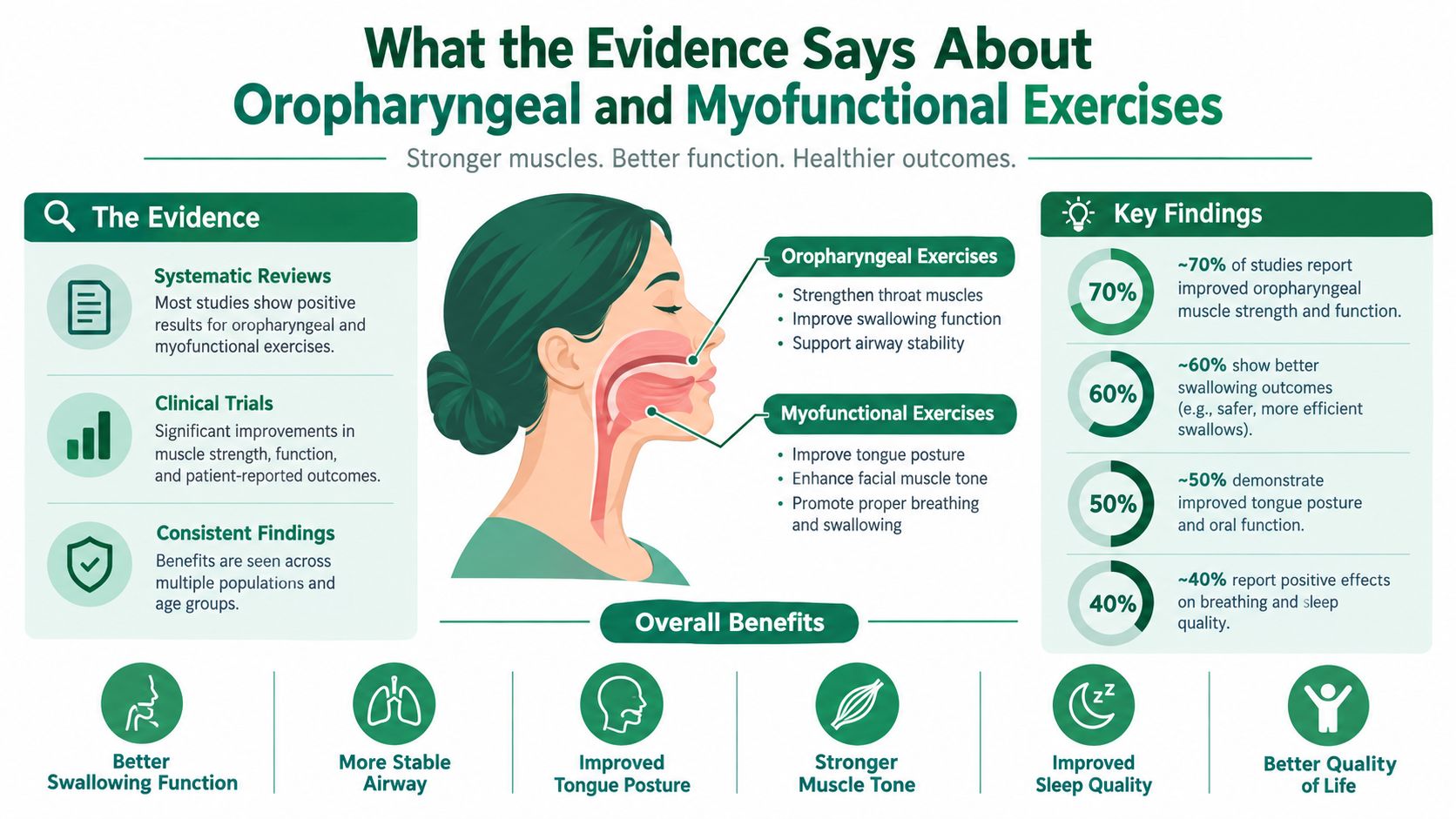
The strongest research doesn't study generic “mouth workouts.” It studies structured myofunctional therapy and oropharyngeal exercise programs, which use repeated movements for the tongue, soft palate, lateral throat walls, lips, and jaw. These exercises aim to improve muscle tone and coordination while encouraging a more stable airway during sleep.
A landmark randomized trial published in 2015 tested six oropharyngeal exercises in 39 adults with snoring. The intervention group practiced the routine three times daily for three months, while the comparison group used breathing exercises and nasal dilator strips. After treatment, the exercise group had statistically significant improvements in both the snore index and total snore index, supporting a measurable reduction in snoring severity over a relatively short treatment window. The trial is available through the PubMed record for the randomized oropharyngeal exercise study.
Later evidence provides a broader, but still cautious, picture. A systematic review pooled nine randomized trials involving 698 participants, with studies conducted from 2009 to 2020. The review found that myofunctional therapy reduced the apnea-hypopnea index, or AHI, compared with control groups and improved snoring intensity in studies that measured it. One summarized trial reported AHI falling from 22.4 to 13.7, a 39% reduction, as reported in the systematic review of myofunctional therapy.
What improvement usually means
The outcome matters. A person may experience quieter snoring without stopping completely. Another person may notice less daytime sleepiness or better nasal breathing, even if the frequency of snoring changes only slightly.
A pooled analysis reported reductions in subjective snoring intensity of 51% on a visual analog scale, 36% on the Berlin Questionnaire measure, and 31% in objectively measured time spent snoring, with the corresponding values detailed in the PubMed review of myofunctional therapy for obstructive sleep apnea. These findings support symptom improvement, but they don't establish that exercises eliminate snoring for everyone.
The distinction is important because a 2020 Cochrane review found that myofunctional therapy probably reduces daytime sleepiness and may slightly reduce subjective snoring intensity, while it may have little to no effect on how often snoring occurs. The Cochrane evidence review on myofunctional therapy also reflects the limits of the evidence, including relatively narrow and varied studies.
Consistency matters because this is neuromuscular training, not a one-night remedy. The most studied programs use regular daily practice over about three months, with one randomized protocol involving roughly thirty minutes of tongue, soft-palate, and lateral pharyngeal-wall work. The practical goal is better airway control and reduced symptoms, not a guaranteed end to snoring.
Oropharyngeal and Tongue Exercises for Snoring
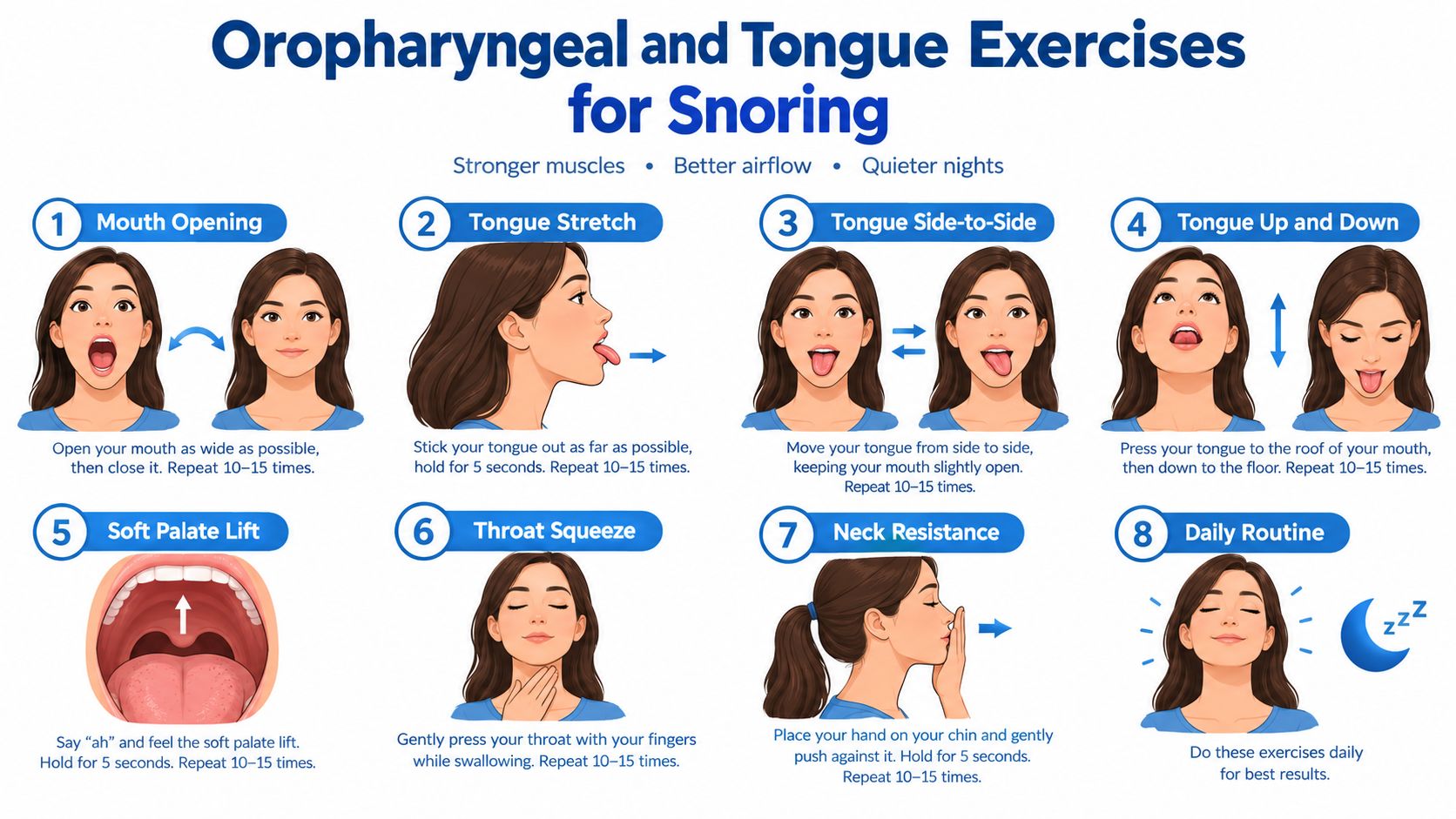
A simple routine should feel controlled rather than forceful. The jaw stays relaxed, the neck remains quiet, and breathing continues normally unless a movement specifically requires a brief pause. Pain, jaw clicking that worsens, throat irritation, or dizziness is a reason to stop and seek professional guidance.
Tongue control and resting posture
Tongue slides train the tongue to move along the roof of the mouth. The tip starts behind the upper front teeth, then the tongue glides backward along the palate without scraping or straining. The movement should be slow enough that the person can feel the middle and back of the tongue working.
For a tongue press, the entire tongue rests against the roof of the mouth. Gentle upward pressure is held briefly, then released fully. The purpose isn't to clench the teeth. The jaw should remain loose, with the lips together and breathing through the nose if the nasal passages are clear.
A tongue stretch involves extending the tongue forward, then gently directing it toward the chin or nose. The stretch should remain comfortable. Pulling hard, curling the tongue aggressively, or tightening the front of the neck turns a coordination exercise into unnecessary strain.
Soft-palate and throat activation
Soft-palate lifts can be practiced by opening the mouth comfortably and producing a sustained “ah” sound while noticing the soft palate rise. The sound should be steady, not loud. A mirror can help the person observe whether the back of the mouth moves without the jaw shifting excessively.
Vowel practice offers another way to activate the mouth and throat. Deliberately shaping vowel sounds, changing their length, and keeping the tongue mobile can make the exercise more engaging. The emphasis stays on clear movement and relaxed breathing rather than volume.
Facial and jaw resistance
For cheek resistance, a person can place the tongue against the inside of one cheek and press outward while the cheek provides gentle resistance. The same action can be performed on the other side. This should activate the cheek and tongue without creating jaw pain.
A controlled jaw opening can also help with awareness of jaw relaxation. The lips begin gently together, then the mouth opens while the jaw drops without pushing forward. People with temporomandibular joint pain should modify or avoid movements that reproduce symptoms. Guidance about oral function and tongue-tie surgery recovery for adults may be relevant when restricted tongue motion affects posture or exercise technique.
Common mistakes include holding the breath, lifting the shoulders, clenching the teeth, and rushing through repetitions. A practical progression is to begin with short, comfortable practice sessions and increase consistency before increasing effort. The aim is accurate motor control that can become a steady daytime habit.
Breathing Retraining and Lifestyle Support for Snoring
Tongue training works in a difficult environment if the person spends the day mouth breathing or goes to bed with a blocked nose. Nasal breathing warms and filters incoming air, while a relaxed tongue resting near the palate can support better oral posture. Persistent congestion, allergies, a deviated nasal structure, or enlarged tissue may need separate evaluation.
A gentle breathing routine can reinforce the desired pattern. The lips stay softly closed, the jaw remains unclenched, and inhalation and exhalation occur through the nose when possible. Diaphragmatic breathing, which allows the lower ribs and abdomen to expand without lifting the shoulders, can reduce unnecessary tension in the neck and upper chest.
Position can change the airway
Some people snore more when sleeping on the back because the tongue and soft tissues shift backward. Side sleeping may reduce that tendency for certain individuals, although it isn't a complete treatment for sleep-disordered breathing.
Head elevation may also feel helpful for some sleepers. A resource explaining wedge pillow insights from DME Superstore can help readers understand how an inclined sleep surface differs from stacking loose pillows. Comfort and spinal alignment still matter, since an awkward position can create neck or jaw tension.
Support the training outside practice
Lifestyle choices can either reinforce or undermine an exercise plan. Limiting alcohol close to bedtime may reduce additional relaxation of the throat muscles. Regular movement, weight management when appropriate, and a consistent sleep schedule can support airway health without replacing targeted therapy or medical assessment.
The same routine may need to be adapted for a person with a tongue-tie, chronic nasal congestion, jaw pain, or a history of airway problems. Root-cause care asks why nasal breathing is difficult, why the tongue rests low, or why the jaw and neck remain tense. A personalized plan may combine breathing retraining, oral exercises, sleep-position changes, and treatment for the underlying contributor.
When Exercises Alone May Not Be Enough
Exercises alone may be reasonable as an initial support for occasional, uncomplicated snoring when the person wakes rested and no one observes breathing pauses. Persistent loud snoring deserves more attention, especially when it occurs with gasping, choking, morning headaches, high blood pressure, or pronounced daytime sleepiness.
Those symptoms don't diagnose sleep apnea. They indicate that a person should move beyond symptom guessing. The American Academy of Sleep Medicine states that obstructive sleep apnea should be diagnosed with objective testing rather than symptoms alone. For uncomplicated adults with signs suggesting moderate to severe obstructive sleep apnea, the guideline supports polysomnography or a technically adequate home sleep apnea test, as explained in the AASM diagnostic testing guideline.
Exercises compared with evaluation and devices
| Situation | More appropriate next step |
|---|---|
| Occasional snoring without daytime symptoms | Gentle exercise, nasal-breathing habits, and sleep-position support may be reasonable |
| Chronic loud snoring or a partner notices pauses | Arrange a sleep evaluation rather than relying on exercises alone |
| Confirmed obstructive sleep apnea | Follow a clinician-guided treatment plan, which may include exercise as an adjunct |
| Persistent symptoms despite consistent practice | Reassess the airway, nasal breathing, tongue function, jaw, and treatment fit |
A sleep study measures breathing and sleep-related changes. Attended type 1 polysomnography is considered the gold standard for diagnosing sleep-related breathing disorders, and an adult AHI of 5 events per hour or fewer is commonly considered normal, according to StatPearls' overview of polysomnography. The result helps determine whether an exercise routine is enough to explore or whether additional care is needed.
Oral appliance therapy can be considered for appropriate patients after evaluation. It uses a fitted dental device to help support the airway during sleep and may serve as an alternative or companion to other treatments, depending on the diagnosis and individual needs. CPAP remains an important treatment for many people, and exercises shouldn't replace prescribed therapy without clinical advice.
For patients exploring non-invasive options for snoring, information about laser therapy for snoring can be discussed during an evaluation. The appropriate choice depends on the anatomy, breathing pattern, sleep-study findings, jaw function, and personal goals.
Starting a Safe Snoring Exercise Routine
A sustainable routine begins with observation. A person can note whether snoring occurs every night, whether the mouth feels dry on waking, whether sleep feels restorative, and whether a partner notices gasping or pauses. A short audio recording may help identify changes in noise, but it cannot diagnose sleep apnea.
Practice should happen when the jaw, neck, and shoulders are relaxed. The person can select one tongue exercise, one soft-palate exercise, and one breathing exercise rather than trying to perform every available movement at once. Accuracy matters more than force, and consistency matters more than an exhausting session.
A practical way to monitor progress
- Track symptoms: Record morning alertness, dry mouth, nasal comfort, and perceived snoring.
- Watch for strain: Stop if exercises trigger jaw pain, neck tension, throat discomfort, or dizziness.
- Review adherence: Note which movements were completed and whether nasal breathing was comfortable.
- Reassess the plan: Persistent snoring, worsening fatigue, or witnessed breathing pauses calls for professional evaluation.
Research on structured programs generally measures change over months rather than overnight. That timeline reflects the nature of neuromuscular retraining. A person who practices consistently but sees no meaningful improvement should not just increase effort. An airway assessment may reveal nasal obstruction, tongue restriction, jaw-related factors, or sleep apnea that requires another approach.
Patients in Newark and Wilmington, Delaware, and Bryn Mawr and the Philadelphia Main Line can seek coordinated care that considers sleep breathing, oral function, jaw symptoms, and conservative treatment options together. Snoring is common and often treatable, but the safest plan matches the exercise routine to the actual airway problem.
Pain and Sleep Therapy Center provides root-cause evaluation for snoring, sleep-disordered breathing, TMJ and craniofacial pain, and tongue-tie concerns, with options that may include at-home sleep testing, oral appliance therapy, breathing guidance, and Snorelase when clinically appropriate. Readers can visit Pain and Sleep Therapy Center to request an appointment or take the Sleep Quiz, or call Newark at (302) 239-1757.