
A partner elbows the other side of the bed at 2 a.m. The room is quiet except for a harsh, uneven rumble that stops briefly, then starts again. By morning, the snorer may feel embarrassed, while the partner feels exhausted. Both may wonder whether the problem is a simple sleep habit, a blocked nose, or something that needs medical attention.
Understanding what causes loud snoring in adults starts with the airway. Snoring is created by narrowed airflow and vibrating tissue, not by a personal failure or a lack of willpower. Anatomy, sleep-related muscle relaxation, nasal congestion, alcohol, medications, body composition, and sleep position can all contribute. In some adults, loud snoring is also a sign of obstructive sleep apnea, a condition that requires proper evaluation rather than guesswork.
Table of Contents
- The Mechanics of Snoring and Airway Flow
- Anatomical Factors That Narrow the Airway
- Behavioral and Lifestyle Triggers
- Recognizing Obstructive Sleep Apnea Warning Signs
- Why Normal Weight Adults Still Snore Loudly
- Finding the Root Cause Through Evaluation
- Next Steps for Better Sleep and Airway Health
The Mechanics of Snoring and Airway Flow
A person can breathe softly while awake and still snore loudly during sleep. The difference comes partly from muscle tone. As sleep begins, the muscles supporting the throat relax. If the upper airway becomes narrower, air must pass through a smaller opening, and the surrounding soft tissues can begin to flutter.
The sound usually comes from tissues such as the soft palate, the area behind the nose, and nearby throat structures. The narrower the passage, the faster air may move through it. That faster flow creates a pressure change that encourages soft tissue to vibrate.
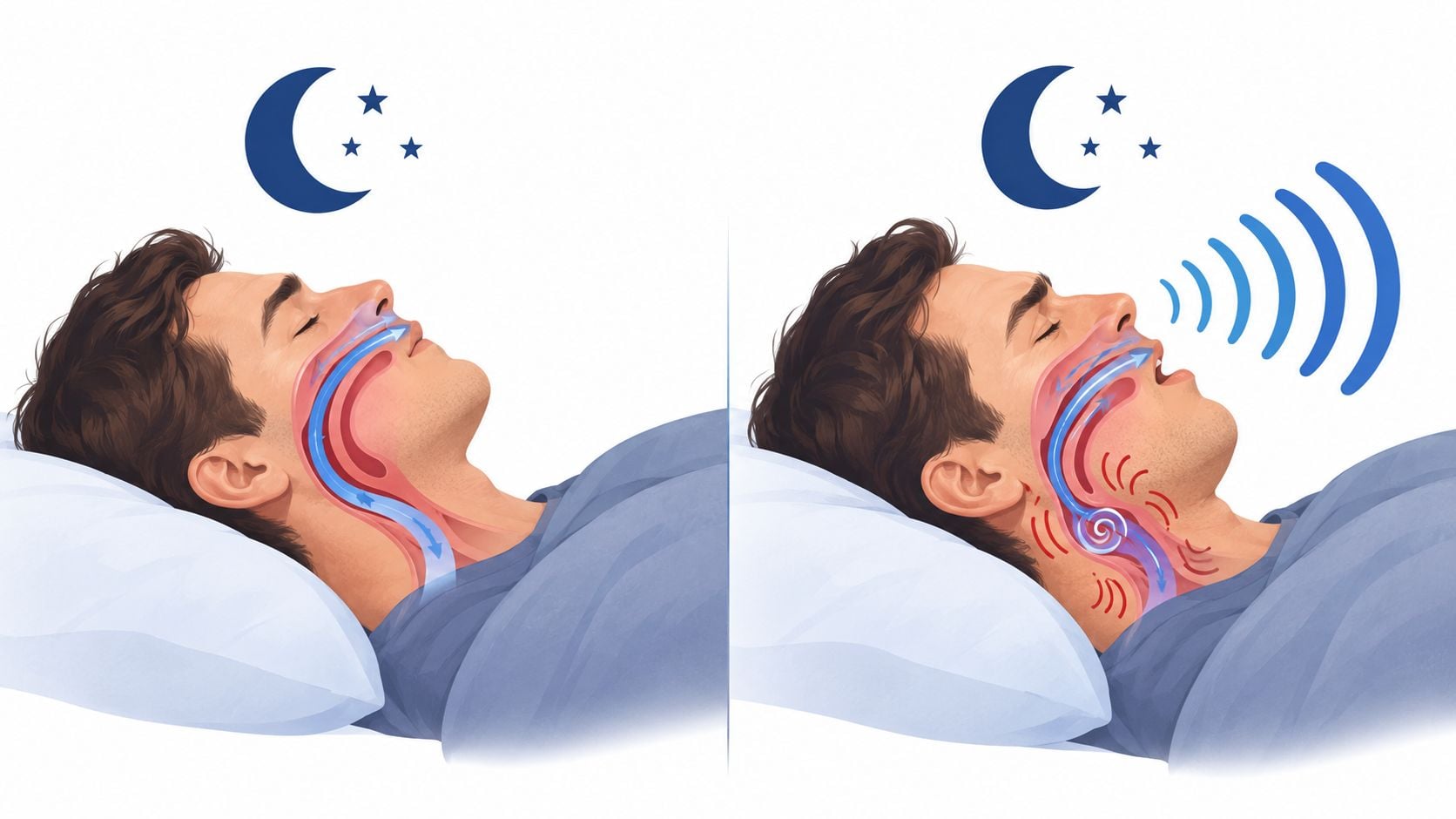
A narrowed passage creates the sound
A useful comparison is a garden hose. Water moves differently through a wide, open hose than through a hose that has been pinched. The narrowed section changes the flow and can create turbulence. During sleep, a narrowed airway behaves in a comparable way, although the airway involves moving soft tissue rather than a flexible hose.
The clinical explanation is more specific. When sleep reduces pharyngeal muscle tone, the upper airway narrows, airflow velocity rises, and the resulting pressure drop promotes flutter of compliant soft tissues, especially the soft palate and nearby nasopharyngeal tissues. That tissue vibration creates the snoring sound, as described in this medical explanation of snoring airflow.
Loudness can reflect narrowing
A louder sound often means that airflow is meeting more resistance or that a larger area of tissue is vibrating. Loudness alone can't determine whether a person has sleep apnea, but it shouldn't automatically be dismissed as harmless noise. A person may have primary snoring, meaning snoring without significant breathing disruption, or may have repeated near-blockages during sleep.
This is why a new pillow may not solve the problem. A pillow can change head and neck position, but it can't correct a small jaw, an enlarged tongue, a blocked nose, or a soft palate that vibrates because the airway becomes unstable. Root-cause evaluation looks at the structures and conditions that make the airway narrow in the first place.
Anatomical Factors That Narrow the Airway
The adult airway isn't a fixed pipe. It is a flexible passage shaped by the jaw, tongue, palate, tonsils, nasal passages, and surrounding soft tissue. Small differences in those structures can change how much room remains for airflow when the throat muscles relax.
A lower jaw that sits short or farther back than the upper jaw can reduce the space available for the tongue. The tongue may rest farther toward the back of the throat, especially during sleep, leaving less room for air to pass. This doesn't mean the person has done anything wrong. Craniofacial structure can contribute to snoring even when weight and daily habits appear healthy.
The structures behind the sound
A large tongue, medically called macroglossia, can occupy more of the airway space. Enlarged tonsils or adenoids can also reduce the opening, although adenoid enlargement is more commonly discussed in children. The soft palate, the flexible tissue at the back of the roof of the mouth, may be long, thick, or especially mobile. Each feature can increase tissue vibration or reduce the space behind the tongue.
Nasal anatomy matters too. A deviated septum, which means the wall between the nasal passages is shifted, can make nasal breathing harder. Nasal polyps, rhinitis-related swelling, and other forms of blockage can push a person toward mouth breathing, which may alter the position of the jaw and tongue during sleep.
Anatomy matters: Loud snoring isn't limited to adults with excess weight. A small jaw, a large tongue, enlarged tonsils, or a blocked nose may be the main reason the airway narrows.
MedlinePlus identifies several anatomical risks, including a lower jaw that is short relative to the upper jaw, a large tongue, large tonsils and adenoids, and neck measurements of 17 inches (43 cm) or more in men and 16 inches (41 cm) or more in women. These thresholds are risk markers, not a diagnosis, and they should be considered alongside symptoms and clinical findings in this overview of snoring causes and anatomy.
Why structure can explain lifelong snoring
Some adults have snored since childhood or early adulthood, long before any noticeable change in weight. That pattern may point toward jaw position, tongue size, palate shape, nasal structure, or restricted oral function. Other adults begin snoring later as muscle tone changes with age, nasal symptoms develop, or medication and alcohol affect the throat.
A dental sleep medicine evaluation can examine how the jaw, tongue, bite, palate, and airway relate to one another. This approach doesn't assume that every snoring problem needs surgery. It helps identify whether conservative care, medical evaluation, oral appliance therapy, nasal care, or coordinated treatment makes sense for the individual.
Behavioral and Lifestyle Triggers
Anatomy establishes the available airway space, but daily factors can make that space less stable. A person with mild narrowing may snore only after drinking alcohol, sleeping on the back, developing a cold, or experiencing a night of severe congestion. Someone with more significant narrowing may snore under several conditions.
Alcohol and sedative medications can relax the muscles that help support the upper airway. When those muscles lose tone, the throat may become more collapsible. Alcohol can also make the soft tissues vibrate more readily, so a person who rarely snores may notice a louder pattern after drinking.
Position changes the airway
Back sleeping, also called the supine position, allows gravity to draw the tongue and soft tissues backward. That movement can reduce the available airway space, particularly when the jaw already sits toward the back or the tongue occupies much of the oral cavity. Side sleeping may reduce positional narrowing for some people, but it doesn't address every structural cause.
Nasal congestion adds another layer. Allergies, a cold, or chronic nasal blockage can make nasal breathing difficult. Mouth breathing may then increase, changing the resting position of the jaw and tongue and increasing the chance of noisy tissue vibration.
The exercises to reduce snoring may provide general strategies for some adults, but exercises and sleep-position changes shouldn't replace an evaluation when snoring is persistent, very loud, or associated with breathing pauses.
A practical way to identify triggers
A short symptom log can help patients and clinicians recognize patterns. The log doesn't diagnose the cause, but it can show whether snoring changes with specific conditions.
- Track the night: Note whether the person slept on the back or side and whether snoring was louder in one position.
- Record nasal symptoms: Congestion, allergies, colds, and nighttime mouth breathing can point toward a nasal contribution.
- Review substances and medications: Alcohol and sedatives may increase airway relaxation. Medication changes should be discussed with the prescribing clinician, not made independently.
- Ask the sleep partner: A partner may notice pauses, gasping, or changes in breathing that the snorer never remembers.
Mayo Clinic describes snoring as the result of partially blocked airflow and vibrating upper-airway tissue, with contributors that include mouth and sinus anatomy, alcohol, allergies, colds, excess weight, and back sleeping. Those factors are summarized in this clinical guide to snoring symptoms and causes.
Recognizing Obstructive Sleep Apnea Warning Signs
Primary snoring and obstructive sleep apnea can sound similar at first, but they aren't the same process. Primary snoring involves vibration as air moves through a narrowed passage. Obstructive sleep apnea, or OSA, involves repeated narrowing or collapse of the airway during sleep even though the body continues trying to breathe.
During an obstructive event, the throat tissues can block airflow. The person may partially wake, tighten the throat muscles, and resume breathing. That cycle can repeat throughout the night, fragmenting sleep and sometimes lowering oxygen levels. An obstructive apnea or hypopnea event is defined as lasting more than 10 seconds in the clinical description provided by this primary-care review of sleep apnea physiology.
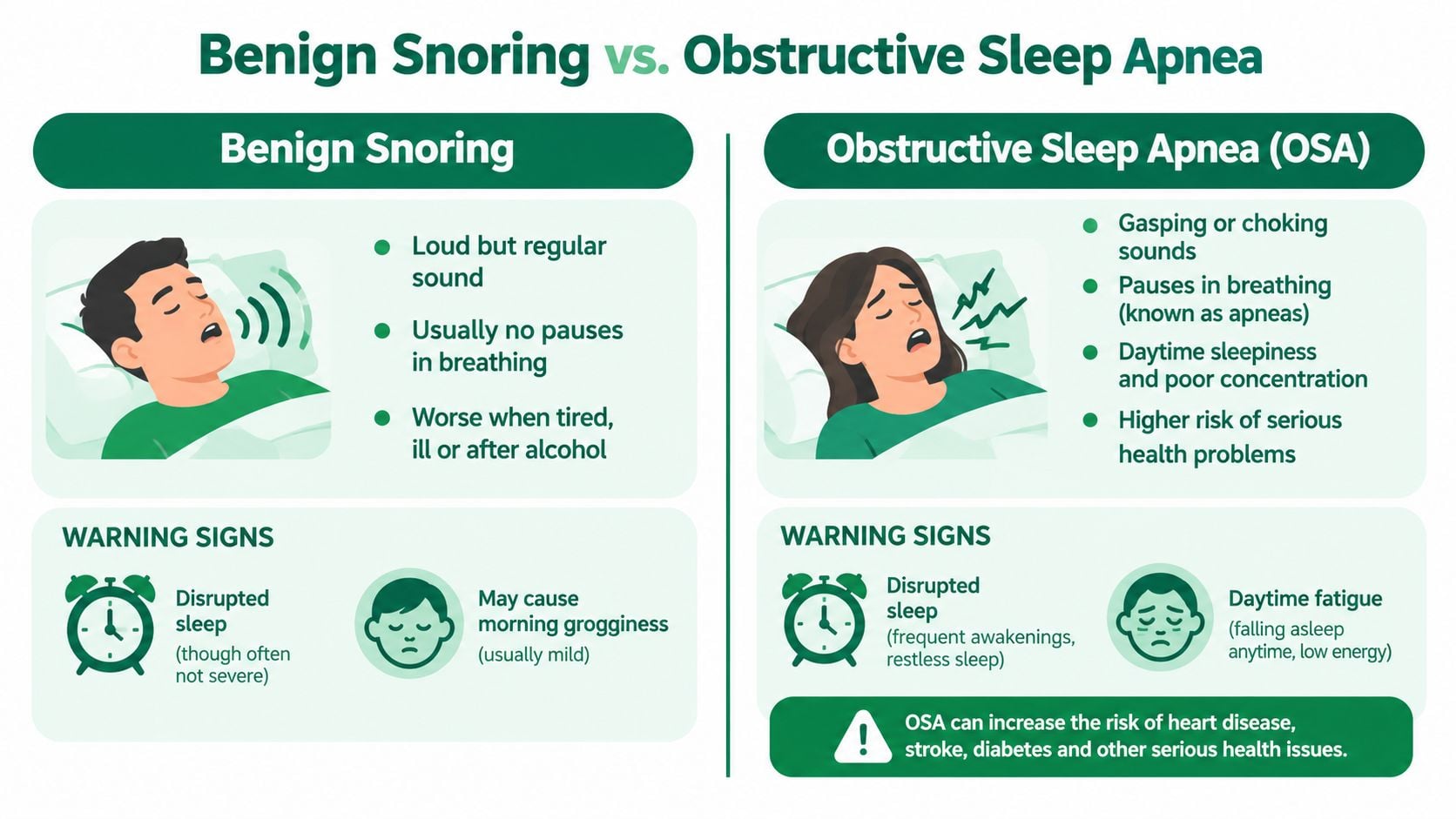
Signs that need attention
Loud snoring by itself can't confirm OSA. The concern increases when another person observes pauses in breathing, followed by gasping, choking, snorting, or a sudden resumption of airflow. The person may not remember these episodes because the arousals can be brief.
Daytime symptoms can also matter. A person may wake with a headache, feel unrefreshed despite spending enough time in bed, struggle to stay alert, or have difficulty concentrating. These symptoms have many possible causes, but paired with frequent loud snoring, they deserve a professional discussion.
Mayo Clinic defines OSA as repeated airway narrowing or collapse during sleep despite continued breathing effort. Loud, frequent snoring with pauses in breathing is a common pattern, as explained in this overview of obstructive sleep apnea symptoms.
Snoring is a clue, not a diagnosis
A sleep partner's observation can help identify a problem, but it can't determine severity. A formal diagnosis requires a sleep study evaluated by a physician. Depending on the clinical situation, testing may take place at home or in a sleep facility.
Resources about sleep-disordered breathing can help patients understand the broader range of airway problems, from snoring to OSA. Patients should seek prompt evaluation when loud snoring occurs with witnessed pauses, choking, marked daytime sleepiness, morning headaches, or consistently unrefreshing sleep.
For readers exploring how oral appliances fit into care, an educational resource about an oral appliance for sleep-disordered breathing may help explain one type of conservative treatment. Such treatment should follow appropriate diagnosis and medical guidance. An oral appliance isn't a substitute for a sleep study or a physician's assessment.
Why Normal Weight Adults Still Snore Loudly
Body weight can affect airway collapsibility, but it isn't the only explanation for loud snoring. Some adults with a normal body mass index have substantial snoring because the airway is narrow for skeletal, soft-tissue, or nasal reasons. Telling every person to focus only on weight can miss the actual mechanical problem.
A small or posteriorly positioned jaw may leave less room for the tongue. A large tongue or enlarged soft palate may narrow the throat when the muscles relax. Nasal polyps, rhinitis, and other nasal conditions can make it difficult to maintain comfortable nasal breathing during sleep.
The jaw and tongue connection
The tongue attaches to the lower jaw and occupies a large part of the mouth. When the lower jaw sits farther back, the tongue may also rest farther back, reducing the space behind it. Restricted tongue mobility, sometimes called a tongue-tie, may affect oral function in some patients, but it can't be assumed to be the cause of snoring without a focused assessment.
Age can also influence the airway. Reduced muscle tone may allow soft tissues to collapse more easily, and sedatives can produce a similar effect. These changes can occur in adults who have never had a weight-related concern.
A normal weight doesn't guarantee a wide airway. The jaw, tongue, palate, nose, and muscle tone all influence how air moves during sleep.
Neutral medical guidance identifies small or posteriorly positioned jaws, macroglossia, enlarged tonsils or soft palate, nasal polyps, rhinitis, aging, and sedatives as possible contributors, not only excess body weight. The MedlinePlus patient information on snoring reinforces why an evaluation should examine anatomy and airway function rather than rely on a single explanation.
Why a root-cause assessment helps
A patient who has maintained a stable, healthy lifestyle may still need an airway examination. The useful question isn't just whether weight contributes. It is whether the airway narrows because of the jaw, tongue, palate, nose, muscle relaxation, or a combination of factors.
That distinction affects treatment planning. A position change may help positional snoring, nasal care may help congestion-related symptoms, and an oral appliance may help appropriate patients whose airway benefits from jaw support. The right path depends on the cause and on whether a sleep study shows OSA.
Finding the Root Cause Through Evaluation
Persistent loud snoring deserves more than trial and error. A careful evaluation connects the nighttime sound with daytime symptoms, partner observations, nasal health, jaw position, tongue function, palate shape, and overall medical history.
Clinical sources note that about half of people who snore loudly may have OSA, while adult OSA prevalence is commonly estimated at roughly 3% to 7% in the general population. Risk is higher in older adults, men, people with obesity, and people with craniofacial risk factors, according to this medical discussion of snoring and sleep apnea. These figures don't diagnose any individual, but they show why persistent loud snoring shouldn't be ignored.
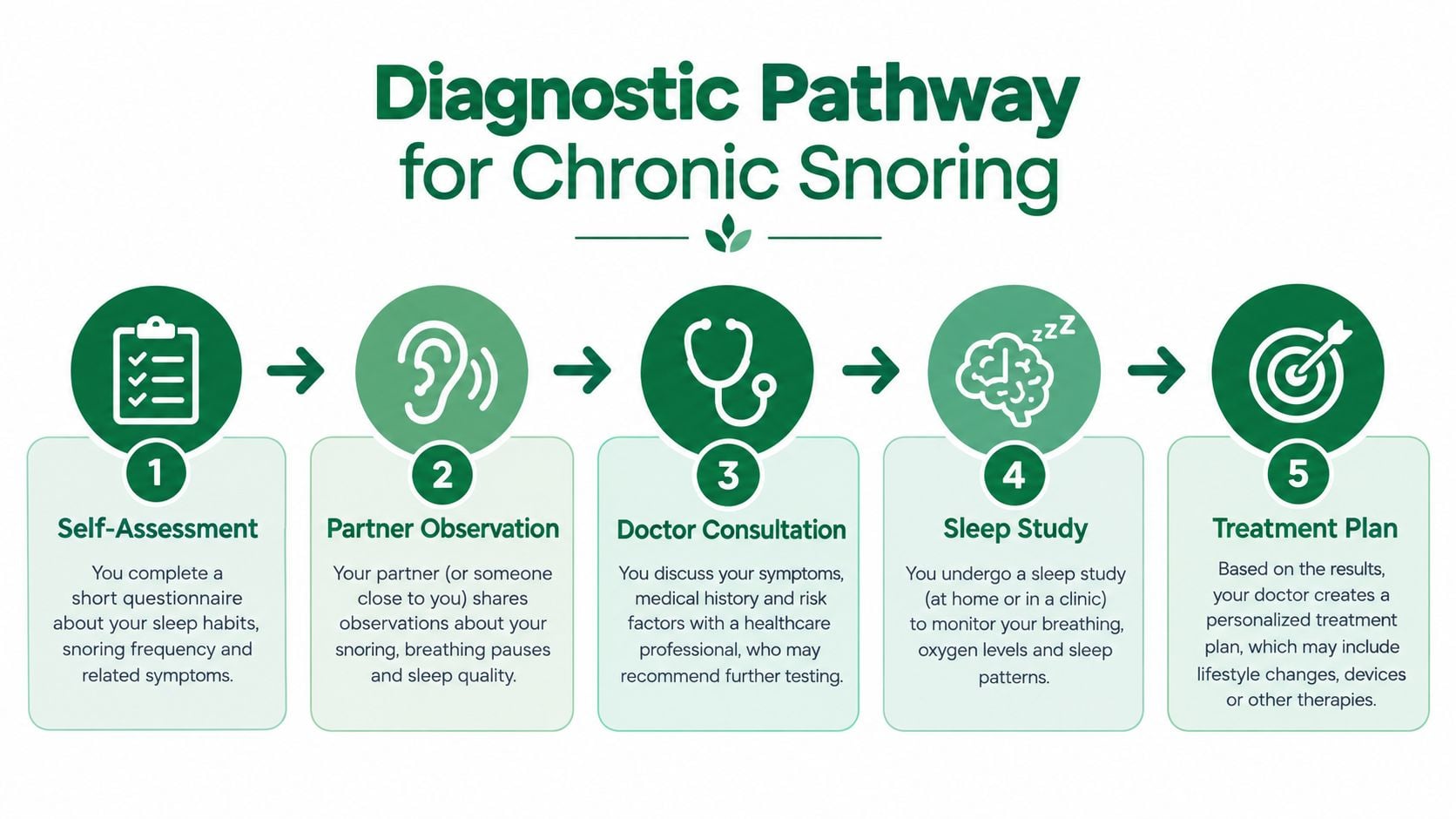
What an evaluation may include
The process generally begins with a detailed history. A clinician may ask about snoring frequency, breathing pauses, gasping, morning symptoms, daytime alertness, nasal congestion, alcohol, medications, sleep position, and previous treatments.
An examination may assess:
- Jaw position and bite: These features can influence tongue posture and the space behind the tongue.
- Tongue and oral function: Restricted movement or a large tongue may affect airway space and nighttime breathing.
- Nasal passages: Congestion, a deviated septum, or polyps may contribute to mouth breathing.
- Soft palate and tonsils: These tissues can vibrate or reduce the airway opening.
- Jaw and facial pain: Clenching, TMJ symptoms, or facial pain may affect treatment choices and appliance design.
A sleep study is the next important step when OSA is possible. Home sleep testing can provide useful information for selected adults, but the test must be ordered or interpreted within appropriate medical care. A physician diagnoses sleep apnea, and treatment should be monitored according to the results.
Matching treatment to the mechanical problem
The goal isn't to silence a sound without understanding why it occurs. If the main issue is nasal blockage, the plan may involve medical assessment of the nose. If the airway benefits from supporting the lower jaw, a custom oral appliance may be considered. If soft-tissue vibration is a major contributor, a targeted therapy may be discussed after evaluation.
Readers seeking broader background on dental sleep medicine in Wesley Chapel can review how dental professionals may contribute to sleep-related breathing care. Dental sleep medicine works alongside physician-led diagnosis, not instead of it.
Next Steps for Better Sleep and Airway Health
Loud snoring doesn't need to be met with shame or panic. It does deserve attention when it persists, disrupts a partner's sleep, or appears with pauses, gasping, daytime sleepiness, headaches, or unrefreshing sleep.
A sensible next step is to document the pattern. A partner's observations can be helpful, and a short record of nasal symptoms, sleep position, alcohol, medications, and morning symptoms can make the clinical visit more useful. The patient should also bring a list of current medications and relevant medical conditions.
Conservative options may address different causes
Treatment is individualized because snoring doesn't have one universal cause. Depending on the evaluation and sleep-study findings, a plan may include:
- Oral appliance therapy: A custom device may reposition or support the lower jaw for appropriate patients. It can be considered as an alternative to CPAP in selected situations, but it doesn't replace physician diagnosis or follow-up.
- Nasal and positional care: Addressing congestion and reducing back sleeping may help when those factors worsen airway narrowing.
- Targeted tissue therapy: Laser therapy for snoring may be discussed when tissue vibration is a relevant part of the problem.
- Tongue-tie evaluation: A restricted tongue may warrant assessment of oral function. Laser frenectomy is not automatically appropriate, and treatment decisions should follow a careful examination.
- Collaborative care: Medical, dental, and allied health professionals may coordinate when nasal disease, OSA, jaw function, or facial pain overlap.
CPAP remains an important treatment for many people with OSA. An oral appliance is not automatically better or appropriate for everyone. The safest choice depends on diagnosis, severity, anatomy, comfort, and follow-up.
Pain and Sleep Therapy Center serves patients in Newark and Wilmington, Delaware, and Bryn Mawr and the Philadelphia Main Line with TMJ and facial pain evaluation, dental sleep medicine, at-home sleep testing, oral appliance therapy, Snorelase when indicated, tongue-tie assessment, and root-cause care. The practice is led by Dr. Ryan Robinson, triple board-certified in craniofacial pain and dental sleep medicine, and emphasizes conservative options before invasive treatment when clinically appropriate.
Readers who are concerned about loud snoring can visit Pain and Sleep Therapy Center to request an appointment or take the Sleep Quiz. The Newark office can also be reached at (302) 239-1757 for guidance on evaluating snoring, sleep-disordered breathing, jaw factors, and possible treatment options.