Waking with a tight jaw, tired chewing muscles, or a headache can make it seem as if the teeth stayed clenched all night. The cause isn't always obvious, and a person may not remember any grinding. A realistic plan doesn't depend on consciously holding the jaw loose during sleep. It focuses on possible triggers, reducing strain, protecting the teeth, and checking for sleep problems that may need attention.
Nighttime jaw clenching is often part of sleep bruxism, the name for repeated clenching, grinding, or jaw thrusting during sleep. Stress may play a role, but so can sleep habits, substances, medicines, daytime jaw tension, or breathing-related sleep disruption. A few practical changes may help, but persistent pain or signs of tooth damage deserve a professional evaluation.
Table of Contents
- Recognizing Why Nighttime Jaw Clenching Happens
- Check Your Symptoms Before Changing Your Routine
- Build a Jaw-Friendly Sleep Routine
- Uncover Triggers With a Two-Week Experiment
- Check Breathing and Sleep Before Choosing an Appliance
- Protect Your Teeth With the Right Mouth Guard
- Know When Your Plan Needs Professional Care
Recognizing Why Nighttime Jaw Clenching Happens
One sleeper wakes with a tired, sore jaw and no memory of grinding. Another learns about it only because a partner heard the noise at 2 a.m. Those differences matter because nighttime clenching works best as a sign to investigate during waking hours.
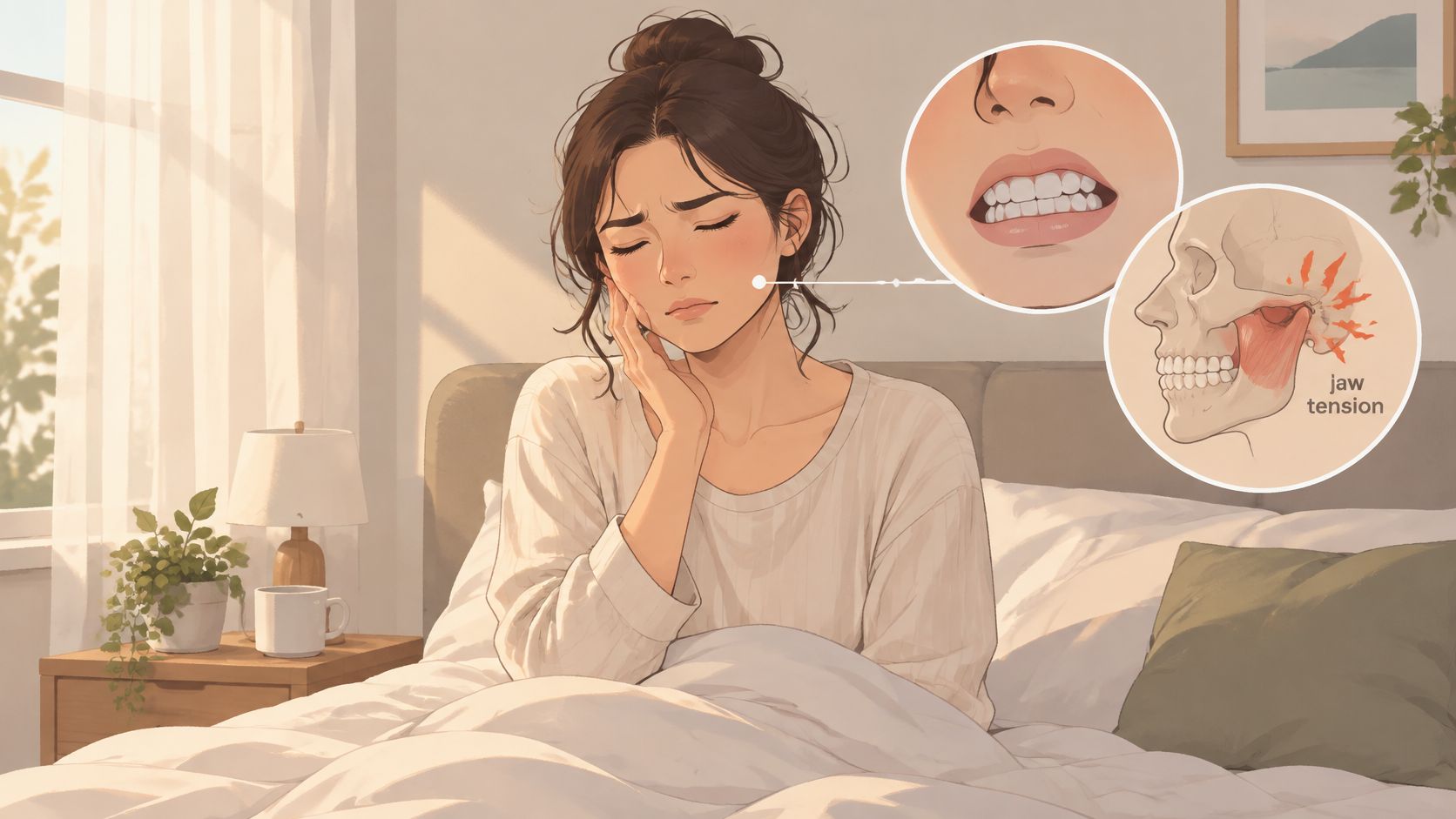
Sleep bruxism is the clinical name for repeated clenching, grinding, or jaw thrusting during sleep. Rates depend on age and on whether researchers count reported sounds, examined tooth wear, or muscle activity during a sleep study. A 2014 review in the AGD self-instruction series reported estimates of about 14% in children, 8% in adults younger than 60, and 3% in adults aged 60 and older, and it also noted laboratory sleep testing that confirmed sleep bruxism in 7.4% of adults aged 20 to 80 (review of sleep bruxism and its assessment/gendent_jf14_344_trindade.pdf?sfvrsn=cb727ab1_0)).
Jaw muscles work like other muscles under load: daytime tension, stress physiology, alcohol, caffeine, tobacco, irregular sleep, and some medicines can each lower the threshold for activity or add to the strain. None proves the cause in one person. Brief arousals can also coincide with jaw activity, which is why breathing problems and fragmented sleep belong in the investigation without being assumed.
The realistic sequence is to ease avoidable jaw loading, protect teeth when damage is possible, review medicines and substances, and check whether sleep itself looks disrupted. Willpower during sleep is unreliable.
A more useful goal: reduce strain, gather clues, and escalate when pain, locking, tooth damage, loud snoring, witnessed pauses in breathing, or severe daytime sleepiness suggest professional evaluation is safer.
Check Your Symptoms Before Changing Your Routine
A partner hears grinding at 3 a.m. The next morning brings a tired jaw and a dull ache at the temples. Each detail feels meaningful, yet no single one confirms the cause, which is why a careful symptom review belongs before any changes to your routine.
A bed partner's report can be helpful, but it doesn't confirm sleep bruxism by itself. Some people never produce audible grinding even when their jaw muscles are active through the night. Under ICSD-3 criteria, diagnosis may involve reported frequent grinding sounds together with a clinical sign, such as unusual tooth wear, morning muscle pain or fatigue, a temple headache, or jaw locking on waking.
Symptoms work like a weather report: they describe conditions, and a trained professional still interprets them. A dentist can assess tooth wear and muscle tenderness, while a clinician can consider jaw function, sleep concerns, and other possible contributors.
| Pattern to track | What it may suggest | What to document |
|---|---|---|
| Grinding sounds reported by a bed partner | Possible sleep-related grinding, but not confirmation by itself | When it happens and whether it's frequent |
| Morning jaw soreness, tightness, or fatigue | Jaw-muscle overuse or tension | Location, severity, and how long it lasts |
| Headaches on waking | A symptom worth discussing, especially if persistent | Timing, location, and accompanying jaw symptoms |
| Tooth sensitivity, wear, chips, or cracks | Possible tooth damage that a dentist can examine | Which teeth feel sensitive or look different |
| Jaw locking or restricted opening | A reason to seek an assessment | When it occurs and whether it affects eating or speaking |
| Teeth touching during focused daytime tasks | Possible daytime bracing or clenching | Activities, stress, and how often it's noticed |
A symptom log turns scattered impressions into something a clinician can read. One rough night proves little; a repeating pattern across many mornings means far more. Record bedtime, awakenings, evening caffeine or alcohol, tobacco use, morning pain or headache, reported snoring, and daytime fatigue. Readers who also wake with headaches can explore the possible connection between teeth clenching and headaches. Bring the notes to a dental or medical appointment, where they can guide the evaluation rather than replace it.
Build a Jaw-Friendly Sleep Routine
A calm bedtime routine can reduce some sources of tension and support steadier sleep, though it can't guarantee that clenching will stop. The temporomandibular joints, or TMJs, are the hinge-like joints that connect the lower jaw to the skull. Reducing unnecessary strain on the jaw muscles and joints is more practical than trying to monitor tooth contact throughout the night.
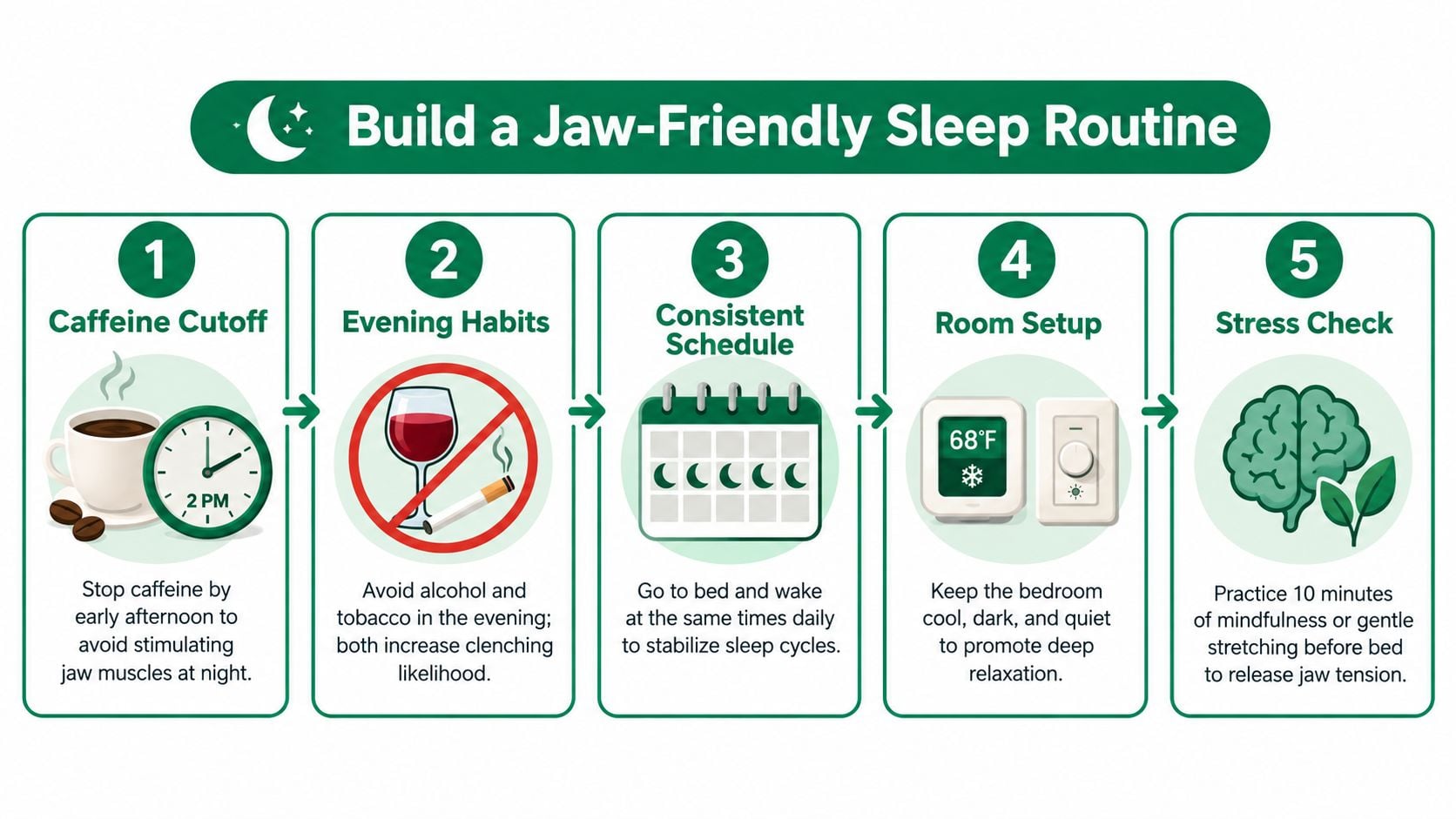
Consider this routine as a starting point:
- Review evening substances. Notice whether caffeine late in the day, alcohol, or tobacco seems to coincide with restless sleep or a sore jaw. Reducing these evening exposures may help; it won't identify every cause.
- Keep sleep timing steady. Going to bed and waking at consistent times can support a regular sleep schedule. This may be especially useful when irregular sleep seems to accompany jaw symptoms.
- Make the room and routine settling. A quieter, more comfortable bedtime environment can make it easier to wind down. Choose a brief practice, such as slow breathing, meditation, or calming audio.
- Let the jaw rest gently. Before sleep, allow the lips to come together with the teeth apart and the jaw relaxed. This is a resting position to practice while awake, not a reason to force the mouth open or keep checking the jaw overnight.
For example, a person who drinks coffee late, wakes briefly, and feels a tired jaw might try moving caffeine earlier, keeping a steadier bedtime, and adding a short relaxation practice. If symptoms improve, that pattern may be useful information. It still doesn't prove that caffeine or stress was the sole cause.
The National Institute of Dental and Craniofacial Research recommends sufficient sleep, a consistent schedule, reducing evening caffeine, alcohol, and tobacco, and using relaxation strategies as part of bruxism self-care (NIDCR guidance on bruxism). Readers seeking gentle jaw relaxation ideas can review ways to relax the masseter muscle, but painful or forceful movements aren't a substitute for an individualized assessment.
Uncover Triggers With a Two-Week Experiment
A simple log can show whether symptoms tend to follow a disrupted night, daytime jaw bracing, or a change in routine. The record isn't a test for bruxism; it helps a clinician understand what happens before and after a difficult morning.
Change only two or three manageable factors at a time. For example, a reader might move caffeine earlier and keep a regular sleep schedule, while noting morning jaw fatigue and any reported snoring. If several habits change at once, it becomes harder to tell which ones may have mattered.
A person working at a computer might notice teeth touching or jaw muscles tightening during focused tasks. That daytime pattern is worth recording, since clenching can happen while awake as well as during sleep. Another person may notice worse morning fatigue after several nights of poor sleep. These observations don't establish cause and effect, but they can guide a more focused conversation with a clinician.
During a painful flare, lower the load rather than testing the jaw. Softer foods may be more comfortable for a while, and avoiding gum or very wide mouth opening can reduce extra strain.
Heat or cold may help ease discomfort. Apply whichever feels better for 10–20 minutes, and stop if it irritates the skin or increases symptoms (NIDCR guidance for temporomandibular disorders). Gentle jaw exercises can be useful for some people, but a qualified clinician should recommend and demonstrate them. Forceful stretching or pushing through pain can aggravate an already irritated jaw.
At the end of the tracking period, look for useful questions rather than a definitive answer: Do headaches follow poor sleep? Does the jaw tighten during work? Are tooth sensitivity or visible wear becoming more noticeable? Does a bed partner report snoring or breathing pauses? A dentist or medical professional can help interpret the pattern and decide what assessment is appropriate.
Check Breathing and Sleep Before Choosing an Appliance
Persistent clenching shouldn't automatically be called a stress habit, but it also doesn't prove that someone has obstructive sleep apnea. Sleep bruxism and sleep-apnea or hypopnea syndrome can occur together, yet research hasn't established a simple cause-and-effect relationship between them (systematic review of sleep bruxism and sleep-disordered breathing).
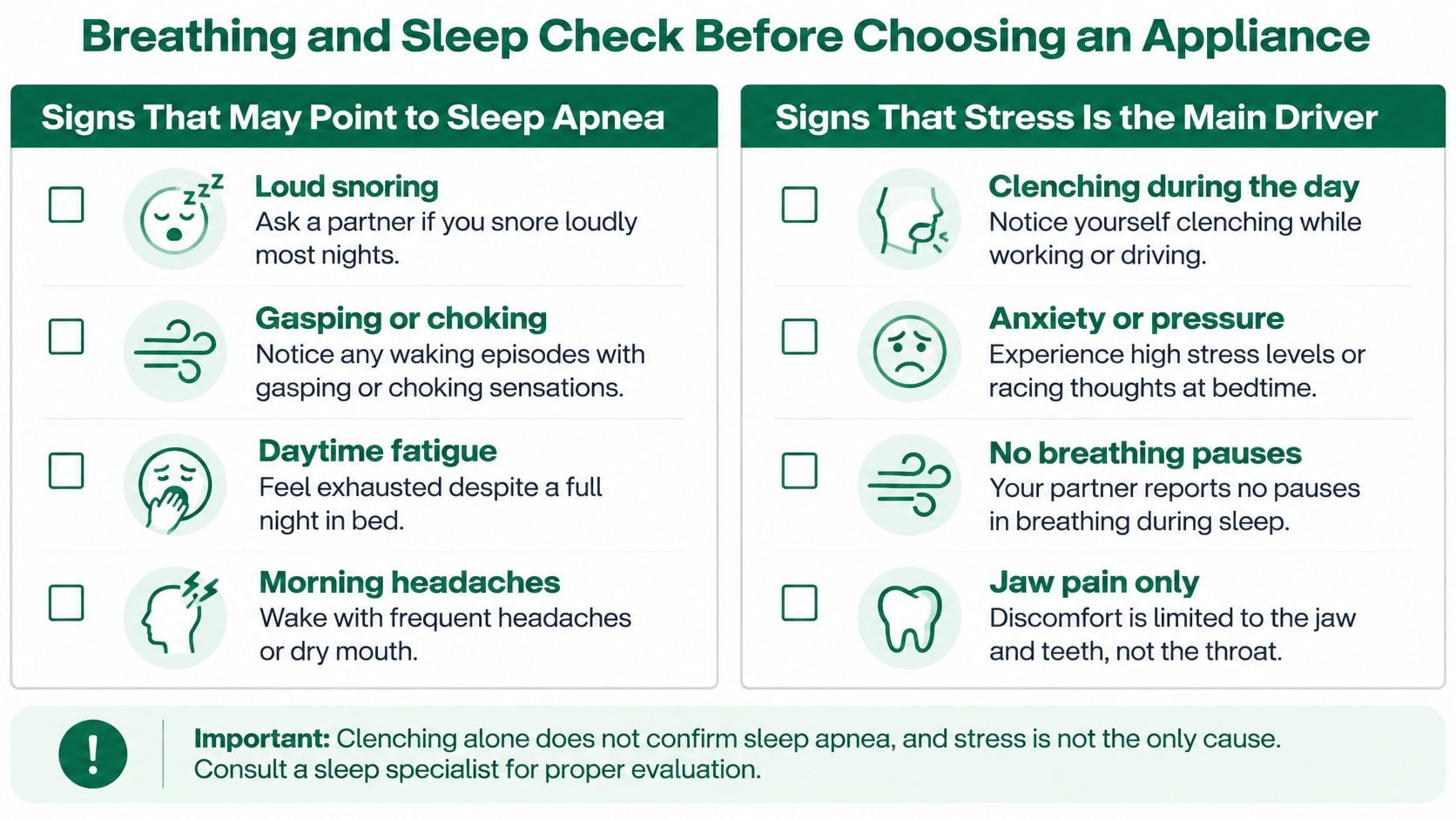
A reader who snores loudly, has witnessed pauses in breathing, wakes gasping, feels very sleepy during the day, or often wakes with headaches should tell a physician or qualified sleep professional. These symptoms call for evaluation, not self-diagnosis. Sleep apnea is diagnosed through a sleep study and physician assessment, using an appropriate home test or an attended study when indicated.
| What to consider | What it can help address | What it can't establish or guarantee |
|---|---|---|
| Symptom and sleep tracking | Patterns in jaw discomfort, sleep disruption, and possible airway symptoms | Whether sleep apnea is present |
| Relaxation and sleep-habit changes | Some behavioral and sleep-related contributors | That all clenching will stop |
| Dentist-supervised mouth guard | Tooth protection and, in selected cases, reduced jaw loading | That an underlying breathing problem is treated |
| Medical sleep evaluation | Assessment for suspected sleep-disordered breathing | That jaw symptoms have only one cause |
Medication and substance use also belong in the review. Alcohol, caffeine, tobacco, and some antidepressant, seizure, and ADHD medicines may be relevant contributors. Anyone concerned about a prescribed medicine should speak with the prescribing clinician before making a change.
A mouth guard can protect teeth without correcting a breathing disorder. Readers who notice snoring or unrefreshing sleep can learn more about sleep-disordered breathing. A clinician can help determine whether sleep testing is appropriate and how any dental appliance fits into care.
Protect Your Teeth With the Right Mouth Guard
A mouth guard's main job is to separate the teeth and help limit grinding damage. A dentist-supervised custom stabilization appliance may also reduce muscle loading for some people, but it doesn't reliably eliminate the underlying sleep-bruxism activity. It isn't a treatment for a breathing disorder.
An appliance needs to fit the person's teeth and jaw comfortably. A dentist can assess whether a device is appropriate, check its fit, and monitor symptoms, bite, and jaw function. An unmonitored boil-and-bite device may fit poorly or irritate symptoms, so it shouldn't be treated as a universal solution. Evidence on stabilization splints suggests possible short-term reduction in sleep-bruxism events, but doesn't show a clear advantage over other oral appliances by 2–6 weeks, and the overall evidence quality is limited (systematic review of oral appliances for sleep bruxism).
A practical follow-up approach is to keep track of comfort, morning pain, tooth sensitivity, headaches, jaw opening, and bite changes after starting a clinician-recommended appliance. Report persistent soreness or worsening symptoms instead of assuming the device is working because it causes discomfort. A dentist can review fit and function and decide whether adjustments or another approach are needed.
For suspected sleep apnea, a night guard selected only for clenching shouldn't replace medical evaluation. A clinician needs to assess for sleep apnea before an oral appliance is used to treat it; when oral-appliance therapy is appropriate for an adult with sleep apnea, it requires qualified dental oversight and follow-up. CPAP remains an important treatment for sleep apnea, while an oral appliance may be an appropriate option in selected cases. The choice should follow assessment, not a guess based on clenching alone.
Know When Your Plan Needs Professional Care
Progress can mean less morning pain, improved jaw movement, fewer signs of tooth damage, or a clearer understanding of what triggers symptoms. The absence of grinding sounds alone doesn't show whether the problem has improved.
Persistent soreness, headaches, sensitive or damaged teeth, loose teeth, jaw locking, restricted opening, snoring, breathing pauses, gasping, or daytime sleepiness warrant evaluation. A dentist can assess teeth and jaw symptoms; a physician or sleep specialist can evaluate possible breathing problems. Physical therapy or coordinated care may also be considered. Pain and Sleep Therapy Center is a TMJ/craniofacial pain and dental sleep medicine practice led by triple board-certified Dr. Ryan Robinson, serving Newark and Wilmington, Delaware, and Bryn Mawr and the Philadelphia Main Line.
Pain and Sleep Therapy Center offers evaluation for jaw and facial pain, dental sleep medicine, and conservative care suited to possible contributing factors. Readers in the area can visit Pain and Sleep Therapy Center to Request an Appointment or Take the Sleep Quiz, or call the Newark office at (302) 239-1757.