If a jaw clicks but still moves comfortably, does the sound really mean something is wrong? That question matters more than how loud the click sounds. Jaw clicking when opening the mouth isn't a diagnosis, and the most useful next step is to separate the noise from pain, locking, and changes in everyday function.
A calm assessment starts with what has changed: whether eating hurts, opening feels limited, or the jaw catches. Those details help determine whether monitoring, a routine examination, or urgent care makes sense.
Table of Contents
- Painless Clicking Versus Symptoms That Need Care
- What Makes the Jaw Joint Click Inside
- How Muscle Tension and Daily Habits Add to Clicking
- How a Specialist Evaluates Jaw Clicking and Imaging
- Conservative and Clinic Treatment Options Compared
- When Jaw Clicking Overlaps With Snoring and Sleep
- Book a Jaw Evaluation Before Symptoms Progress
Painless Clicking Versus Symptoms That Need Care
Jaw clicking is common. A 2025 systematic review in the Journal of Oral & Facial Pain and Headache found clicking or other temporomandibular joint sounds in 29.8% of participants across 22 studies involving 6,372 people. That finding describes joint sounds, not how many people need treatment.
The National Institute of Dental and Craniofacial Research explains that clicking or popping without pain is common and generally doesn't require treatment. Concern grows when sound comes with tenderness, restricted opening, chewing difficulty, locking, or a meaningful change from a person's usual pattern.
Jaw clicking patterns and the action each one calls for
| Symptom pattern | What it may point to | Suggested action |
|---|---|---|
| Painless clicking, normal opening, stable over time | Common joint sound, generally not a treatment need | Monitor and note any change |
| Clicking with ongoing pain or tenderness | Joint or chewing-muscle involvement possible | Non-urgent clinical exam |
| Clicking with headaches, morning jaw fatigue or chewing limits | Functional strain from joint or muscles | Routine evaluation with a clinician |
| Jaw locks open or shut at times | Mechanical joint problem such as disc displacement | Prompt evaluation |
| Cannot open or close fully, or cannot eat or drink | Possible urgent dysfunction | Urgent medical care |
| Facial swelling, fever, numbness, weakness or visual changes | Possible infection, neurological or other urgent cause | Urgent medical care |
| Jaw symptoms with chest pain, breathlessness, sweating or faintness | Possible cardiac emergency | Call emergency services now |
These categories guide action, not self-diagnosis. Mayo Clinic's TMJ guidance supports evaluation for persistent pain or tenderness and difficulty opening or closing completely. New neurological symptoms, visual changes, or chest symptoms shouldn't be assumed to come from a jaw disorder.
Age and prevalence don't determine the diagnosis
Clicking occurs across ages. In a 2024 BMC Oral Health clinical study of patients with temporomandibular disorders, self-reported clicking occurred in 57.0% of patients aged 15 or younger, compared with 28.5% in the oldest group studied. Those patients already had jaw-related disorders, so the figures aren't population estimates.
Population surveys summarized by NIDCR also differ by country and how sounds are recorded. Prevalence provides context, not a diagnosis at any age.
Practical rule: The symptom pattern matters more than the sound itself.
A click doesn't prove disc damage, arthritis, or a need for an appliance, imaging, or surgery. The immediate action is to identify the matching symptom pattern and record when it began.
What Makes the Jaw Joint Click Inside
A jaw click comes from movement within or around the joint. The temporomandibular joint, or TMJ, connects the lower jaw to the skull. Its rounded end, called the condyle, both rotates and slides against the skull as the mouth opens. A small cartilage disc sits between the moving surfaces, cushioning their contact.
The illustration shows these parts during opening.
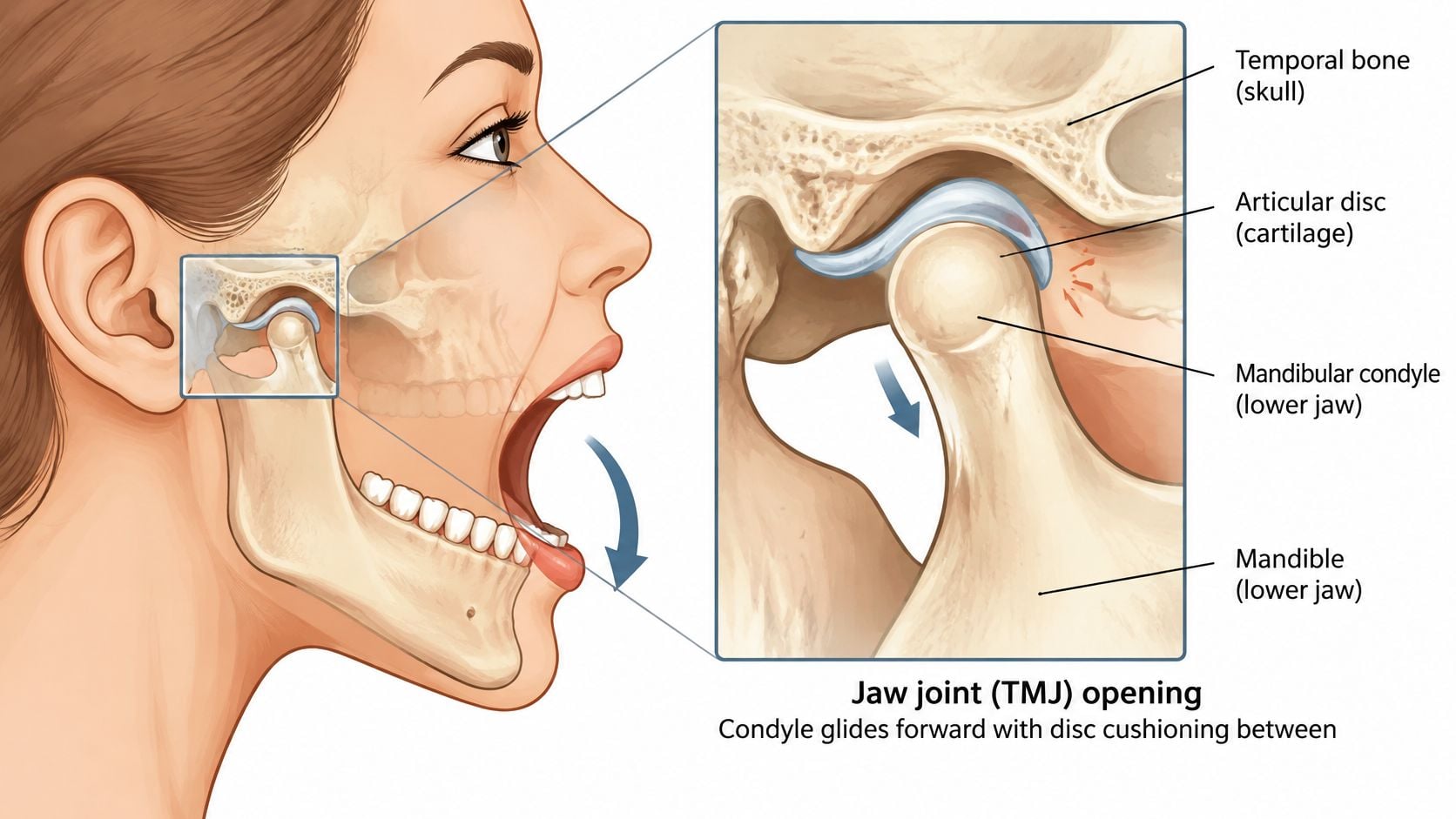
One mechanism that can create a click is disc displacement with reduction. The disc may sit forward when the mouth is closed, then move back between the joint surfaces as the jaw opens. That return movement can make a distinct sound. As the mouth closes, the disc may shift forward again, sometimes producing another click.
Here, reduction means the disc returns to a position between the joint surfaces during movement. It describes the motion, not how the person feels. Both sounds can occur without pain or limits on eating.
Why sound alone can't show the disc's position
A click is a sound produced during joint movement, not a map of where the disc sits. The National Academies' discussion of temporomandibular disorders explains that clicking and jaw deviation can't reliably establish the exact disc position. Magnetic resonance imaging, or MRI, is the standard imaging method when a precise internal-joint diagnosis is necessary.
Clicking and locking aren't interchangeable
A click is a sound during movement. Locking means the jaw catches and has trouble opening or closing normally. A disc that doesn't return to its usual working position can contribute to closed locking, though other mechanisms may also be involved.
For example, a person who clicks while eating comfortably has a different movement pattern from someone whose jaw catches before they can take a normal bite. Repeatedly forcing the jaw open can aggravate discomfort without clarifying what is happening.
TMJ and facial pain can involve jaw pain, facial pain, chronic headaches, and clicking or popping sounds. A thorough evaluation considers how the joint moves alongside the person's symptoms and history to identify possible root causes.
Track the details that describe the movement:
- Side: Whether the sound comes from the right, left, or both joints.
- Timing: Whether it happens during opening, closing, or both.
- Movement: Whether the jaw catches or moves differently when the sound occurs.
- Associated symptoms: Whether pain accompanies the click.
How Muscle Tension and Daily Habits Add to Clicking
A jaw that feels tired after concentrated computer work may have been braced for hours without much awareness. The masseter, the strong chewing muscle at the cheek, and the temporalis, the broad muscle at the temple, help close the jaw. They can become sore when kept active instead of resting.
Bruxism means teeth grinding or jaw clenching. It can occur while awake or asleep, although daytime bracing and sleep-related grinding aren't identical behaviors. Both deserve attention when they accompany soreness or tooth wear, but neither can be diagnosed from a click alone.
Habits worth noticing
- Clenching during stress or concentration: Holding the teeth together keeps the chewing muscles engaged even when there's no food to chew.
- Chewing gum or ice: Repeated chewing or biting hard material adds work during a period when the jaw may already feel irritated.
- Nail biting or chin support: Biting nails repeatedly loads the jaw; leaning the chin heavily into a hand can also alter its resting position.
- One-sided chewing: Favoring one side may reflect habit, but it can also signal a painful tooth or another problem that needs examination.
- Forward-head screen posture: Long periods without movement can accompany neck and jaw tension, even though posture alone doesn't establish the cause of TMD.
Temporomandibular disorders, or TMD, are conditions affecting the jaw joints, chewing muscles, or both. Muscle tenderness and joint clicking can occur together, so a painless click doesn't make nearby soreness irrelevant.
Stress and disrupted sleep may contribute to clenching in some people. For general relaxation ideas, Cleverfy Beauty's practical stress management techniques can complement, rather than replace, clinical care. No stress-management routine can establish why a joint clicks.
A gentler resting pattern
At rest, the teeth generally don't need to remain pressed together. Brief reminders to release tooth contact and take comfortable movement breaks may help identify unconscious bracing. Painful stretching or repeated attempts to make the joint pop aren't useful habit exercises.
Nasal breathing and tongue resting posture also influence oral rest position. Persistent nasal blockage or difficulty finding a comfortable resting position deserves assessment rather than forced changes.
The center's guide to relaxing the masseter muscle provides further education about jaw tension. Habit changes are often an early step, but they're most useful when an examination clarifies whether symptoms arise mainly from muscles, joints, teeth, or another source.
How a Specialist Evaluates Jaw Clicking and Imaging
A click is a sound to investigate, not a diagnosis by itself. The useful questions are whether it comes with familiar pain, restricted movement, locking, or other symptoms, and what the examination finds.
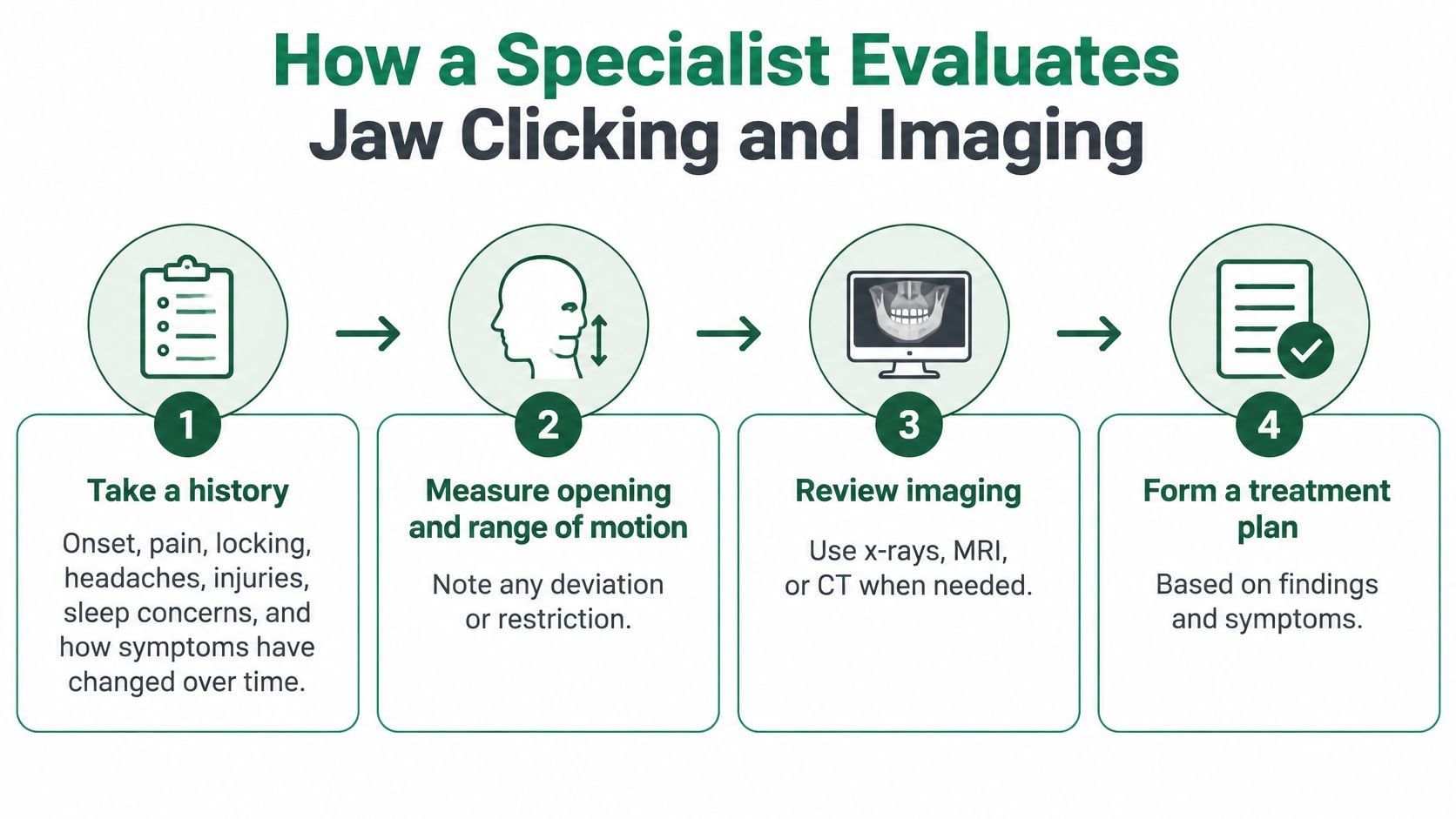
What the examination includes
Take a detailed history. The clinician asks about symptoms, when they began, changes over time, injuries, sleep concerns, and what movements are difficult. For clinicians organizing an interview, patient history taking sample templates show ways to structure that conversation.
Measure opening and movement. The clinician assesses how far the jaw opens and observes its path, including any deviation, catching, or restriction. These measurements help describe how the jaw functions.
Check joint sounds during movement. The clinician listens and may feel for sounds or vibrations as the jaw opens, closes, and moves side to side or forward. The DC/TMD clinical publication describes reproducible examiner-detected sounds as part of assessing joint conditions. It also reports MRI abnormalities in 20%–34% of asymptomatic patients, a reminder that an image needs to be interpreted in context.
Examine tenderness. Gentle pressure over the joints, cheeks, and temples can show whether an area reproduces the person's familiar pain.
Review teeth and bite. Tooth wear, dental pain, and changes in how the teeth meet add useful context. These findings alone do not establish the cause of TMD.
Select imaging to answer a clinical question. Cone-beam computed tomography, or CBCT, shows hard tissues such as bone. MRI can assess discs and other soft tissues. The choice depends on what the examination suggests and whether imaging could guide care.
Consider sleep diagnostics when indicated. Snoring, observed pauses in breathing, or significant sleepiness may prompt a sleep assessment. A clinician can recommend an appropriate diagnostic pathway.
Why different imaging tests may be discussed
Pain and Sleep Therapy Center evaluates jaw concerns using patient history and interview, physical examination, range of motion, joint sounds or vibrations, and hard-tissue imaging. In some cases, evaluation may also involve sleep diagnostics or hospital-based soft-tissue diagnostics.
A 3D CBCT scan of the jaw joint is frequently needed, and patients may be referred to a diagnostic imaging center to have it completed. Whether imaging is appropriate depends on the symptoms and examination findings.
For appointment preparation, use the checklist in the final section of this article. During the visit, ask what the examination found, what diagnosis is being considered, and how a proposed scan could affect the care plan.
Conservative and Clinic Treatment Options Compared
| Option | What it targets | Often considered when | Notes |
|---|---|---|---|
| Soft foods and jaw rest | Load on the joint during flares | Early or mild symptoms | Short-term measure |
| Heat or cold with gentle jaw exercises | Muscle soreness and stiffness | Tender muscles with clicking | Listed by NIDCR as initial care |
| Over-the-counter NSAIDs such as ibuprofen | Pain and inflammation | When medically appropriate | Confirm with a clinician |
| Habit reduction and stress management | Clenching, gum chewing, nail biting | Habit-driven symptoms | Often combined with other care |
| Physical therapy | Jaw movement and muscle function | Restricted motion or chronic pain | Clinician-guided program |
| Orthotic oral appliance therapy | Joint stabilization and bite support | Ongoing symptoms associated with grinding or joint loading | Effect on headaches varies |
| Cold laser therapy | Pain modulation as an adjunct | Pain-related cases | Used alongside other care |
| Specialist referral or surgery | Diagnostic uncertainty or structural problems | Severe or unresolved cases | Surgery rarely needed first |
Why conservative care comes first
Conservative care means starting with less invasive approaches that can be adjusted or stopped. The American Academy of Orofacial Pain's TMJ information supports conservative management, including self-care, exercises, physical therapy, and selected appliances. Surgery is rarely needed and is generally reserved for severe cases with a clear indication.
During a flare, softer foods such as eggs, yogurt, cooked vegetables, or tender fish can reduce chewing demands. Jaw rest means avoiding unnecessary loading, not keeping the jaw completely motionless. Heat or cold should be comfortably applied with skin protection, and exercises should stay within the clinician's guidance.
Nonsteroidal anti-inflammatory drugs, or NSAIDs, include ibuprofen. They aren't appropriate for everyone, particularly with certain stomach, kidney, bleeding, or medication concerns. A clinician or pharmacist can review safety before use.
Treatment success should be judged by comfort, eating, movement, and daily function, not only by whether a click disappears.
How clinic-based options fit together
An orthotic is a custom oral appliance intended to support a more comfortable jaw relationship and manage loading. It requires follow-up to assess comfort, function, and bite changes. It shouldn't be treated as an automatic answer to every joint sound.
Cold laser therapy may be considered as an adjunct for pain management, not a standalone correction for every internal joint problem. Physical therapy can address movement and muscle function through an individualized program rather than forceful generic exercises.
Pain and Sleep Therapy Center's treatment plans may combine orthotic therapy, cold laser therapy, lifestyle modifications, and collaborative care. Its overview of TMJ treatment options offers additional context for those discussions.
The center doesn't guarantee that appliances will resolve headaches, although headache occurrence frequently improves with therapy. If an appliance doesn't meet treatment goals, the center actively supports access to other effective therapies. The clinician and patient should choose a plan based on the symptom pattern, realistic goals, and reassessment, rather than a promise of a particular outcome.
When Jaw Clicking Overlaps With Snoring and Sleep
Jaw symptoms and sleep-disordered breathing can occur together, which is why sleep questions belong in a jaw evaluation. Their coexistence doesn't mean that clicking proves an airway problem or that treating the jaw will automatically resolve poor sleep.
Pain and Sleep Therapy Center identifies substantial overlap in its TMJ care information, reporting that greater than 60% of patients with TMJ issues have obstructive sleep apnea. That figure shouldn't be used to estimate an individual person's likelihood from clicking alone. It explains why a sleep study may be suggested during TMJ therapy.
Sleep symptoms that deserve attention
- Loud snoring: Especially when persistent or disruptive.
- Observed breathing pauses: A partner may notice pauses followed by gasping or snorting.
- Morning symptoms: Headaches, jaw fatigue, or unrefreshing sleep can provide useful context.
- Daytime effects: Sleepiness and fatigue deserve discussion even when sleep seems long enough.
Obstructive sleep apnea, or OSA, involves repeated breathing interruptions related to upper-airway blockage during sleep. A physician evaluates and diagnoses sleep apnea using a sleep study. Home sleep testing is appropriate for some patients, while others need a different testing pathway.
The center's explanation of snoring and TMJ concerns can help patients prepare for a coordinated discussion. Sleep symptoms should be disclosed before any nighttime appliance is selected.
Why appliance selection matters
A nighttime appliance can be a maintenance component of TMJ care, but a jaw appliance and a sleep-apnea appliance aren't interchangeable. An appliance not designed to control apnea may worsen breathing; the center cautions that severity can double in some patients. That possibility calls for screening and individualized monitoring, not an assumption that every guard is harmful.
Oral appliance therapy is a CPAP alternative for selected patients when coordinated with the treating physician. Patients already using CPAP should continue prescribed treatment and discuss proposed changes with their physician.
Adult tongue ties, which restrict tongue movement, may contribute to oral-function difficulties and can be associated with snoring, sleep-disordered breathing, and head, neck, or shoulder discomfort. They shouldn't be assumed to explain OSA without a full assessment.
Before appliance selection: Jaw comfort and nighttime breathing both belong in the treatment discussion.
Bringing jaw and sleep concerns to the same appointment helps clinicians avoid treating either in isolation.
Book a Jaw Evaluation Before Symptoms Progress
Is the click painless and your jaw moving normally, or does it come with pain or restricted movement? The sound alone does not diagnose a problem. If clicking is stable and painless, it may not need treatment. Pain that worsens or difficulty opening and moving the jaw deserves evaluation rather than waiting for a routine checkup.
Medication and injury history, sleep concerns, and any oral appliances can help a clinician understand the broader picture. Share these details at your appointment, especially if a device seems to change your comfort or breathing.
A root-cause approach to care
Pain and Sleep Therapy Center evaluates TMJ-related pain and emphasizes conservative, non-invasive care suited to the findings. The team can coordinate with medical and dental professionals when symptoms call for broader assessment.
Dr. Ryan Robinson, triple board-certified in craniofacial pain and dental sleep medicine, leads the practice. Patients with sleep concerns are seen by a dentist with advanced training in treating sleep apnea.
The center has offices in Newark, Delaware, and Bryn Mawr, Pennsylvania. An evaluation can clarify which symptoms need attention without committing you to an appliance or procedure.
Pain and Sleep Therapy Center provides root-cause evaluation for jaw clicking, jaw and facial pain, and related sleep concerns. Visit Pain and Sleep Therapy Center to Request an Appointment or Take our Sleep Quiz.