A report arrives in a patient portal late at night. It lists initials, graphs, and a number circled in bold, but it doesn't plainly say whether sleep is healthy or what should happen next. That gap between a number and its meaning is where most confusion starts.
Understanding sleep apnea test results meaning begins with one calm principle. A single score gives a severity category. The full report, paired with symptoms and medical history, guides the next step, and a sleep physician makes the diagnosis.
Table of Contents
- Sleep Apnea Severity Levels at a Glance
- What Each Number on Your Report Measures
- How Much a Home Sleep Test Can Tell You
- Why the Same Number Can Mean Different Things
- How Results Shape Your Treatment Options
- Questions to Bring to Your Sleep Physician
- Confirm Your Next Step With a Sleep Specialist
Sleep Apnea Severity Levels at a Glance
The central number on most adult reports is the apnea-hypopnea index, or AHI, or the respiratory event index, or REI, on many home tests. An apnea is a pause in breathing. A hypopnea is a partial reduction in breathing. The index estimates how many of those events occur, on average, each hour.
How to Place a Number
The American Academy of Sleep Medicine measure classifies results below 5 events per hour as normal, 5 to 14.9 as mild obstructive sleep apnea, 15 to 29.9 as moderate, and 30 or more as severe. Those cutoffs turn a raw count into a shared language for physicians, dentists, and patients. They don't, by themselves, explain how a person feels during the day.
| Events per hour | AASM category | What it means for next steps |
|---|---|---|
| Below 5 | Normal range | Usually reassuring, but persistent symptoms still deserve review |
| 5 to 14.9 | Mild obstructive sleep apnea | Treatment options are discussed, guided by symptoms and oxygen findings |
| 15 to 29.9 | Moderate obstructive sleep apnea | Treatment is commonly recommended, with related health risks evaluated |
| 30 or more | Severe obstructive sleep apnea | Prompt physician review and a treatment plan are typically prioritized |
Three short examples show how the table works in practice. An AHI of 8 falls in the mild range. An AHI of 22 falls in the moderate range, and an AHI of 36 falls in the severe range.
A reader can use those examples as a first check, not as a self-diagnosis. Find the AHI or REI on the first page or summary, match it to a row, then look for the physician's written impression nearby. That impression may add words such as obstructive, central, or positional, which change what the number means.
Why the Category Matters, and Where It Stops
Severity helps set urgency. A higher category often prompts a closer look at related concerns such as excessive daytime sleepiness, high blood pressure, cardiovascular disease, and impaired driving. It can also affect how quickly treatment starts and how closely progress is checked.
The category is a milestone, not a verdict. Clinicians read it alongside symptoms, oxygen levels, age, medical conditions, body position, and, when available, sleep stage. Events that cluster on the back or during dream sleep can matter even when the full-night average looks modest.
A low index does not automatically mean sleep is restful. If loud snoring, morning headaches, or daytime fatigue continue, those symptoms still deserve a clear explanation.
A practical step helps at this stage. Print the full report, circle the AHI or REI, and bring every page to the appointment. Sleep apnea is diagnosed through a sleep study and a physician, not from a number alone, and the extra pages often contain the details that explain the headline score.
What Each Number on Your Report Measures
Reports use several related measures because breathing events affect the body in more than one way. Some count events. Others show oxygen changes, brief awakenings, sleep stages, or body position.
| Term | What it measures | Where it usually appears |
|---|---|---|
| AHI (apnea-hypopnea index) | Apneas and hypopneas per hour of sleep | Polysomnography |
| REI (respiratory event index) | Breathing events per hour of recording time | Home sleep tests |
| RDI (respiratory disturbance index) | Events plus effort-related arousals per hour of sleep | Polysomnography |
| ODI (oxygen desaturation index) | Oxygen drops per hour | Polysomnography and some home tests |
| SpO2 nadir | Lowest oxygen saturation recorded | Both |
| T90 (time below 90% saturation) | Cumulative time with oxygen under 90% | Both |
| Arousal index | Arousals per hour of sleep | Polysomnography |
| Sleep stages (N1 to N3, REM) | Share of time in each sleep stage | Polysomnography only |
| Body position | Whether events occur mostly when lying on the back | Both |
Reading the Rows in Plain Language
The RDI is broader than the AHI. It adds effort-related arousals, which are brief shifts toward wakefulness linked to harder breathing effort, even when oxygen doesn't drop much. A higher RDI than AHI can help explain fragmented, unrefreshing sleep.
The ODI counts oxygen drops per hour. The SpO2 nadir is the single lowest oxygen reading, while T90 shows total time spent below 90%. One brief dip and a long stretch below 90% tell different stories, so both values matter.
The arousal index counts brief awakenings per hour, many of which a sleeper won't remember. Sleep stages show time in light sleep, deep sleep, and REM, the stage linked with dreaming. Body position shows whether events gather during back-sleeping, which may point toward positional options.
SpO2 needs careful reading. The Mayo Clinic overview of obstructive sleep apnea diagnosis describes SpO2 as the percentage of hemoglobin carrying oxygen in the blood, and a report may include the lowest level, the average level, and time below a threshold. A single low reading doesn't diagnose sleep apnea on its own, because sensor quality, body position, and lung or heart disease can affect it.
A useful habit is simple. Note which terms appear on the report. Many home tests list only an index and oxygen values, so missing rows don't mean missing effort. They reflect what that test was built to measure.
How Much a Home Sleep Test Can Tell You
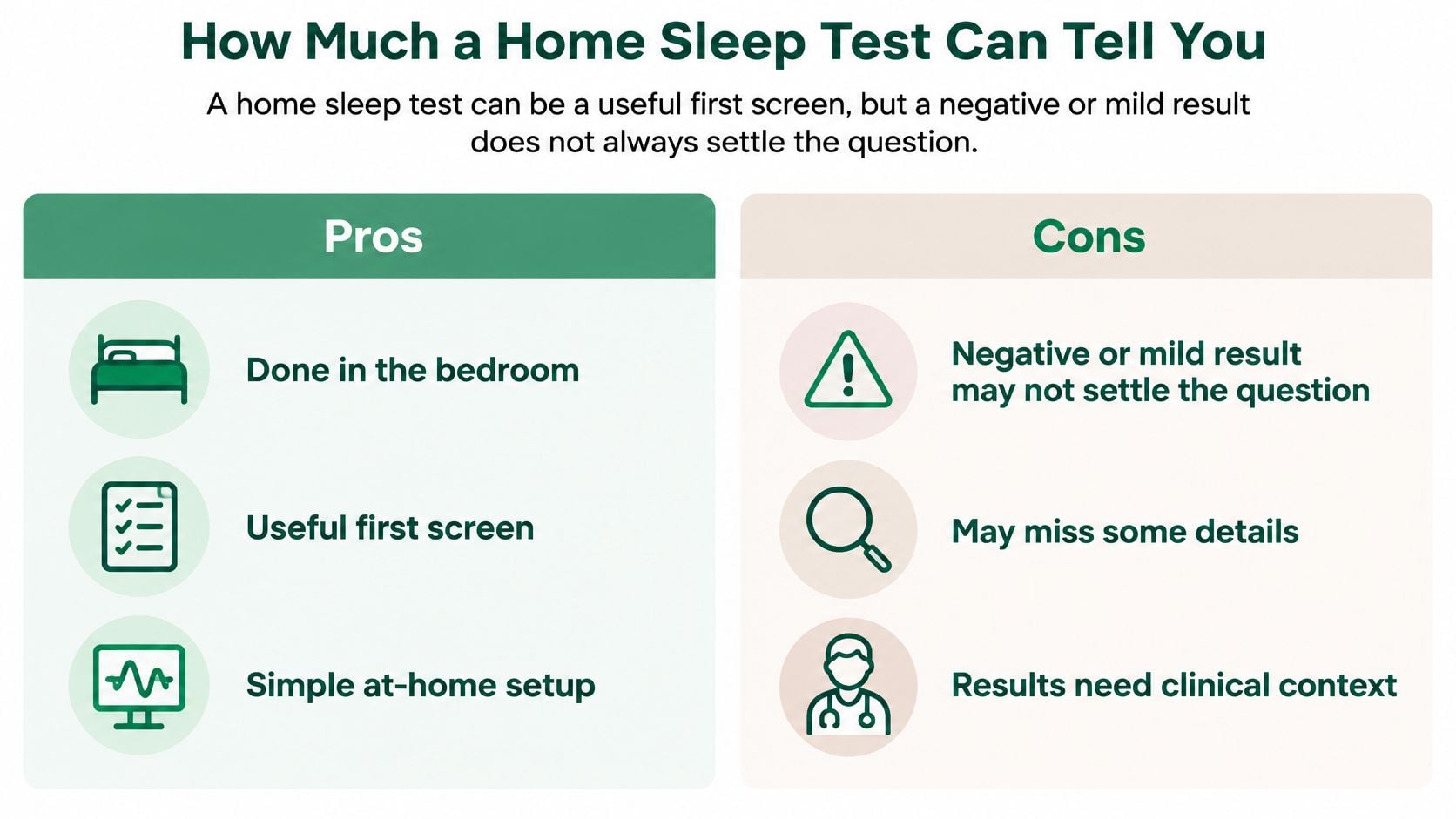
A home sleep test can be a useful first screen, but a negative or mild result does not always settle the question. A diagnosis is determined either by an overnight polysomnogram at a facility designed to monitor sleep or by a home sleep study, and each method reads the night a little differently.
Home test sensors monitor airflow, respiratory effort, blood oxygenation, movement patterns, and snoring. Testing in a familiar bedroom is part of the appeal, and sleep environment matters for a clean recording: the same thinking that leads readers to seek out mattress tips for quieter nights applies here, since a comfortable setup helps the test capture a typical night. Comfort steps do not replace testing, and the full process is outlined in this guide to a home sleep apnea test.
The Main Limit in Plain Words
Home sleep tests that record without EEG sensors cannot reliably distinguish sleep from wakefulness. They divide breathing events by total recording time and report an REI, a respiratory event index, rather than a true AHI. If you lie awake for a long stretch, that larger denominator can make the rate look lower than it would during confirmed sleep. A clinical reference on home testing reports that using recording time rather than confirmed sleep time can underestimate the AHI by at least 20%. The American Academy of Sleep Medicine public safety FAQ also notes that home testing can underestimate severity, does not routinely capture arousals, and reports a false-negative rate as high as 17% in relevant settings.
That gap changes what "normal" means. A normal home result is normal within what the test was built to see, so read it alongside your symptoms rather than as a final answer.
What home tests do well
- Bedroom screening: Records breathing events and oxygen during a typical night at home
- Lower barrier to start: Offers a simpler first step when a physician suspects obstructive sleep apnea
Where they fall short
- Estimated sleep time: Wake time can dilute the reported event rate
- Limited scope: Cannot evaluate periodic limb movements, parasomnias, nocturnal seizures, bruxism, or narcolepsy
- Less arousal detail: May miss sleep fragmentation that a lab study can record directly
A home sleep study costs less than an in-lab study but can sometimes under-diagnose sleep apnea. With severe symptoms and a negative home test, an in-lab study is occasionally recommended as follow-up. A boarded sleep physician reads and interprets the raw data either way, so the question worth raising is which test fits the symptoms you still have.
Reader action: If a home report is negative but snoring, witnessed pauses, or daytime sleepiness continue, ask the physician whether an attended in-lab polysomnogram is warranted instead of repeating the same test.
Why the Same Number Can Mean Different Things
Two people can share the same AHI and need very different conversations. The Merck Manual discussion of obstructive sleep apnea notes that standard categories classify mild disease at 5 to below 15 events per hour, moderate at 15 to 30, and severe above 30, yet two people with the same AHI can have very different physiological burdens. Event length, oxygen change, sleep stage, and symptoms explain much of that difference.
Three Hypothetical Patterns
These illustrations aren't patient stories or clinical thresholds. They're simple patterns that show why clinicians read past the headline.
Pattern one, modest count with long oxygen drops. Say the overall event count is mild, but oxygen stays low for long stretches and daytime fatigue is strong. The nadir and T90 may deserve more attention than the category suggests, because prolonged low oxygen adds burden that a count alone hides. Readers who recognize that tired pattern can review how sleep apnea and chronic fatigue can overlap, then discuss it with a physician.
Pattern two, higher count with brief events. Say events are frequent but short, with small oxygen changes and few symptoms. That profile still needs care, yet the risk discussion and treatment pace may differ from pattern one. Frequency matters, and so does what each event does to oxygen and sleep continuity.
Pattern three, low count with poor sleep quality. Say the index is low, but sleep feels unrefreshing and headaches or poor concentration persist. Insomnia, fragmented sleep, circadian timing problems, medication effects, pain, or another sleep disorder may explain those symptoms better than breathing events do.
Context Measures That Clarify the Picture
Clinicians often weigh the ODI, average and lowest oxygen, duration of low oxygen, event duration, and clustering during REM or back-sleeping. They also check whether respiratory-effort arousals raise the RDI above the AHI. That gap can signal repeated sleep disruption even when scored apneas and hypopneas look limited.
Medical context matters too. Blood pressure, heart or lung disease, age, and alertness at work or while driving can shift how a result is prioritized. A number that looks borderline on paper may carry more weight when symptoms affect safety.
The better question isn't only which severity label applies. It's which result best explains the symptoms, and what that result changes about the next step.
How Results Shape Your Treatment Options
Results guide treatment options, but they don't decide them alone. Symptoms, airway and jaw anatomy, medical history, and personal preferences all shape the plan. A physician confirms the diagnosis first, then the care team matches options to the pattern on the report.
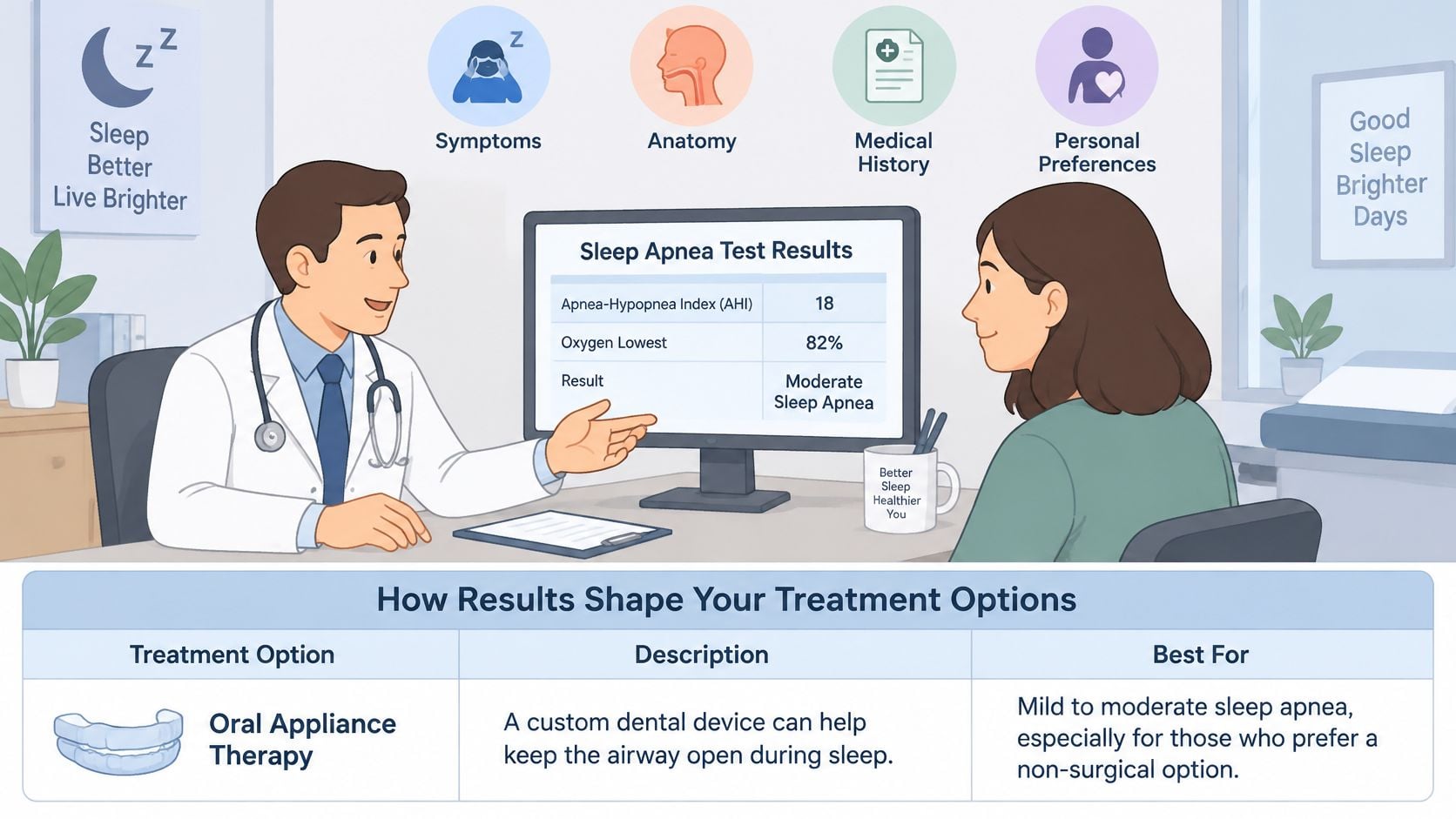
| Option | Often considered when | Points to discuss |
|---|---|---|
| Oral appliance therapy | Mild to moderate sleep apnea, or CPAP not tolerated | Fit, adjustment period, follow-up sleep test |
| CPAP | Moderate to severe sleep apnea, often a first-line option | Mask fit, nightly use, adherence |
| Positional and lifestyle measures | Mild sleep apnea or events mostly when sleeping on the back | Sleep position, alcohol timing, weight changes |
| Surgery or other procedures | Selected anatomical cases after conservative options | Specialist evaluation, risks, recovery |
How Each Path Fits a Report
Oral appliance therapy uses a custom dental device that gently moves the lower jaw forward during sleep. It may help many patients with mild to moderate disease, and it's also discussed when CPAP isn't tolerated. Fit checks, gradual adjustment, jaw comfort, and a follow-up sleep test help confirm whether it's meeting goals. A side-by-side review of oral appliance therapy versus CPAP can help readers prepare questions.
CPAP delivers steady air pressure through a mask to keep the airway open. It's commonly considered for moderate to severe disease and works best with consistent nightly use and a good mask fit. Leak, pressure comfort, nasal dryness, and adherence data are practical points to review early, not after months of frustration.
Positional and lifestyle measures may help when events mostly occur on the back or when disease is mild. Side-sleeping strategies, alcohol timing, and weight changes are typical discussion points. Readers reviewing bedroom setup as one small part of that conversation can compare mattresses for sleep apnea, while keeping medical treatment decisions with their physician.
Surgery or other procedures are considered only in selected anatomical cases, after conservative options have been reviewed with a specialist. That order matters. Non-invasive paths come first when they're clinically appropriate, and anatomical procedures require a clear reason, expected benefit, and recovery plan.
Many patients benefit from combined approaches, such as a device plus positional steps. When physical barriers in the airway prevent CPAP and oral appliances from helping, Pain and Sleep Therapy Center works with the appropriate physician to create a plan for the best possible outcome. When an oral appliance doesn't meet treatment goals, the center actively supports the patient in obtaining other effective therapies.
No option should be chosen from the AHI alone. The right question is whether the therapy fits the diagnosis, the anatomy, and the life it has to work in every night.
Questions to Bring to Your Sleep Physician
A short, prepared list makes the review appointment more useful. It also prevents a common problem, leaving with a treatment name but no clear reason why it fits the report.
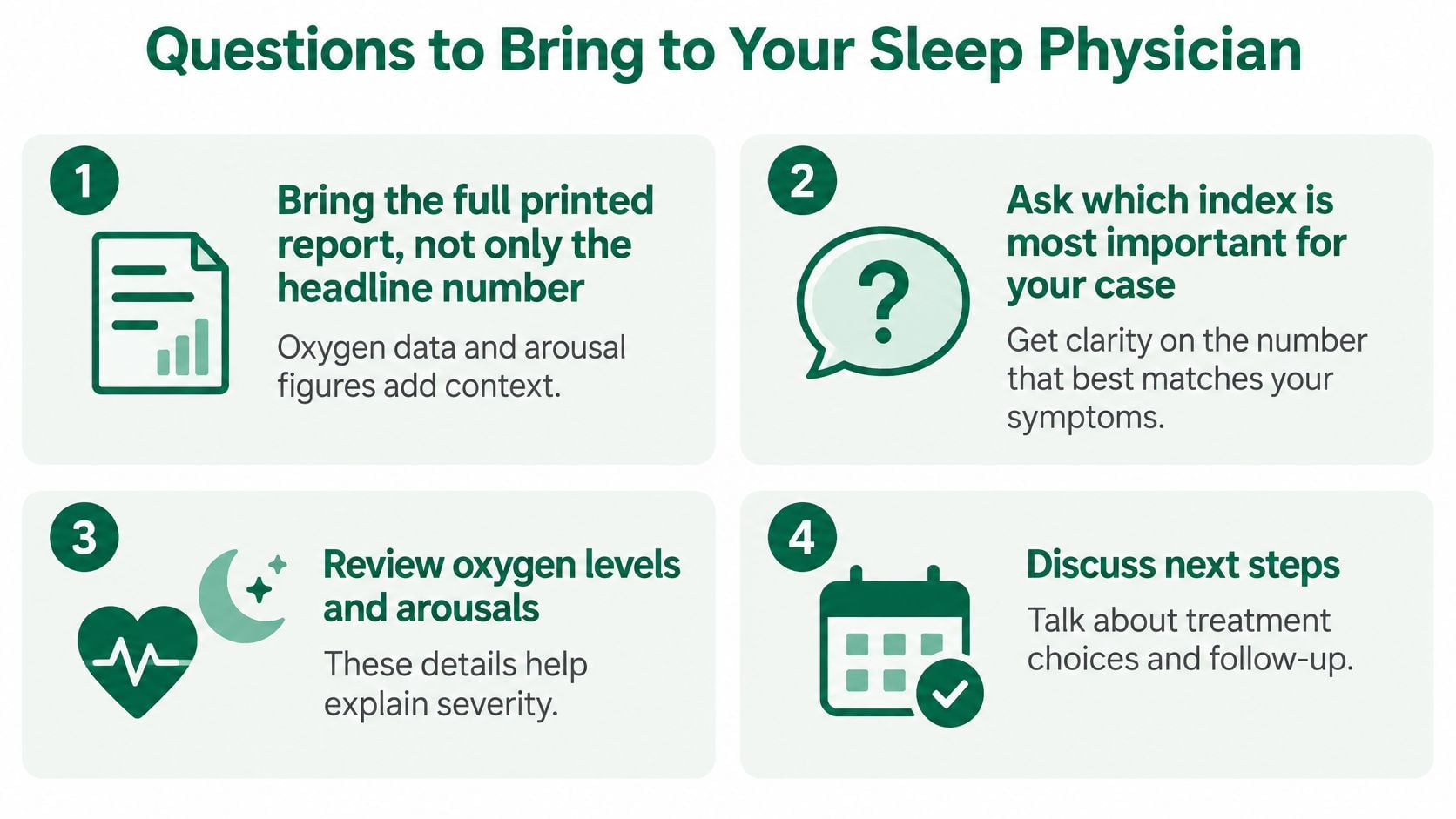
- Bring the full printed report. Oxygen data, arousal figures, and position details add context that the headline number can't provide.
- Ask which index is reported, AHI or REI. That answer shows whether events were divided by confirmed sleep time or recording time.
- Ask about the lowest oxygen reading and time below 90%. Depth and duration together show oxygen burden more clearly than either value alone.
- Ask whether arousals, body position, or REM sleep changed the picture. Clustering can explain symptoms and may point toward specific treatment steps.
- Ask whether a home result needs an in-lab study. Persistent symptoms after a negative, inconclusive, or technically limited home test may justify direct sleep recording.
- Ask which options fit anatomy and goals, and what happens next. A clear follow-up test and timeline show how success will be judged.
A boarded sleep physician reads and interprets the raw data from both the polysomnogram and the home sleep study. That interpretation connects the tracings to symptoms and medical history, which is why the written impression matters as much as the tables.
Timing deserves one direct question too. If a reader hasn't had a sleep study, or it's been over 2 years since the last one, a call to the office can clarify whether a new study should be arranged before consultation. Symptoms can change, and an older report may no longer describe current sleep.
Before the visit, write down snoring, witnessed pauses, morning headaches, dry mouth, and daytime sleepiness, with rough frequency. A partner's observations can be especially helpful, since the sleeper often doesn't hear pauses or gasping. Bring that list with the report.
Confirm Your Next Step With a Sleep Specialist
A report works more like a map than a verdict: the AHI gives the category, while oxygen patterns, symptoms, and test type show which road matters next. Read together, those pieces prevent two common errors, overreacting to one score or dismissing real symptoms because a score looks low. A score can frame the conversation; diagnosis still rests on a sleep study interpreted by a physician.
Pain and Sleep Therapy Center is a dental sleep medicine and TMJ practice led by Dr. Ryan Robinson, triple board-certified in craniofacial pain and dental sleep medicine. Care emphasizes root-cause evaluation and conservative, non-invasive options before surgery, with physician coordination when medical findings require it.
Sleep and jaw concerns can overlap. Greater than 60% of patients with TMJ issues have obstructive sleep apnea, so a sleep study may be suggested during TMJ therapy. That overlap explains why sleep questions can surface during TMJ care even when jaw pain has more than one driver.
A reassuring home result has limits. If loud snoring, witnessed pauses, morning headaches, or daytime sleepiness remain strong, the next conversation should ask whether the home study could have missed events that an in-lab study would capture. The aim is matching the test's blind spots to the pattern you live with.
Readers who want a clear starting point can Request an Appointment or Take our Sleep Quiz through the website. The sleep quiz takes 15 seconds and helps evaluate sleep health before a fuller conversation. The practice serves patients in Newark, Delaware and Bryn Mawr, Pennsylvania.
Uncertainty after a sleep test is understandable, and it does not have to stall care. Bring the report and the questions it raised, then ask which finding best explains the nights and days being experienced. That conversation turns numbers into a plan, without promising a particular outcome.
Pain and Sleep Therapy Center helps patients understand sleep test findings in context and, when a physician diagnosis supports it, may discuss conservative options such as oral appliance therapy as part of coordinated care. Readers in Newark, Delaware and Bryn Mawr, Pennsylvania who want help deciding the next step can visit Pain and Sleep Therapy Center to request an appointment or take the sleep quiz.