A person's breathing events fall after sleep apnea treatment, yet their energy barely changes. That mismatch can be frustrating, but it gives the next step a clear focus: check whether treatment is addressing the breathing problem, then consider other reasons fatigue may persist.
Sleep apnea can coexist with short sleep, insomnia, low mood, a medicine side effect, or a medical condition that drains energy. Treating apnea may help while leaving another contributor untouched, much like fixing one leak does not repair every source of water damage.
A useful path is to notice the pattern of symptoms, confirm apnea through a sleep study and physician, choose treatment based on the results, and track both breathing and energy. Persistent fatigue is a reason to reassess, not proof that treatment has failed or that apnea explains every tired day.
Table of Contents
- Does Sleep Apnea Cause Chronic Fatigue
- Spotting Sleep Apnea Behind Your Fatigue
- How Breathing Pauses Drain Your Energy
- How to Get Tested for Sleep Apnea
- Choosing Between CPAP, Oral Appliances and Lifestyle Changes
- What Fatigue Improvement to Expect and How to Track It
- Deciding Your Next Step for Persistent Fatigue
Does Sleep Apnea Cause Chronic Fatigue
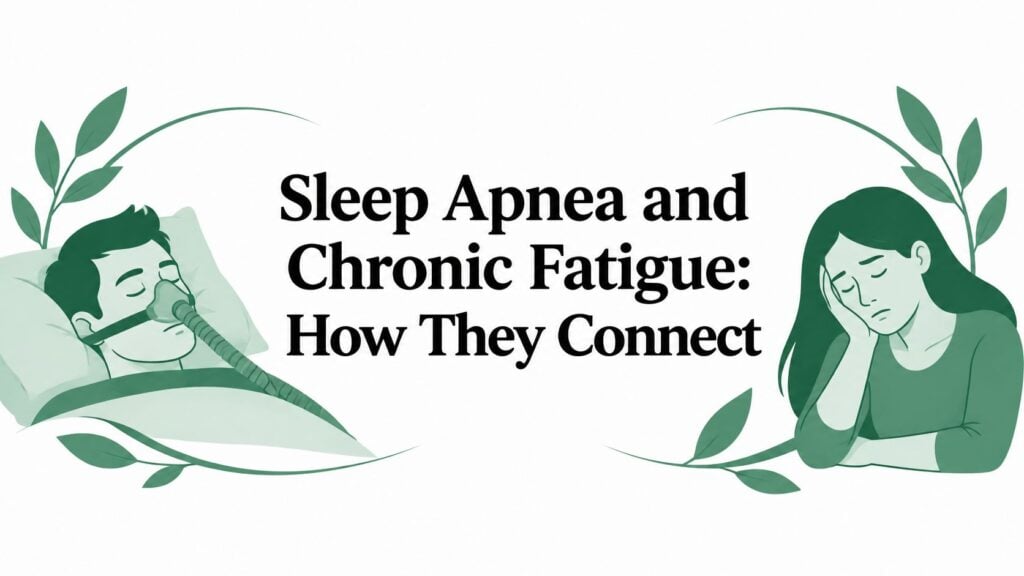
Could fatigue from sleep apnea feel different from an ordinary short night? It may show up as a steady loss of energy or sleep that never feels restorative, even when time in bed seems adequate.
Obstructive sleep apnea, often called OSA, occurs when the upper airway repeatedly narrows or closes during sleep. Breathing pauses can lower oxygen, while brief arousals pull the brain into lighter sleep. The result is fragmented rest, even if a person does not remember waking.
How Common the Problem Is
A clinical review indexed by the U.S. National Library of Medicine reports that OSA, defined as at least 5 breathing interruptions per hour, affects almost 1 billion people worldwide. The review also reports that approximately 425 million adults aged 30 to 69 have moderate-to-severe disease, defined as at least 15 events per hour.
In the United States, reported OSA prevalence is approximately 25% to 30% among men and 9% to 17% among women, with higher rates reported in Hispanic, Black, and Asian populations. These figures describe patterns across populations; a person's fatigue still needs to be understood in their own context.
Why the Connection Gets Missed
Daytime effects do not look the same for everyone. Some people feel sleepy and may nod off during quiet tasks. Others mainly notice low energy, unrefreshing sleep, headaches, irritability, or foggy thinking.
The distinction can be confusing: someone who never falls asleep in a chair may still have disrupted sleep from repeated airway obstruction. That disruption can affect concentration and daily function. A screening conversation can help identify whether sleep apnea is worth investigating, while objective testing is needed to establish the diagnosis.
Apnea can contribute to fatigue, and treatment may help. If fatigue continues, it deserves its own evaluation rather than being automatically attributed to apnea.
When fatigue remains after treatment begins, the next question is whether breathing is still being disrupted or another factor is contributing. That makes persistent tiredness a diagnostic question, not proof that treatment has failed or that apnea explains every difficult day.
Spotting Sleep Apnea Behind Your Fatigue
Could sleep apnea be behind fatigue that feels like ordinary tiredness? The pattern matters more than how tired you feel on one particular day.
Some people struggle to stay awake while reading or doing other quiet tasks. Others feel wired but drained, wake unrefreshed, or have trouble concentrating. These symptoms can point toward sleep apnea, but none can confirm it alone.
The apnea-hypopnea index, or AHI, counts apneas and hypopneas per hour and helps describe obstructive sleep apnea severity. In adults, an AHI of 5 to 14.9 events per hour is generally classified as mild OSA, 15 to 29.9 as moderate, and 30 or more as severe. These ranges describe test results, not how much fatigue a person feels.
Symptom Patterns That Lean Toward Sleep Apnea or Another Cause
| Symptom or clue | Leans toward sleep apnea | Leans toward another cause |
|---|---|---|
| Falling asleep during quiet tasks | Common in sleep apnea, especially with loud snoring | Sedating medicines, short sleep, narcolepsy-type disorders |
| Waking unrefreshed after a full night | Common in sleep apnea from repeated arousals | Insomnia, depression, restless legs |
| Witnessed breathing pauses or gasping | Strongly suggests sleep apnea | Needs a clinician review; rarely explained by other causes alone |
| Morning headaches or dry mouth | Can occur with sleep apnea | Medication effects, teeth grinding, other sleep disorders |
| Low energy without sleepiness | Less typical of sleep apnea | Anemia, thyroid disease, low mood, chronic illness |
| Restless legs or nighttime leg jerks | Possible overlap | Restless legs syndrome or periodic limb movements |
| Poor concentration and mood changes | Can occur with sleep apnea | Depression, anxiety, insomnia, medication effects |
Anemia means a shortage of healthy red blood cells, which carry oxygen through the body. Thyroid disease refers to an underactive or overactive thyroid gland, which helps regulate energy use.
How to Read the Pattern
Several clues together make sleep apnea more plausible than one symptom on its own. Witnessed pauses plus morning headaches justify a sleep study, especially when loud snoring or unrefreshing sleep also occurs. Low energy by itself is less specific and may have other explanations.
Snoring is a useful clue, but it does not settle the diagnosis. SleepHabits explains sleep apnea symptoms, and this guide to whether snoring signals sleep apnea describes why the sound needs to be considered alongside other symptoms.
A bed partner may notice breathing pauses or gasps that the sleeping person cannot report. That account adds useful detail, but a sleep study is needed to assess whether sleep apnea is present and how severe it is.
If fatigue continues after treatment begins, consider two questions in order: is the treatment adequately addressing the breathing problem, and could another cause also be contributing? Persistent fatigue is a reason to review the treatment and symptoms with a clinician, not proof that sleep apnea explains every tired day.
How Breathing Pauses Drain Your Energy
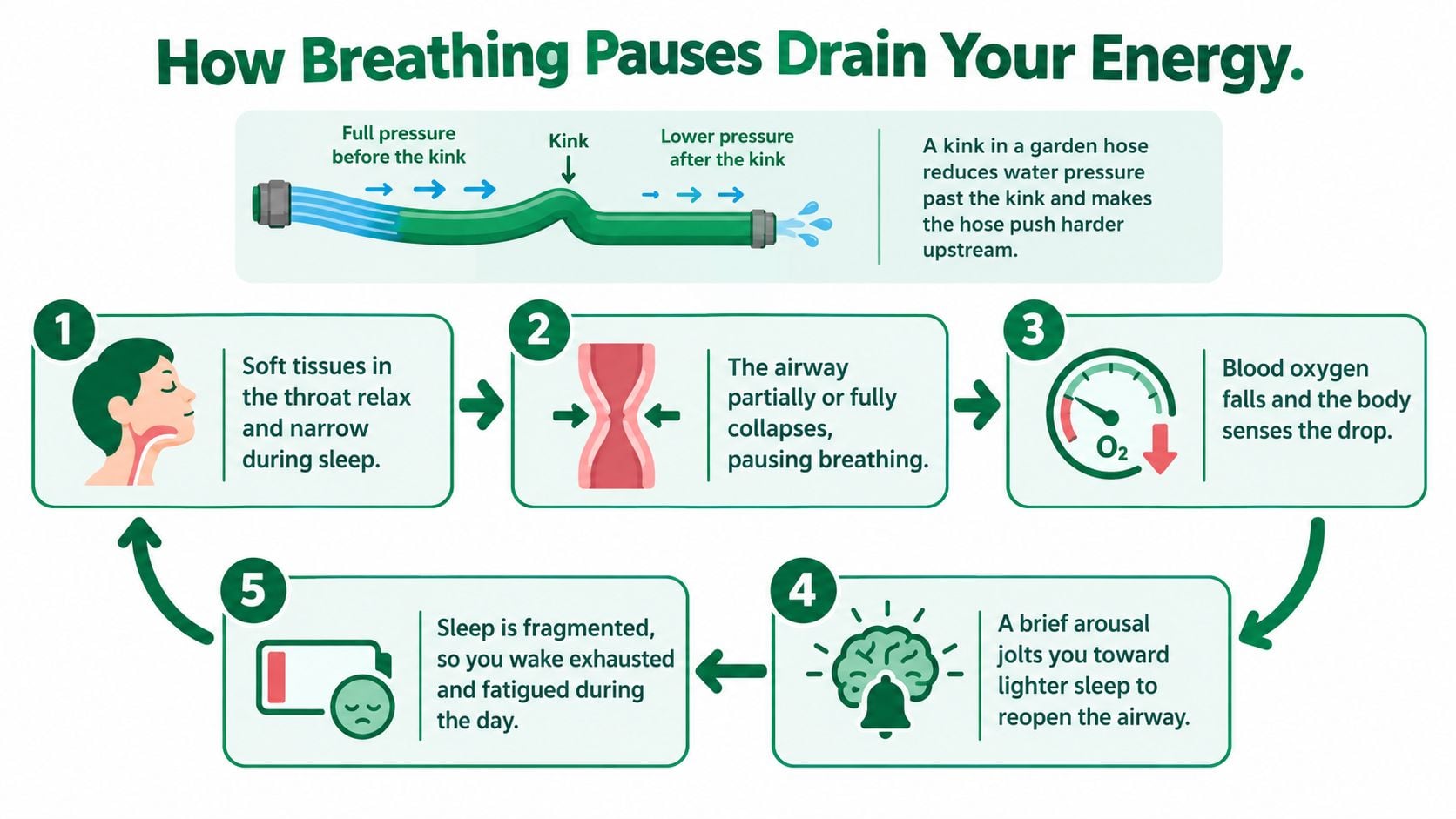
A kinked garden hose gives a useful picture. Pressure drops past the kink, flow weakens, and the system pushes harder upstream to compensate, which is close to what happens when the throat narrows during sleep.
During an obstructive event, soft tissues in the throat collapse or narrow, so airflow falls or stops even though the chest keeps trying to breathe. Oxygen dips, carbon dioxide builds, and the brain briefly arouses the person to reopen the airway, often without full awareness.
Two Problems Happening at Once
The first problem is chemical. Recurrent airway collapse causes intermittent low oxygen and carbon dioxide accumulation, a pattern a review indexed through PubMed Central links with oxidative stress, meaning cell damage from unstable molecules, plus inflammation and increased sympathetic activity, the body's fight-or-flight system. Over time, that stress may injure wake-promoting circuits, the brain networks that keep a person alert.
The second problem is broken sleep continuity. Each arousal may last only seconds, but repeated arousals reduce restorative sleep and can impair attention, memory, and daytime alertness. A person can spend eight hours in bed and still get far less steady, deep sleep than the clock suggests.
Consider two people with the same event count. One has short events with mild oxygen dips, while the other has longer events, deeper desaturation, and far more arousals, so their mornings may feel very different.
Why Event Count Isn't the Whole Story
AHI measures frequency, not the full burden. The American Academy of Sleep Medicine summary of the joint oral appliance guideline notes that oxygen desaturation, event duration, sleep stage, body position, medication use, and coexisting conditions can all influence how a person feels.
That's why clinicians also look beyond one number. Useful sleep-study details include:
- Oxygen nadir: The lowest oxygen level reached during sleep.
- Oxygen-desaturation index: How often oxygen drops by a set amount per hour.
- Time below 90% saturation: How long oxygen stays under that threshold.
- Arousal frequency: How often sleep is pulled lighter to restart breathing.
Treatment acts on the airway in different ways. CPAP uses positive air pressure to splint the airway open, while an oral appliance repositions the lower jaw and tongue-related soft tissues to improve airway space. Neither device should be chosen just to treat a vague label of chronic fatigue, because the cause needs confirmation first.
Practical rule: Repeated pauses explain why energy can fall, but they don't prove every case of tiredness starts in the airway.
A physician-led evaluation can separate OSA from insufficient sleep, anemia, thyroid disease, depression, medication effects, or another sleep disorder. That separation protects patients from both missed apnea and misplaced blame.
How to Get Tested for Sleep Apnea
Could sleep apnea be contributing to your fatigue, and what can a test really tell you? A sleep evaluation turns symptoms and sleep patterns into information a clinician can interpret, while also helping identify other possible reasons for persistent tiredness.
The Testing Path Step by Step
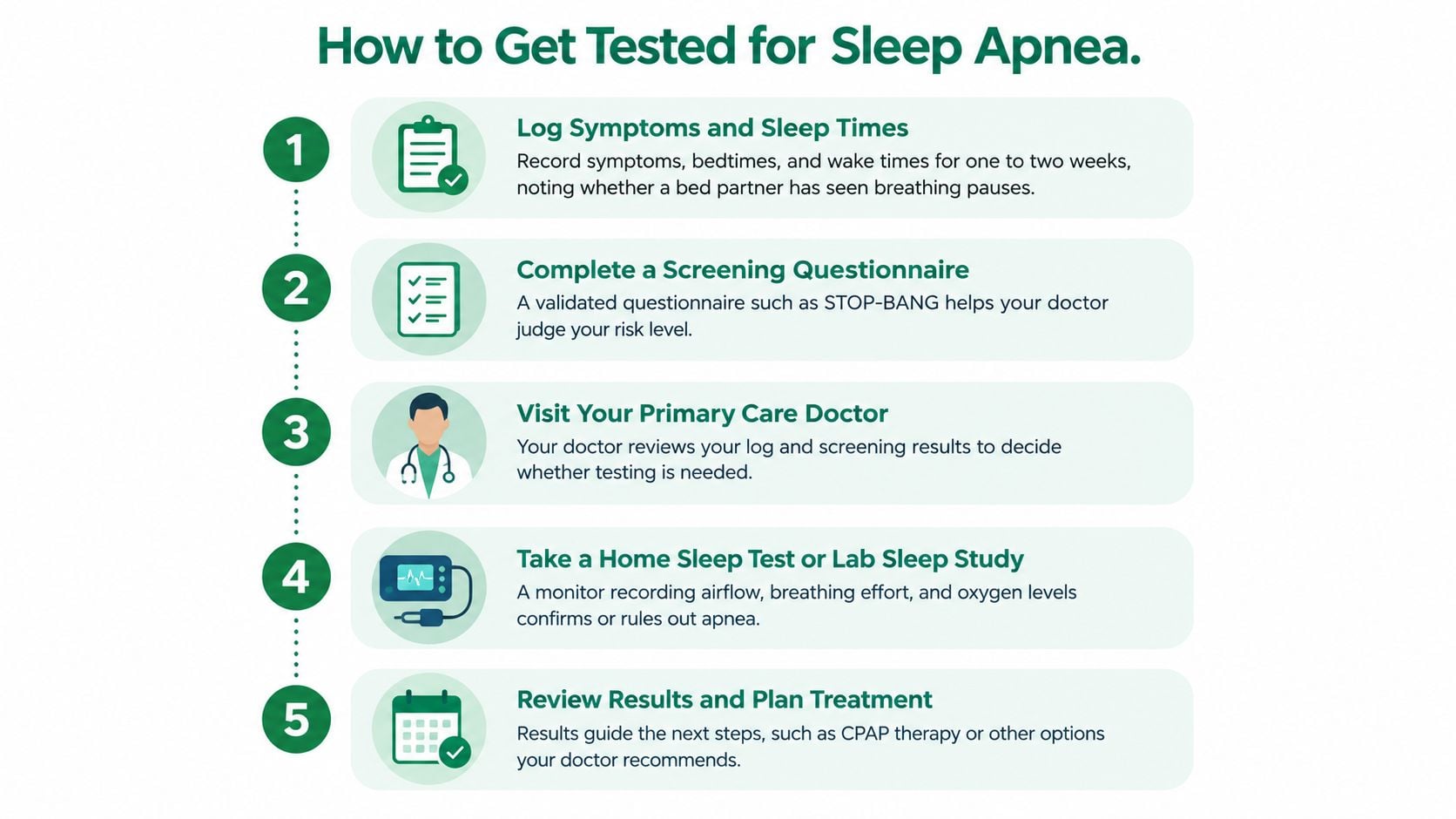
Log symptoms for one to two weeks: Record bedtimes, wake times, morning headaches, naps, and energy dips. A short record gives the clinician patterns to discuss rather than relying on memory. Note any pauses or gasping witnessed by a bed partner, too.
Book a medical sleep evaluation: A physician or qualified sleep professional reviews symptoms, health history, and medicines, then decides whether testing is appropriate. The conversation can also identify other causes of fatigue that may need attention.
Match the test to the person: The American Academy of Sleep Medicine clinical practice guideline for diagnostic testing describes attended in-laboratory polysomnography as the standard diagnostic test when obstructive sleep apnea (OSA) is suspected. It records breathing, oxygen, brain activity, heart rate, and other body signals overnight. A home sleep apnea test may suit some adults with a higher likelihood of uncomplicated moderate-to-severe OSA.
Complete the overnight study: Sensors measure airflow, breathing effort, and oxygen as you sleep, giving the clinician measurable events to compare with your symptoms. Before your appointment, read this guide to preparing for a sleep study so you know what to expect.
Review results with the clinician: The AASM diagnostic testing guideline explains that five or more predominantly obstructive events per hour with relevant symptoms or medical findings can support diagnosis, while 15 or more events per hour may support diagnosis even without reported symptoms. The clinician interprets these thresholds alongside the full study and your health history.
Ask what else could explain fatigue: If the study does not account for your symptoms, discuss whether thyroid or anemia testing is appropriate. Insomnia, periodic limb movements, mood disorders, and medicine effects may also be relevant.
Follow up after a negative home test: A negative or technically inadequate home test may not rule out OSA. If suspicion remains, the clinician may recommend an in-lab study. Fatigue that continues after a normal result still deserves follow-up.
Choosing Between Home and Lab Testing
Home testing is simpler, but it measures fewer signals and may underestimate severity or miss other sleep disorders. In-lab testing may be preferable for people with significant heart or lung disease, chronic opioid use, or complex symptoms, because staff can monitor sleep stages and adjust sensors during the night. Your clinician can explain how these differences apply to your situation.
Patients in Newark and Wilmington, Delaware, and in Bryn Mawr and the Philadelphia Main Line can discuss testing options in light of their symptoms and medical history. The useful question is which test can answer the clinical concern. If fatigue persists after apnea treatment, clinicians can also check whether treatment is addressing the breathing problem and consider other causes rather than assuming every tired day has the same explanation.
Choosing Between CPAP, Oral Appliances and Lifestyle Changes
Which treatment fits depends on the sleep study, health history, comfort, and whether the approach can be used consistently. CPAP is a commonly discussed first-line treatment, particularly for moderate-to-severe obstructive sleep apnea. The American Academy of Sleep Medicine and American Academy of Dental Sleep Medicine oral appliance guideline describes CPAP as more effective for lowering the apnea-hypopnea index (AHI) and improving oxygen saturation, while recognizing oral appliances as an alternative for some adults.
A custom oral appliance holds the lower jaw forward to help keep the airway open. The guideline recommends that sleep physicians consider a prescription oral appliance for adults who cannot tolerate CPAP or prefer another treatment. It favors a custom, titratable device, which a qualified dentist fits and adjusts gradually. Pain and Sleep Therapy Center offers custom oral appliance therapy for suitable adults, with evaluation of jaw, head, and facial pain that may affect device use.
Earlier practice parameters from the American Academy of Sleep Medicine also addressed oral appliances for people with mild-to-moderate OSA who prefer them, do not respond to CPAP, are not appropriate candidates for it, or have not succeeded with it. Whatever the option, comfort matters: treatment can only help while it is being used.
Treatment Options for Sleep Apnea and the Fatigue Question
| Option | How It Works | Often Considered For | Points to Discuss |
|---|---|---|---|
| CPAP | Positive air pressure through a mask helps keep the airway open | Moderate-to-severe OSA; commonly used as a first-line treatment | Mask fit, dryness, and nightly hours of use |
| Custom oral appliance | Holds the lower jaw forward to widen airway space | Mild-to-moderate OSA; adults who cannot tolerate CPAP or prefer an alternative | Custom, adjustable fit by a qualified dentist; jaw comfort; follow-up sleep testing |
| Weight management | May reduce tissue around the throat and lessen airway collapse for some people | Adults with OSA who carry excess weight | Gradual change; may help but is rarely a stand-alone fix |
| Side sleeping | May reduce airway collapse in positional OSA | Mild OSA that worsens when sleeping on the back | Positional aids vary in comfort and fit |
| Alcohol and sedative limits | May reduce muscle relaxation during sleep | Anyone with OSA or unexplained fatigue | Timing of doses and medication review with a prescriber |
| Treating coexisting conditions | Addresses anemia, thyroid disease, insomnia, or mood disorders | Patients whose tests show another cause | Physician-directed care, often alongside sleep apnea treatment |
Readers comparing the two main device options can review oral appliance therapy versus CPAP before discussing choices with a clinician. A sleep study helps frame that conversation: the severity of apnea and oxygen levels, along with jaw health and personal comfort, can all influence which option is suitable.
Lifestyle measures also have a role. Weight management, side sleeping, and limiting alcohol near bedtime may help some people, but they are rarely enough on their own for moderate-to-severe OSA. Do not change sedative medicines without the prescriber's guidance.
Follow-up testing can confirm whether an oral appliance is improving breathing, even when it feels comfortable. If fatigue continues after treatment begins, the next question is whether the treatment is adequately addressing sleep apnea or whether another cause also needs attention.
What Fatigue Improvement to Expect and How to Track It
How soon should energy improve when sleep apnea treatment is working? Fatigue may ease fairly quickly once breathing events are controlled, though recovery varies. This helps set realistic expectations: lingering tiredness does not automatically mean treatment has failed, and improvement does not guarantee every symptom will disappear.
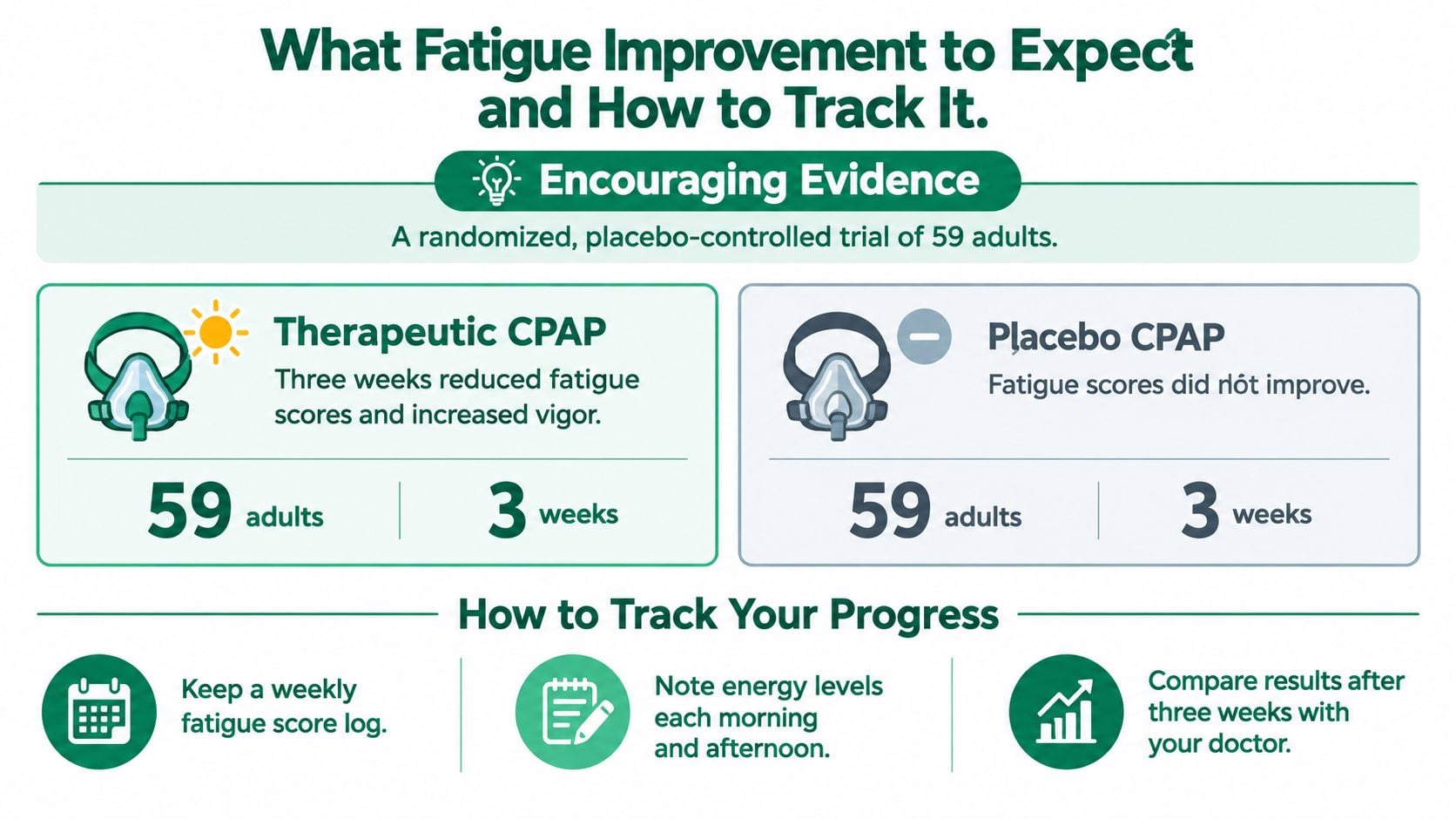
A randomized, placebo-controlled trial described in an American Academy of Sleep Medicine report on a randomized CPAP fatigue trial included 59 adults. After three weeks, therapeutic CPAP reduced fatigue scores and increased vigor, while placebo CPAP did not produce comparable changes. Among participants with pronounced baseline sleepiness, mean Epworth Sleepiness Scale scores fell from 13.0 to 8.9. The scale measures how likely someone is to doze in everyday situations.
Improvement is common, but residual sleepiness can remain. A peer-reviewed review in the Annals of the American Thoracic Society reports that population-based studies estimate 9% to 22% of patients treated with CPAP continue to experience excessive daytime sleepiness.
Residual Sleepiness on CPAP in Published Studies
The review summarizes residual sleepiness findings across study groups and follow-up periods:
| Group | Timepoint | Residual sleepiness |
|---|---|---|
| Sleepy at baseline, all CPAP users | 3 months | 34% |
| Sleepy at baseline, CPAP 6 or more hours nightly | 3 months | 22% |
| Randomized trial, all participants | 6 months | 22% |
| Randomized trial, CPAP 4 hours or less nightly | 6 months | 31% |
| Randomized trial, CPAP more than 4 hours nightly | 6 months | 18% |
| Population studies, CPAP-treated patients | Mixed follow-up periods | 9% to 22% |
Across these findings, greater nightly CPAP use generally accompanies less residual sleepiness, though symptoms can persist. The next question is why. Treatment may not be fully effective, or fatigue may have another contributor, such as insufficient sleep, medication effects, depression, another sleep disorder, or an unaddressed medical condition.
What to Track Each Week
- Repeat symptom scores: Use the Epworth Sleepiness Scale or a fatigue questionnaire at consistent intervals.
- Daily function notes: Record naps, drowsiness while driving, focus, and how refreshed you feel in the morning.
These notes can show whether energy and everyday functioning are changing over time. A normalized AHI does not guarantee that fatigue has resolved, so persistent symptoms deserve reassessment as part of follow-up.
Deciding Your Next Step for Persistent Fatigue
Why might fatigue remain after sleep apnea treatment? Breathing can improve while energy stays low, because apnea may be one contributor among several. Persistent tiredness calls for a closer look at the whole picture.
A 2026 case-control study reported in Sleep examined people with hypermobile Ehlers-Danlos syndrome or hypermobility spectrum disorder, conditions affecting joints and connective tissue. CPAP reduced apnea frequency adequately, but daytime sleepiness did not significantly improve. This finding may not apply to everyone. It does show that apnea may not be the main source of fatigue for some people.
Chronic pain, widespread symptoms, autonomic complaints, connective-tissue disorders, and medication-related sedation can all complicate the picture. Autonomic complaints involve automatic body functions, such as heart rate and blood pressure. If these symptoms are present, ask whether they need assessment alongside sleep apnea.
Reasons to Ask for Further Evaluation
- Autonomic symptoms: Changes involving heart rate or blood pressure may warrant discussion with a clinician.
- Possible medication sedation: Bring up medicines or supplements that could contribute to tiredness.
- Insomnia or periodic limb movements: These can disrupt sleep even when breathing treatment is in place.
- Possible medical or mood-related causes: Ask whether conditions such as anemia, thyroid disease, or depression should be considered.
Make the appointment easier to use. Bring a sleep and symptom log, a full list of medicines and supplements, and notes on when fatigue is worst. Timing can help guide the conversation. If relevant, bring information about your CPAP or oral appliance as well.
Improvement is possible, though it is not guaranteed. A 2024 clinical study found that 17 of 23 PAP-adherent patients with documented fatigue, 74%, reported improvement or resolution at follow-up. That result offers reason for hope while leaving room for individual differences.
Dr. Ryan Robinson, triple board-certified in craniofacial pain and dental sleep medicine, practices in Newark, Delaware, at (302) 239-1757, and in Bryn Mawr, Pennsylvania. Patients can Request an Appointment to discuss evaluation and testing, or Take our Sleep Quiz as a starting point for screening. A quiz does not provide a diagnosis.
Readers in Newark and Wilmington, Delaware, and Bryn Mawr and the Philadelphia Main Line can discuss persistent fatigue, sleep testing coordination, and conservative options such as custom oral appliance therapy with Pain and Sleep Therapy Center. A consultation can help clarify whether sleep apnea may be contributing to low energy, which sleep study may fit, and what follow-up should address.