Yes, snoring can be a sign of sleep apnea, but it isn't proof on its own. Roughly half of people who snore loudly have OSA, many people snore without apnea, and some people with apnea don't snore loudly at all.
That's the part that usually surprises people. A partner hears the noise, a child notices it on a family trip, or someone wakes up embarrassed in a hotel room, and the question lands fast, is snoring a sign of sleep apnea, or just an annoying habit? The honest answer is that snoring is a screening clue, not a diagnosis.
The good news is that this clue can be useful. It can point to a problem worth checking, especially when it shows up with breathing pauses, gasping, choking, morning headaches, or daytime sleepiness. For readers who need a practical tool while they sort through symptoms, a HIPAA-ready dictation app comparison can also be helpful for keeping symptom notes private and organized before a visit.
For a simple starting point, think of snoring as the sound of airflow meeting a narrowed throat. That sound matters more when it's loud, frequent, and paired with the kind of symptoms described in this guide to loud snoring in adults. The sections below walk through what that sound means, when it's more concerning, and why some people with sleep apnea barely snore at all.
Table of Contents
- What Snoring Can Tell You About Your Sleep
- How Snoring and Airway Collapse Actually Work
- Symptoms and Risk Factors That Raise Concern
- When Sleep Apnea Shows Up Without Loud Snoring
- What Sleep Testing Actually Measures
- Treatment Paths After a Diagnosis
- Your Next Steps and When to Reach Out
What Snoring Can Tell You About Your Sleep
A bed partner hears the rumble first. A child notices it on a road trip. A hotel roommate complains, and suddenly a simple nighttime noise turns into a real health question.
Snoring can be a sign of sleep apnea, but it's only a clue. The American Medical Association says approximately half of people who snore loudly have OSA, while many people snore and never develop sleep apnea at all. The reverse also matters, because some people with OSA do not snore prominently, so quiet sleep is not always reassuring. The AMA's summary on sleep apnea makes that distinction clear.
Start with the right mental model
Snoring is a sound, not a diagnosis. It usually means air is moving through a narrower-than-usual airway and making soft tissue vibrate, but vibration alone does not tell the full story. The key question is whether airflow is also being reduced or interrupted during sleep.
Practical rule: loud snoring matters most when it comes with pauses, choking, gasping, or daytime symptoms.
That is why a snore should be treated as a prompt to ask better questions, not as proof of disease. The next questions are simple ones, did anyone see breathing stop, does the person wake gasping, and is daytime energy clearly off? When those answers lean yes, sleep evaluation becomes the next sensible step.
For someone trying to track symptoms in a clear, private way before a visit, a structured note list works better than trying to remember everything in the exam room. That kind of organization can make a difficult conversation easier and less rushed.
How Snoring and Airway Collapse Actually Work
Snoring is a vibration problem. Sleep apnea is a breathing problem. Those two things often travel together, but they are not the same measurement.
A simple way to picture it
Think of a soft plastic straw that has partly collapsed. When air pushes through it, the straw can rattle and buzz. That's the idea behind snoring, relaxed tissues in the throat narrow the passage and vibrate as air moves by.
In obstructive sleep apnea, the narrowing goes further. The airway can partially close, or close completely for a time, even while the chest and belly still try to breathe. That is why a person can look like they are trying to sleep normally while their breathing is being interrupted.
The airway event itself is what matters clinically. A brief partial reduction in airflow is called a hypopnea, and a complete stop in airflow is called an apnea. The vibration sound of snoring can happen with or without either of those events, which is why loudness alone can't tell the whole story. The AASM explains this distinction in its sleep apnea factsheet, and it notes that many people with OSA snore loudly, followed by pauses, choking, snorting, or gasping as airflow returns (AASM sleep apnea factsheet).
Snoring is the noise. Apnea is the interruption.
That difference is the key to understanding why a person may sound dramatic at night yet have no clinically important breathing disorder, while another person may seem relatively quiet and still have repeated airway collapse. Sleep medicine looks for the breathing pattern, not just the sound.
Symptoms and Risk Factors That Raise Concern
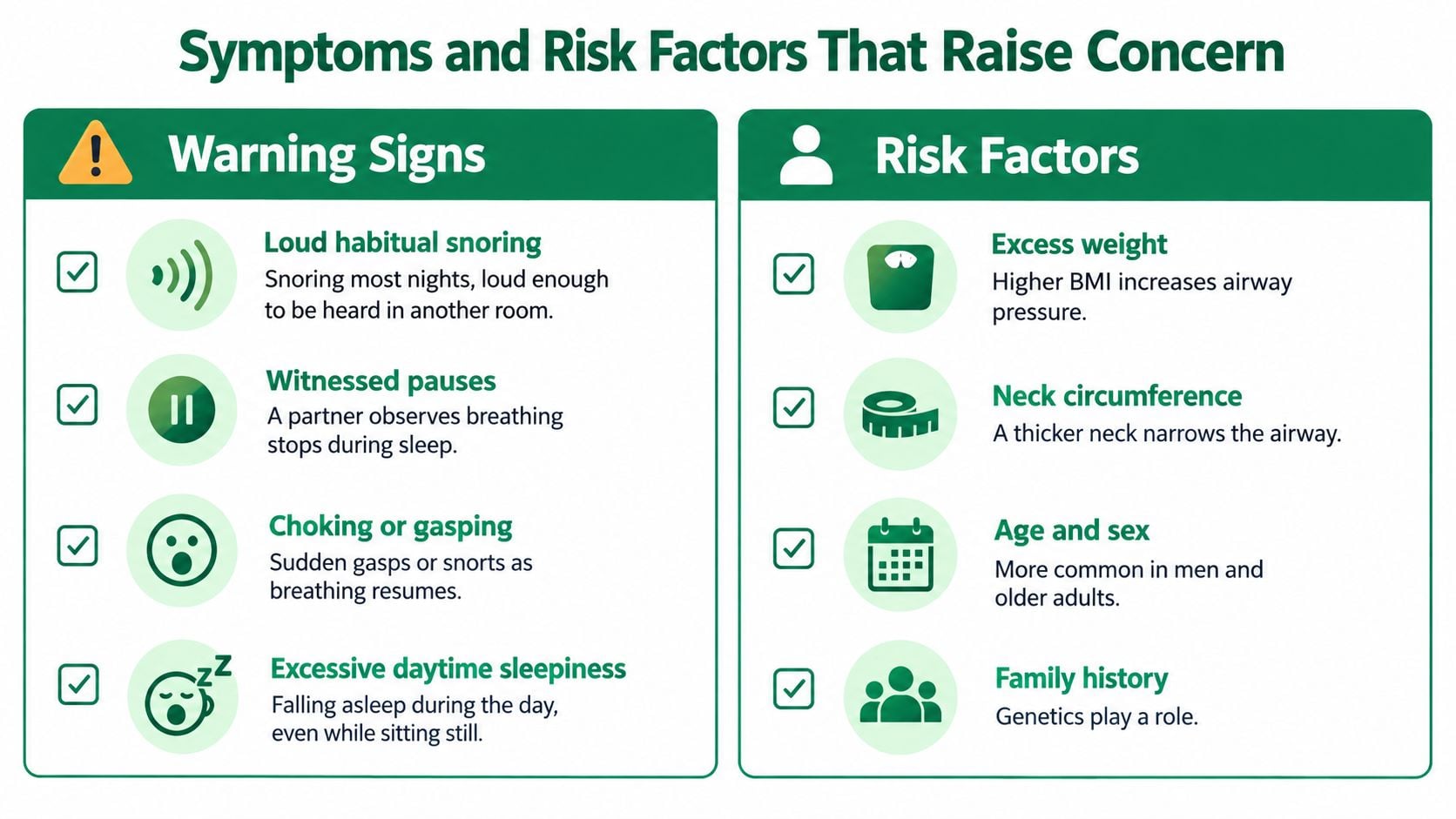
Loud snoring becomes more worrisome when it stops being just a sound and starts coming with a pattern. The pattern is what tells a clinician that the airway may be collapsing, not vibrating.
The signs that deserve attention
The NHLBI lists frequent loud snoring, breathing that starts and stops, and gasping as sleep-apnea symptoms, and it advises medical evaluation rather than treating snoring as proof by itself (NHLBI sleep apnea symptoms). That lines up with the everyday red flags people usually notice first.
- Witnessed pauses: A partner sees breathing stop for a few seconds, then start again with a snort or gasp.
- Morning symptoms: Headaches, dry mouth, or waking up feeling unrefreshed instead of rested.
- Daytime effects: Sleepiness, poor concentration, irritability, or nodding off when sitting still.
- Higher blood pressure patterns: Especially when blood pressure stays up despite treatment.
- Habitual loudness: Snoring that happens most nights and is loud enough to disrupt others.
Risk factors that raise the odds
Certain features make snoring more concerning because they raise the chance that the airway will narrow during sleep. NIH materials list obesity, older age, male sex, alcohol use, smoking, a recessed lower jaw, a large tongue, enlarged tonsils or adenoids, a larger neck, and smaller airways as relevant risk factors (NIH overview of OSA risk factors).
None of those factors diagnoses sleep apnea on its own. They just move the odds. A person with few classic risk factors can still have OSA if the symptoms are strong, and a person with several risk factors may still need objective testing before anyone can say for sure what's happening at night.
Bottom line: the most important question is not whether snoring exists, it's whether it comes with pauses, gasping, daytime impairment, or a higher-risk airway pattern.
When Sleep Apnea Shows Up Without Loud Snoring
Not everyone with sleep apnea sounds dramatic at night. That's where many consumer articles miss the mark, and it's why some people go years without the right evaluation.
Quiet sleep can still be disrupted sleep
A woman who mainly reports morning headaches, fatigue, and poor concentration may not think of sleep apnea if she doesn't snore loudly. An older adult may sleep alone and never get the witness report that would have made the pattern obvious. A thin person with a recessed jaw may assume stress is the whole explanation because weight isn't the issue.
That is a real clinical trap. The absence of loud snoring should not be treated as a clean bill of health, because OSA can present with fatigue, insomnia, mood changes, or cognitive symptoms instead of obvious nighttime noise. The clinical point is simple, symptoms matter even when the room is quiet.
Why questions alone can't settle it
Questionnaires can help spot risk, but they can't confirm the diagnosis. Current guidance favors objective testing over symptom guessing when OSA is suspected, especially when the story is mixed or the presentation is atypical (sleep apnea evaluation guidance).
That matters most for people who are tired, headachy, irritable, or waking unrefreshed but have never been told they snore. If the breathing history is unclear and the daytime symptoms fit, the evaluation still belongs on the table.
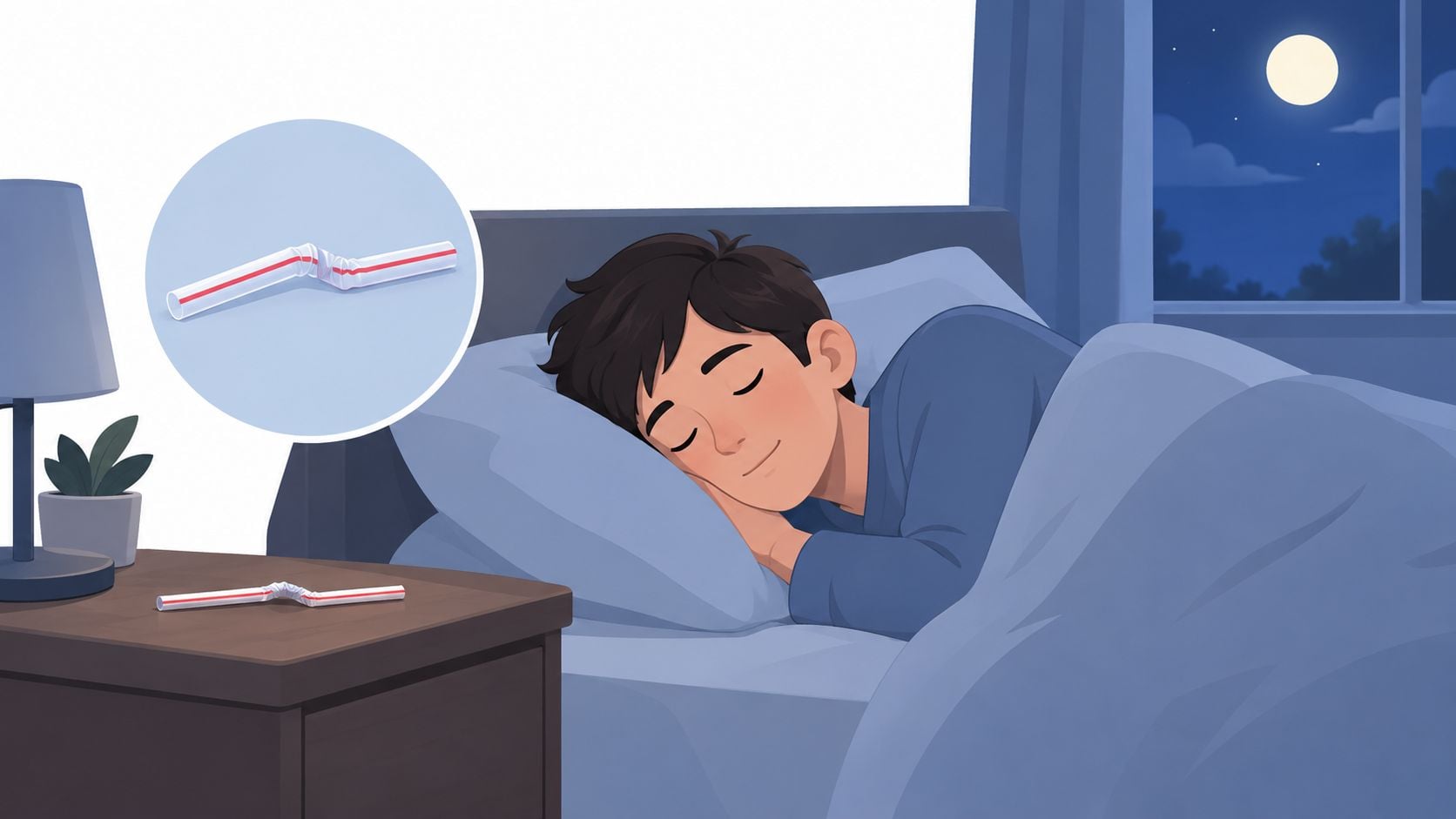
A quiet sleeper can still have repeated airway collapse, especially when the only clue is daytime fatigue or morning headaches.
What Sleep Testing Actually Measures
A sleep study asks a more precise question than most expect. It doesn't just ask whether someone snores, it asks how often breathing is disturbed and whether those disturbances affect sleep and oxygenation.
What the test records
An in-lab polysomnography study is the standard diagnostic test when OSA is suspected, according to the American Academy of Sleep Medicine (AASM diagnostic guidance). It tracks breathing, sleep stages, effort, and oxygen levels so the clinician can see what's happening through the night. A home sleep apnea test can be appropriate for some adults too, but it gives less information.
The main summary number is the apnea-hypopnea index, or AHI, which is the average number of apneas plus hypopneas per hour of sleep. That number helps show how often breathing is being interrupted, but it still has to be interpreted with symptoms and the rest of the test data. A negative home test doesn't always end the story if the symptoms still fit, because the AASM says polysomnography is recommended when the home test is negative, inconclusive, or technically inadequate despite ongoing suspicion.
When home testing makes sense
A home test can be a practical first step when a clinician thinks OSA is likely and the setup is otherwise appropriate. A lab study is more complete when the case is unclear, when another sleep disorder may be present, or when the home result doesn't match what the person feels during the day.
For people exploring evaluation options, at-home sleep testing information can help explain what the process usually looks like and how a clinician decides between home testing and an in-lab study.
| Test type | What it measures | Best use | What happens next |
|---|---|---|---|
| In-lab polysomnography | Full overnight sleep and breathing data | Suspected OSA with complex or unclear symptoms | Guides diagnosis and treatment planning |
| Home sleep apnea test | Focused breathing data at home | Selected adults with suspected OSA | A negative or unclear result may need more testing |
Treatment Paths After a Diagnosis
Once testing confirms OSA, treatment is matched to the person, not just the index number. Severity, airway anatomy, other health issues, and patient preference all matter.
The main options
CPAP remains an established treatment, and it can be very effective when used consistently. For adults who cannot tolerate CPAP or prefer a different option after discussing choices with a qualified clinician, AASM guidance supports a custom, titratable oral appliance. Those devices generally advance and stabilize the lower jaw, which can help enlarge the space behind the tongue and reduce soft-tissue collapse during sleep.
The American Academy of Dental Sleep Medicine reports that, in mild OSA, treatment success defined as AHI below 5 was seen in 76% of CPAP users and 62% of oral-appliance users in one cited comparison (AADSM oral appliance evidence). Effectiveness still varies by patient and disease severity, so the result that works for one person may not be the right fit for another.
For a clearer look at choices after diagnosis, oral appliance therapy without CPAP is one conservative path often discussed alongside other non-surgical measures.
A practical comparison
| Treatment | How It Works | Who It Suits | Follow-Up |
|---|---|---|---|
| CPAP | Delivers pressurized air to keep the airway open | Many patients with confirmed OSA | Device checks, symptom review, and medical follow-up |
| Custom oral appliance | Advances the lower jaw to reduce collapse | Adults who prefer an alternative or can't tolerate CPAP | Follow-up sleep testing to confirm control |
| Lifestyle and positional strategies | Reduce triggers that worsen collapse | Often used alongside device therapy | Ongoing symptom monitoring |
Pain and Sleep Therapy Center also works with patients who need a conservative dental sleep medicine option as part of the treatment discussion. That kind of care is most useful when the goal is root-cause evaluation and non-invasive support before any surgical path is considered.
Your Next Steps and When to Reach Out
The clearest takeaway is simple. Snoring is a screening signal, not a diagnosis, and it matters most when it is loud, habitual, and paired with breathing pauses, gasping, morning headaches, sleepiness, or concentration problems.
If the pattern sounds familiar, the next step is not guesswork. A qualified clinician can help decide whether a home sleep test or an in-lab study makes sense, and that's the only reliable way to confirm sleep apnea. If testing shows OSA, treatment can be matched to the person's needs, anatomy, and comfort level.
For patients in Newark and Wilmington, Delaware, and on the Philadelphia Main Line, including Bryn Mawr, Pain and Sleep Therapy Center provides sleep evaluation, oral appliance therapy, and other conservative options when appropriate. Readers can also take the sleep quiz or request an appointment when the snoring question is no longer easy to ignore.
Pain and Sleep Therapy Center helps patients sort out whether snoring is just noise or a sign of something more. If sleep apnea or loud snoring has become part of the picture, a careful evaluation can help guide the next step, whether that means testing, oral appliance therapy, or another conservative approach. Visit Pain and Sleep Therapy Center to learn more or request an appointment.