Yes, clenching teeth can contribute to headaches by overworking the chewing muscles and irritating the jaw joints, and a 2021 systematic review found a positive association between awake bruxism and tension-type headache, with reported odds ratios reaching 5.23 (PubMed). But a headache is not proof that clenching is the cause, and the true answer usually comes from looking at the whole symptom pattern.
Have you ever noticed how a headache can seem like a jaw problem one day and a stress problem the next? That confusion is common, because the jaw, head, neck, sleep, and stress response often overlap in ways that are easy to miss at home.
Table of Contents
- The Short Answer on Clenching and Headaches
- How a Tight Jaw Turns Into a Headache
- Daytime Clenching Versus Nighttime Grinding
- Symptom Patterns That Suggest Clenching Is Part of the Story
- What a Root-Cause Evaluation Looks Like
- When Your Headache Is Probably Not About Clenching
- Conservative Care Options Worth Knowing About
- Putting It Together and Finding the Right Next Step
The Short Answer on Clenching and Headaches
Can clenching teeth cause headaches? Yes, it can. Tight jaw muscles can overwork the temporalis and masseter muscles, and they can also irritate the temporomandibular joint, the hinge where the jaw meets the skull.
That strain often shows up as a pressure-like headache in the temples, forehead, or sides of the head. Some people notice it after a long stretch of talking, chewing, or concentrating with a tense jaw. Others feel it most clearly in the morning, after the jaw has been active during sleep.
Clenching is one piece of the puzzle, not the whole picture.
Stress, sleep problems, neck tension, migraine, and other headache disorders can look similar, which is why the headache itself does not prove the jaw is the main source. A better clue is pattern: if the pain changes when the jaw changes, clenching is more likely involved. If it does not, the cause may be broader.
The literature supports that broader view. A 2021 systematic review found a positive association between awake bruxism and tension-type headache, which fits the clinical pattern that daytime clenching is the variant most often linked with head pain (PubMed). That does not mean every clencher gets headaches. It does mean jaw tension deserves attention when the symptoms line up.
How a Tight Jaw Turns Into a Headache
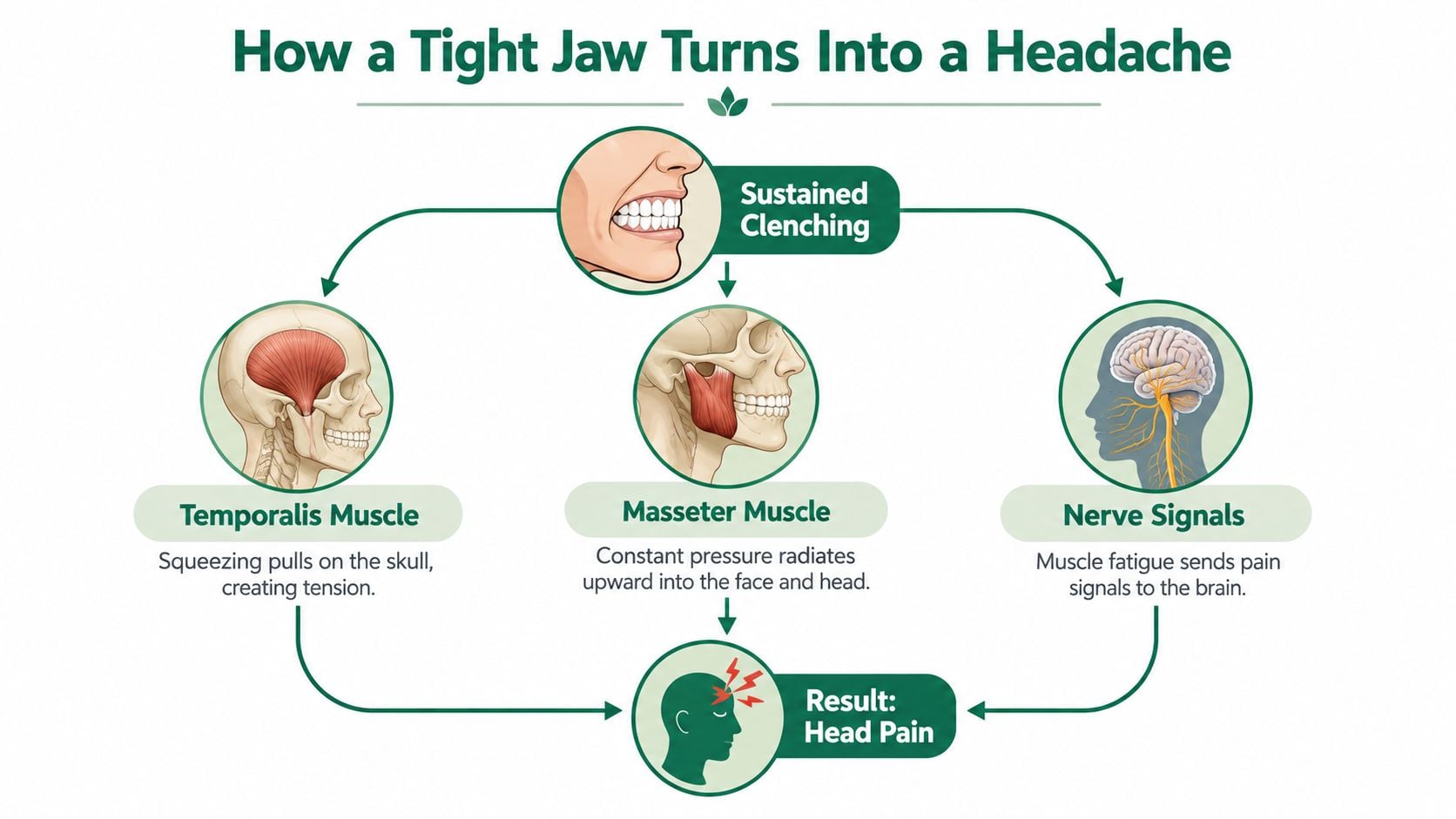
A clenched jaw is a lot like holding a fist shut for hours. At first, the muscles work harder. Over time, they fatigue, become tender, and can start referring pain upward into the temples, forehead, face, or even the ears.
The muscles most often involved
The temporalis muscle sits on the side of the head, and the masseter sits at the jaw angle. When either stays tense, the brain may read that overload as head pain rather than just jaw pain. That's one reason a person can feel a headache without obvious tooth pain.
The temporomandibular joint, often called the TMJ, also matters. It's a small but busy joint, and irritation there can create a spread of discomfort that feels broader than the jaw itself. A person may notice soreness near the ear, pressure at the temples, or a dull ache that seems to “travel” rather than stay in one spot.
Mayo Clinic lists tired or tight jaw muscles, jaw or facial soreness, and a dull headache that begins at the temples among common bruxism symptoms, and notes that severe bruxism may lead to tension-type headaches and TMJ problems (Mayo Clinic).
If the jaw muscles are doing extra work for long periods, the head can become part of the pain pattern.
For readers looking at jaw pain and headache together, the pattern often makes more sense than any single symptom. The jaw isn't always the only source, but it can be the place where the tension first becomes noticeable. For more detail on that overlap, TMJ and tension headaches is a helpful related topic.
Daytime Clenching Versus Nighttime Grinding
Awake clenching and sleep bruxism are related, but they're not the same thing. Awake bruxism happens during the day, often while someone is working, concentrating, driving, or under stress. Sleep bruxism happens during sleep, when the person has far less control over it.
Why the difference matters
The strongest headache signals often line up with daytime muscle overuse, not just nighttime grinding. A 2025 retrospective study reported that secondary headache and cervical pain in TMD patients were associated with bruxism, especially awake bruxism rather than sleep bruxism, with notable associations in children, adolescents, and young adults (Frugone et al., 2025).
That distinction matters because a night guard alone rarely tells the whole story. If the jaw is being clenched for hours during the day, the problem doesn't begin at bedtime, so the solution usually has to include daytime awareness too.
What that means in real life
A person who clenches while concentrating may need reminder-based habit change, stress management, posture awareness, and jaw relaxation practice. Someone with sleep bruxism may need a different workup, especially if sleep quality is poor or there are signs of snoring or unrefreshing sleep.
One small habit can start the shift today. During a few routine moments, let the lips rest together, keep the teeth apart, and let the tongue rest softly on the roof of the mouth. That position gives the jaw muscles a break without requiring constant effort.
Symptom Patterns That Suggest Clenching Is Part of the Story
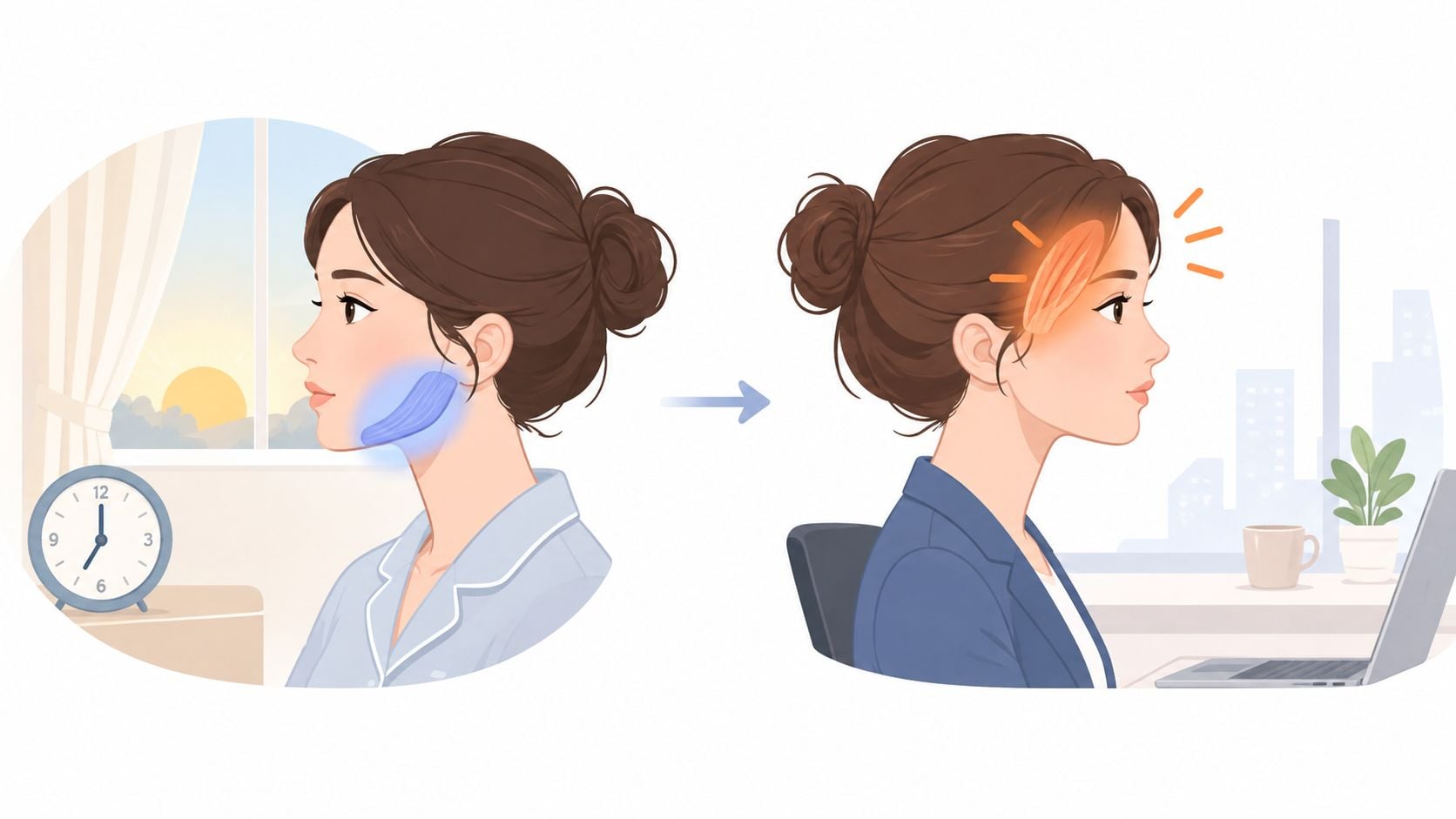
The most useful clue is rarely one symptom by itself. It's the cluster. Morning jaw soreness, temple pressure after long meetings, and a sense that the bite feels “off” can point toward jaw muscle overload more clearly than any one complaint on its own.
Clues that often travel together
- Morning jaw soreness: A stiff or tired jaw on waking can suggest that the muscles worked hard overnight.
- Temple pressure after chewing or talking: Pain that worsens after gum, long calls, or big meals often points toward muscle strain.
- Tooth sensitivity without obvious decay: Teeth under repeated force can feel sensitive even when there's no cavity.
- Clicking or popping near the ear: Joint sounds can go with joint irritation or altered jaw movement.
- Restricted opening: A jaw that feels tight or “stuck” can reflect muscle guarding or joint involvement.
- Neck or shoulder tension with stress: Jaw tension often travels with broader muscle tension.
A 2022 systematic review and meta-analysis found that 61.58% of people with TMDs had headaches, while 59.42% of people with headaches had TMDs. Among patients with painful TMD, headache prevalence reached 82.80% (systematic review). Those figures don't prove cause, but they do show how often the problems travel together.
A simple tracking idea
For two weeks, note three things each day, pain timing, jaw habits, and sleep quality. Add stress level and whether chewing, speaking, or waking in the morning seems to change the pain. That short record can make an appointment much more useful.
Helpful pattern check: if headaches line up with jaw loading, the jaw deserves a closer look.
If jaw popping is part of the picture, this guide to why the jaw keeps popping can help make the symptoms feel less mysterious.
What a Root-Cause Evaluation Looks Like
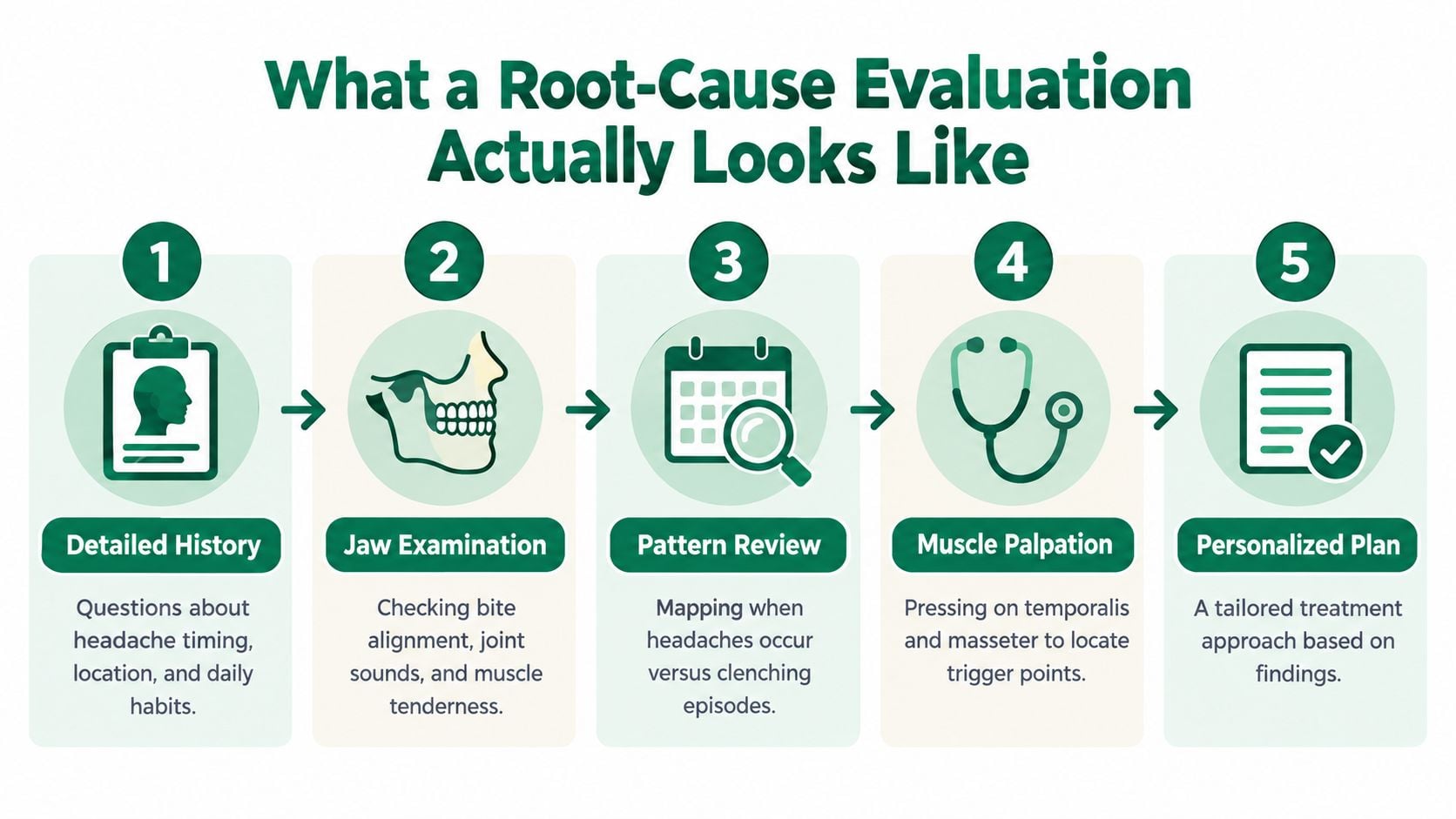
A careful evaluation starts with the story, not the label. A clinician asks when the headaches show up, where the pain sits, whether mornings are worse, and whether chewing, speaking, stress, or sleep changes the pattern. Those details help separate a jaw-driven pattern from pain that is only nearby.
What gets checked
The exam often includes the temporalis and masseter muscles, the jaw joints, range of motion, and signs of tooth wear or damage. The goal is to look for a pattern, because jaw pain, headache, and neck tension can overlap without having the same cause.
Expect questions about morning timing, one-sided pain, and whether chewing or waking changes the intensity. Those answers often shape the next step before any imaging is ordered.
When sleep assessment enters the picture
If snoring, daytime fatigue, gasping, or witnessed pauses in breathing appear alongside jaw symptoms, a sleep evaluation may be considered. The American Academy of Sleep Medicine states that polysomnography is the standard diagnostic test for adults when a sleep evaluation raises concern for obstructive sleep apnea, and diagnosis is a physician's role (AASM standards).
That matters because sleep-related jaw clenching and morning headaches can overlap with other sleep problems. A full picture is safer than focusing on one possible cause.
A tracking note can help here. For two weeks, write down pain timing, jaw habits, sleep quality, stress level, and whether chewing, speaking, or waking in the morning changes the pain. A short record like that gives the visit more context and makes patterns easier to see.
When Your Headache Is Probably Not About Clenching
Jaw clenching can be part of a headache story, but it is not the whole story for every patient. A one-sided throbbing headache with nausea, light sensitivity, sound sensitivity, or visual changes fits migraine more closely than muscle overload. Electric, shock-like facial pain points somewhere else.
Lookalikes that deserve a separate look
Sinus-related pain usually goes with congestion, recent illness, or pressure in the face. Cluster headaches tend to arrive in intense, time-limited attacks. Neuralgias often feel sharp, stabbing, or electric rather than tight or dull.
The American Academy of Orofacial Pain describes TMD as a group of musculoskeletal and neuromuscular conditions and notes that teeth grinding or clenching may be involved, but evidence is limited that clenching or grinding alone is a major contributing factor (AAOP). That caution keeps the jaw from being blamed for every kind of head pain.
Why this distinction protects the reader
A jaw-focused plan will not help a migraine if migraine is the actual problem. It also will not address sinus pressure, nerve pain, or another headache disorder that needs different care. A clearer map of the headache type is the outcome that protects the reader from the wrong treatment.
Bring the full headache history to the visit. The details that matter most are often the ones people almost skip, like morning timing, one-sided pain, or symptoms outside the jaw.
If the question is jaw pain versus nerve pain, this comparison of TMJ or trigeminal neuralgia can help frame the difference before an appointment.
Conservative Care Options Worth Knowing About
The first step is usually the least invasive one. The American Academy of Orofacial Pain lists education and self-care, physical therapy, oral appliances in selected cases, medication when appropriate, behavioral approaches, and coordination with other healthcare professionals as possible options, and notes that most TMD problems respond to conservative care (AAOP patient FAQs).
Common conservative tools
- Softer foods and smaller bites: These reduce the load on sore chewing muscles.
- Jaw rest and movement awareness: Avoid wide yawning, limit gum chewing, and notice when the teeth are touching.
- Heat or ice: Either can help some people, depending on whether the pain feels more tight or more inflamed.
- Stress reduction: Brief breathing practice, movement breaks, and sleep hygiene can lower the drive to clench.
- Physical therapy or behavioral care: These may help when posture, muscle tension, or habit loops are part of the story.
- Oral appliances in selected cases: These can be useful when matched to the right diagnosis, but they are not a universal fix.
These options work best as part of a broader evaluation, because clenching is often only one piece of the picture. A jaw guard may protect teeth in the right situation, but it does not explain why the muscles are tight, why sleep is poor, or why the headache keeps returning.
| Option | What It Targets | Best For | Honest Limit |
|---|---|---|---|
| Softer foods | Muscle load | Flare-ups and sore chewing muscles | Does not address the habit alone |
| Heat or cold | Pain and stiffness | Short-term symptom relief | Relief may be temporary |
| Habit reminders | Daytime clenching | Awake bruxism | Works only if used consistently |
| Stress management | Clenching drive | Stress-linked jaw tension | Does not replace an exam |
| Oral appliance | Tooth and joint loading | Selected patients with the right pattern | Not appropriate for everyone |
The practical goal is to reduce strain while the root cause is being sorted out. A conservative plan can include symptom relief, habit tracking, and a closer look at sleep, stress, posture, and jaw mechanics before anything more involved is considered.
Pain and Sleep Therapy Center uses a root-cause approach for TMJ, head, and facial pain, and its care planning can include conservative evaluation, oral appliance therapy, and related non-invasive options when appropriate. For many readers in Newark, Wilmington, Bryn Mawr, and the Philadelphia Main Line, that stepwise care is a practical fit when the jaw and headaches seem connected.
Putting It Together and Finding the Right Next Step
Clenching can contribute to headaches, but it's usually one contributor inside a bigger pattern. The clearest path forward is not to guess harder, it's to look at the story more carefully, jaw symptoms, sleep, stress, neck tension, and the headache pattern itself.
A study of 203 patients in a TMD or orofacial-pain clinic found headaches in 67.5%, and among people with painful TMD, headache prevalence rose to 82.8% (study). That kind of overlap is exactly why a careful evaluation matters. It helps separate jaw-driven pain from migraine, sleep-related issues, and other causes that need different treatment.
If the symptoms keep recurring, a conservative evaluation is a smart next step, not an overreaction. Readers in Newark or Wilmington, Delaware, or on the Bryn Mawr and Philadelphia Main Line, can use that visit to get a clearer answer and a plan that fits the pattern.
Pain and Sleep Therapy Center evaluates TMJ, head, and facial pain, along with sleep-related concerns that can overlap with clenching and morning headaches. If the jaw, sleep, or headache pattern still feels hard to untangle, visit Pain and Sleep Therapy Center to request an appointment or take the Sleep Quiz.