In the United States, cold laser therapy often costs about $30 to $200 per session, and the full total depends on how many sessions are planned, what type of provider delivers care, and whether evaluation is billed separately. That second part matters most when jaw pain has already disrupted sleep, meals, and work, and a patient is trying to compare a low advertised visit price with a longer plan that includes several appointments. A per-session number alone doesn't answer the actual budget question.
Table of Contents
- Typical Cold Laser Therapy Costs by Setting
- What You Are Paying for in a Session
- Six Factors That Move Your Total Price
- How to Estimate Your Full Treatment Cost
- Insurance Coverage Issues to Check First
- Lower-Cost Options to Discuss Alongside Cold Laser
- Is Cold Laser Worth Its Cost for You
- Confirm Your Estimate Before You Book
Typical Cold Laser Therapy Costs by Setting
A clinic may quote one session, while a wellness provider may offer a monthly membership. Those prices cover different services, so compare what is included before judging which option costs less. In the United States, a practical benchmark for cold laser therapy cost is about $30 to $200 per session, according to the American Academy of Orthopaedic Surgeons overview of laser therapy. Cold laser therapy is also called low-level laser therapy or photobiomodulation, often shortened to PBM. PBM describes treatment with low-intensity light rather than heat-producing surgical energy.
A localized visit for jaw or facial pain may include an assessment and targeted treatment. A wellness session may be shorter and staff-assisted, while a full-body light bed is a different service with different equipment, treatment time, and overhead.
Published Prices by Setting
| Setting | What Is Usually Included | Typical Price Range |
|---|---|---|
| Localized clinic session for pain | Treatment session only, as quoted by the provider | About $30 to $200 per session |
| Clinical-grade PBM visit, 20 to 40 minutes | Provider-supervised treatment visit | About $150 to $300 per visit |
| Wellness red-light or PBM session | Short session, often staff-assisted | About $25 to $100 per session |
| Monthly wellness membership | Repeated sessions for a set monthly fee | About $99 to $250 per month |
| Full-body PBM at a physical therapy practice | First visit, single visit, five-pack or unlimited month | $25 first visit, $35 single, $150 for five, $185 unlimited monthly |
| Typical quoted consumer session | Standard-length session | About $35 to $100 per session |
| Longer or higher-powered session | Extended treatment time or higher output | About $120 to $150 per session |
These figures are examples of published prices, not guaranteed quotes for a particular office or city. Local rent, staffing, and demand can affect what a provider charges. Equipment price does not establish clinical benefit, and treatment settings are not fully standardized, so a higher price alone cannot tell you whether a session is a better fit.
Write down two numbers: the per-session price and the planned session count before booking a series.
Together, those numbers give you a starting estimate for the treatment episode. Then ask whether the evaluation, follow-up visits, and reassessment are included or billed separately. A low session fee can add up across a longer plan, while an included evaluation may change the initial bill. Compare the expected total, not just the first advertised price.
What You Are Paying for in a Session
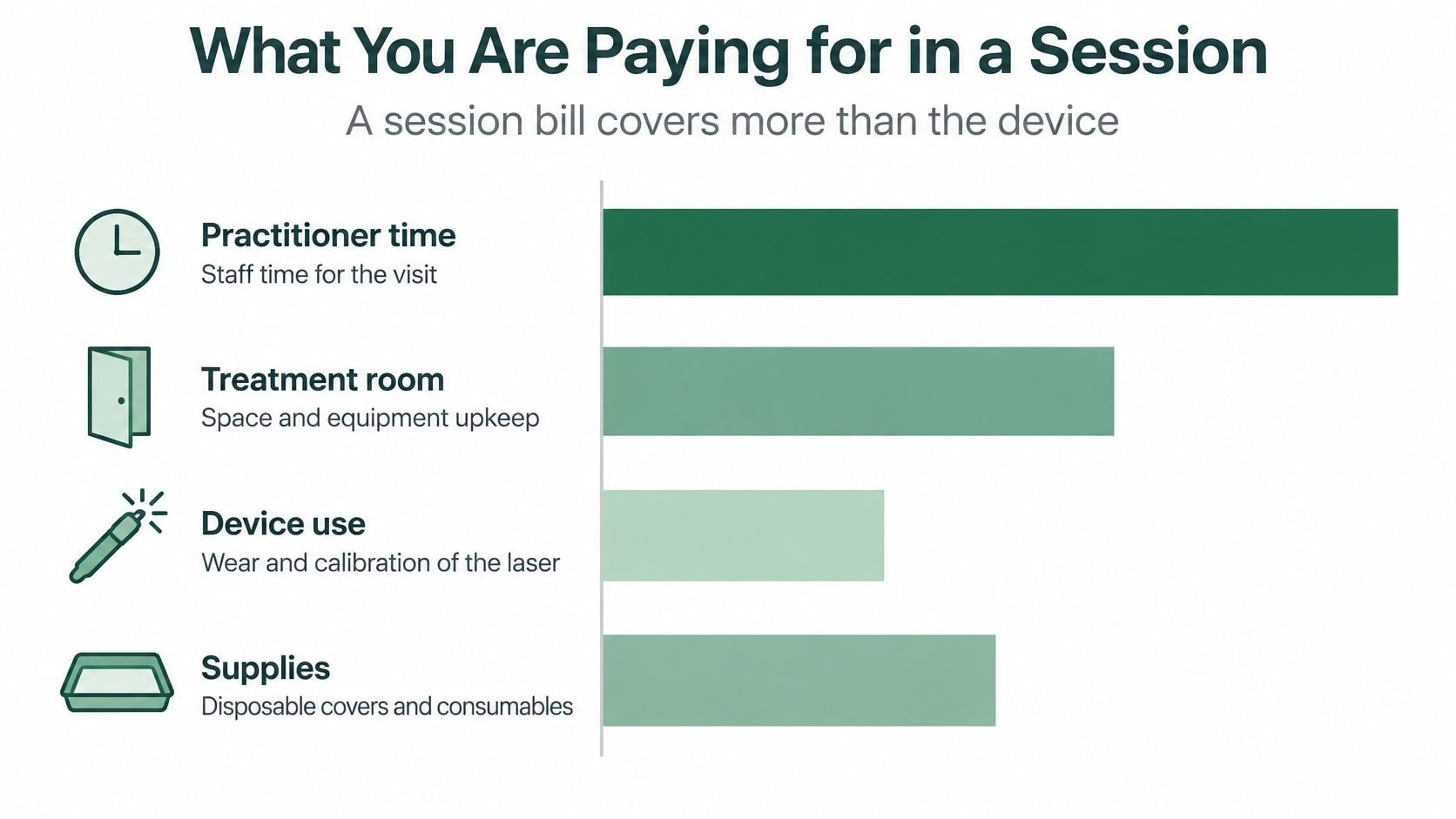
A dental cleaning bill covers more than the polishing tool. It also covers the hygienist's time, the chair, the room, infection control, and supplies. A cold laser session works in a similar way, even though the device often gets most of the attention.
A hospital-based costing analysis of a 660-nm, 100-mW protocol delivered at 33 J/cm² for approximately 30 minutes found that labor accounted for 66% of total cost, while equipment accounted for only 2.8%, according to the hospital-based photobiomodulation costing analysis. Infrastructure accounted for 22% and supplies for 9% in that same analysis. Those figures aren't U.S. retail prices, but the pattern is useful. People and space drive much of the bill.
Device Cost Is Only Part of the Story
Laser-based devices generally cost more than LED-based devices. That doesn't mean the most expensive machine is the right choice for a given jaw, muscle, or joint problem. Wavelength, power output, dose, and treatment time matter because they describe how light is delivered to the target tissue.
Patients considering low-level laser therapy for TMJ-related care can ask three direct questions at booking.
- Visit length: How many minutes of treatment are included?
- Provider involvement: Who delivers the session, and who supervises it?
- Included care: Does the fee cover only light delivery, or also examination and follow-up?
Home Devices Are a Separate Category
Home-use devices shouldn't be compared with clinic visits as if they're interchangeable. A 2021 peer-reviewed review of PBM for hair loss reported device prices ranging from about $200 to $3,000, according to the 2021 peer-reviewed review of photobiomodulation for hair loss. A lower purchase price doesn't replace a clinical evaluation. Diagnosis, dose, and safety still need attention, especially when pain could come from a joint, muscle, bite, or sleep-related cause.
Six Factors That Move Your Total Price
The total depends on more than the fee for one visit. A useful comparison accounts for how many visits are planned, what each visit includes, and whether added services are billed separately. Provider type, location, packages, bundled care, and the treatment area and device can all shift the bill.
Factors That Change the Total Cost
| Factor | How It Changes the Total | What to Ask |
|---|---|---|
| Number of sessions | Each visit adds to the episode cost, even when the fee per visit is modest | What session count is recommended, and when will progress be reassessed? |
| Provider type | Credentials, clinician time, supervision, and facility costs differ across medical, dental, physical therapy, and wellness settings | Who delivers and supervises the session? |
| Geographic region | Rent, staffing, and local market rates vary between metro areas | Can I get the visit quote in writing? |
| Package or membership | A package may lower the per-visit cost, while unused sessions may be lost | When do sessions expire, and what is the refund policy? |
| Bundled services | Evaluation, imaging, orthotic fittings, and follow-up may be separate fees | Which services are included, and which are billed separately? |
| Treatment area and device | A localized jaw or facial session may be priced differently from a full-body light-bed session | What treatment area and device does the quoted price cover? |
Provider type affects what the fee buys. A physician-led clinic, dental office, physical therapy practice, and wellness spa may offer similar-sounding light sessions, yet differ in evaluation, clinician involvement, and supervision. Ask who is responsible for your care, not just what the session is called.
Location also shapes quotes. Rates in Newark and Wilmington, Delaware, may differ from those in Bryn Mawr and the Philadelphia Main Line. Compare written estimates that specify the same treatment area, session length, provider involvement, and included services, much like comparing two receipts with the same items listed.
Packages require a different calculation from single visits. Compare the package total with the cost of the visits you expect to use, then check expiration and refund terms. A lower per-visit figure does not reduce the episode cost if sessions go unused.
A clear quote names the treatment area, device, session length, included services, and any fees outside the light session itself.
How to Estimate Your Full Treatment Cost
A useful estimate treats care as a full treatment episode, not a single visit. For readers who want a broader framework for sequencing care and fees, planning your dental care offers helpful context on organizing treatment decisions before costs are committed. Patients who need to review payment logistics can also review available financing information as part of planning.
Six Steps for a Realistic Estimate
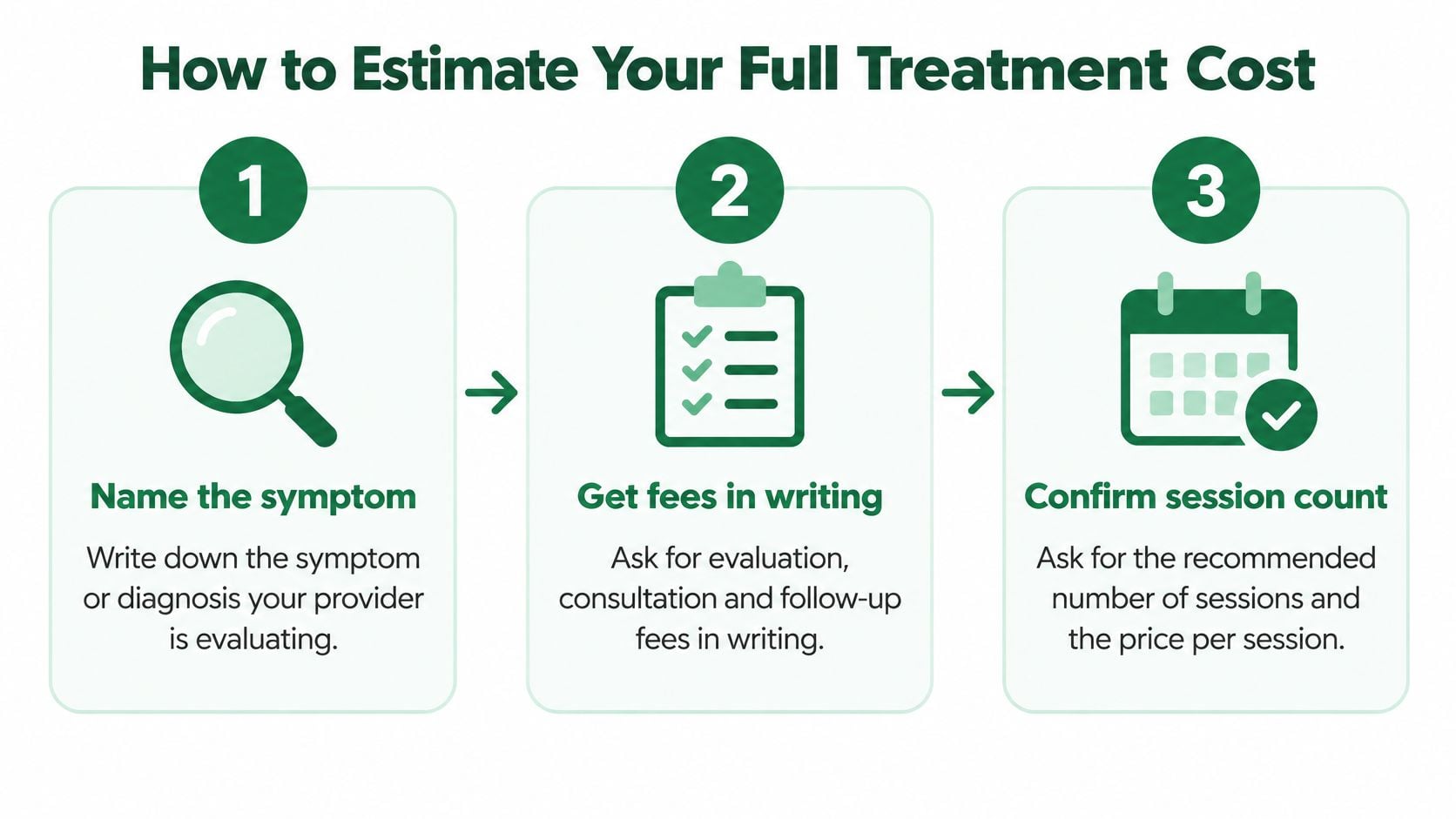
- Name the problem being evaluated. Jaw pain, facial pain, muscle tenderness, and limited opening can have different causes and plans.
- Get evaluation and follow-up fees in writing. Consultation and reassessment may not be part of the session fee.
- Confirm the recommended session count. A plan should also name the point where progress is measured again.
- Multiply price by visits. This simple step creates the session-only total.
- Add non-session costs. Adjunctive orthotic or behavioral care, travel, parking, and time away from work affect the overall burden.
- Set a stopping point. If measurable progress isn't present at reassessment, the plan should pause for discussion of alternatives.
Worked Examples
Say a session costs $75 and the plan includes 15 sessions. The math is $75 multiplied by 15, which equals $1,125 before consultation.
Two visits a week for eight weeks equals 16 sessions. At $25 each, sessions total $400. At $150 each, they total $2,400.
A $185 monthly membership compared with $25 single visits breaks even at about eight visits in one month, since eight visits would cost $200. Fewer visits make single sessions cheaper in that example. These examples are planning estimates, not quotes. A written estimate from the treating provider replaces them.
Insurance Coverage Issues to Check First
Coverage depends on the plan, employer, contractor, or workers' compensation program. The same treatment may be covered for one person and denied for another because diagnosis, policy language, and billing rules differ. Ask how the rules apply to the full treatment episode, including any bundled evaluation, planned sessions, and costs left to pay yourself.
A federal employee health-plan policy describes low-level laser therapy as investigational for temporomandibular joint pain and many musculoskeletal conditions, while allowing consideration for preventing oral mucositis during cancer treatment, according to The Pricer summary of cold laser therapy costs and coverage. The policy also notes that treatment may require up to 15 sessions.
Some public programs cover treatment under bundled rules. Washington State workers' compensation guidance allows clinical low-level laser therapy in specified settings, with payment bundled with other physical-medicine services. Separate billing receives no additional payment in that program. For broader background on how coverage rules can differ, see Sunridge Medical's insurance coverage guide. Confirm the final answer with both the treating office and your plan.
Questions for the Coverage Call
- Diagnosis code: Which code will the office use for the visit?
- Written policy: Is laser therapy covered, excluded, or considered investigational for that diagnosis?
- Prior authorization: Must approval be obtained before treatment begins?
- Visit limits: Do sessions count toward a therapy visit cap?
- Cash option: What price applies if coverage is denied?
A coverage answer is useful only if it clarifies your likely out-of-pocket cost for the whole course, not just one visit. Ask for any evaluation fees, session limits, and billing rules in writing, then compare the estimate with your plan's response.
Sleep-related symptoms follow a separate diagnostic path. Sleep apnea is diagnosed through a sleep study and physician evaluation, and medically necessary diagnostics are distinct from optional adjunct treatment. Ask the office directly about its billing, and confirm benefits with your plan before starting a series.
Lower-Cost Options to Discuss Alongside Cold Laser
Cold laser therapy is often discussed as an adjunct, meaning an added treatment, rather than the only plan. Many lower-cost steps address daily strain, jaw function, or sleep habits at the same time. Several options can be combined after an evaluation identifies likely contributors.
Self-care comes first for many patients because it reduces repeated stress on sore muscles and joints. Soft foods during a flare, heat or cold packs, jaw rest, posture changes, and stress habits don't require a device. Guided jaw exercises or physical therapy add professional instruction when movement, neck strain, or muscle coordination needs attention.
Lower-Cost Options to Discuss With a Provider
| Option | What It Involves | How Cost Usually Works | Question to Ask |
|---|---|---|---|
| Self-care basics | Jaw rest, soft foods, heat or cold packs, posture and stress habits | Low or no direct cost | Which daily habits affect symptoms most? |
| Physical therapy or jaw exercises | Guided stretching and strengthening for jaw and neck | Usually billed as therapy visits | Does the plan limit therapy visits? |
| Oral orthotic (splint) for TMJ | Appliance that stabilizes the bite and jaw | Device plus fitting and adjustment visits | Is a splint appropriate for the diagnosis? |
| Oral appliance therapy for snoring or sleep apnea | Dental device that repositions the lower jaw during sleep; an option for some patients | Device plus follow-up visits | Does the sleep study result support candidacy? |
| Sleep hygiene and behavior changes | Consistent sleep schedule, alcohol timing, side-sleeping habits | Low cost | Which changes fit the routine? |
| At-home sleep testing | Home test reviewed by a physician to diagnose sleep apnea | Set by testing and plan rules | Is home testing right for the symptoms? |
| Medication review | Physician reviews pain or sleep-related medicines | Visit fee | Could a current medicine be contributing? |
An oral orthotic, also called a splint, may help stabilize the bite and jaw for some TMJ patients. Its main costs are the device and fitting or adjustment visits. Broader non-surgical treatment options for TMJ can help frame that discussion.
For snoring or sleep apnea, an oral appliance repositions the lower jaw during sleep and may be an option for some patients. CPAP remains a standard, effective treatment for many people. The right choice depends on sleep study results and physician guidance, not preference alone.
Is Cold Laser Worth Its Cost for You
A useful decision starts with the likely benefit and the full treatment episode: the session price, how many sessions are proposed, and whether evaluation is included. A 2026 systematic review of 14 randomized controlled trials involving 1,001 participants found possible short-term pain relief in some comparisons, with inconsistent effects across TMD subtypes and treatment protocols, according to the 2026 systematic review of photobiomodulation for temporomandibular disorders. Results vary, so a proposed course should include a clear way to assess whether treatment is helping.
An updated systematic review included 40 studies. Pain reduction appeared in 27 of 40 studies, while jaw-opening gains were seen in only 7 of 15 studies, according to the updated systematic review in the Journal of Lasers in Medical Sciences. These findings suggest pain and jaw movement can respond differently.
Cost per Measurable Improvement
Price alone does not establish value. A 2025 economic evaluation reported a laser-session price of $39.60, with the laser arm costing $40.12 per unit of controlled pain intensity versus $5.50 for placebo/control, according to the 2025 economic evaluation of photobiomodulation. The comparison treatment cost less and still produced some improvement, so the added benefit needs to justify the extra cost.
A Practical Decision List
- Record a baseline: Note pain level, mouth opening, chewing comfort, headaches, and sleep quality before treatment.
- Set a reassessment point: Agree on when results will be reviewed, based on the proposed number of sessions.
- Define meaningful change: Decide what improvement would make daily activities easier.
- Pause when progress stalls: Revisit the plan if the agreed improvement is not happening.
This approach turns an open-ended package into a course with a measurable stopping rule. It also keeps the decision focused on whether improvement is worth the full episode cost, rather than on the fee for one visit.
Confirm Your Estimate Before You Book
Before booking, ask the office to explain the full treatment episode, not only the fee for one light session. Confirm whether the estimate includes an evaluation, how many sessions it assumes, and when your progress and costs will be reviewed. A written estimate makes it easier to compare the expected total with your budget.
For the first call, have your estimate and insurance details ready. Ask which services may be billed separately and what your plan requires you to pay. Guidance on documents needed to verify insurance can help you organize the information before contacting the office. Also agree on a measurable point for reassessment, such as changes in pain, jaw movement, or chewing comfort, so treatment does not continue without a clear reason.
Conservative, non-invasive options can be discussed alongside cold laser therapy. If symptoms involve more than one area, ask how the office will coordinate care with your physician, dentist, or therapist. The aim is a plan that fits your needs, with a clear point for checking whether the cost is producing a meaningful improvement.
Loud snoring, unrefreshing sleep, or daytime fatigue are reasons to seek evaluation. Bring a note of your symptoms and questions about the next steps, so the first conversation can focus on what assessment or care may be appropriate.
Pain and Sleep Therapy Center, in Newark, Delaware and Bryn Mawr, Pennsylvania, evaluates TMJ, head, and facial pain and discusses conservative options, including cold laser therapy when appropriate. Led by Dr. Ryan Robinson, triple board-certified in craniofacial pain and dental sleep medicine, the practice offers an appointment request and a sleep quiz. The Newark office can be reached at (302) 239-1757. A call can clarify what an estimate includes and whether the proposed plan has a defined reassessment point.