There's no single fixed length for TMJ pain: many mild flares ease within a few weeks to several months with self-care, while pain lasting 3 months is treated as chronic and deserves evaluation rather than endless waiting.
The calendar alone doesn't tell the whole story. Someone whose jaw feels less sore but opens less comfortably still needs attention, while mild discomfort that steadily improves may allow a short period of watchful self-care. The most useful question combines time with function: are eating, opening, sleep, and daily life getting better?
Table of Contents
- How Long TMJ Pain Usually Lasts
- Why Some Jaw Pain Fades and Some Stays
- What Shortens or Lengthens Recovery
- Warning Signs That Should Not Wait
- How Treatment Can Change the Timeline
- Decide Whether to Request an Evaluation
How Long TMJ Pain Usually Lasts
The temporomandibular joint (TMJ) connects the lower jaw to the skull, just in front of the ear. Temporomandibular disorders (TMD) affect the jaw joints, chewing muscles, or both. People often call the symptoms “TMJ,” although TMJ is the name of the joint, not the diagnosis.
For many people, the discomfort is temporary. The American Academy of Orofacial Pain's patient guide supports conservative care for TMD; the patient guidance summarized here describes improvement within a few weeks to several months and recommends contacting a healthcare professional when symptoms continue for a week or longer, particularly when jaw use is affected.
Typical TMJ pain timelines by pattern
The table offers a starting point for matching a symptom pattern to a next step. It isn't a forecast for an individual person.
| Pain pattern | Typical course | What to do |
|---|---|---|
| Mild flare that is steadily improving | A few weeks to several months, often with self-care | Continue simple care and arrange a check if improvement stops |
| Symptoms affecting chewing, opening, or daily life | Still present after about a week | Contact a healthcare professional |
| Pain reaching the chronic threshold | At least 3 months | Seek evaluation rather than waiting indefinitely |
| Already chronic TMD pain in study populations | Median 44 months; reported range 13 to 65 months | Treat as prolonged pain that still may improve with care |
| Severe disorder with chronic pain and disability | Develops in about 10 percent of TMD patients and isn't a self-timed flare | Get a root-cause plan rather than relying on time alone |
The chronic-duration figures need careful interpretation. A BMJ guideline and related evidence review describes chronic pain as lasting at least 3 months and reports a median duration of 44 months, with a range of 13 to 65 months, among studies reporting duration in people already classified as having chronic TMD pain. Those participants weren't a sample of everyone with a new jaw ache.
Watch the direction, not just the date
A mild flare may make a firm sandwich uncomfortable while softer meals remain easy. If soreness fades and normal chewing gradually returns, that's different from pain that remains unchanged while the person avoids more foods.
A useful check includes ordinary activities: finishing a meal, speaking comfortably, brushing the back teeth, and yawning without forcing the jaw. Someone who reports less pain only because almost all jaw movement has stopped hasn't necessarily regained function.
Practical rule: A short watch makes sense only while symptoms and jaw function are moving in the right direction.
Most TMD is mild and self-limiting, meaning it can settle without extensive treatment. Still, the right table row is the one that matches both duration and impact, not the least concerning description.
Why Some Jaw Pain Fades and Some Stays
Two people can develop jaw soreness around the same time and follow very different paths. One may have a brief spell of muscle overload; another may have continuous pain, disturbed sleep, and increasing difficulty eating. A shared start date doesn't mean a shared recovery date.
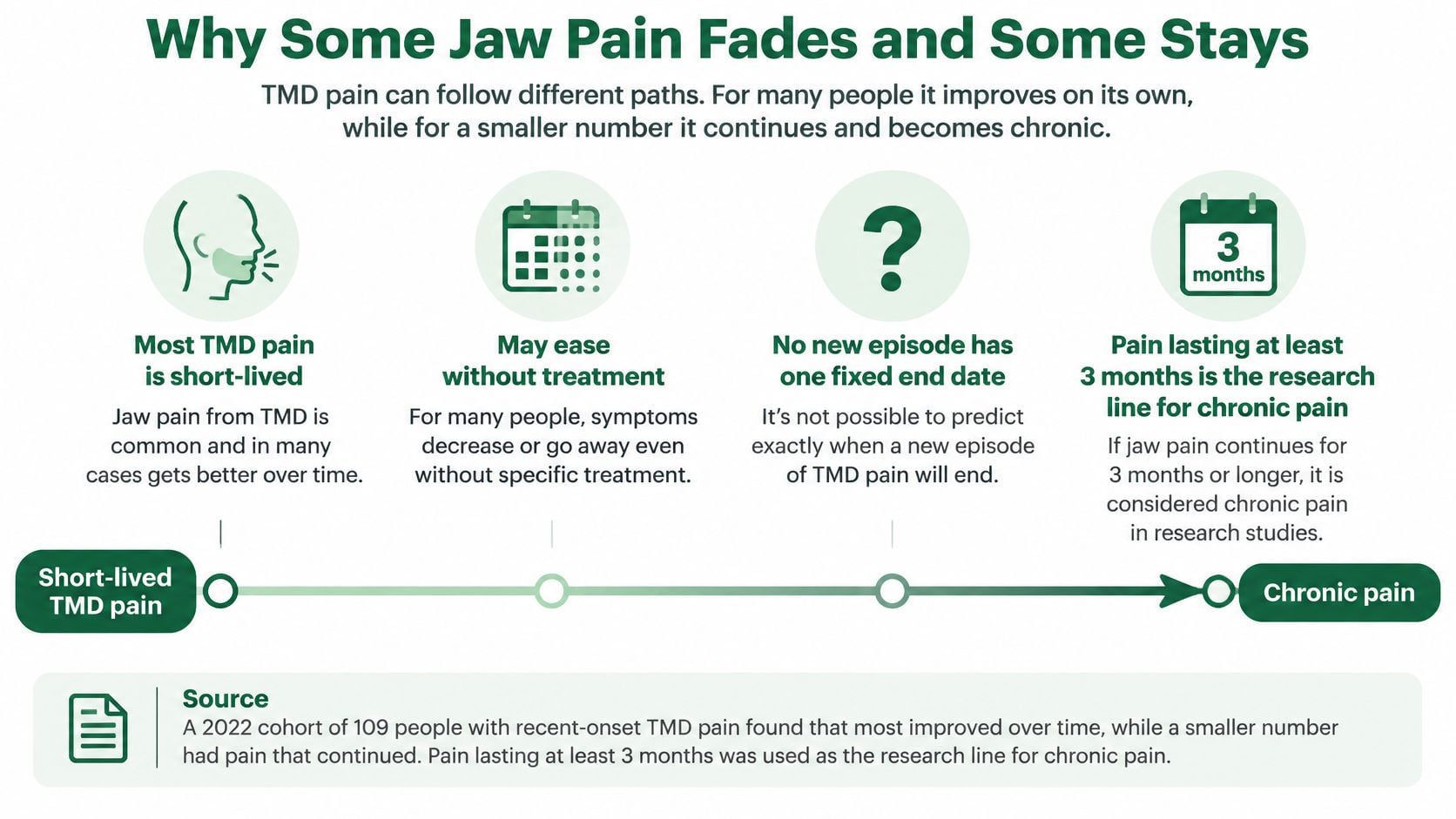
A prospective cohort summarized in the National Institute of Dental and Craniofacial Research's TMD information followed 109 people with acute pain-related TMD in 2022: at the 3-month follow-up, 59 participants, or 54.13%, met the study definition of chronic pain-related TMD; the source also notes that approximately 10% of TMD patients develop severe disorders associated with chronic pain and disability. Higher initial pain, continuous pain, and interference with work, recreation, social activities, or family life were associated with a greater likelihood of persistence.
That cohort result isn't a personal probability for everyone with a sore jaw. It describes a particular group who already had acute pain-related TMD and were followed using a study definition.
Three illustrative patterns
The following scenarios illustrate decisions, not patient stories or promised outcomes.
- A short muscle flare: An adult notices clenching during a stressful week. The chewing muscles feel sore, but opening remains normal and meals become easier with softer foods. A steadily improving pattern may support a brief period of simple care.
- Progressively harder chewing: Another adult has pain with meals for six weeks and notices a smaller opening each week. That person needs an assessment now rather than waiting for a chronic-pain label.
- Persistent pain with broader symptoms: Someone has more than three months of jaw and temple pain, headaches, and poor sleep. Care should address the whole pattern, including jaw function and sleep, rather than focusing only on the painful spot.
These patterns also explain why the question “How long does TMJ pain last?” can't be answered with one recovery date. The important difference isn't how sore the jaw feels today. It's whether pain is intermittent or constant, whether everyday activities remain possible, and whether the person is recovering normal movement.
A clinician may ask when pain occurs, what brings it on, and whether symptoms spread beyond the jaw. These questions help distinguish an improving episode from one that needs a broader plan.
Long-term recovery can take different forms
Long-lasting pain doesn't mean improvement is no longer possible. It can mean that progress needs to be measured through several outcomes: comfortable meals, better sleep, fewer pain interruptions, and easier movement.
The long-term findings summarized in the BMJ clinical practice guideline include a five-year follow-up of 234 people with chronic TMD pain: 49% reported complete recovery, 14% reported more than 50% relief, 8% reported 20–50% relief, and 13% reported no change; the guideline also reports complete remission in 24% of the OPPERA cohort at five years. These are separate groups with different outcomes, not competing promises about a particular patient.
Bruxism, meaning teeth grinding or clenching, doesn't provide a dependable recovery clock either. A 2024 South Korean study of 96 patients with TMD reported mean pain durations of 13.91 months among bruxers and 20.91 months among non-bruxers. That comparison doesn't establish that grinding protects against persistent pain or that stopping it sets a recovery date.
Long-term improvement may mean complete recovery for some people and meaningful symptom reduction for others.
The practical response is neither endless waiting nor assuming the worst. It's choosing care according to the person's current limitations and reviewing whether treatment produces useful change.
What Shortens or Lengthens Recovery
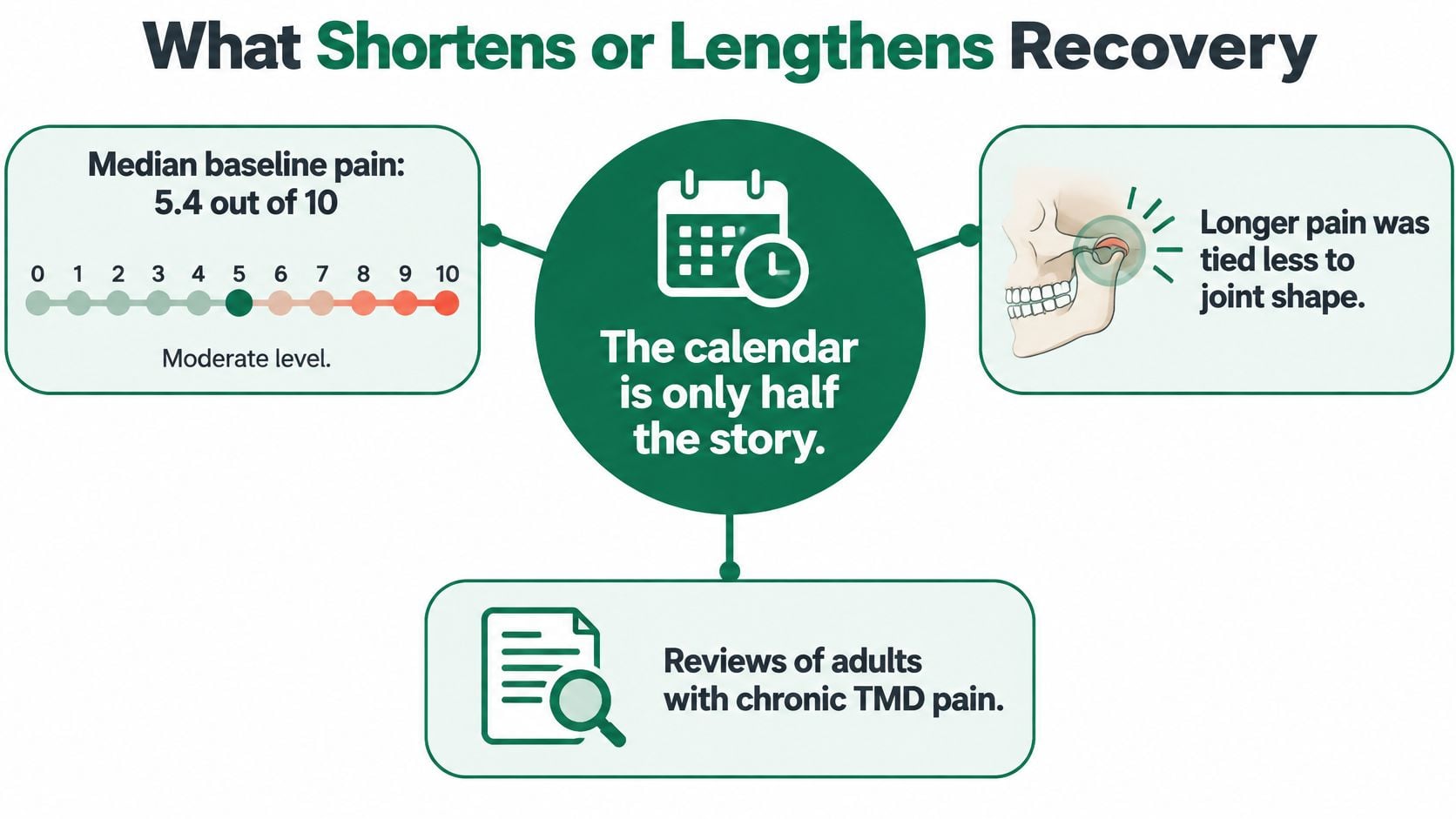
The calendar is only half the story. A BMJ systematic review of trials involving adults with chronic TMD pain reported a median baseline pain intensity of 5.4 out of 10, a moderate level, and identified several signals associated with persistence, including higher initial pain, greater disability, widespread pain, depression, and pain catastrophizing.
Pain catastrophizing means repeatedly expecting the worst from pain or feeling unable to cope with it. It doesn't mean the pain is imagined. Emotional distress, sleep disruption, muscle guarding, and pain can affect one another.
Patterns that guide care
A shorter initial episode, comfortable mouth opening, and declining interference with daily activities are encouraging patterns. Continuous pain, difficulty eating, pain elsewhere in the body, and poor sleep call for closer assessment.
These are clues, not verdicts. Certainty varies across prognostic factors, so no single mood score, movement test, or symptom should determine treatment by itself.
Strong pain can make the nervous system more sensitive. A person may tighten the jaw muscles protectively, sleep poorly, and avoid movement, making normal chewing harder. Treatment may need to address several parts of that cycle.
- Pain and activity: Record whether symptoms interrupt meals, conversation, or work.
- Sleep and mood: Note unrefreshing sleep, distress, and whether symptoms are harder after a poor night.
- Other pain: Include headaches, neck discomfort, and pain elsewhere in the body.
- Jaw movement: Track comfortable opening without repeatedly forcing or testing the jaw.
Duration is a reason to investigate
A 2024 five-year observational study found that TMD pain lasting six months or longer was associated with 2.24 times higher odds of requiring at least six months of treatment. An association isn't a guarantee, but a longer history deserves a clear assessment rather than another open-ended trial of self-care.
Diagnostic delays also occur: a 2025 international patient survey found that 28.1% of respondents had TMJ-related pain for more than one year before receiving a correct diagnosis. Unexplained duration is a reason to look for contributing conditions, not evidence that symptoms must continue indefinitely.
For suspected nighttime clenching, education on how to stop clenching the jaw at night can support a clinical discussion. Clenching shouldn't automatically be treated as the only explanation.
People considering supplements can compare topical and oral CBD options through HempWell USA, but that commercial resource doesn't establish that CBD shortens TMD recovery. A clinician or pharmacist should review possible medication interactions and other risks before use.
Warning Signs That Should Not Wait
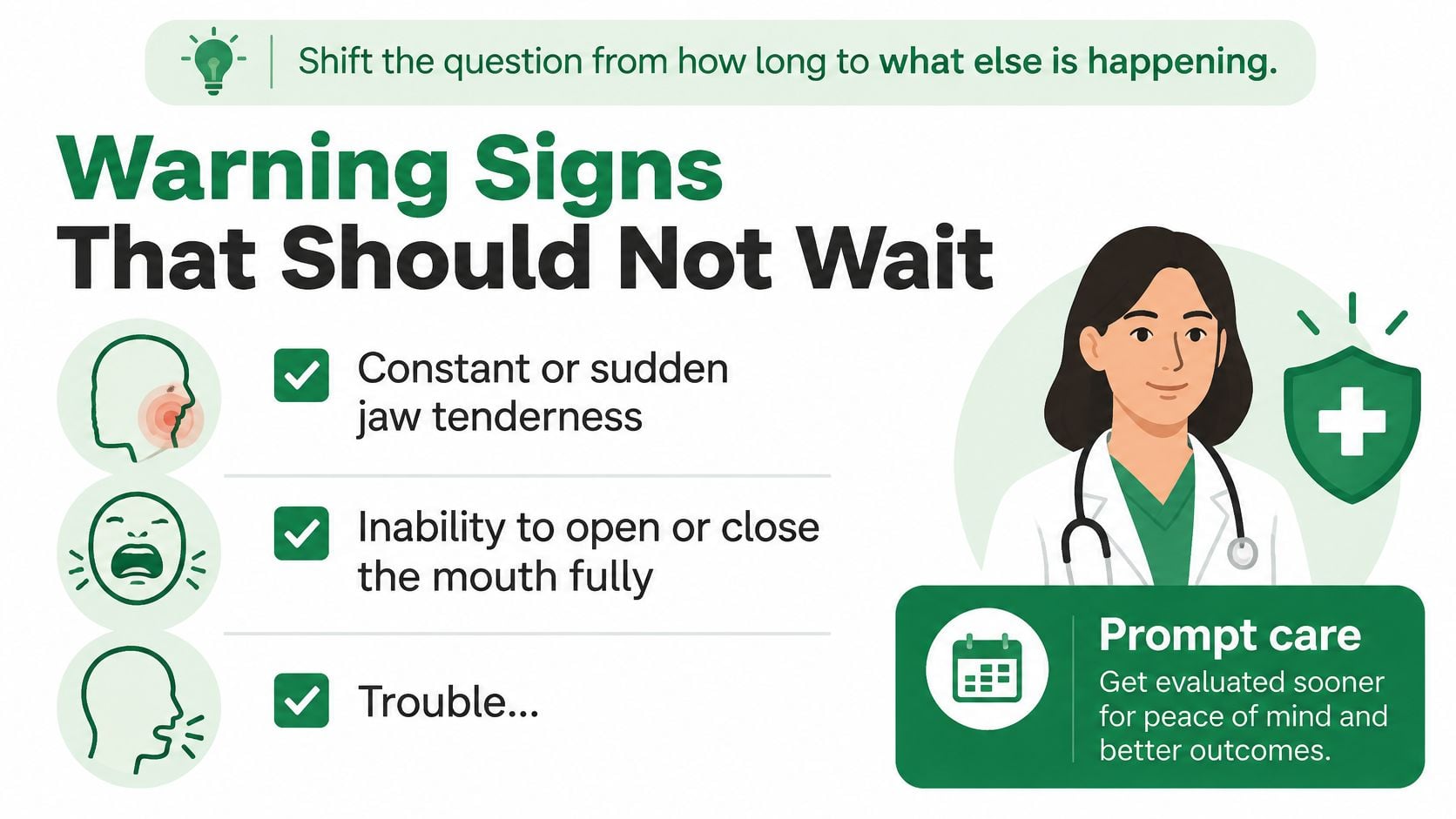
Sometimes the safer question isn't how long jaw pain lasts, but what else is happening. Jaw pain can arise from dental, muscular, joint, nerve, or medical conditions, and an article can't distinguish them reliably.
The Mayo Clinic's TMJ symptom guidance recommends evaluation for persistent tenderness, pain, or difficulty opening or closing the jaw. Associated symptoms help determine whether a person needs emergency care, urgent assessment, or a scheduled jaw evaluation.
Symptoms needing emergency or urgent medical attention
- Possible heart symptoms: Jaw pain with chest pain, breathlessness, sweating, or faintness may signal a cardiac emergency. Emergency medical help is appropriate immediately.
- Severe headache or vision symptoms: A severe new headache with scalp tenderness or vision changes needs urgent medical assessment rather than an assumption of TMD.
- Possible spreading infection: Fever with restricted opening or facial or neck swelling needs prompt assessment. Trouble breathing or swallowing requires emergency help.
- New neurological changes: New weakness, numbness, or other sudden neurological symptoms warrant urgent medical attention.
These symptoms don't establish a diagnosis. They indicate that home observation alone isn't an appropriate next step.
Jaw-function changes that need prompt assessment
Constant or sudden jaw tenderness, inability to open or close fully, and trouble eating deserve professional attention. A jaw that locks or opens less over time should be checked even if pain medicine makes the soreness easier to tolerate.
Other reasons for a broader medical or dental check include unexplained weight change, persistent mouth sores, new changes in sensation, and pain after an injury. The assessment may need to look beyond the jaw joint.
Brief, shock-like facial pain can also differ from typical muscle soreness. Information about TMJ pain and trigeminal neuralgia can help explain the distinction, but symptom descriptions alone can't confirm either condition.
Less pain isn't the same as restored jaw movement.
Pain and mechanical recovery can diverge. A person may feel more comfortable while still struggling to bite into food, brush normally, or speak for extended periods.
For that reason, follow-up should include function, not just a pain rating. A reassuring trend means the person is returning to ordinary jaw use, not merely avoiding everything that hurts.
How Treatment Can Change the Timeline
Months of jaw pain don't automatically mean surgery is next. A 2025 clinical-practice guideline summary reported symptom relief in more than 85% to 90% of patients across three longitudinal studies lasting two to 10 years, with stability reached for most participants within six to 12 months after conservative treatment began.
That window describes outcomes after care started, not a deadline for every patient. Conservative care means approaches that avoid surgery and generally begin with reversible measures.
How common care options relate to timing
| Approach | Role in care | Timing to discuss |
|---|---|---|
| Self-care with heat or cold | Comfort while arranging an exam; 15 to 20 minutes several times daily | Short-term support over days to weeks; stop if worse |
| Medication, physiotherapy, and cognitive-behavioral care | Primary conservative options in guideline summaries | Discuss gradual progress; most participants in the cited studies reached stability within six to 12 months |
| Oral appliance or orthotic | Provisional, time-limited stabilization for selected cases | Reassess on a set schedule; ongoing wear isn't automatic |
| Cold laser therapy | An adjunct that may help pain modulation and tissue healing | Alongside, not instead of, identifying contributing factors |
| Sleep evaluation | Assessment when snoring or unrefreshing sleep accompanies jaw pain | Sleep apnea diagnosis requires a sleep study and a physician |
For comfort during the wait for an examination, Mayo Clinic's treatment guidance recommends heat or cold for 15 to 20 minutes several times daily, with cold suggested for acute pain and heat for chronic dull pain. A cloth barrier helps protect the skin, and either approach should stop if symptoms worsen.
Softer foods and avoiding gum or forceful opening may reduce unnecessary strain. Exercises should match the diagnosis; forceful stretching isn't an appropriate default for a painful or locking jaw.
Match treatment to the findings
A root-cause evaluation considers the muscles, joints, teeth and bite, habits, sleep, and relevant medical history. It shouldn't assume that every painful jaw needs bite changes or an appliance.
Physiotherapy can address movement and muscle function. Cognitive-behavioral treatment teaches practical ways to manage pain-related distress and activity, while medication choices require attention to medical history and other medicines. An overview of how TMJ disorders are treated can help patients prepare questions.
Sleep symptoms deserve their own assessment. Sleep apnea is diagnosed through a sleep study and a physician; an oral appliance may be an alternative to CPAP for appropriate patients, while CPAP remains an important treatment.
Some practices also offer Snorelase for selected snoring concerns and laser frenectomy for tongue ties in infants, children, and adults. Neither belongs in every jaw-pain plan, and a tongue-tie procedure shouldn't be presented as a routine treatment for TMD or sleep apnea.
Persistent, widespread, or treatment-resistant pain may require specialist referral and coordinated care. The next step should follow the findings, not just the number of unsuccessful products already tried.
Decide Whether to Request an Evaluation
If mild discomfort is clearly improving and chewing, speaking, and opening remain comfortable, brief self-care with a planned recheck can be reasonable. Persistent limits, locking, worsening movement, headaches, or poor sleep favor an evaluation instead of continued guessing.
Pain and Sleep Therapy Center, led by Dr. Ryan Robinson, who is triple board-certified in craniofacial pain and dental sleep medicine, offers root-cause evaluation and conservative options for TMJ, head, and facial pain. With offices in Newark, DE, and Bryn Mawr, PA, the team serves patients from Wilmington, Delaware, and the Philadelphia Main Line.
Many patients improve with conservative care, but no plan can guarantee an individual timeline. This article provides education, not a diagnosis.
Request an Appointment through the Newark office at (302) 239-1757. For loud snoring, gasping, or daytime fatigue, Take our Sleep Quiz as a screening step, with sleep apnea diagnosis requiring a sleep study and a physician.
Pain and Sleep Therapy Center offers jaw-function assessment, craniofacial pain care, and dental sleep medicine to help identify what may be prolonging symptoms. Visit Pain and Sleep Therapy Center to Request an Appointment and discuss a conservative plan based on symptoms, sleep, and everyday jaw function.