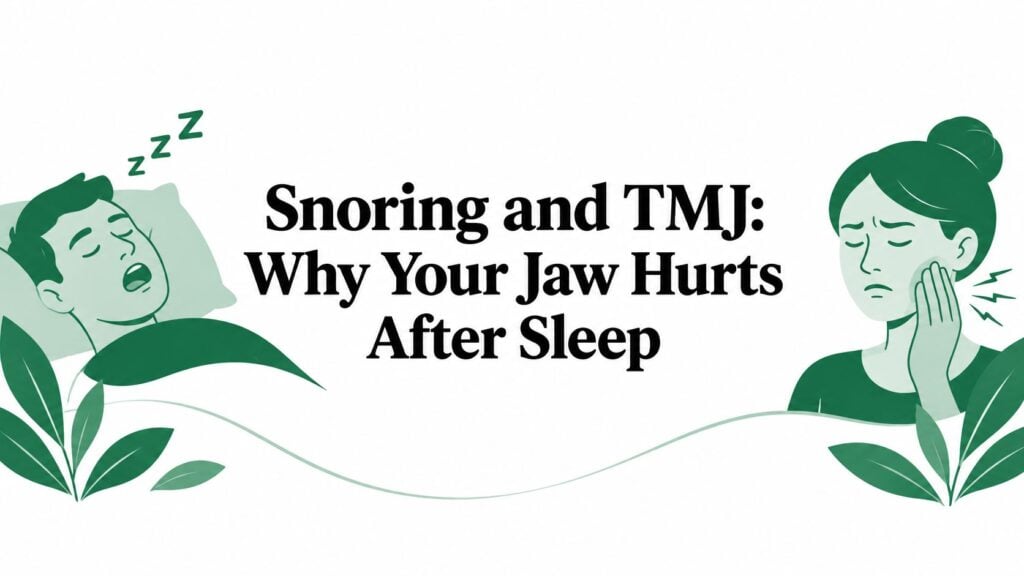
A partner says the snoring has grown louder. The person waking up, meanwhile, has a sore jaw and a dull morning headache. It's natural to wonder whether the jaw is causing the noise, whether poor breathing is straining the jaw, or whether both symptoms have separate causes.
Snoring and jaw pain can happen together, but neither symptom alone explains the other. Sorting out the likely cause means looking at the airway, jaw function and tongue posture before choosing a device or treatment.
Table of Contents
- Snoring and Jaw Symptoms That Often Appear Together
- Common Misconceptions About Snoring and TMJ
- How the Airway, Bite and Tongue Are Linked
- How Snoring and TMJ Are Evaluated Together
- Treatment Options That Address Both Sides
- Tongue Ties, Breathing Habits and Daily Routines
- Confirm the Root Cause Before Choosing Treatment
Snoring and Jaw Symptoms That Often Appear Together
A person may snore regularly and wake with a tight jaw, sore face, or morning headache. These symptoms can share a cause, or arise separately, so it helps to sort possible airway, bite, and tongue-posture factors before choosing a device.
The epidemiologic review of snoring and sleep-disordered breathing reports that 37.2% of men and 22.4% of women snored at least five nights per week in a U.S. adult study. Persistent snoring can occur with obstructive sleep apnea (OSA), a condition in which breathing repeatedly narrows or stops during sleep. Snoring alone does not establish an OSA diagnosis; it matters more when considered alongside other symptoms.
Symptom patterns and where to start
| Symptom pattern | What it may suggest | Where to start |
|---|---|---|
| Loud, frequent snoring with witnessed pauses or gasping | Possible OSA | Sleep evaluation with a physician |
| Morning headaches or dry mouth with snoring | Possible sleep-disordered breathing | Sleep and dental review |
| Jaw clicking, popping, or soreness when chewing | Possible TMD involving the joint or muscles | Functional jaw exam |
| Clenching, grinding, or a tight jaw on waking | Possible bruxism and muscle strain | Bite and jaw muscle exam |
| Daytime sleepiness with snoring | Possible sleep apnea risk | Screening, followed by sleep testing if appropriate |
| Jaw pain or snoring that begins after an oral appliance is used | Possible change in bite or airway | Reassess sleep and jaw findings |
Chronic headaches, jaw or facial pain, and clicking or popping sounds can accompany TMJ problems. A thorough evaluation looks for the source rather than assuming that one symptom explains the others. For people who wake with a tight jaw, this guide to reducing nighttime jaw clenching offers related information.
Sleep position and mattress support may help with comfort, but they cannot confirm or rule out a breathing disorder. For general sleep-environment ideas, see sleep advice from Gorins Furniture & Mattress. Arrange an evaluation if a bed partner notices breathing pauses or gasping, snoring occurs with marked daytime sleepiness, or a new oral appliance is followed by worsening jaw pain or locking.
Common Misconceptions About Snoring and TMJ
Jaw disorders can involve the jaw joint, the muscles used for chewing, or both. The National Institute of Dental and Craniofacial Research describes temporomandibular disorders, or TMD, as a varied group of conditions, not a single problem with one cause. Its overview of TMD also explains why reported rates change depending on whether a study measures joint pain, muscle pain, limited function or a formal diagnosis.
“Quiet snoring means there's no breathing problem.” The sound level and the severity of sleep apnea aren't interchangeable. A quiet night doesn't establish that breathing stayed normal.
“Jaw pain always comes from grinding.” Pain may involve the jaw joint or chewing muscles, and grinding is only one possible contributor. A jaw exam helps distinguish soreness during movement from tenderness in the muscles or other signs of strain.
“One device fixes both problems.” A mandibular advancement appliance can help keep the airway open for some people, but it also changes lower-jaw position and may aggravate TMD. Both sleep symptoms and jaw function need follow-up if a device is used.
“A home test replaces a physician's review.” A home sleep apnea test can be appropriate for some adults, but choosing and interpreting it belongs within physician-directed sleep care. A test result needs to be considered alongside the person's symptoms and medical assessment.
“Tongue ties only affect infants.” A restricted tongue can be relevant to breathing, oral function and jaw or neck tension in adults as well as children. Whether it's contributing to a person's symptoms requires an individual assessment.
The evidence connecting snoring to a specific TMJ diagnosis is less definitive than the evidence connecting snoring with OSA. The symptoms may overlap, but they're signals to evaluate, not proof that one caused the other.
How the Airway, Bite and Tongue Are Linked
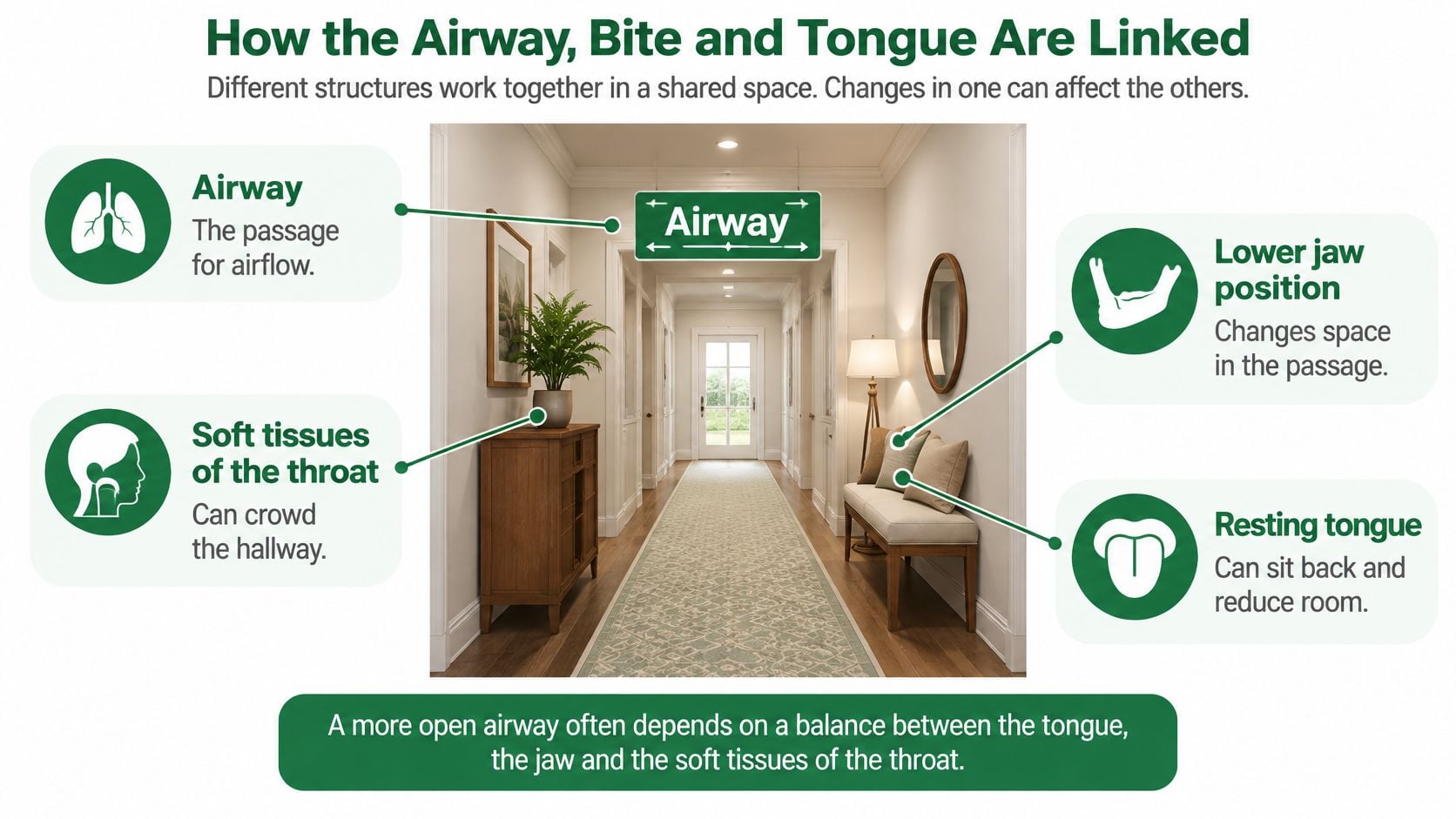
A person may snore at night and wake with a sore jaw, yet those symptoms can have different causes. Snoring often begins when relaxed throat tissues vibrate as air moves through a narrowed airway. The jaw's position, tongue posture and nasal blockage can each affect the space available for airflow.
What can narrow the passage
During sleep, throat muscles relax. In obstructive sleep apnea (OSA), the airway can partly or fully collapse, interrupting airflow. A lower jaw that sits farther back, a tongue resting low or toward the back of the mouth, and nasal blockage may also affect airflow. These features can guide an airway assessment, but none confirms a diagnosis on its own.
The jaw has moving parts of its own. The temporomandibular joints, or TMJs, work with the chewing muscles to open, close and move the lower jaw. Changes in jaw position or muscle activity can place different loads on those joints and muscles. That may matter when the jaw is already sore, though snoring alone does not indicate a jaw disorder.
Breathing disruptions, mouth breathing and changes in jaw-muscle activity have been proposed as possible contributors to facial and jaw strain. A systematic review describes these potential links while noting that the evidence does not establish which condition causes the other. In a case-control dataset discussed in the review of the relationship between snoring and TMD, 51% of people with OSA had TMD signs or symptoms, compared with 32% of controls. The figures show an association in that dataset, not a proven cause-and-effect relationship.
Why both sides matter
A person who snores and wakes with a tender jaw may have an airway issue, a jaw-muscle problem, or both. The likely cause matters: airway narrowing, bite and jaw mechanics, and tongue posture point to different questions for assessment. For an overview of what can cause loud snoring in adults, consider how several factors can affect airflow.
Addressing the sound alone may miss a breathing issue, while focusing only on jaw pain may overlook sleep-related factors. Sorting out the possible causes helps guide what should be assessed before a device is chosen.
How Snoring and TMJ Are Evaluated Together
A jaw evaluation starts with how the joint and surrounding muscles function. The clinician asks about pain and medical and dental history, then checks jaw movement, range of motion, joint sounds or vibrations, and muscle tenderness. Clicking or popping, limited movement, and pain can help identify which structures need closer assessment.
The airway and sleep history add another part of the picture. A clinician may ask about snoring, morning headaches, dry mouth, daytime sleepiness, and breathing concerns. A sleep questionnaire can help organize these details, but it does not replace a clinical evaluation.
| Test or step | What it checks | Who typically provides it |
|---|---|---|
| Symptom questionnaire or sleep quiz | Snoring, sleepiness and other sleep concerns | Patient completes; clinician reviews |
| Physical jaw exam | Range of motion, joint sounds or vibrations, and muscle tenderness | Dentist or TMD specialist |
| Home sleep apnea test | Sleep-related breathing and oxygen levels | Physician-directed, for suitable adults |
| In-lab polysomnography | Overnight sleep and breathing patterns | Sleep physician |
| 3D CBCT scan of the jaw joint | Bone and joint structure | Imaging center by referral |
| Airway and tongue exam | Nasal breathing, tongue mobility and frenulum | Relevant dental or medical clinician |
The findings guide what happens next. A physician determines whether sleep testing is appropriate and which type fits the situation. A home test may be suitable for some adults; in-lab polysomnography provides a more detailed overnight assessment. If a home result is negative or inconclusive but concerns remain, further evaluation may be needed.
Jaw imaging answers a different question. A 3D CBCT scan can show the bony structure of the joint, and patients may be referred to an imaging center to have it completed. In some cases, sleep diagnostics or hospital-based soft-tissue diagnostics provide additional information.
This process helps distinguish whether symptoms are more consistent with an airway concern, a jaw or bite issue, tongue movement, or a combination. That distinction matters because a device chosen for one cause may not address another. Before testing or treatment, ask what finding prompted the recommendation, who will interpret the results, and how jaw function will be considered.
Treatment Options That Address Both Sides
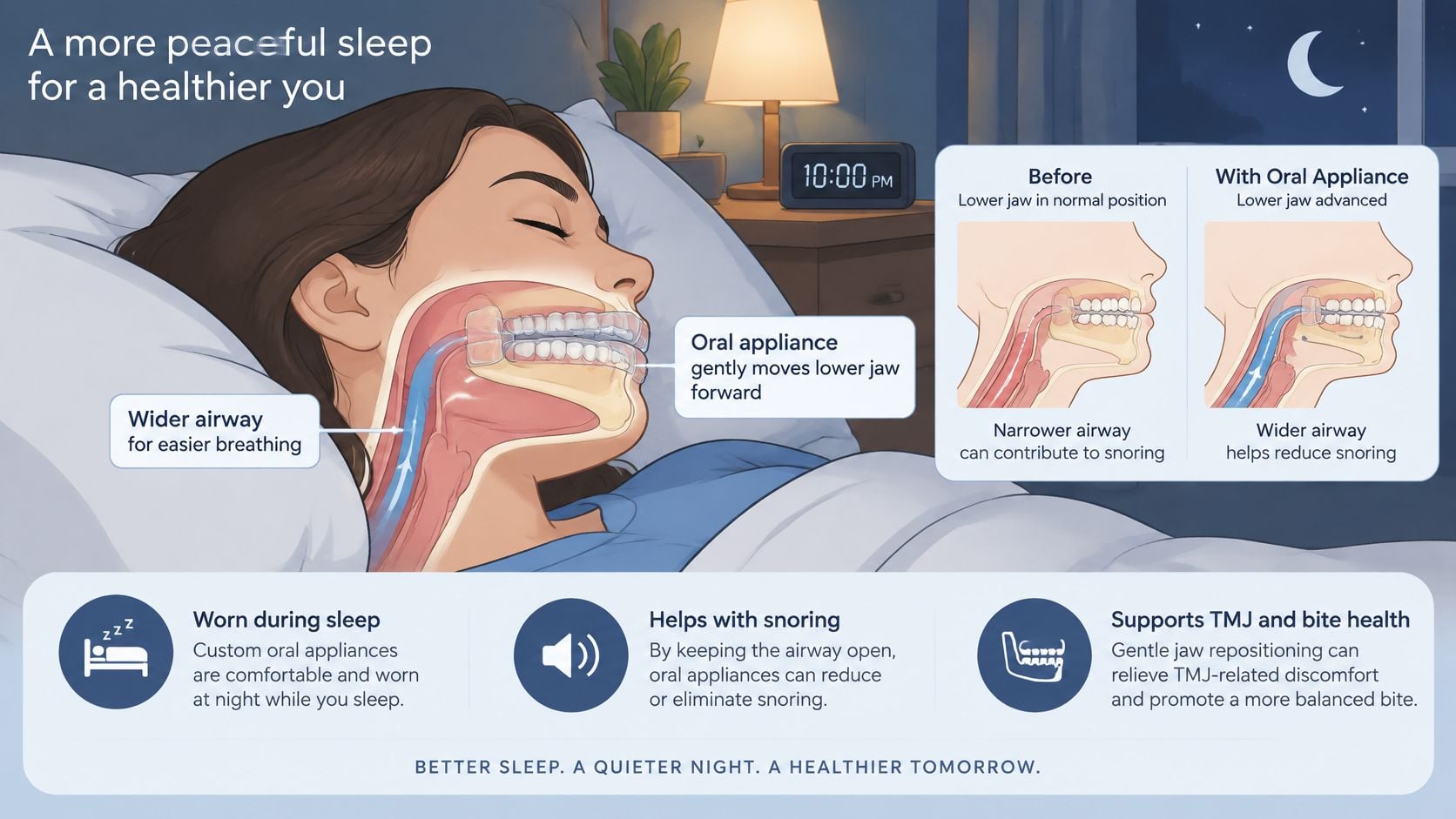
A jaw-positioning appliance may reduce snoring or improve obstructive sleep apnea (OSA) by moving the lower jaw forward and changing the space behind the tongue. The same movement can aggravate jaw symptoms in some people with active TMD. So the first question is what is driving each symptom: airway collapse, jaw or bite problems, or a combination.
The American Academy of Sleep Medicine (AASM) recommends oral appliances mainly for adults with OSA who cannot tolerate CPAP or prefer an alternative. Its review of oral appliance practice parameters reported that appliances controlled sleep apnea in approximately 52% of patients across mild-to-severe cases. The review also states that oral appliances are generally less effective than CPAP at reducing breathing events and are not recommended as first-line treatment for severe OSA, defined as an apnea-hypopnea index greater than 40 events per hour. Treatment choice depends on the diagnosed severity and follow-up testing.
Compare the treatment target
| Option | Main target | Key consideration |
|---|---|---|
| Oral appliance, or mandibular advancement | Airway during sleep | Adjusted gradually; may aggravate TMD in susceptible patients |
| Stabilization orthotic | Jaw joint and muscle pain, bite stability | Used mainly for pain and function; does not treat sleep apnea |
| Cold laser therapy | Pain modulation as an adjunct | Used alongside other care; evidence varies by condition |
| CPAP | Keeps the airway open with air pressure | A treatment option for OSA |
Before fitting a mandibular advancement device, the care team can record jaw pain, range of motion, bite and joint sounds as a baseline. Gradual adjustments and follow-up help identify discomfort, tooth changes, joint sounds or changes in how the teeth meet. If pain worsens or the jaw locks, the appliance's position and the diagnosis should be reassessed. The clinical guidance on oral appliances and jaw effects describes possible joint pain, muscle discomfort, tooth discomfort and bite changes.
A nighttime appliance used for TMJ maintenance or tooth protection serves a different purpose unless it is designed to manage sleep apnea. A jaw-positioning appliance needs to address the breathing problem while being monitored for effects on jaw function. Simple tests can help estimate how far the jaw should advance to reduce snoring, and finding the best position may take time.
Comfort measures can support a broader plan, but they do not replace diagnosis or prescribed treatment. For general mattress and sleep-position ideas, these tips to ease snoring with the right mattress may be useful. No single option is guaranteed to resolve both snoring and jaw pain; treatment should match the likely causes and be adjusted with follow-up.
Tongue Ties, Breathing Habits and Daily Routines
A tongue tie, or ankyloglossia, is a short or tight frenulum that limits tongue movement. The tongue's mobility can affect how it rests in the mouth and how a person manages oral functions. In adults, restricted movement may be relevant to sleep-disordered breathing, snoring, sleep apnea, and head, neck or shoulder pain. Children may also need assessment when tongue movement is linked with feeding or airway concerns.
Evaluation starts with an exam of tongue movement and the frenulum by a trained provider. If restriction is found and treatment is appropriate, a laser frenectomy may be considered, with aftercare coordinated around the person's needs. Releasing tissue isn't automatically the right answer for every tongue tie; the decision should take symptoms, function and the broader airway picture into account. More information about tongue-tie symptoms in adults can help adults recognize concerns to raise during an assessment.
Habits that support care
Myofunctional therapy is a type of exercise-based training for the tongue, lips and breathing pattern. It may work on resting the tongue on the roof of the mouth, nasal breathing when the nose is clear, and a steady swallowing pattern. These skills can support a treatment plan, but they don't replace sleep testing or a medical diagnosis when OSA is suspected.
A simple daily checklist can help build consistent habits:
- Keep a regular sleep schedule. A steady routine supports more predictable sleep and makes changes in symptoms easier to notice.
- Consider side sleeping when a physician agrees. Sleep position may affect symptoms for some people, but it isn't a substitute for evaluating possible OSA.
- Review alcohol and sedating medicines near bedtime with a physician. Don't stop a prescribed medicine without medical advice; ask whether its timing or effects could matter for sleep.
- Discuss persistent nasal congestion with a doctor. A blocked nose may make comfortable nasal breathing harder and deserves attention rather than guesswork.
- Practise prescribed breathing and tongue exercises consistently. Regular practice can help reinforce the skills taught in therapy.
Dry mouth on waking may be a reason to note breathing habits and discuss symptoms, rather than trying to infer the cause from the symptom alone. Mouthology's guide to morning breath provides further general context about why breath can smell different after sleep. A provider can help determine whether a tongue restriction, nasal issue, sleep disorder or another factor deserves attention. Some treatment plans combine habit changes with a device or, when appropriate, a laser release, since one step may not address every contributing factor.
Confirm the Root Cause Before Choosing Treatment
A snoring sound and a sore jaw can have different causes, even when they appear together. Treatment choices should follow an evaluation of the airway, bite, and tongue, rather than aiming only to quiet the noise or ease the jaw pain.
Sleep apnea requires diagnosis through a sleep study and a physician. A screening quiz can help indicate whether an evaluation may be appropriate, but it cannot diagnose obstructive sleep apnea. A dentist with advanced training in sleep apnea treatment can assess jaw and bite function as part of the broader evaluation.
TMJ assessment may include patient history, a physical examination, jaw range of motion, and joint sounds or vibrations. Imaging of the joint's hard tissues may also be needed. A 3D CBCT scan is frequently used, and patients may be referred to a diagnostic imaging center for it. In some cases, sleep diagnostics or hospital-based soft-tissue diagnostics help clarify what is contributing to symptoms.
These findings guide the next step. A nighttime appliance used for TMJ maintenance may worsen sleep apnea if it is not designed to control it, so the appliance's purpose and effect on breathing need consideration. When snoring is the concern, simple tests can help determine how much advancement is needed; finding the best position may take time and adjustment.
Pain and Sleep Therapy Center evaluates TMJ and facial pain, sleep disorders, and tongue-tie concerns, with care guided by a root-cause assessment. The practice is led by Dr. Ryan Robinson, a triple board-certified specialist in craniofacial pain and dental sleep medicine, and has locations in Newark, Delaware, and Bryn Mawr, Pennsylvania.
Patients can visit Pain and Sleep Therapy Center to request an appointment or take the Sleep Quiz.