Among people with painful temporomandibular disorders, headache reaches 82.80%, according to a 2022 systematic review and meta-analysis. That figure reframes facial pain with headache. The jaw can be part of the picture, and it still isn't an automatic explanation. Two problems can be active at once, and a few patterns need medical care before any jaw plan starts.
Pain may sit in the cheek, temple, ear, or jaw while the driver is a joint, a muscle, a nerve, a sinus, the neck, or breathing during sleep. Sorting the pattern comes first.
Table of Contents
- Why Facial Pain and Headache Often Appear Together
- Match Your Symptoms to the Most Likely Source
- Signs That Need Emergency or Same-Day Care
- How Clinicians Sort TMD From Other Headache Causes
- Why Sleep Apnea Belongs in the Jaw Pain Picture
- Non-Invasive Options That Target the Root Cause
- Request an Appointment for a Root-Cause Evaluation
Why Facial Pain and Headache Often Appear Together
61.58% of people with temporomandibular disorders (TMD) have headache, rising to 82.80% when the TMD is painful, and migraine is the most common primary headache type at 40.25% versus 18.89% for tension-type headache, according to a 2022 systematic review and meta-analysis that pooled 31 studies. TMD covers conditions that affect the jaw joints, chewing muscles, and nearby structures.
Those numbers describe overlap, not cause. A pooled rate shows how often two conditions travel together in study groups. It does not show which problem started first or whether one created the other. That distinction matters because a clinician asks about pain with chewing, jaw clicking, temple pain, and headache timing before deciding what the jaw is doing.
The jaw joint, chewing muscles, and head share nerve pathways, so pain behaves like a shared phone line: a ring in one room is heard in several rooms. Pressing a sore chewing muscle can produce a temple ache that feels like a headache even though the muscle started it. That overlap is why facial pain with headache is common.
A 2025 systematic review estimates that 29.5% of people worldwide have a TMD. Common is not automatic. Headache with jaw pain can have more than one driver, and migraine and TMD often coexist. Sorting the pattern and checking for red flags comes before any treatment discussion, so the jaw is not blamed for every headache and serious causes are not missed.
TMJ and facial pain can show up as chronic headaches, jaw pain, facial pain, and clicking or popping, and a thorough evaluation identifies root causes. Adults who want a plain walk-through of jaw symptoms can read jaw pain guidance for West Valley adults before a visit.
| Measure | Result | Source |
|---|---|---|
| Headache prevalence among people with TMD (pooled) | 61.58% (95% CI 45.26-76.66) | 2022 systematic review |
| Headache prevalence among people with painful TMD | 82.80% (95% CI 75.41-89.10) | 2022 systematic review |
| TMD prevalence among people with headache (pooled) | 59.42% (95% CI 51.93-66.60) | 2022 systematic review |
| Migraine among TMD populations | 40.25% (95% CI 35.37-45.23) | 2022 systematic review |
| Tension-type headache among TMD populations | 18.89% (95% CI 12.36-26.44) | 2022 systematic review |
| Global TMD prevalence (2025 systematic review) | 29.5% | 2025 systematic review |
Match Your Symptoms to the Most Likely Source
Use the table as a map, not a diagnosis. Find the pattern in the first column, check where the pain sits, then answer the question in the last column before any label sticks. More than one row can be true at the same time. The table starts a conversation with a clinician. It isn't a verdict.
Two rows need extra care. Constant one-sided pain with numbness or steady worsening needs a medical exam before anyone applies a jaw label. Brief electric-shock jabs call for a neurology conversation, not a splint by itself. A diagnostic re-evaluation of non-dental facial pain reported a median delay of 17 months (interquartile range 7 to 96 months) while people moved between dental, neurologic, and pain services.
Practical rule: A dated symptom diary shortens that search. Write the time, the trigger, what chewing or jaw movement does, nausea or light sensitivity, neck movement, and how you slept.
The useful question isn't only whether the jaw can cause headaches. It's which features make TMD more likely than migraine, trigeminal neuralgia, cervicogenic headache, sinus disease, or neuropathic facial pain, and when that label should be dropped. If shocks are the main story, a closer look at TMJ pain versus trigeminal neuralgia helps separate a joint problem from a nerve problem.
| Pattern | Where the pain sits | Often points toward | Key question to ask |
|---|---|---|---|
| Pain that worsens with chewing, yawning or talking | Jaw, temple, cheek or ear | TMD (jaw joint and chewing muscles) | Does pressing the jaw reproduce the headache? |
| Throbbing headache with nausea or light sensitivity | One side of the head, attacks lasting hours to days | Migraine | Are there migraine features such as nausea or light sensitivity? |
| Brief electric-shock jabs | Cheek, lip, gums or jaw, often set off by touch or talking | Trigeminal neuralgia | Is there a trigger zone that sets off each jab? |
| Headache starting at the base of the skull | Back of the head, neck, usually one side | Cervicogenic headache (neck origin) | Does neck movement change the headache? |
| Facial pressure with congestion or thick nasal discharge | Cheeks, forehead or under the eyes, worse when bending forward | Sinus disease | Are nasal symptoms or fever present? |
| Constant one-sided pain with numbness or steady worsening | Face, may spread over time | Needs medical exam before any TMD label | Is there numbness, weakness or progressive change? |
Signs That Need Emergency or Same-Day Care
Safety comes before any jaw treatment. Irreversible dental or bite changes can hide a missed nerve, blood-vessel, infection, or heart problem. Use this checklist to decide how fast to act, then let a clinician confirm the cause. At this stage the only question is speed: minutes, days, or a routine appointment.
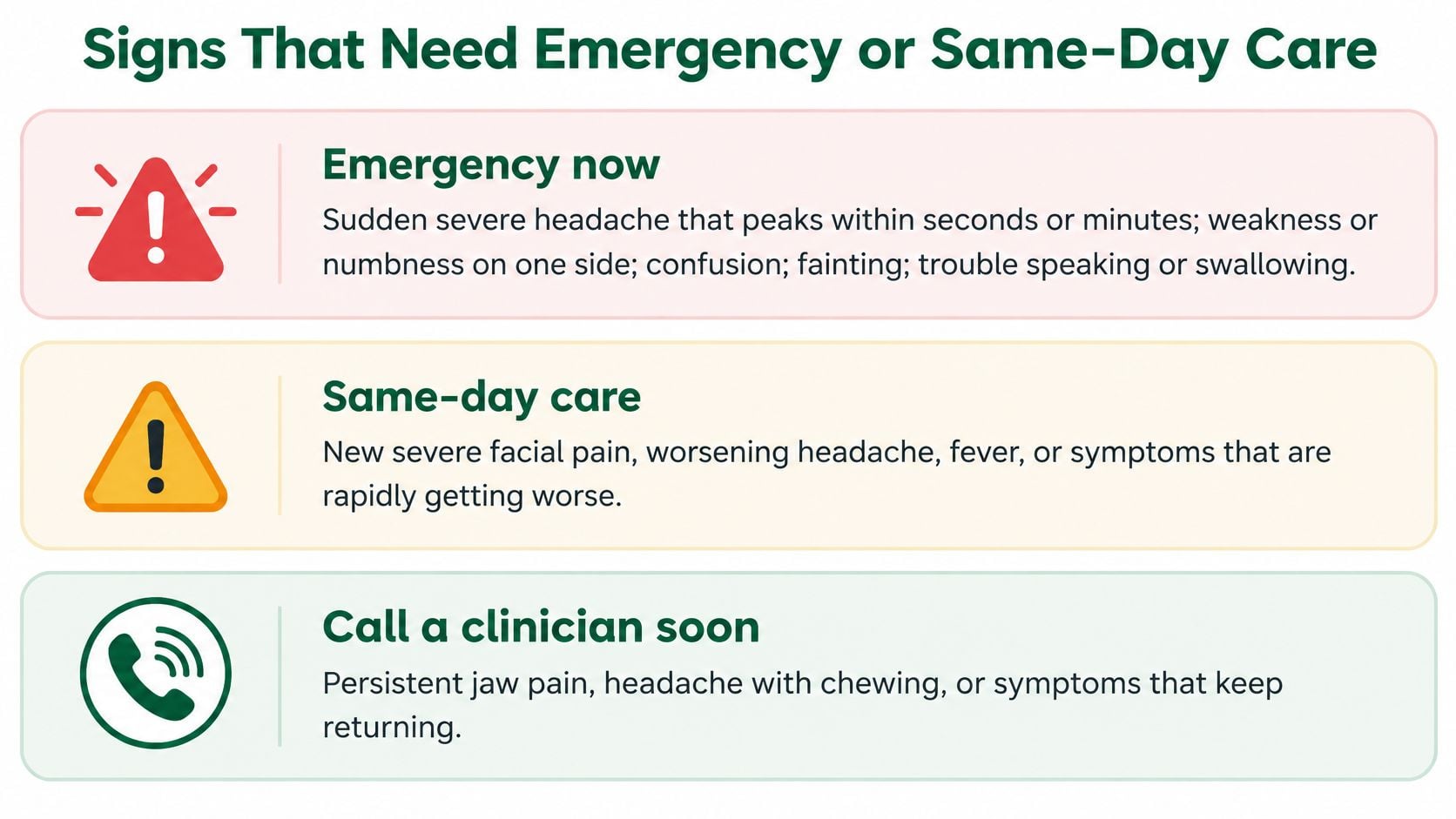
Emergency now
Call emergency services for any of these:
- Sudden severe headache: Pain peaks within seconds or minutes.
- One-sided weakness or numbness: Face, arm, or leg.
- Brain warning signs: Confusion, fainting, or trouble speaking.
- Breathing or swallowing trouble: Don't wait for a dental visit.
- Vision changes: New blurring, double vision, or vision loss.
- Jaw or face pain with heart clues: Chest pressure, shortness of breath, sweating, nausea, or pain at rest. Exertional jaw pain can reflect heart trouble rather than TMD, as the Merck Manual headache approach notes among serious secondary causes.
Same day, not a home remedy
Fever with facial swelling, or severe trouble opening the mouth, needs same-day care. In someone over 50, jaw pain while chewing, scalp or temple tenderness, or vision changes can signal giant cell arteritis, inflammation of the temporal arteries. That needs same-day medical assessment, not a bite appliance. These are the cases where the mouth and jaw are reporting on something happening elsewhere, so a splint would only delay the answer.
Urgent medical assessment, not a jaw trial
A clinical review of temporomandibular disorders is clear: a first or worst headache, a rapidly worsening headache, a new headache after age 50, fever with a stiff neck, a rash, papilledema (a swollen optic disc), cancer or a weakened immune system, or focal neurologic deficits needs urgent medical assessment rather than empiric TMJ treatment.
Below that line sits the ordinary case. Persistent or recurring facial pain with headache and none of these signs can wait for a non-urgent specialist visit, even if the pain is unpleasant and has been around for weeks. The distinction cuts both ways. It keeps a blood-vessel, nerve, or heart problem from being worked up as a bite problem, and it keeps a straightforward muscle or joint headache out of emergency care that cannot help it. Duration alone does not decide this. A headache you have carried for months and one that broke in last week get sorted by pattern and by what the examination finds.
What points back toward muscle or joint: pain when the temporalis or masseter is pressed, pain with jaw loading, limited or uneven opening, and joint tenderness or sounds.
How Clinicians Sort TMD From Other Headache Causes
Diagnosis is a fit between the story and the exam, not a single test. The NIH Diagnostic Criteria for Temporomandibular Disorders use history plus examination, and they treat temple headache as part of that exam.
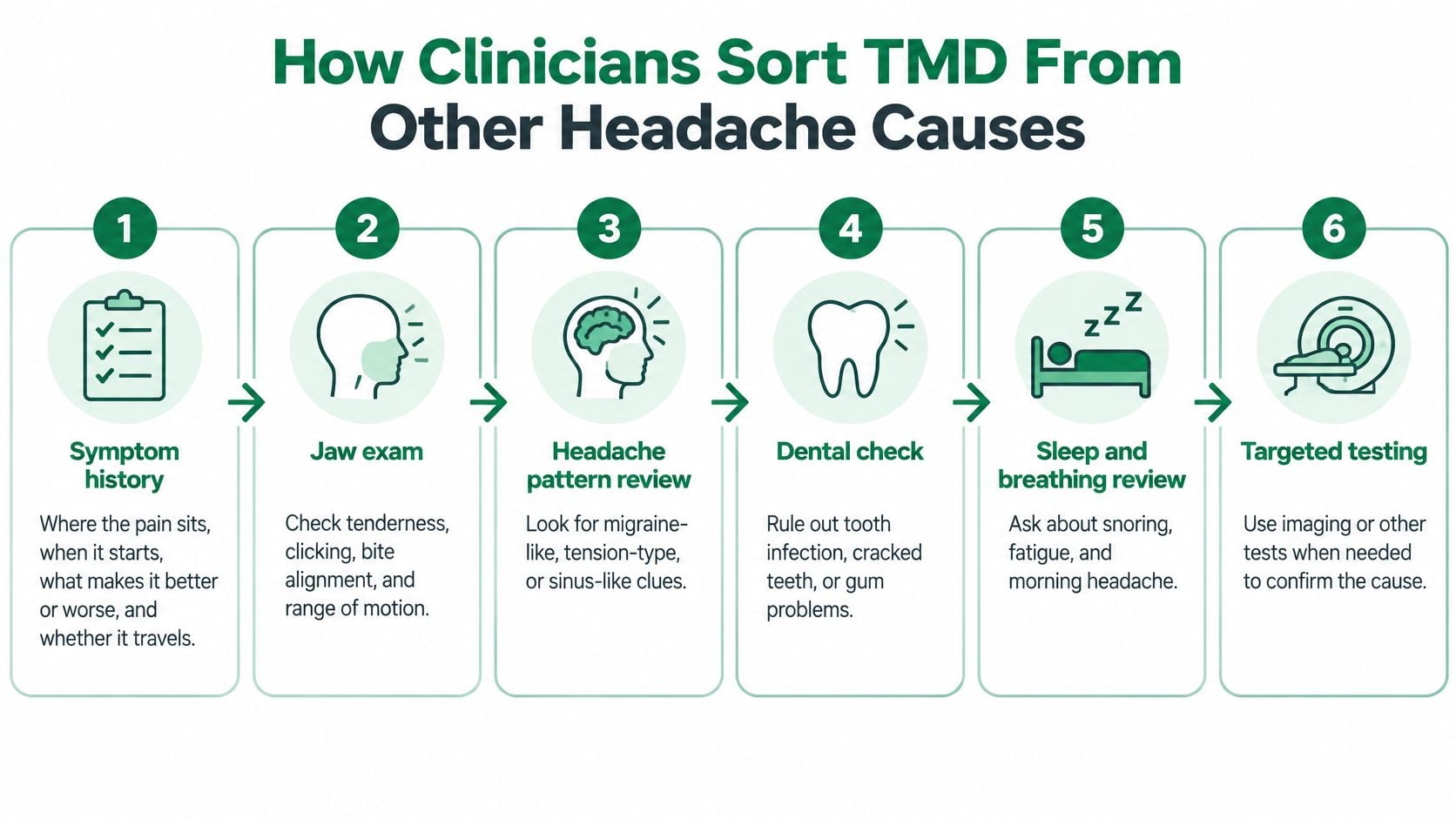
- Symptom history. The clinician asks where pain sits, when it starts, what makes it better or worse, and whether it travels to the face, ear, or neck. A pain that only appears after a long chew is a different clue from pain that arrives at random.
- Headache history. The criteria ask whether there was a headache in the temple area during the previous 30 days. That question keeps headache inside the jaw workup instead of treating it as a separate complaint.
- Jaw examination. Opening range, side-to-side movement, joint sounds, and tenderness are checked. Pressing the chewing muscles and the joints shows whether a familiar headache comes back. Pain on jaw movement points more toward muscle. Focal joint tenderness and sounds point more toward the joint itself.
- Exclusion exam. Neurologic, ear, oral, and neck checks look for causes that a splint won't touch. Facial, mouth, or jaw pain isn't always TMD.
- Imaging when it changes the plan. A panoramic X-ray gives an initial look at teeth and bone. MRI is preferred when soft tissue inside the joint must be seen. A 3D CBCT (cone beam) scan of the jaw joint is frequently needed, and patients may be referred to a diagnostic imaging center to have it completed.
- Review. If the pieces don't fit, the diagnosis is reconsidered and a referral follows.
TMJ disorders are diagnosed through physical examination, range of motion, joint sounds or vibrations, joint hard-tissue images, patient history and interview, and in some cases sleep diagnostics and hospital-based soft-tissue diagnostics. A matching pattern between the headache and the jaw findings supports TMD. A poor fit points toward other causes.
Why Sleep Apnea Belongs in the Jaw Pain Picture
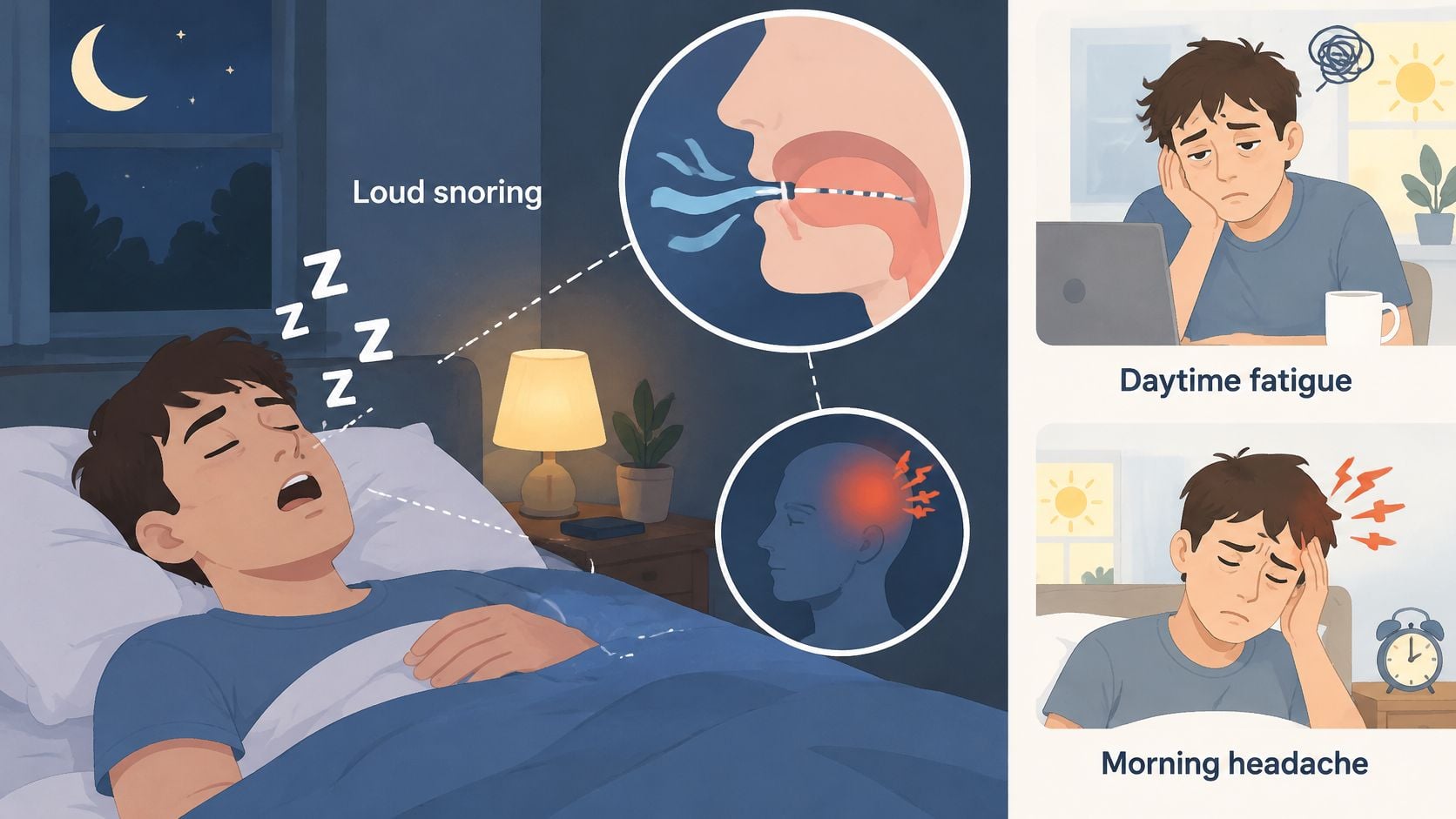
Greater than 60% of patients with TMJ issues have obstructive sleep apnea, so a sleep study may be suggested during TMJ therapy. That figure explains why a jaw examination keeps circling back to the airway. Obstructive sleep apnea means repeated pauses in breathing during sleep.
Take a patient who wakes with a headache most mornings, snores loudly enough to wake a partner, and feels drained by mid-afternoon. The jaw aches too, which makes TMD an easy first guess. That cluster of complaints is a reason to test for apnea, and the test result decides the diagnosis. Loud snoring, daytime fatigue, morning headache, and unrestful sleep all justify an evaluation, and only a sleep study confirms whether breathing stops during the night.
The American Academy of Sleep Medicine identifies polysomnography, an overnight sleep study, as the standard test for adults when evaluation raises concern for obstructive sleep apnea. Its oral-appliance guidance also says apnea status should be known before an oral appliance is started. That protects people who still have untreated disease, and it sets a baseline for judging whether treatment is working. A physician or qualified sleep clinician reads the study and sets severity before a therapy is chosen.
Tongue ties and airway barriers
In adults, tongue ties can cause sleep-disordered breathing, snoring, sleep apnea, and head, neck, and shoulder pain. Check tongue mobility as part of the airway assessment, alongside the jaw and breathing findings, because a restricted tongue changes how the whole upper airway behaves. When a physical barrier in the airway keeps CPAP or an oral appliance from helping, Pain and Sleep Therapy Center works with the appropriate physician on a plan. CPAP remains an important option. An oral appliance is a possible alternative for selected adults, not a replacement for every person.
Morning head pain is one reason people look for answers. A short guide on waking up with headaches walks through that pattern. For the jaw-and-sleep overlap in plain language, Seven Oaks Dentistry explains the connection.
Non-Invasive Options That Target the Root Cause
The driver picks the treatment. Clenching that produces morning headaches responds to different care than an airway that collapses at night, and a food trigger responds to something else again. That is why the mapping below starts with the likely source, never the symptom on its own. The sequence holds in every case: confirm the driver, start the matched option, then measure progress on a set schedule using a headache diary or follow-up sleep testing.
Each option works like a key cut for one lock. The splint that settles a clenching headache does nothing for an airway obstruction, and an oral appliance will not release a myofascial trigger point. Combining treatments is common and often necessary. Cold laser therapy, for instance, runs alongside heat, stretching, and stress reduction, and rarely holds on its own. Subjective symptoms generally improve within 30 to 60 days. Treat that window as a general observation about timing, not a deadline that decides whether care is working.
| Likely driver | Conservative option | How progress is checked | Notes |
|---|---|---|---|
| Jaw clenching or grinding with TMD | Custom orthotic (bite splint) and jaw exercises | Pain frequency and jaw opening at week 4, then again at week 8 | If opening has not improved by week 8, the plan is adjusted rather than extended unchanged |
| Muscle tension and myofascial pain | Cold laser therapy alongside heat, stretching and stress reduction | Tenderness on exam and a headache diary at each visit | Works best as part of a combined plan; used alone it rarely holds |
| Sleep-disordered breathing | Custom oral appliance fitted by a dentist with sleep training | Follow-up sleep study | A physician or sleep clinician confirms the diagnosis and severity first |
| Food or lifestyle triggers | Food and lifestyle journal | Repeating patterns across the journal | A single visit history misses what a week of notes reveals |
| Airway barrier that blocks CPAP or an oral appliance | Coordinated plan with the appropriate physician | Sleep testing and clinician review | Keeps medical and dental care working on the same plan |
Nutrition counseling may involve keeping a food journal to uncover additional triggers that add to chronic pain or inflammation. A cheese-heavy dinner or a skipped meal will not surface in a five-minute history. It shows up across a week of notes. When the pattern fits no row here, a referral to neurology, ENT, or sleep medicine comes before any further jaw treatment, because not every headache belongs to the jaw.
No single option works for every patient, and no appliance is guaranteed to end headaches, though headache frequency often improves with therapy. Plans are built to protect the bite and the jaw joint, and any remaining risk to either area is discussed before care begins. Ask about benefits, risks, and alternatives at each visit, and know that a plan can be paused at any time. A fuller look at non-surgical TMJ treatment covers how conservative steps are ordered before surgery is considered.
Surgery isn't the starting point. Conservative, reversible care comes first, and only after the driver is clear.
Request an Appointment for a Root-Cause Evaluation
Bring a dated symptom diary to the first visit: where the pain sits, when it starts, what triggers it, how chewing or jaw movement changes it, whether nausea or light sensitivity accompanies it, and how sleep has been. That pattern helps the clinician sort jaw, nerve, sinus, neck, and sleep-related drivers before treatment is chosen. If any red flag from the emergency list applies, handle that first; booking can wait.
At Pain and Sleep Therapy Center, a root-cause evaluation starts with a history and jaw exam, symptom mapping, and imaging or sleep screening when those tests are clinically indicated. Dr. Ryan Robinson, who leads the practice, is a triple board-certified specialist in craniofacial pain and dental sleep medicine. A TMJ appliance is not guaranteed to solve headaches, though headache occurrence frequently improves with therapy.
Plans may include orthotic therapy, cold laser therapy, lifestyle changes, and coordinated care with other professionals. The center has offices in Newark, Delaware, and Bryn Mawr, Pennsylvania.
Use the Sleep Quiz on the Pain and Sleep Therapy Center site as a screening step, then request an appointment. The quiz can flag sleep-related risk; it does not replace an evaluation.
The practice looks for the driver, including jaw joints, chewing muscles, and sleep-related breathing, before recommending surgery. Conservative options such as orthotic therapy, cold laser therapy, and oral appliance therapy may help once the cause is clear.