
If a TMJ splint can be removed, does that automatically make it risk-free? A removable appliance may seem simple, but its effect depends on which teeth it covers, how it positions the jaw, how long it's worn, and whether sleep-related breathing problems are present.
The temporomandibular joint (TMJ) connects the lower jaw to the skull. Disorders affecting that joint and the chewing muscles are called temporomandibular disorders (TMD). Understanding TMJ splint therapy side effects means separating manageable discomfort from changes that deserve a clinical review, without assuming that every new symptom is normal adjustment.
Table of Contents
- Common Side Effects You May Notice First
- Bite Changes That Signal a Need for Review
- Risk Factors That Raise Side Effect Risk
- Sleep and Airway Changes Behind New Snoring
- How to Track and Reduce Side Effects During Treatment
- Mitigation Strategies for Common Side Effects
- Timeline for Symptoms and Bite Checks
- Confirm the Next Step With a Specialist
Common Side Effects You May Notice First
Splints aren't uniformly harmful, but side effects are reported, and research hasn't reliably measured how often they happen. The following overview describes symptoms worth recording, not a prediction that every patient will experience them.
| Side Effect | What Readers Notice | Evidence Status |
|---|---|---|
| Changes in salivation | More or less saliva, dry mouth | Reported; frequency unknown |
| Tooth or dental tension | Teeth feel sore or pressured, often on waking | Reported; frequency unknown |
| Increased clenching | Tired jaw muscles and more awareness of clenching | Reported; frequency unknown |
| Worsening jaw symptoms | Temporary rise in pain, clicking or fatigue | Reported; frequency unknown |
| Bite or tooth-contact change | Teeth meet differently or chewing feels off | Described in reviews; frequency unknown |
| Airway or sleep change | New snoring or witnessed breathing pauses | Limited data; needs sleep study |
A 2024 Cochrane review included 57 studies involving 2,846 participants, yet the available evidence wasn't sufficient to determine the overall benefits or harms of bite-related treatments for TMD. That uncertainty matters: a symptom can be reported in clinical literature without researchers knowing its true frequency.
What a new symptom can mean
Tooth tension may feel like pressure across several teeth rather than a sharp toothache. Increased clenching may appear as tired cheeks or temples on waking. Saliva changes can be noticeable even when the appliance otherwise feels comfortable.
Some reported effects are described as manageable through appliance adjustment. That doesn't mean a patient should tolerate worsening symptoms until the mouth adapts. A clinician needs to check whether the appliance fits properly and whether its contact surfaces match the intended treatment.
The timing alone doesn't establish the cause. For example, morning jaw fatigue that begins after treatment could reflect increased clenching, uneven appliance contact, or the underlying jaw condition. An examination helps distinguish those possibilities.
Practical starting point: A short symptom log is more useful than assuming that every unfamiliar sensation is harmless.
From the first day of wear, a patient can note morning jaw comfort, saliva changes, tooth pressure, chewing comfort, and sleep quality. Brief descriptions such as back teeth feel pressured or chewing feels different give the treating clinician something concrete to assess.
The important distinction is between a removable device and a risk-free treatment. Response depends on fit, design, wear time, and the diagnosis being treated.
Bite Changes That Signal a Need for Review
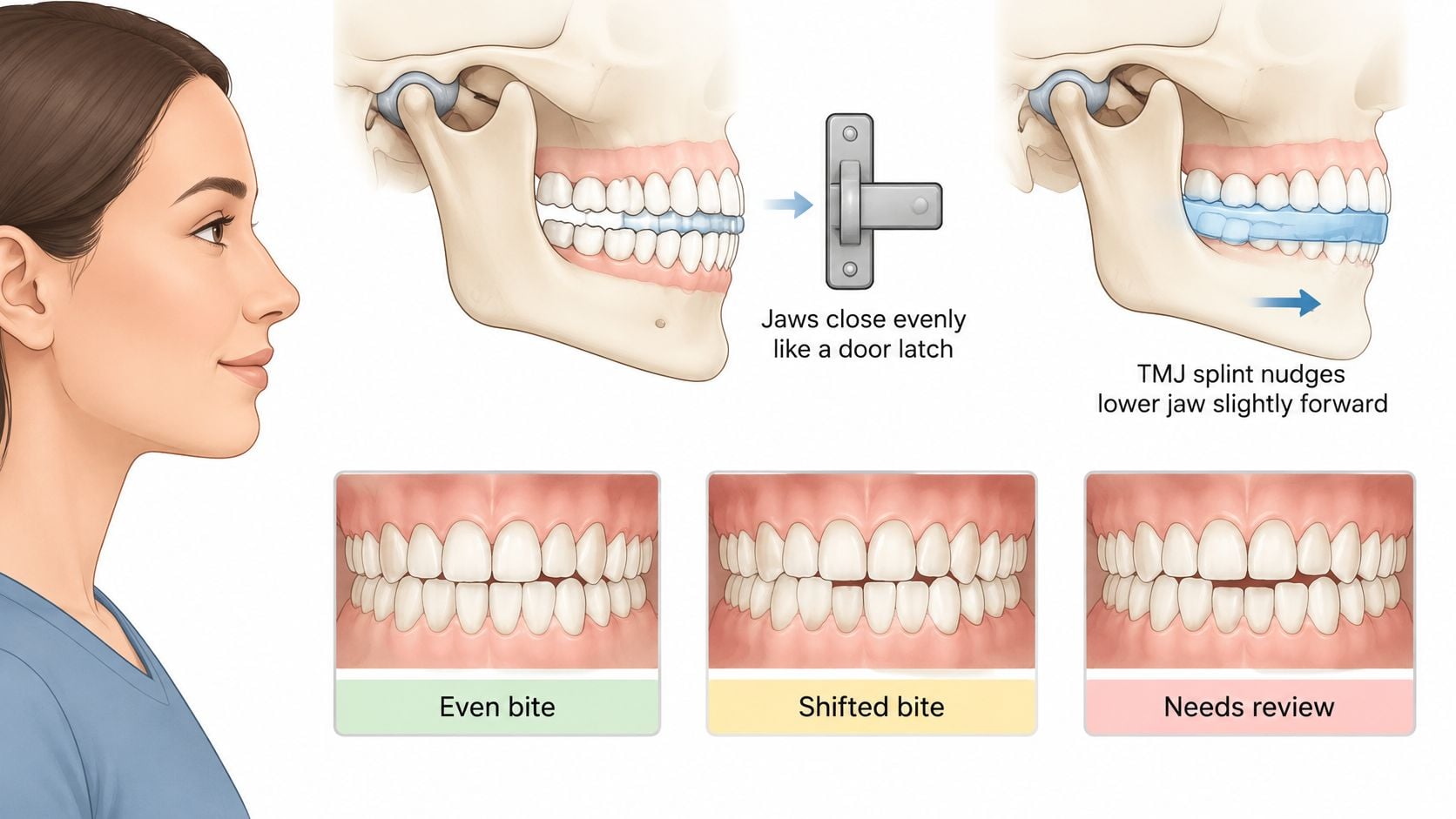
Occlusion means the way the upper and lower teeth meet. A familiar bite is a little like a door latch that closes cleanly: a change in alignment can make closure feel different, even when the shift seems small.
A splint changes tooth contact while it's in place. Some designs also hold the lower jaw in a different position, so the clinician must distinguish the intended effect during wear from an unwanted change after removal.
How tooth contact can change
Possible mechanisms include sustained contact with the jaw held differently, uneven contact against the appliance, and changes in the muscle pattern used to close the mouth. These mechanisms can contribute to:
- Posterior open bite: The back teeth no longer touch when the jaw closes.
- Altered occlusal contacts: Different teeth touch first, or contact feels uneven.
- Changed vertical dimension: The height of the bite changes.
Anterior repositioning splints, which guide the lower jaw forward, have been associated with posterior open bite. Concern is greater when the joint's cushioning disc remains displaced or moves unstably. Such changes can become difficult to reverse, which is why a repositioning design needs a clear purpose and close supervision.
Changes that deserve attention
Warning signs include a new gap between teeth, chewing that feels awkward, uneven closure, or jaw fatigue accompanied by a changed bite. A sensation that resolves and a persistent discrepancy aren't necessarily the same problem, but both deserve documentation.
The U.S. National Institute of Dental and Craniofacial Research advises that a splint shouldn't be intended to permanently change the bite and recommends stopping use and consulting the treating clinician if it causes pain.
Pain and Sleep Therapy Center takes every possible precaution to prevent harm to the patient's occlusion and TMJ, while recognizing that consequences in these areas remain possible. Its patient education on jaw realignment provides additional context for discussing alignment concerns.
A documented starting bite allows meaningful comparisons at visits. Patients should describe what feels different rather than repeatedly forcing the teeth together to test the bite.
Risk Factors That Raise Side Effect Risk
Could the way a splint is designed or worn affect the chance of side effects? Appliance design, wear pattern, treatment duration, and follow-up all shape what needs monitoring. A removable device still applies force to teeth and joints, so it should be used according to its prescription.
The clinical review of splint therapy describes concerns associated with continuous 24-hour wear and anterior bite-splint use beyond 2 weeks in patients with problems inside the joint. Research on side effects remains limited, making careful reassessment important.
| Risk Factor | Why It Matters | Question to Ask the Clinician |
|---|---|---|
| Continuous 24-hour wear | The review describes irreversible occlusion changes with continuous wear | Should this appliance be worn only at night? |
| Anterior midpoint-stop design | Associated with device aspiration and anterior open-bite formation | Does this design fit the diagnosis? |
| Prolonged treatment duration | The review describes permanent posterior occlusal changes with extended use | When will the bite next be checked? |
| Anterior bite splint with intracapsular joint pathology | Increased compression risk is reported beyond the interval identified above | Has the joint been evaluated before treatment? |
Why these distinctions matter
Continuous wear keeps teeth in contact with the appliance rather than their usual opposing contacts. Follow the prescribed wear schedule, and ask the clinician before extending nighttime use into the day.
An anterior midpoint-stop appliance concentrates contact near the front of the mouth. The review reports concerns including an anterior open bite and aspiration, which means the device enters the airway. Swallowing an appliance is a different event; either situation needs prompt medical attention.
With prolonged treatment, ask whether the original reason for wearing the appliance still applies and when the bite should be checked. Changes in back-tooth contact may be easy to miss without a comparison over time.
Intracapsular joint pathology refers to a problem inside the jaw joint. When it is present, the effect of an anterior bite splint on joint loading needs particular attention.
Full-coverage stabilization splints cover an entire dental arch. Partial-arch and anterior appliances contact a more limited area, so their risk profiles differ. The appropriate design depends on the treatment purpose and the patient's joint and bite findings.
Use the appliance for the prescribed hours, then report new discomfort or changes in how the teeth meet. The review identifies situations that warrant caution, but does not establish a dependable population percentage for lasting bite changes. Follow-up helps the clinician decide whether the appliance and wear pattern remain appropriate.
Sleep and Airway Changes Behind New Snoring
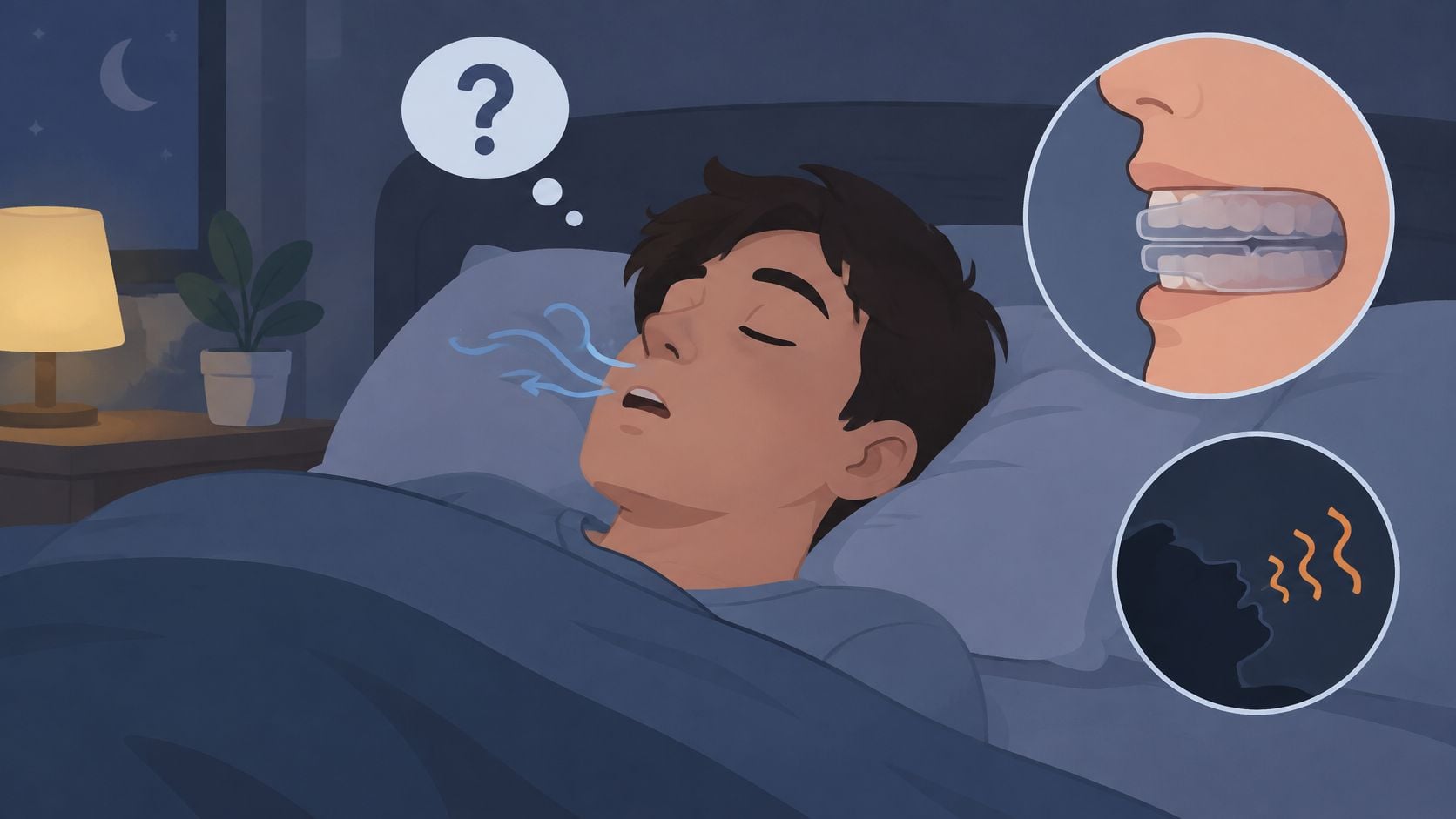
Could a nighttime splint change breathing during sleep? Jaw comfort and airway function need to be considered together, especially when snoring or unrefreshing sleep is already present.
Some people with TMD also have obstructive sleep apnea (OSA), a condition involving repeated episodes of upper-airway blockage during sleep. A sleep evaluation may therefore be appropriate during TMJ care, rather than treating nighttime jaw symptoms in isolation.
What airway measurements can and can't establish
A 2025 prospective study of adults with TMD found significant reductions in selected airway-related measurements after stabilization-splint treatment, including a decrease in average hyoid-to-mandibular-plane distance from 12.06 mm to 10.99 mm. This measure describes the position of a small neck bone relative to a reference plane along the lower jaw.
The authors suggested that backward movement and clockwise rotation of the lower jaw might help explain the changes. Measurements behind the nose didn't change significantly.
These findings don't show that stabilization splints cause sleep apnea. Measurements of anatomy aren't equivalent to measuring breathing interruptions during sleep. They do support taking new sleep symptoms seriously.
Symptoms worth reporting
- New or louder snoring: Especially when the change begins after appliance use.
- Witnessed breathing pauses: A bed partner notices interruptions or gasping.
- Morning headaches: Particularly when accompanied by unrestful sleep.
- Worsening sleep quality: More awakenings or feeling less refreshed.
A nighttime TMJ appliance isn't automatically designed to treat OSA. An appliance that doesn't address an existing breathing disorder may worsen it in some patients, so the distinction between jaw treatment and sleep-apnea treatment matters.
Pain and Sleep Therapy Center's explanation of snoring and TMJ helps patients discuss this overlap. A physician's assessment and a sleep study are needed to diagnose sleep apnea; a symptom checklist or anatomical image can't confirm it.
A dated log of sleep changes, including observations from a bed partner, can help guide that evaluation.
How to Track and Reduce Side Effects During Treatment
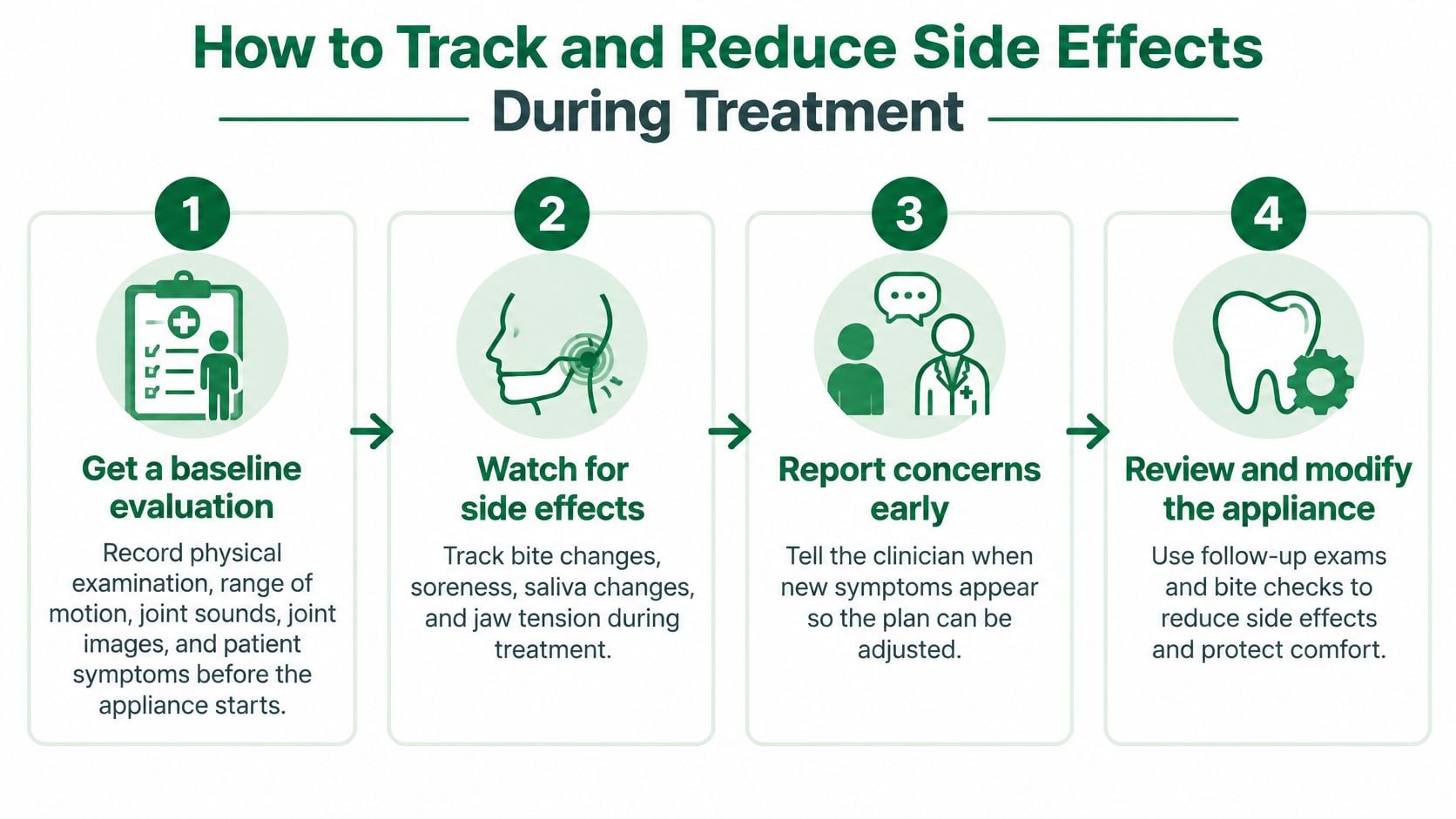
Monitoring works best when the patient and clinician agree on the starting condition, the wear instructions, and the changes that should trigger contact. Comfort alone isn't enough to judge whether an appliance remains appropriate.
A practical monitoring routine
Establish the baseline before treatment. At Pain and Sleep Therapy Center, diagnosis includes physical examination, range of motion, joint sounds or vibrations, joint hard-tissue images, and patient history and interview, with sleep diagnostics and hospital-based soft-tissue diagnostics in some cases; these findings provide a starting point for comparison.
Identify the appliance's purpose and written wear schedule. Confirming whether it stabilizes tooth contact or repositions the jaw helps clarify the intended effect and the checks needed during treatment.
Follow the prescribed schedule without extending wear independently. Extra daytime or overnight use changes the treatment exposure and may increase bite-related risk.
Keep a daily symptom log. Recording morning jaw tension, saliva changes, tooth pressure, chewing comfort, and sleep makes patterns easier to recognize than relying on memory.
Attend follow-up visits with the appliance. The clinician can examine its fit, check contact points with marking paper, and compare jaw movement and tooth contact with the baseline.
Report new bite changes, pain, chewing difficulty, or breathing symptoms promptly. If the appliance causes pain, stopping use and contacting the treating clinician allows reassessment rather than continued exposure to a possible problem.
What a useful log looks like
A simple notebook or phone note can include the date, the prescribed wear completed, and a short description of symptoms. Consistent wording helps: left jaw tired on waking is easier to compare over time than an entry that only says bad morning.
The log should distinguish symptoms present before treatment from new ones. It can also record whether discomfort occurs while wearing the appliance, immediately after removal, or during meals.
A useful follow-up visit checks both how the patient feels and how the teeth and jaw function.
A retrospective study of 74 adults treated with stabilization splints documented measurable skeletal and dental changes after therapy. Its design couldn't prove that the splint alone caused each change, and the findings don't mean every patient develops harmful changes.
The practical lesson is narrower: altered tooth contact, chewing difficulty, or jaw fatigue warrants examination rather than reassurance based only on the appliance being removable. Whenever a symptom log reveals a new pattern, the treating clinician should decide whether fit, wear instructions, or the treatment approach needs review.
Mitigation Strategies for Common Side Effects
Small comfort measures may help with selected symptoms, but adjusting an appliance belongs with the clinician. Filing, heating, or reshaping it at home can change the contacts that were intended to guide jaw closure.
Comfort measures matched to the symptom
- Saliva changes: Drinking water throughout the day may help with dry-mouth discomfort. Persistent dryness or excess saliva should be reported so fit and other possible causes can be assessed.
- Tooth or dental tension: The clinician can check pressure points and determine whether the appliance surface or wear schedule needs adjustment. Sharp or localized tooth pain shouldn't be labeled adaptation.
- Increased clenching: During waking hours, gentle awareness of keeping the teeth apart may reduce unnecessary contact. Resting the tongue lightly against the roof of the mouth can be considered when comfortable, without pressing or forcing a position.
- A jaw-symptom flare: Temporarily choosing softer foods and avoiding gum or wide opening may reduce strain. Jaw-rest strategies and exercises should match the diagnosis rather than follow a generic stretching routine.
- Bite or airway changes: These need clinical assessment, not a home adjustment. Breathing concerns may require physician-directed sleep testing.
Avoid treating every symptom the same way
A patient with extra saliva but stable chewing needs a different discussion from someone whose back teeth no longer meet. Likewise, a tired jaw and newly witnessed breathing pauses shouldn't be grouped together as routine appliance discomfort.
The guide to treating TMJ symptoms offers context for conservative care. The most useful plan addresses the source of the problem instead of adding more wear time or more exercises without an examination.
These measures may help, but they don't replace evaluation. Responses differ between patients, and persistent symptoms can indicate that the current approach needs modification.
Timeline for Symptoms and Bite Checks
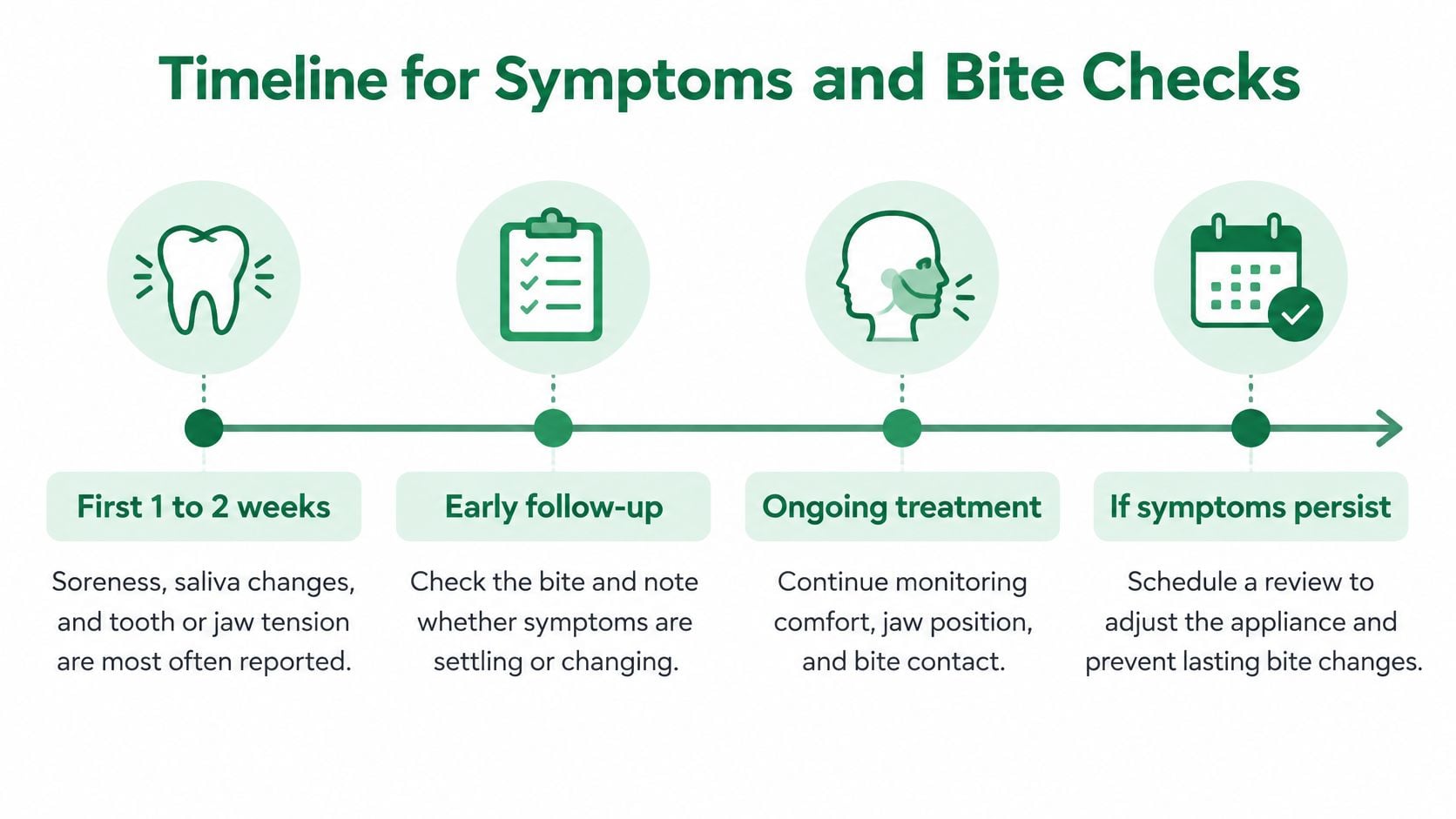
When should a change prompt a closer look? A timeline can help organize follow-up, but concerning changes deserve attention whenever they occur. The checkpoints below are guides, not established deadlines for when side effects must begin or end. Because evidence on side effects is limited, monitor symptoms in context: appliance design, wear pattern, and sleep status can all matter.
| Timeframe | What to Expect | What to Do |
|---|---|---|
| First 1-2 weeks | Soreness, saliva changes, or tooth and jaw tension may occur during adjustment | Record symptoms and attend prescribed adjustment visits |
| 2-4 weeks | Effects may settle or shift as the appliance fit and tooth contacts are reviewed | Compare changes with your starting symptoms |
| 30-60 days | Subjective symptoms generally improve within the center's treatment guidance, though this is not guaranteed | Review progress at a follow-up visit |
| Beyond 60 days | Ongoing pain, a new bite change, or breathing symptoms call for reassessment | Schedule an evaluation |
| Any time | Appliance-related pain or a clear change in tooth contact | Stop wearing it if it causes pain and contact the clinician |
Track changes alongside treatment goals
Early adjustment visits allow the clinician to review contacts and areas of pressure. Later follow-ups should consider whether the appliance is meeting the original treatment goals. Continued wear alone does not establish progress.
Pain and Sleep Therapy Center's guidance states that subjective symptoms generally improve within the treatment window shown above. This refers to how symptoms feel, not proof that the joint, bite, or airway no longer needs monitoring. Headache occurrence frequently improves with therapy, but the center does not guarantee that an appliance will resolve headaches.
Follow-up principle: Judge improvement against the patient's starting symptoms and treatment goals.
A useful review considers eating comfort, jaw movement, morning symptoms, and sleep together. Dated notes can help show how these change between visits, including whether an improvement lasts or reverses. The appliance is removable, but that does not make it risk-free: changes in fit, wear, or sleep symptoms still warrant attention.
Confirm the Next Step With a Specialist
Reassessment is appropriate if a splint becomes uncomfortable, interferes with normal function, or no longer fits the treatment goals. Appliance design and wear pattern matter, and a removable splint is not automatically risk-free.
A new bite discrepancy, ongoing pain, new snoring, witnessed breathing pauses, or morning headaches that begin during treatment can all warrant review. Breathing symptoms should be medically evaluated rather than attributed to the splint alone.
A root-cause approach to the decision
Dr. Ryan Robinson, triple board-certified in craniofacial pain and dental sleep medicine, leads Pain and Sleep Therapy Center. The center emphasizes identifying underlying causes and considering conservative, non-invasive options before surgery. A specialist can assess jaw mechanics, muscle symptoms, daily habits, and sleep status, since these factors may affect which appliance or treatment approach is appropriate.
When an oral appliance does not meet treatment goals, the center supports patients in obtaining other effective therapies. A change in approach can be a reasonable response to the patient's findings and goals.
Bring these items to an evaluation:
- The current appliance: Include any device used before the present one.
- Written wear instructions: These clarify the prescribed schedule.
- A symptom log: Note changes in tooth contact and sleep observations.
Pain and Sleep Therapy Center serves patients in Newark, Delaware, and Bryn Mawr, Pennsylvania. Request an Appointment supports an individualized review, while Take our Sleep Quiz offers screening, not a diagnosis.
Pain and Sleep Therapy Center evaluates and treats TMJ, head and facial pain, and sleep concerns. Visit Pain and Sleep Therapy Center to Request an Appointment or Take our Sleep Quiz and discuss a suitable next step.