At 2 a.m., a person may pull off a CPAP mask for the third time, frustrated by air pressure, leaks, noise, or the feeling of being confined. The next morning, the question is understandable: can sleep apnea be treated without CPAP?
Sometimes it can. The safer question, however, isn't which device replaces CPAP for everyone. It's which treatment matches the person's type of apnea, airway anatomy, health needs, and ability to use the therapy consistently, and how the care team will confirm that it works.
CPAP remains the most effective treatment for reducing airway obstruction in many patients. Yet a treatment that stays on the nightstand cannot provide its full potential. A personalized, monitored plan may include a custom oral appliance, positional therapy, behavioral support, an implant, surgery, or a combination of approaches.
Table of Contents
- Why Patients Look for CPAP Alternatives
- Understanding Sleep Apnea and How It Is Diagnosed
- Oral Appliance Therapy as a Leading CPAP Alternative
- Positional Therapy and Behavioral Strategies That Support Treatment
- When Advanced Options Like Inspire and Surgery Enter the Conversation
- Verifying Whether a Non-CPAP Therapy Actually Works
- Building Your Personalized Non-CPAP Treatment Plan
Why Patients Look for CPAP Alternatives
A patient can understand that CPAP is the standard option and still struggle to sleep with it. The problem is often practical, not philosophical. Pressure can feel unnatural. Leaks can wake a bed partner. Skin may get sore. Some people pull the mask off in their sleep and only notice it in the morning. Others do well at home but have trouble keeping the routine going during travel or shift changes.
That experience deserves a clinical response, not blame. Reported CPAP adherence ranges from 30% to 60%, so real-world use matters when clinicians weigh the likely benefit of any therapy. This adherence range is summarized in a clinical review available through the National Institutes of Health.
Consistency changes the treatment conversation
CPAP usually gives the strongest physiologic control of obstructive events. In crossover studies, it brought the apnea-hypopnea index, or AHI, down to low levels in nearly all participants, while oral appliances did not reach similar control in at least one-third. A systematic review found that CPAP improved AHI by an additional 8.40 events per hour compared with oral appliances, while oral appliances still improved AHI by 13.40 events per hour from pretreatment levels. Those findings are reported in the American Academy of Sleep Medicine review of oral appliance therapy.
Those numbers can sound confusing at first. A simple way to read them is this: one treatment may work better in the lab, but the better choice for a specific person also depends on whether it is worn and tolerated night after night.
Practical rule: The best treatment plan is the one that addresses the patient's medical risk and can realistically be used night after night.
Alternatives are still medical treatment
Non-CPAP options are not interchangeable items on a shelf. They are different treatments for different patterns of sleep apnea. Oral appliances, positional therapy, weight management, selected exercises, hypoglossal nerve stimulation, and surgery each fit a particular situation. A person with mild, position-dependent obstructive sleep apnea may need a very different plan from someone with persistent oxygen drops and moderate-to-severe disease.
That is why matching matters. The airway can behave like a collapsible passage, but it does not collapse the same way in every patient.
A physician still needs to diagnose sleep apnea with a sleep study and coordinate treatment with the right professionals. In dental sleep medicine, that often includes a qualified dentist who evaluates the teeth, jaw joints, bite, and how far the lower jaw can move forward safely. The treatment question then becomes one of phenotype matching and proof. Which therapy fits this person's apnea pattern, and how will follow-up testing confirm that it is actually controlling the condition?
Understanding Sleep Apnea and How It Is Diagnosed
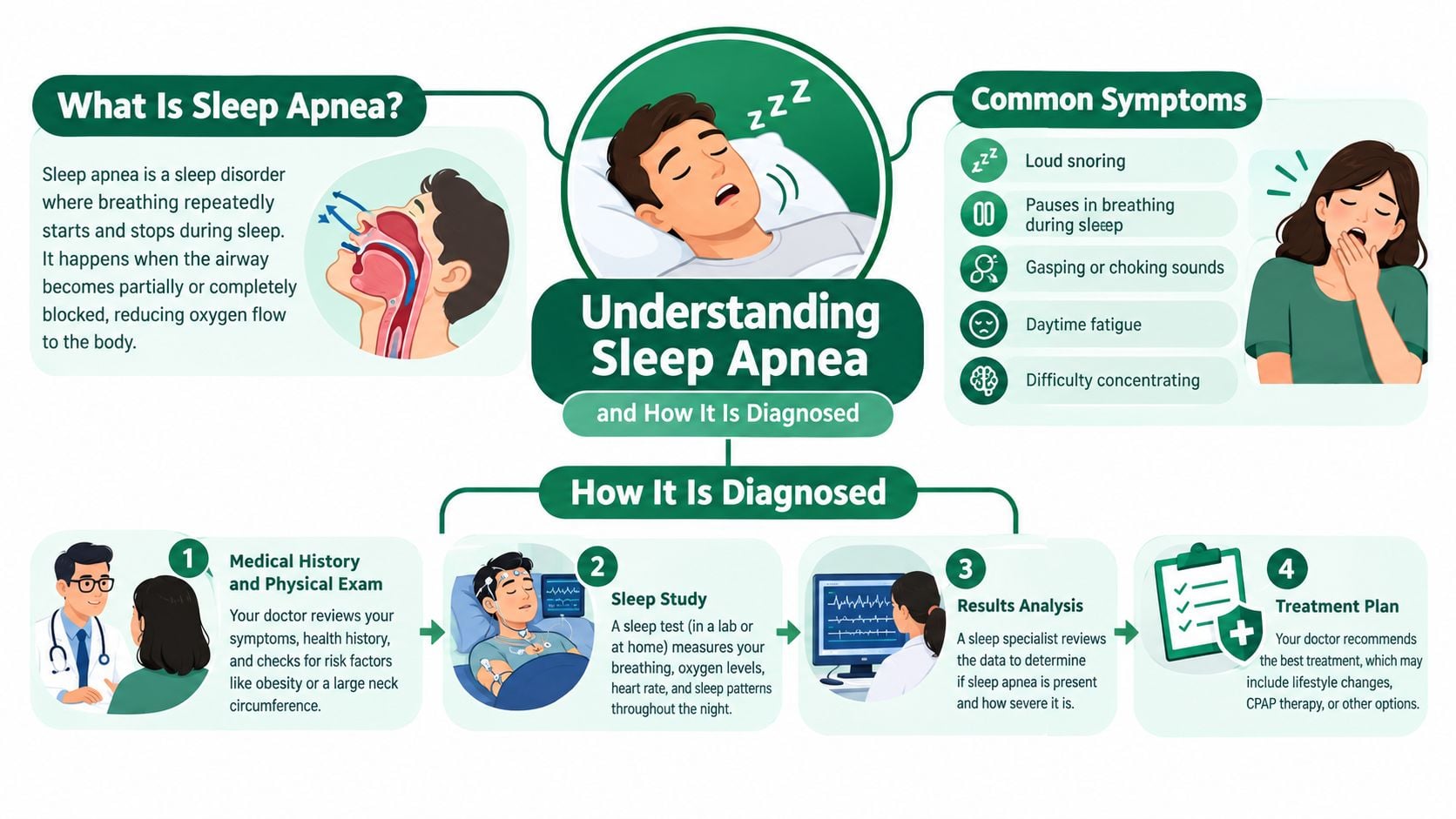
Obstructive sleep apnea occurs when the upper airway narrows or closes repeatedly during sleep. A useful comparison is a hallway that becomes partially blocked. Air can move through when the passage is open, but the tongue, soft palate, and other tissues may shift backward during sleep and restrict airflow.
The body may respond with a brief arousal, a change in breathing effort, or a drop in oxygen saturation. These events can happen without the person remembering them. Snoring, morning headaches, dry mouth, restless sleep, and daytime sleepiness may occur, but snoring alone can't confirm or rule out sleep apnea.
Why a sleep study comes first
A sleep study records breathing patterns and other signs of sleep-disordered breathing. A home sleep apnea test may be appropriate for some adults, while an in-lab polysomnogram provides more detailed monitoring and may be needed when the diagnosis is uncertain or other sleep conditions are suspected.
The study helps clinicians determine whether breathing events are primarily obstructive, central, or mixed. It also provides the AHI, which represents the number of apneas and hypopneas recorded per hour of sleep or testing time. Severity, body position, sleep stage, oxygenation, and the pattern of events all influence treatment selection.
A patient looking for plain-language information about sleep-disordered breathing may recognize symptoms, but recognition isn't diagnosis. A clinician must interpret the test and consider the broader health picture.
What the results change
A treatment that may help mild or position-dependent apnea might be insufficient for severe obstruction or persistent hypoxemia. The report may also reveal that events occur mostly while sleeping on the back, which can make positional therapy more relevant.
The next step is a coordinated evaluation. A sleep physician establishes the diagnosis and medical severity. A qualified dental sleep medicine provider can then assess jaw movement, dentition, bite, temporomandibular-joint health, and airway-related anatomy before recommending an oral appliance.
Oral Appliance Therapy as a Leading CPAP Alternative
A patient who says, “I know I won't sleep with CPAP on,” is not really asking for a random substitute. The better question is whether a non-CPAP option matches the way that person's airway collapses, their jaw function, and their dental support. For many adults with obstructive sleep apnea, a custom mandibular advancement device is one of the main options to consider.
This appliance works by holding the lower jaw slightly forward during sleep. Advancing the lower jaw forward pulls the tongue base away from the back of the throat and can enlarge the airway space behind it. That mechanical change can reduce collapse in patients whose anatomy responds to jaw advancement.
The American Academy of Sleep Medicine and American Academy of Dental Sleep Medicine recommend considering oral appliance therapy for adults with obstructive sleep apnea who cannot tolerate CPAP or prefer another treatment. Their joint clinical practice guideline supports a custom, titratable device prescribed by a qualified dentist.
Who may benefit
Oral appliances may fit adults with mild-to-moderate obstructive sleep apnea, especially when the airway pattern, jaw anatomy, and dental health all support the treatment. They can also be considered for some adults with severe apnea who refuse CPAP or cannot tolerate it, but that choice calls for careful selection and follow-up testing to confirm it is controlling the disorder.
A dentist near you who fits sleep apnea mouth guards can assess whether this approach makes sense by looking at several practical factors:
- Baseline AHI and oxygenation: The sleep study shows how much obstruction and oxygen stress the treatment must address.
- Positional dependence: Events that happen mostly on the back may behave differently from events that occur in every position.
- Jaw mobility: The lower jaw has to move forward comfortably enough for the device to work.
- Teeth and periodontal health: The appliance needs stable dental support.
- Jaw-joint symptoms: Temporomandibular-joint pain, clicking, or limited opening may require a modified plan.
A non-custom mouthpiece is not the same as a professionally fitted device. The AASM and AADSM guidance on oral appliance therapy recommends a custom, titratable appliance rather than an unmonitored prefabricated one. “Titratable” means the dentist can adjust the jaw position in small steps while tracking comfort, bite changes, and symptom response over time.
What treatment feels like
Adjustment is usually gradual. Some patients notice morning jaw soreness, temporary bite changes, more saliva, or dry mouth. Those effects should be reported, because the device design or the advancement schedule can often be modified.
Oral appliances can improve breathing measures and symptoms, but results vary from person to person. CPAP generally lowers breathing events and improves oxygenation more strongly, while an oral appliance may still be the better real-world treatment for a patient who will use it consistently. The National Heart, Lung, and Blood Institute overview of sleep apnea treatment explains why treatment choice and follow-up should be individualized.
A custom appliance is a validated option when the patient's apnea pattern, anatomy, preferences, and dental condition line up. The key is matching the therapy to the patient, then verifying that it works.
Positional Therapy and Behavioral Strategies That Support Treatment
Back sleeping can worsen obstructive sleep apnea because gravity encourages the tongue and soft palate to move backward. Positional therapy aims to keep a person from spending much of the night on the back through side-sleeping techniques, specialized pillows, wearable supports, or electronic devices that provide a gentle cue when the person rolls supine.
The important qualifier is positional dependence. A sleep study should show that breathing events are substantially worse while supine before positional therapy is considered as a primary strategy. A payer guideline notes that high-quality evidence remains insufficient for electronic positional-therapy devices, so marketing claims shouldn't replace clinical evaluation.
Layering supportive measures
Behavioral strategies can support a primary treatment, especially when a patient has several contributors to airway narrowing. Weight management may be useful when high weight contributes to airway collapse, but sleep apnea can affect people at different body sizes, and weight changes don't automatically resolve the condition.
Evening alcohol and sedating substances may relax throat muscles and worsen obstruction. Regular sleep timing, exercise, and smoking cessation can support overall sleep health, but they shouldn't be presented as a replacement for testing or clinically indicated treatment.
Myofunctional therapy uses exercises for the tongue, lips, soft palate, and throat. Some patients may benefit, but support remains more appropriate as part of a broader plan than as a stand-alone response to moderate-to-severe apnea.
- For position-dependent apnea: Side sleeping may be useful when the sleep study confirms a strong supine pattern.
- For airway-supportive habits: Limiting evening alcohol and maintaining a consistent sleep schedule can reduce avoidable aggravating factors.
- For high weight: A clinician-guided weight-management plan may complement oral appliance therapy or another primary treatment.
- For oral and airway function: Exercises may support muscle coordination, but symptoms and sleep-study results still determine whether additional treatment is needed.
A comfortable sleep surface may also support side sleeping and reduce pressure that makes a position difficult to maintain. Readers evaluating bedroom changes can review this resource on mattresses that may support sleep apnea relief while remembering that bedding does not diagnose or treat airway obstruction.
The sleep and snoring exercise guidance from Pain and Sleep Therapy Center can offer general education, but any exercise plan should fit the patient's diagnosis and broader care plan. Behavioral measures work best when their effect is checked rather than assumed.
When Advanced Options Like Inspire and Surgery Enter the Conversation
A common turning point sounds like this. You tried the lower-burden options, you want something that fits real life, and your sleep study still shows enough obstruction that “just doing something different” is not the same as choosing the right next treatment. At that stage, the question shifts from what can replace CPAP to which non-CPAP treatment matches your airway pattern, anatomy, and severity.
For some adults, that discussion includes an implanted therapy or surgery. These are not general upgrades. They are targeted treatments used when the pattern of collapse, body habitus, and prior treatment experience suggest a procedure may fit better than an oral appliance alone.
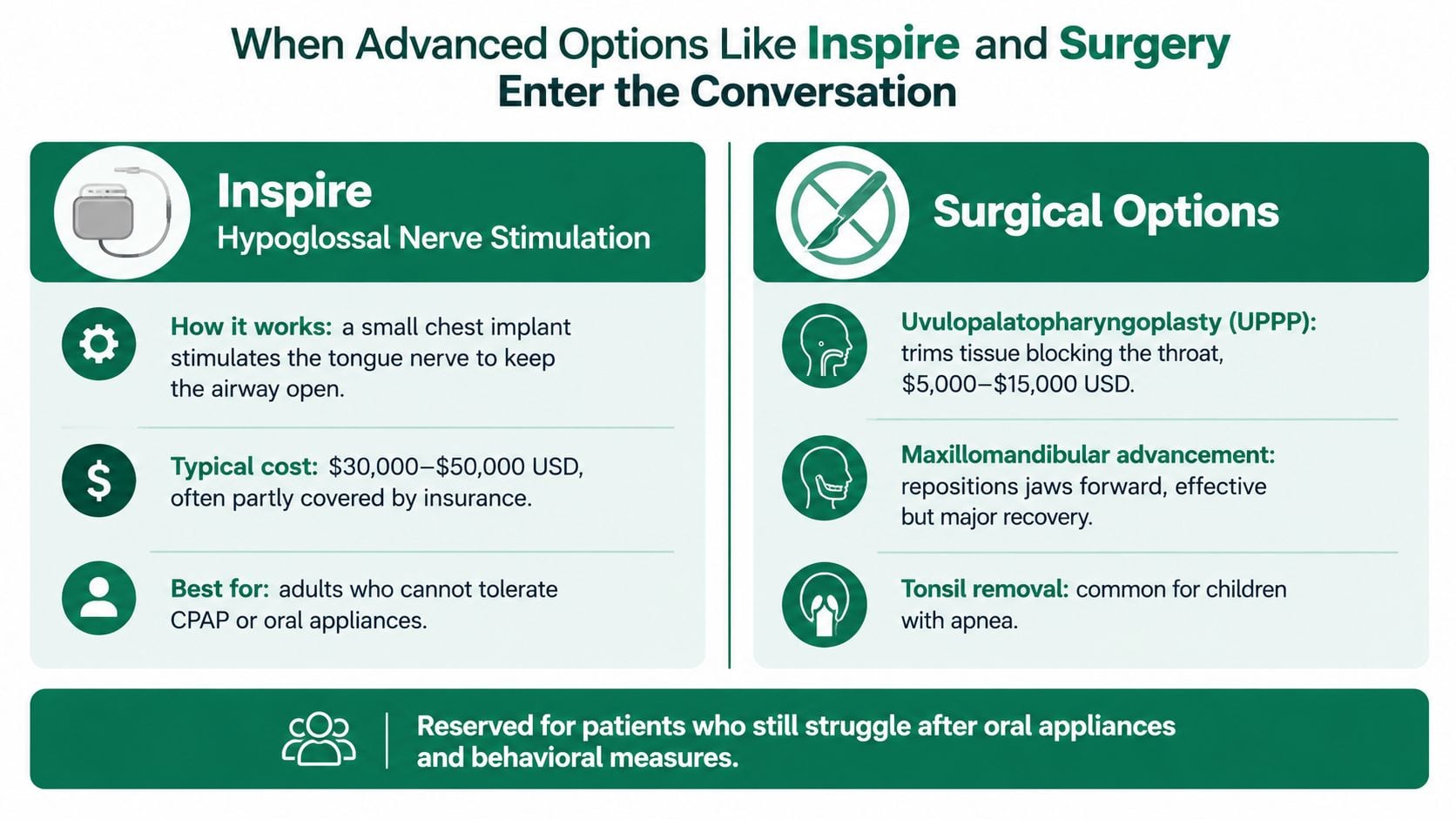
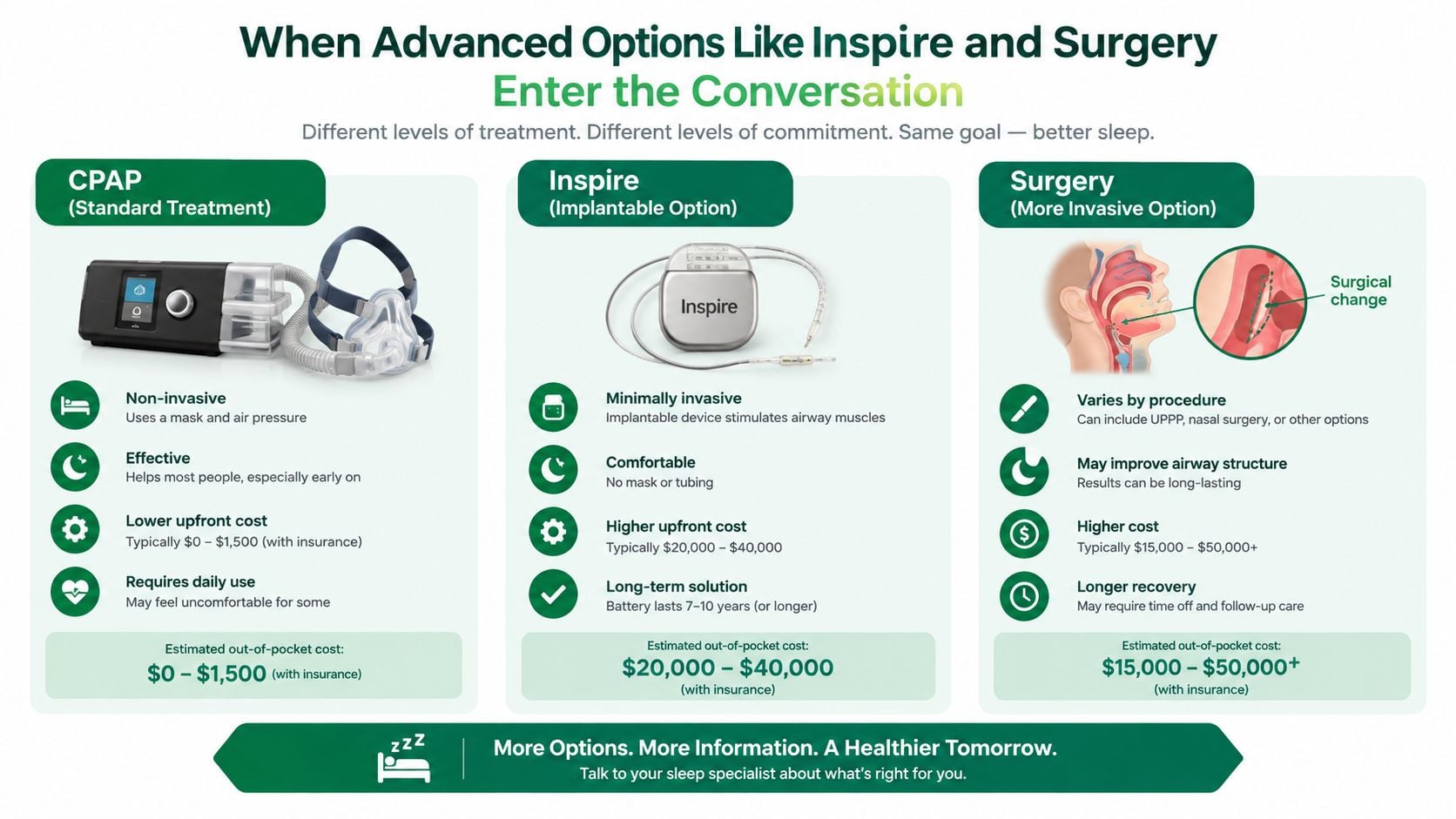
Hypoglossal-nerve stimulation, often called Inspire, uses an implanted system that senses inspiratory effort and stimulates the hypoglossal nerve. That nerve helps control tongue movement. The goal is simple. During sleep, the device is timed to encourage the tongue to move forward so the airway is less likely to collapse.
Who may be evaluated for stimulation
Selection is specific. It is not based on snoring alone or on a patient merely preferring an implant. Typical criteria described for this therapy include:
- Moderate-to-severe predominantly obstructive apnea
- CPAP nonadherence
- BMI below 32 kg/m²
- AHI from 20 to 50 events per hour
- Adequate non-supine disease burden
- No complete concentric palatal collapse on drug-induced sleep endoscopy
These criteria are summarized in the CMS coverage information for hypoglossal-nerve stimulation. The workup usually includes a sleep study, an anatomic review, and a focused airway exam. That detail matters because two people can both have obstructive sleep apnea and still need very different treatments.
In the selected group described by CMS, 12-month outcomes showed median AHI decreased 68%, from 29.3 to 9.0 events per hour, and median oxygen-desaturation index decreased 70%, from 25.4 to 7.4 events per hour. Sixty-six percent of participants achieved both at least a 50% AHI reduction and a final AHI below 20 events per hour. Median sleep time with oxygen saturation below 90% declined from 5.4% to 0.9%. These results help frame who may benefit. They do not promise the same response for every patient.
Where surgery fits
Surgery enters the conversation when anatomy points to a structural problem that a device may not fully address. Depending on the findings, surgery may target the tonsils, soft palate, nasal blockage, or jaw position. Uvulopalatopharyngoplasty, or UPPP, reshapes tissue around the palate and throat. Maxillomandibular advancement moves the jaws forward to create more airway space, but it involves a much bigger recovery.
The main question is fit. Surgery can help the right patient, especially when the collapse pattern is clear, but it should be chosen with the same phenotype-based logic as any other apnea treatment. A broad clinical review of sleep apnea treatment options describes surgery as one option within a larger treatment framework rather than a universal answer. In practice, some patients still need combination care, such as a procedure plus positional therapy or an oral appliance, when a single approach does not control the airway well enough.
Verifying Whether a Non-CPAP Therapy Actually Works
Quieter snoring can be encouraging, but it doesn't prove that apnea is controlled. A person may wake feeling better while breathing events, oxygen drops, or cardiovascular strain continue during sleep.
That's why follow-up testing is central to apnea treatment without CPAP. After an oral appliance has been adjusted, a follow-up home sleep apnea test or another objective study can show whether the AHI, respiratory effort, and oxygenation have improved. Symptoms remain useful, but they can't replace measurements.
What follow-up should include
A complete plan may include:
- Repeat sleep testing: This confirms whether breathing events and oxygen levels improved with the therapy in place.
- Dental monitoring: A qualified dentist checks the appliance, teeth, bite, jaw comfort, and temporomandibular-joint symptoms.
- Health review: Daytime sleepiness, blood pressure, morning headaches, and sleep quality help clinicians assess the broader response.
- Periodic reassessment: Changes in weight, dental health, medications, anatomy, or symptoms may change treatment needs.
AASM and AADSM guidance supports objective follow-up sleep testing after titration and ongoing dental supervision. The device should be adjusted or replaced when necessary, and persistent apnea should prompt a discussion about escalation or combination therapy.
A therapy that reduces snoring but leaves clinically important apnea untreated is not a complete treatment plan.
This principle also applies to over-the-counter mouthpieces, lifestyle-only plans, and electronic devices marketed without a clear testing pathway. Non-CPAP care should mean monitored, personalized treatment, not an unverified product.
Building Your Personalized Non-CPAP Treatment Plan
A clinician usually works through five practical questions:
- How severe is the apnea? The AHI, oxygenation, and pattern of events establish the starting point.
- What does the anatomy show? Jaw position, tongue mobility, nasal and throat structure, dentition, and joint health affect treatment fit.
- What can the patient use consistently? A therapy must work in real life, not only in theory.
- What other health concerns matter? Blood pressure, daytime sleepiness, cardiovascular risk, and jaw symptoms may change the priority.
- How will success be measured? Follow-up sleep testing and clinical monitoring determine whether the plan needs adjustment.
This framework helps match options to the person rather than treating CPAP alternatives as a single category. A custom oral appliance may suit one patient, while another may need positional support, a combination approach, hypoglossal-nerve stimulation, surgery, or renewed CPAP troubleshooting.
Conservative and reversible options are often explored before surgery, but severe disease and persistent hypoxemia require appropriate medical attention. Coordination between a sleep physician and a qualified dentist helps protect both airway health and dental health.
Adults in Newark and Wilmington, Delaware, and Bryn Mawr and the Philadelphia Main Line, Pennsylvania, can begin with an evaluation rather than choosing a device alone. Pain and Sleep Therapy Center offers sleep-disordered-breathing assessment, at-home sleep testing, custom oral appliance therapy, snoring care, and related TMJ and craniofacial evaluation under the leadership of Dr. Ryan Robinson, a triple board-certified specialist in craniofacial pain and dental sleep medicine. The Newark office can be reached at (302) 239-1757.
Pain and Sleep Therapy Center evaluates sleep apnea, snoring, jaw health, and airway-related factors to help adults identify a monitored treatment path beyond CPAP when appropriate. Visit Pain and Sleep Therapy Center to request an appointment or take the Sleep Quiz and begin a personalized evaluation.