
A baby may feed better immediately after a tongue-tie release, then become fussy at the next feeding. An older child may speak or swallow differently for a short time. An adult may notice less restriction but still need help retraining tongue and jaw movement. These changes can be unsettling, especially when a healing area looks different from one day to the next.
Tongue tie procedure recovery has two parts: tissue healing and functional recovery. The wound may heal within several weeks, while feeding, speech, swallowing, or oral coordination takes longer to adapt. Knowing the difference helps families monitor calmly, recognize warning signs, and arrange follow-up when progress stalls.
Table of Contents
- Understanding Tongue Tie Procedure Recovery Timeline
- Post-Procedure Care and Wound Healing
- The Evidence on Post-Procedure Stretching and Exercises
- Distinguishing Normal Recovery from Warning Signs
- Age-Specific Recovery Considerations
- When to Seek Follow-Up Assessment
Understanding Tongue Tie Procedure Recovery Timeline
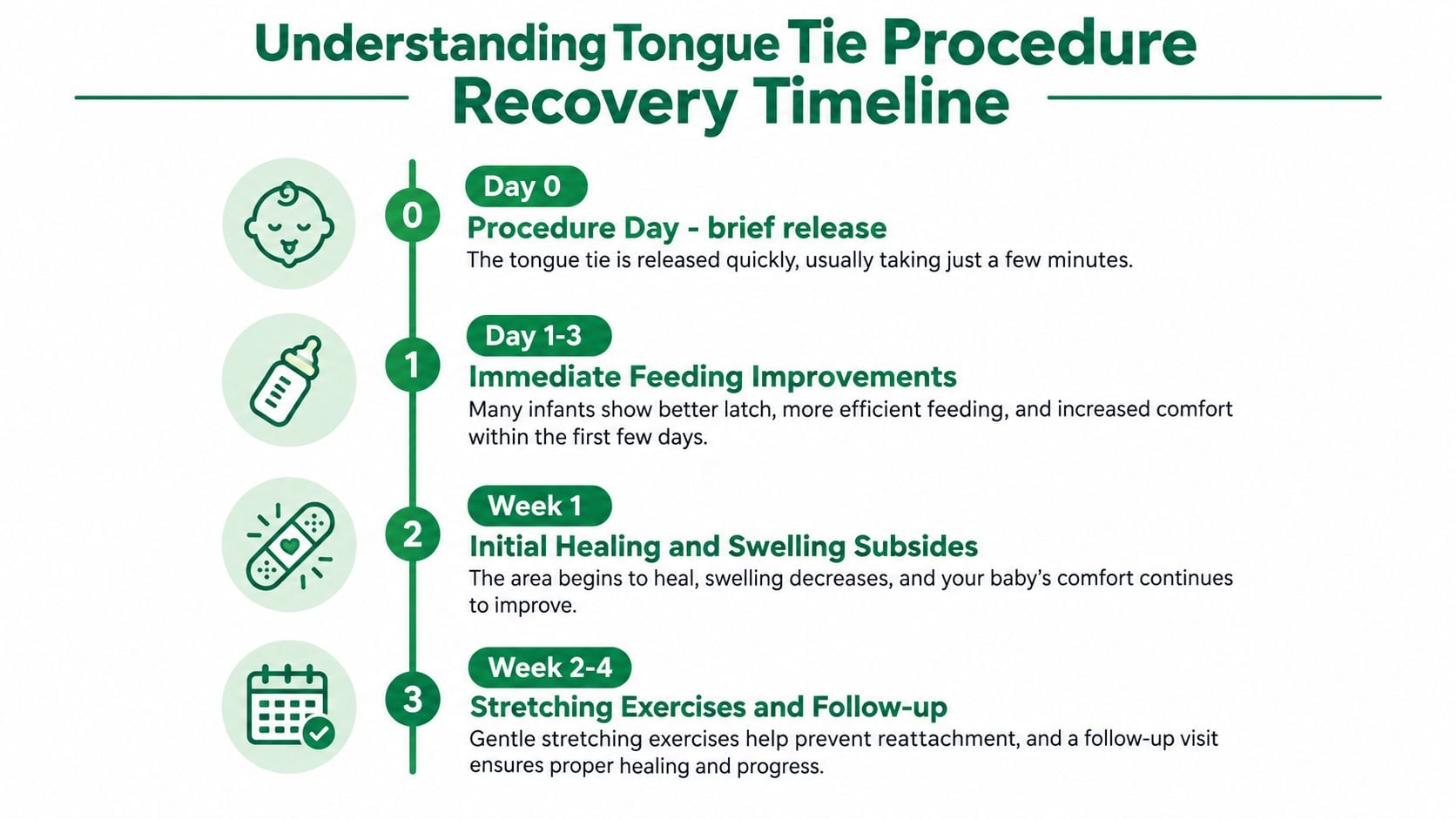
At the first feeding after a release, two things can be true at once. The tongue may move more freely, and feeding may still look awkward. That gap is what often confuses families. The procedure changes tissue right away, but the baby, child, or adult still has to learn how to use that new range of motion during sucking, swallowing, speaking, or eating.
Some infants do seem better almost immediately. In a historical cohort summarized in the peer-reviewed review of frenotomy evidence, 54 of 56 infants showed improvement in breastfeeding mechanics and maternal nipple pain after frenotomy. 79% improved immediately, while another 16% improved within 48 hours. That is encouraging, but it does not mean every feeding problem disappears on day one.
Pain relief and functional improvement are related, but they are not the same outcome. A mother may feel less nipple pain even while the baby still tires quickly, slips off the breast, or transfers milk inefficiently. That helps explain why pooled research found a modest reduction in maternal nipple pain after treatment, while objective infant breastfeeding measures were less consistent. Latch technique, milk supply, oral-motor coordination, and other feeding factors still matter.
What the first two days can look like
The first hours are often uneven.
Brief soreness, fussiness, extra sleepiness, or a changed feeding rhythm can all happen early on. Some babies organize a deeper latch quickly. Others need several feeds before the new tongue motion feels coordinated. Older children and adults may notice tenderness when eating, speaking, or lifting the tongue. Those short-term changes are part of adjustment, not proof that the procedure worked or failed.
A more useful question is whether function is trending in the right direction over the next several days. Are feeds becoming less stressful? Is latch pain easing? Is milk transfer, swallowing comfort, or tongue movement getting a little more organized rather than more chaotic? One randomized study of 60 breastfed infants reported subjective improvement in 21 of 27 mothers, or 78%, in the frenotomy group compared with 14 of 30, or 47%, in the control group. At three months, 56% of respondents reported full resolution and 8% reported no improvement.
Practical rule: Judge recovery by the pattern, not by a single feeding.
If comfort improves but function does not, follow-up is reasonable. If latch remains painful, weight gain is inadequate, or the child still cannot eat or drink comfortably after the early adjustment period, reassessment can help sort out whether the issue is healing, feeding technique, oral-motor coordination, or another problem that needs support.
Post-Procedure Care and Wound Healing
Wound care starts with following the treating clinician's discharge instructions. Families should know what level of discomfort, bleeding, feeding change, and swelling is expected for the specific procedure, because aftercare can differ by age, anatomy, anesthesia, and technique.
A prospective 2022 cohort of newborns treated with lingual laser frenotomy reported average intraoperative pain of 5.7 on the study pain scale, resolving within 30 minutes. Postoperative pain averaged 4.4, observed complications were limited to mild punctate bleeding, carbonization at the treated site, and temporary restlessness, and all wounds were completely healed by postoperative day 30 in the prospective cohort study.
Protecting the healing area
Caregivers shouldn't peel, scrape, or forcefully manipulate the healing tissue. They should give food, liquids, or milk according to the clinician's age-specific guidance and observe whether intake is adequate. Pain medicine should be used only as directed by the treating medical professional.
A Cochrane review found no excess bleeding during the procedure or within 24 hours across five studies involving 302 infants. The pooled risk difference was 0.00, with a 95% confidence interval from -0.03 to 0.03, although the review emphasized that the sample was too small to exclude rare events in the evidence review. Possible complications include bleeding, infection, and injury to nearby structures, including Wharton's duct.
A healed surface is only one milestone. Wound closure doesn't prove that feeding, speech, swallowing, or tongue coordination has normalized. Lactation support, speech therapy, oral-function therapy, or medical review may still be needed.
Families can also review the center's post-frenectomy care guidance for practical questions to discuss with the treating clinician.
The Evidence on Post-Procedure Stretching and Exercises
A family may hear two very different instructions after a tongue tie procedure. One clinician advises stretching. Another says to leave the area alone and focus on feeding or mouth function. That disagreement reflects a real evidence gap, especially when families want to know whether a healed wound will lead to better sucking, swallowing, speech, or tongue movement.
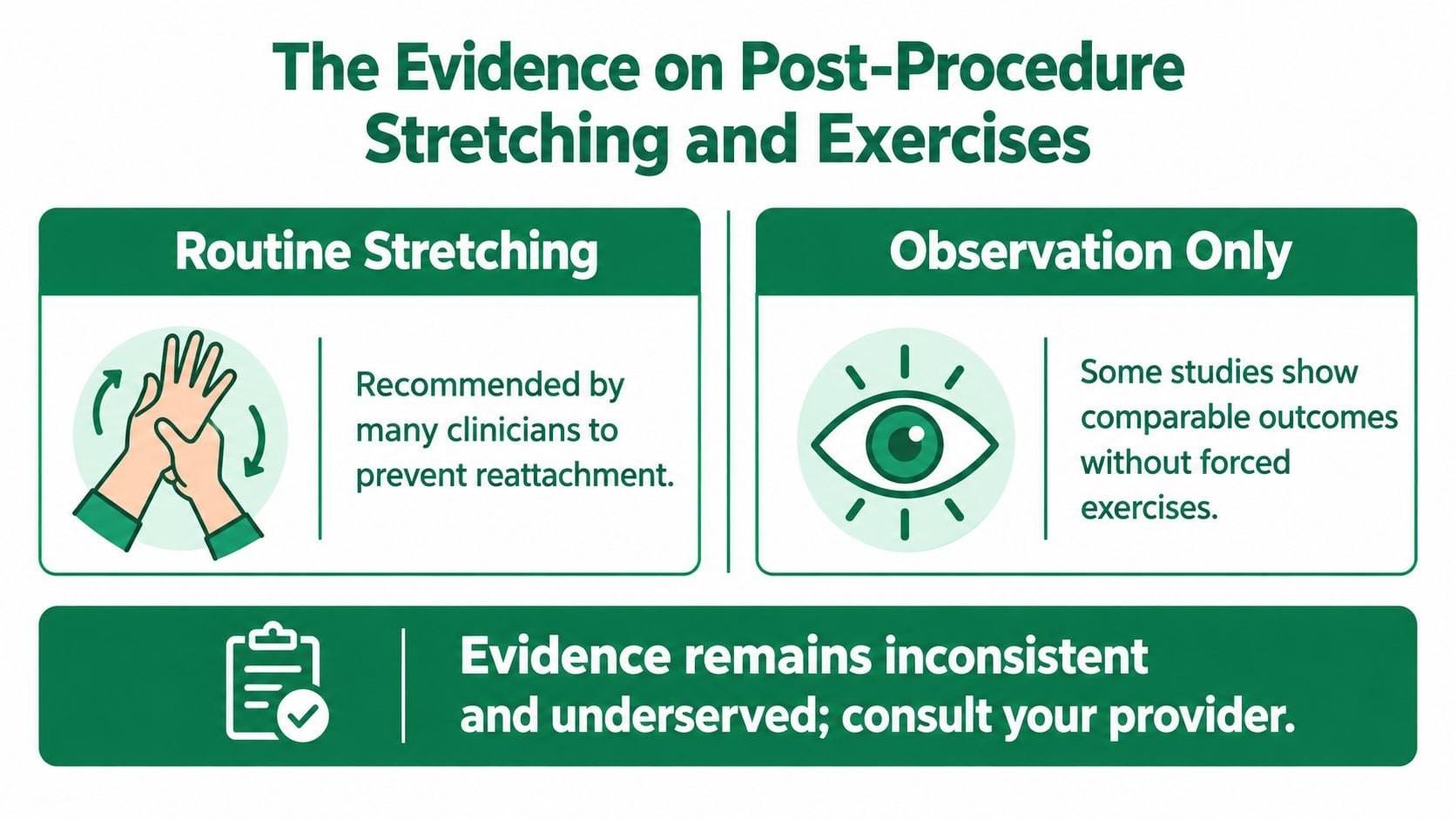
Current guidance does not support one routine plan for everyone. The American Academy of Pediatrics states that evidence is insufficient to recommend for or against routine post-frenotomy stretching or massage in its clinical report.
One prospective study did report better outcomes among caregivers who followed a stretching program. Persistent feeding difficulty occurred in 0% of adherent patients, compared with 14.8% of non-adherent patients and 16% of non-stretching patients. Recurrence occurred in 5.6%, 40.7%, and 16%, respectively, while revision was required in 5.6%, 37.0%, and 32%, respectively in the prospective study.
Those numbers sound persuasive, but they do not settle the question. The study included only 88 infants, adherence varied, and better results may reflect several factors, including which families could carry out the plan consistently. The practical takeaway is narrower. Stretching may help in some cases, yet the evidence remains limited and does not prove that every infant or child needs the same protocol.
Gentle function isn't forceful wound manipulation
Functional recovery and wound care are related, but they are not the same thing. A mouth can look like it is healing normally while latch, swallowing, speech, or tongue coordination still lag behind. Gentle exercises work like practice for movement patterns. Forceful wound pressing is a different action and may not improve function at all.
If a clinician recommends exercises, families need plain instructions about the goal, the pressure, the timing, and the stopping point. The right plan depends on age, anatomy, the procedure performed, feeding or speech concerns, and how well the child tolerates handling. Families looking for broader examples of oral-motor work can review exercises that may reduce snoring, but those exercises do not replace individualized postoperative guidance or follow-up when function is not improving.
Distinguishing Normal Recovery from Warning Signs
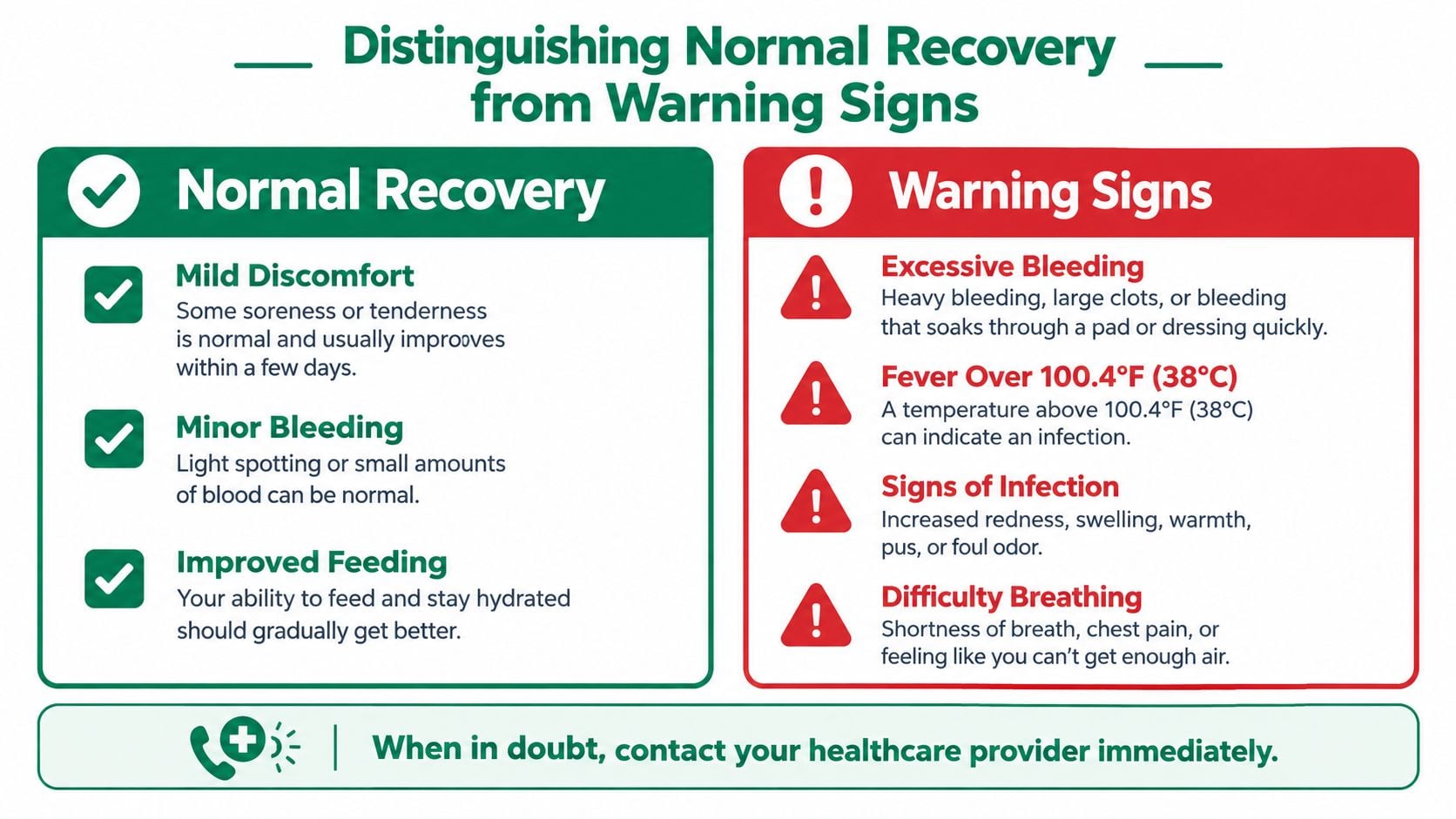
Recovery can look uneven without being dangerous. Mild soreness, temporary fussiness, small amounts of bleeding, and variable feeding may occur during early adaptation. Some babies struggle with latch for hours or days, and feeding can remain inconsistent for weeks, according to NHS patient guidance on tongue-tie recovery.
The safest approach is to judge symptoms by severity, direction, and function. A child who is uncomfortable but continues drinking and gradually settles is different from a child whose intake is worsening. A healing site that looks unusual isn't automatically infected, but increasing pain, fever, swelling, bad odor, or refusal to eat needs clinical attention.
A simple decision framework
Continue planned monitoring when discomfort is mild, feeding or drinking remains adequate, and symptoms are stable or improving. Keep the treating clinician's instructions available, and record meaningful changes in latch, pain, intake, wet diapers, weight concerns, speech, or tongue movement.
Contact the treating clinician promptly if any of the following occurs:
- Bleeding: Bleeding persists or doesn't stop with the pressure method provided at discharge.
- Intake: Feeding or drinking worsens, or the child refuses intake.
- Hydration: The child shows possible dehydration, such as markedly reduced intake or concerning changes in urination.
- Infection signs: Fever, increasing swelling, worsening redness, discharge, bad odor, or escalating pain develops.
- Breathing: Breathing difficulty occurs. This requires urgent medical evaluation.
- Function: Latch, milk transfer, speech, swallowing, or tongue movement remains poor without a gradual trend toward improvement.
Cleveland Clinic also advises contacting the treating clinician if bleeding doesn't stop with pressure, fever or increasing swelling develops, feeding worsens, or dehydration appears in its frenotomy guidance. Emergency symptoms shouldn't wait for a routine appointment.
A later feeding problem doesn't automatically mean residual tongue restriction. Milk supply, latch technique, oral-motor coordination, pain, sensory sensitivity, and other medical factors may need review before anyone considers another procedure.
A complications series reported repeat procedures requested or performed in 32% of referred reports and oral aversion in 28%, alongside reports of poor feeding, apnea or breathing difficulty, pain, bleeding, and weight loss. These aren't procedure-wide incidence rates, because the study captured referred complication reports as summarized in the American Academy of Pediatrics clinical report. They do show why careful diagnosis and follow-up matter.
Age-Specific Recovery Considerations
A baby may feed right after a release and still struggle later that day. That can confuse families, but it often reflects the gap between healing and function. The tissue may be less restrictive right away, while latch, sucking rhythm, and feeding endurance still need time to adjust. In infants, the most useful markers are feeding observation, maternal comfort, hydration, and weight trend, not the wound by itself.
Older children, teens, and adults usually bring longer-standing habits into recovery. If the tongue has moved in a limited way for months or years, the mouth and nearby muscles may have adapted around that pattern. Releasing tissue can create more range of motion, but motor learning requires practice. Speech, chewing, swallowing, oral posture, and even jaw and neck tension may improve only if the person learns how to use that new motion well.

Rehabilitation depends on readiness
Orofacial myofunctional therapy is a set of exercises that targets how the oral and facial muscles work. In selected older children and adults, it may support tongue range of motion, eating, speech, or swallowing after a lingual frenectomy. Babies and toddlers usually are not good candidates because this therapy depends on understanding directions and practicing them consistently according to the clinical explanation of myofunctional therapy.
A practical way to judge progress is simple. Is healing occurring, and is function also improving? If the site looks typical but feeding, speech, swallowing, or comfort stay unchanged, follow-up may be needed. Adults may also need care that addresses jaw comfort, sleep-related breathing concerns, or coordination with other clinicians. Guidance on adult tongue-tie surgery recovery can help frame questions about soreness, eating, speaking, exercises, and follow-up.
When to Seek Follow-Up Assessment
A planned reassessment gives recovery a better chance than waiting indefinitely or assuming that repeat surgery is the answer. Around 7 to 14 days, the clinician can evaluate wound contraction, tongue movement, feeding mechanics, maternal nipple pain, and the child's overall progress. Evidence also suggests that functional measures can improve during the first one to two weeks, including breastfeeding self-efficacy, nipple pain, and LATCH scores in the pediatric recovery review.
Longer-term review makes sense when symptoms remain abnormal. Persistent poor latch, pain, inadequate weight gain, speech difficulty, swallowing concerns, or limited tongue function deserves renewed lactation, medical, dental, or therapy assessment. A release alone may not resolve every contributing factor.
Laser shouldn't be marketed as superior, because available evidence hasn't established better breastfeeding outcomes than conventional techniques. Method selection should reflect anatomy, clinician expertise, bleeding considerations, age, and the functional aftercare plan as discussed in the American Academy of Pediatrics clinical report.
The Pain and Sleep Therapy Center uses a root-cause approach to tongue-tie, TMJ and craniofacial pain, and sleep-related breathing concerns. Its care may include evaluation, laser frenectomy when appropriate, oral-function support, and coordination with external medical, dental, lactation, or therapy providers for patients in Newark and Wilmington, Delaware, and Bryn Mawr and the Philadelphia Main Line.
Families seeking a careful evaluation of tongue mobility, feeding or oral function, TMJ symptoms, or sleep-related breathing can visit Pain and Sleep Therapy Center to learn about available services. The center is led by Dr. Ryan Robinson, triple board-certified in craniofacial pain and dental sleep medicine, and appointments can be requested at (302) 239-1757.