Painless jaw clicking is common and, by itself, isn't a temporomandibular disorder and doesn't require treatment. The important distinction is whether the jaw still opens comfortably, moves freely, and works normally during eating and talking.
A small sound near the ear can feel unsettling, especially when it seems to come from inside a joint. The National Institute of Dental and Craniofacial Research distinguishes harmless joint sounds from symptoms that deserve attention, such as pain, locking, or restricted movement. Watching those changes is more useful than trying to silence every click.
Table of Contents
- What a Click Without Pain Usually Means
- When a Quiet Click Stays Harmless
- How the Jaw Joint Makes a Click
- Will This Click Turn Into a Problem
- Everyday Habits That Load the Joint
- Everyday Examples and the Sleep Link
- Decide Whether to Watch or Be Seen
What a Click Without Pain Usually Means
A person takes a bite of breakfast, hears a soft click near the ear, and keeps eating without discomfort. Later, the same sound happens during a yawn. Nothing hurts, and the mouth opens as easily as usual.
That pattern doesn't automatically suggest a jaw disorder. Temporomandibular disorders, usually shortened to TMD, are a group of problems affecting the jaw joints and the muscles used for chewing. TMJ means the temporomandibular joint itself, not a diagnosis.
How common are joint sounds?
Among 6,718 healthy job applicants, 20.1% reported hearing jaw-joint sounds; clinicians detected clicking or crepitation by touch in more than 12.2%, listening detected sounds in almost 72.5%, and a recording method detected sounds in 84% of a randomly selected subgroup, as described in the NIDCR's archived TMJ disorders document.
Those very different results need context. Feeling a joint with fingertips won't capture every subtle sound that sensitive equipment can record. Crepitation, also called crepitus, means a grinding or crackling noise rather than a single click.
The figures don't mean that everyone with a recorded sound had a medical problem. They illustrate how much the answer changes depending on whether someone notices a noise or an examiner actively searches for one.
Practical distinction: A sound describes something the joint does. It doesn't, by itself, explain whether the joint needs care.
A door hinge offers a useful, limited analogy. A hinge may tick while the door still opens and closes smoothly. The tick alone doesn't establish that the hinge is failing.
A jaw is more complex than a hinge, but the same reasoning helps prevent unnecessary worry. The useful questions concern comfort, movement, and change, not loudness alone. Comfortable meals, ordinary speech, and unrestricted opening provide more meaningful information than whether a click can be heard across a quiet room.
When a Quiet Click Stays Harmless
Comfortable movement without pain or tenderness is the most reassuring pattern. A click accompanied by trouble chewing, stiffness, or locking belongs in a different category, even when the sound itself hasn't changed.
The comparison below separates background noise from changes that affect function. It isn't a diagnostic checklist, but it can help a person describe the problem clearly during an appointment.
Jaw click patterns and what to do
| Pattern | What it usually means | Next step |
|---|---|---|
| Click or pop only, full opening, no pain or tenderness | Common joint sound, not TMD by itself | Observe; no treatment needed for the sound alone |
| Click with jaw, face, temple, or chewing-muscle pain | May be part of TMD | Clinical evaluation of head, neck, face, and jaw |
| Jaw catches or locks, even if it releases | Disc may not be sliding smoothly | Evaluation; don't force the jaw open |
| Opening gets smaller or the jaw pulls to one side | Functional change, not just noise | Evaluation and measurement of motion |
| Bite suddenly feels different | Possible joint or bite change | Evaluation before any permanent dental change |
| Snoring, breathing pauses, or daytime sleepiness with jaw symptoms | Not a sleep apnea diagnosis | Sleep study interpreted by a physician |
The first row describes a person who can eat, speak, and yawn normally despite an occasional sound. That person generally doesn't need corrective treatment to make the joint quiet.
Pain changes the assessment. Soreness in the temple or chewing muscles matters even when the joint itself doesn't feel tender. The American Academy of Orofacial Pain emphasizes considering the full symptom pattern, including tenderness and movement problems, rather than identifying a disorder from noise alone.
Changes that shouldn't be dismissed
A brief catch also deserves attention. A jaw that sticks and then releases isn't functioning in quite the same way as a jaw that makes a sound but never hesitates. The disc inside the joint may contribute, but an examination is needed before naming the cause.
Progressively smaller opening, a new sideways pull, or a bite that suddenly feels unfamiliar are also functional changes. Repeatedly stretching the mouth or shifting the jaw to recreate the sound isn't a useful home test.
- Pain or tenderness: Arrange an assessment rather than assuming the sound explains everything.
- Catching or reduced opening: Describe when it happens and whether meals are becoming harder.
- A changed bite: Seek an evaluation before considering treatment that permanently alters tooth contact.
- Sleep symptoms: Report breathing pauses and daytime sleepiness separately from the jaw complaint.
The most helpful approach is to identify the pattern that fits. A harmless-sounding click doesn't cancel out new locking, and a loud click doesn't automatically outweigh otherwise normal function.
How the Jaw Joint Makes a Click
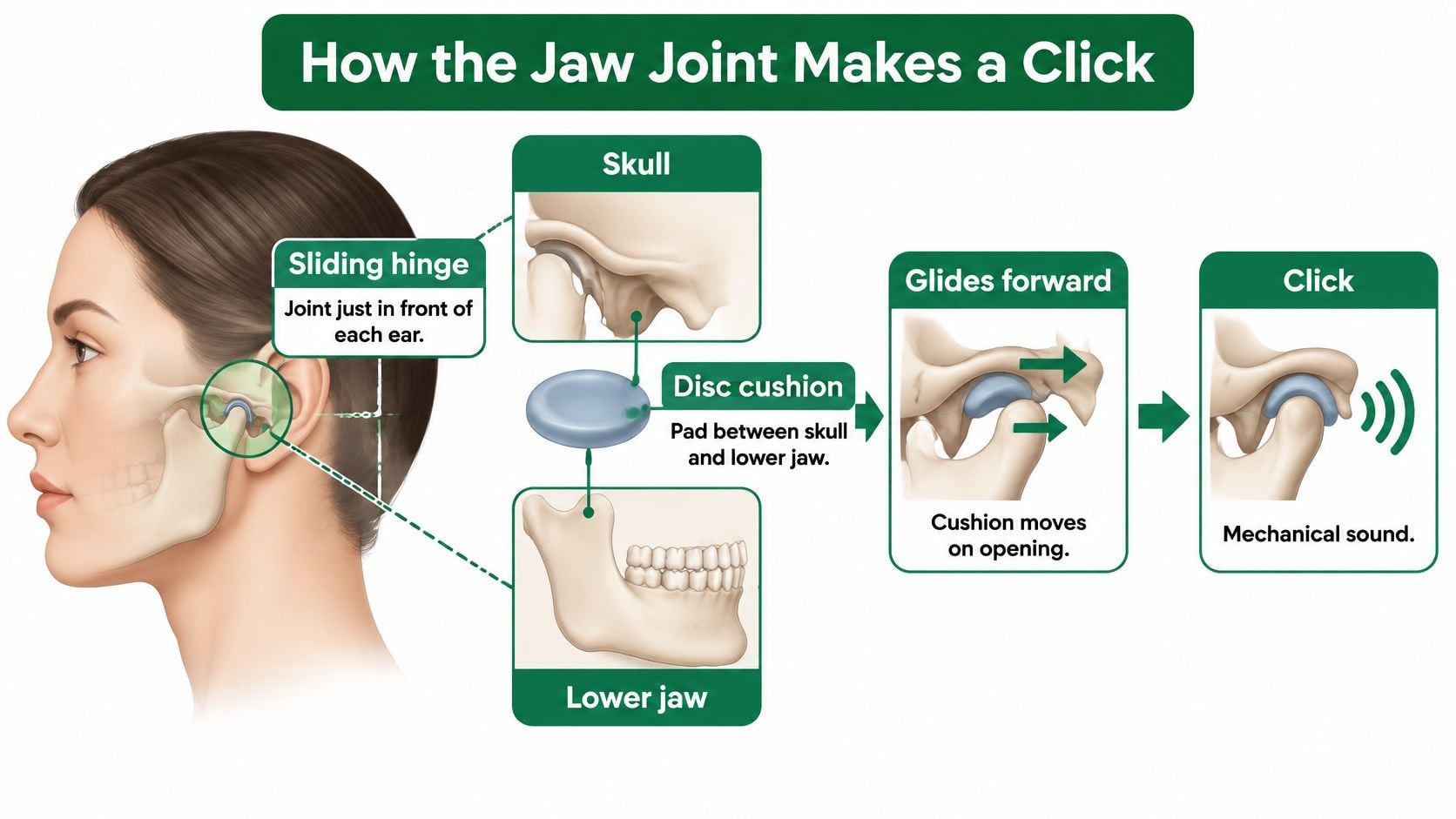
The jaw joint sits just in front of each ear and works as a sliding hinge. It allows the lower jaw to rotate and move forward, making activities such as chewing and yawning possible.
A small disc, a pad of connective tissue, sits between the lower jaw and the skull. During opening, the disc normally moves with the joint. If its movement changes, the joint may produce a click.
A cushion that changes position
One possible explanation is disc displacement with reduction. In plain language, the cushion sits out of its usual position and then returns to a working relationship with the jaw during movement. Clinicians call that return reduction.
That movement can make a click, but hearing a click doesn't prove that it occurred. Nor does the absence of a click prove that the disc is positioned normally.
In a peer-reviewed imaging study, anterior disc displacement with reduction appeared in 112 of 128 examined joints, or 87.5%; of those joints, 98 clicked and 14 didn't, while 16 of 114 clicking joints, or 14.0%, showed no disc displacement on MRI.
Those mismatches matter more than the technical name. Sound isn't a reliable map of the structures inside the joint. A clinician can't confidently identify disc position just by listening during opening and closing.
When imaging answers a useful question
MRI, or magnetic resonance imaging, can help assess soft tissues such as the disc. It becomes more useful when the examination leaves uncertainty or when pain, locking, substantial motion loss, or progressive functional changes need explanation.
A first assessment generally documents:
- Opening and movement: How far the mouth opens and whether it moves off course.
- Joint and muscle tenderness: Where pressure or movement reproduces symptoms.
- Bite and chewing function: Whether tooth contact or everyday eating has changed.
Pain and Sleep Therapy Center's diagnostic process may also require a 3D CBCT, a cone beam computed tomography scan of the jaw joint. Such scans are frequently needed during the center's TMJ diagnostic workup, and patients may be referred to a diagnostic imaging center.
CBCT and MRI answer different questions. CBCT mainly shows hard tissues such as bone, while MRI helps evaluate soft tissues. Neither should be treated as an automatic next step for an isolated, comfortable click; the examination should establish what information is needed.
Will This Click Turn Into a Problem
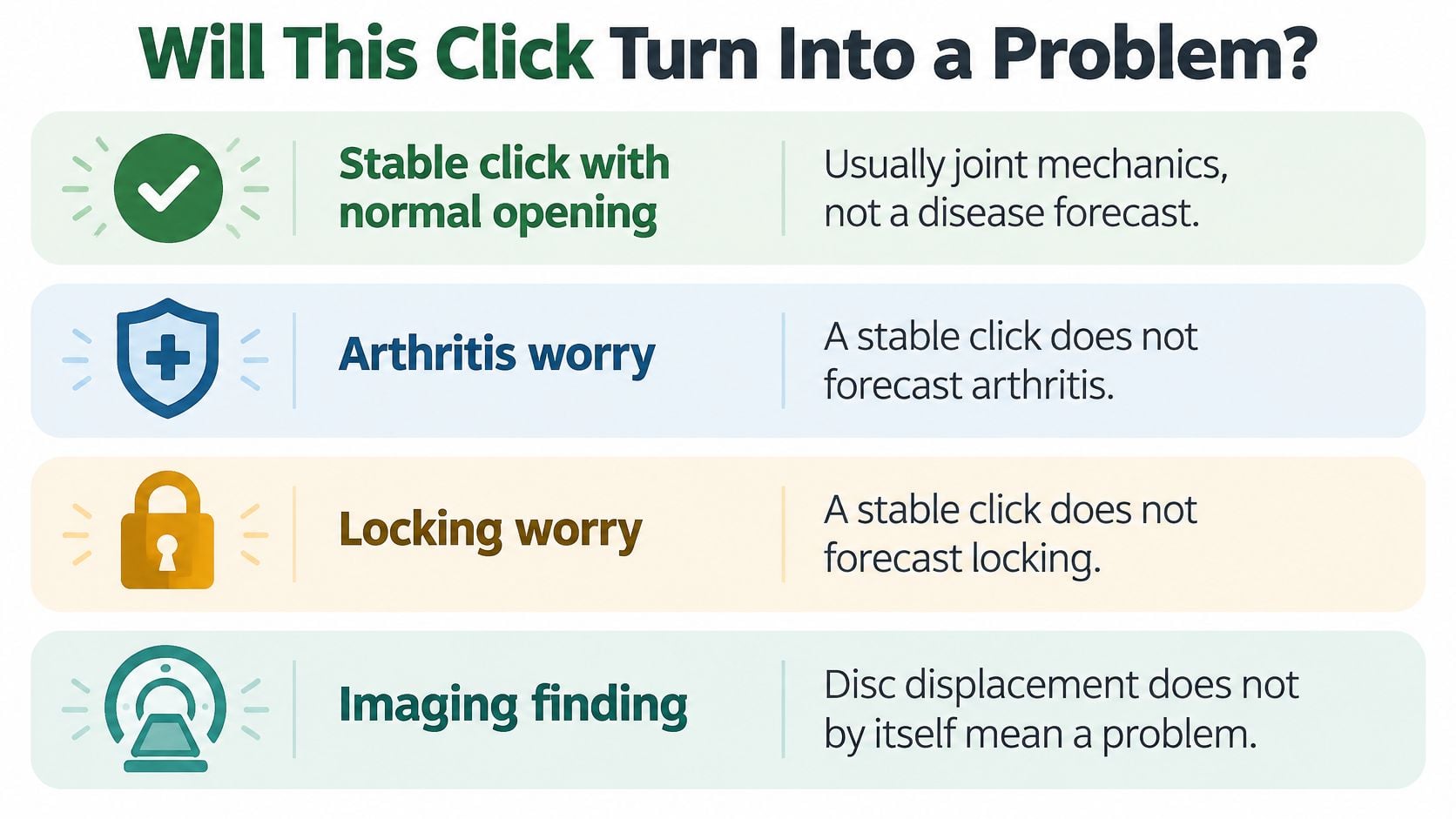
A stable click doesn't reliably predict future TMD. It isn't enough to forecast arthritis or eventual locking, and a disc-position finding doesn't establish how severe a person's symptoms will become.
That reassurance has a boundary. No sound can be declared permanently unimportant without regard to later changes. The useful distinction is stable versus evolving, consistent with the symptom-based approach described in the Canadian Chiropractic Guideline Initiative's TMD guidance.
What to track in a painless jaw click
A brief note over several weeks can make change easier to recognize. The note doesn't need repeated testing or constant attention; observations during normal meals and conversation are enough.
| What to note | A stable pattern | A reason to get checked |
|---|---|---|
| How often and which side | Same side, same situations, not spreading | New side, much more often, or a sudden change |
| Opening width | Comfortable full opening, roughly three finger-widths as a loose personal reference, not a diagnostic cutoff | Opening shrinks or the jaw pulls sideways |
| Pain | None during chewing, talking, or yawning | New jaw, face, temple, or muscle pain |
| Catching or locking | Jaw never sticks | Jaw catches, even if it releases |
| Chewing and bite | Food and tooth contact feel the same | Chewing is harder or the bite feels off |
Finger sizes and normal opening differ. A clinician's measurement is more useful than forcing fingers between the teeth, and any home comparison should remain gentle. A decrease from the person's usual comfortable opening matters more than passing a home test.
A useful entry might describe a right-sided click during breakfast, comfortable opening, no pain, and no catching. A later entry describing morning sticking or difficulty biting a familiar sandwich gives the clinician more actionable information than a description of sound volume alone.
Putting future risk in perspective
The NIDCR's prevalence overview estimates that TMD affects approximately 5% to 12% of the population overall and summarizes a Swedish survey in which joint sounds were reported by 12.0% of males and 16.5% of females.
Those figures describe populations, not an individual's future. They shouldn't be used to calculate the chance that a particular click will become painful.
The purpose of tracking is to notice a change in function, not to prove that a joint can be made silent.
A newly noticed or louder click can be recorded without assuming damage. A click paired with morning catching, shrinking opening, or altered chewing is a stronger reason for a baseline examination, even before pain becomes persistent.
Everyday Habits That Load the Joint
Ordinary chewing is a load the jaw is built to carry. Constant clenching adds unnecessary work, much as carrying an overloaded backpack makes an ordinary walk harder.
For jaw clicking without pain, reducing avoidable strain is more reasonable than treating the sound itself. The aim isn't to stop normal jaw movement or make eating feel dangerous.
Less extra work during the day
Several common habits deserve attention:
- Constant gum chewing: Reduce prolonged chewing that continues well beyond meals.
- Nail biting: Keep the teeth out of tasks that repeatedly load the jaw.
- Sustained clenching: Notice whether the teeth remain pressed together during driving, reading, or desk work.
- Grinding: Discuss suspected grinding during an evaluation rather than assuming every click comes from it.
During rest, the teeth can remain slightly apart, with the tongue resting gently against the palate. That position shouldn't require effort or a forceful press. Sore chewing muscles by evening may be a useful cue to notice daytime tension.
A short food note can also reveal whether particularly hard or chewy foods coincide with discomfort or more noticeable sounds. That doesn't make diet a treatment for the underlying anatomy, and a comfortable person doesn't need an unnecessarily restrictive diet.
Educational resources on ways to stop grinding teeth from Prosth & Co. can help explain habit-focused options. Pain and Sleep Therapy Center's jaw-clenching remedy guidance also provides context for recognizing unnecessary muscle activity.
Nighttime care needs a separate decision
A nighttime appliance can be a maintenance therapy for diagnosed TMD, but it isn't automatically appropriate for painless clicking. A standard jaw appliance isn't the same as an appliance designed to manage obstructive sleep apnea, and an unsuitable appliance may worsen sleep-related breathing in some patients.
Appliance planning should therefore include questions about snoring, witnessed breathing pauses, and sleepiness. A device doesn't diagnose sleep apnea, and it shouldn't be assumed to replace CPAP.
Conservative care first: A joint sound alone isn't a reason to reshape teeth, permanently change the bite, or proceed to surgery.
At Pain and Sleep Therapy Center, medication is used to support more definitive TMJ therapies rather than as a stand-alone solution. Habit changes and other conservative measures may help, but no single approach guarantees that symptoms or sounds will disappear.
Everyday Examples and the Sleep Link
Someone whose jaw has clicked on the same side for years may still eat comfortably and open normally. In that situation, observation and less unnecessary chewing can be reasonable, without turning a familiar sound into a disease.
A different person might first notice a click after a wide yawn or a long dental visit. If comfort and opening remain normal, a brief symptom log is more informative than assuming that a scan is immediately necessary. The timing is worth recording, but it doesn't prove an injury.
When the everyday situation changes
A jaw that clicks and then sticks while biting a sandwich tells a different story. Even if discomfort passes quickly, the sticking deserves assessment. The person shouldn't force the mouth open or repeatedly reproduce the catch.
The illustration below shows ordinary activities in which jaw and sleep symptoms may become noticeable.
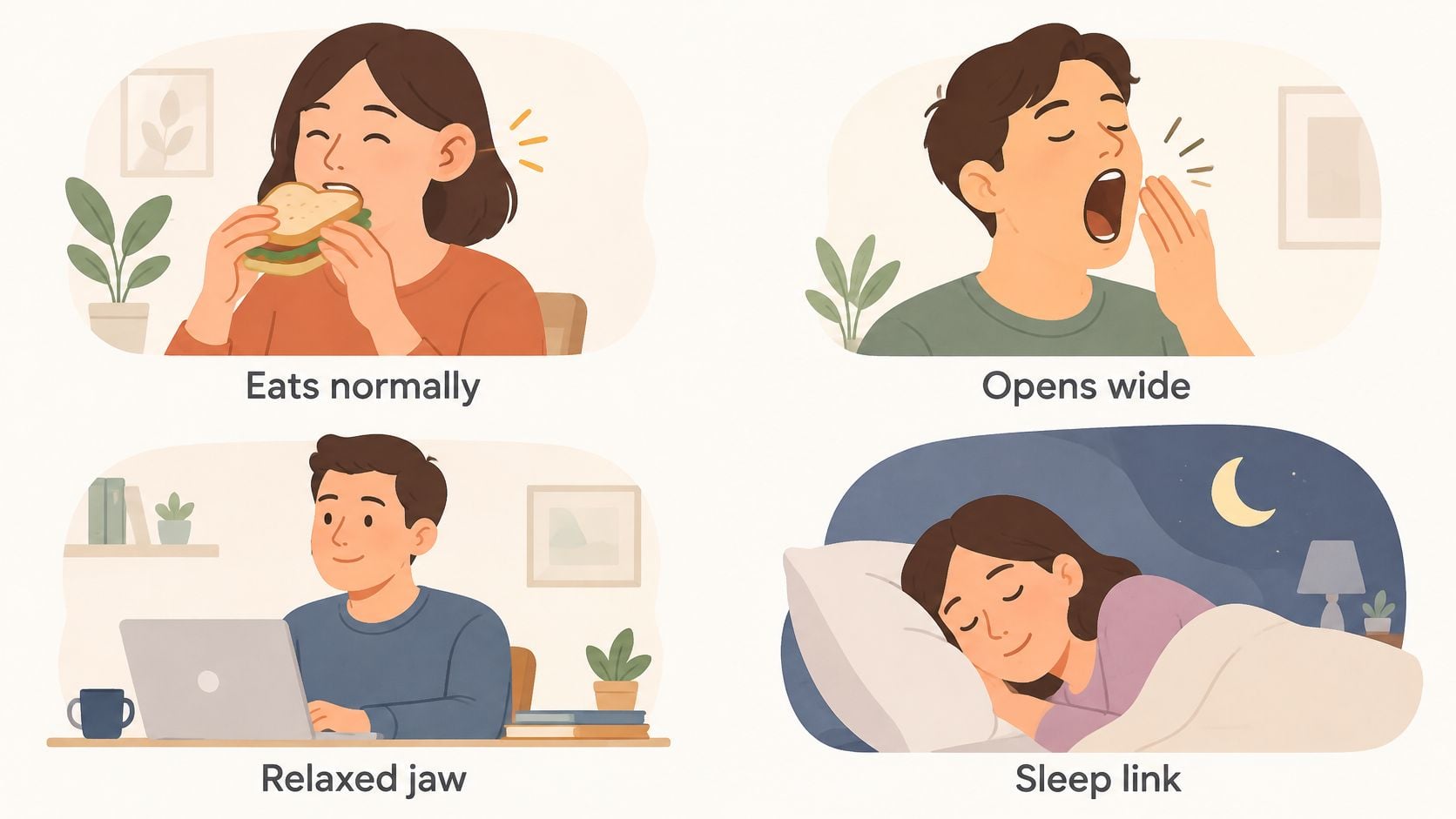
A fourth situation involves clicking alongside loud snoring, witnessed pauses in breathing, unrefreshing sleep, or daytime fatigue. That person has separate jaw and sleep questions. Neither the noise nor tiredness establishes obstructive sleep apnea, a condition in which the upper airway repeatedly narrows or closes during sleep.
What proper sleep evaluation involves
The American Academy of Sleep Medicine's adult sleep apnea guideline identifies polysomnography, an attended overnight sleep study, as the standard diagnostic test; selected uncomplicated adults may instead begin with a home sleep apnea test interpreted by a qualified sleep physician.
For adults with a confirmed diagnosis, a custom, titratable oral appliance, meaning one that can be gradually adjusted, may be prescribed through coordinated sleep and dental care. It isn't a universal replacement for CPAP, and follow-up sleep testing checks whether treatment is effective.
- Jaw assessment: History, physical examination, opening range, and joint sounds or vibrations help characterize the complaint.
- Additional diagnostics: Hard-tissue imaging, hospital-based soft-tissue imaging, or sleep diagnostics may be appropriate in selected cases.
- Coordinated interpretation: A physician diagnoses sleep apnea using the sleep study and clinical assessment.
Pain and Sleep Therapy Center uses this broader diagnostic process rather than evaluating sound in isolation. Its explanation of snoring and TMJ symptoms offers additional context for discussing both concerns during an appointment.
Decide Whether to Watch or Be Seen
The decision can remain simple without becoming dismissive. A painless click with comfortable opening, no locking, and an unchanged pattern can usually be watched. New pain, catching, reduced opening, or a changed bite makes an evaluation more useful than waiting for the noise to fade.
Strong sleep symptoms also deserve attention, even when the jaw feels fine. A sleep concern doesn't need to wait until the click becomes painful.
What an evaluation should clarify
A useful visit establishes what has changed and what affects daily life. The clinician reviews the history, watches jaw movement, checks joint sounds, and examines the muscles for tenderness. Imaging or physician-directed sleep testing is added when it can answer a specific clinical question.
Pain and Sleep Therapy Center is led by Dr. Ryan Robinson, a triple board-certified specialist in craniofacial pain and dental sleep medicine. The practice evaluates jaw, head, and facial pain with a root-cause approach that considers symptoms together rather than assuming every headache or click has the same explanation.
- Movement concerns: Bring notes about catching, smaller opening, or changes during meals.
- Pain concerns: Describe location, timing, and effects on talking, chewing, or sleep.
- Sleep concerns: Include observed breathing pauses, snoring, and daytime sleepiness.
Care matched to the findings
Depending on the diagnosis, treatment may include orthotic therapy, a fitted oral appliance, cold laser therapy, lifestyle modifications, and collaboration with other healthcare professionals. Conservative, non-invasive options are considered before surgery, and results aren't guaranteed.
The practice has offices in Newark, Delaware, and Bryn Mawr, Pennsylvania, serving patients from Wilmington and the Philadelphia Main Line. Its information on pain in the TMJ can help patients describe symptoms before a visit.
A stable sound doesn't need to become a treatment project. A changing pattern deserves a clear explanation and an individualized next step.
Pain and Sleep Therapy Center offers root-cause evaluation of jaw, head, facial pain, and related sleep concerns to help distinguish a harmless click from a problem affecting function. For a changing jaw click, visit Pain and Sleep Therapy Center to Request an Appointment, or call the Newark office at (302) 239-1757. Those whose main concern is snoring or poor sleep can Take our Sleep Quiz as a screening step, not a diagnosis; sleep apnea still requires a sleep study and physician evaluation.