Can TMJ be fixed? For many people, yes, though the answer carries an asterisk worth understanding. Patients with a temporomandibular disorder often improve substantially, and some resolve completely: in a five-year follow-up of adults with chronic TMD pain, 49% reported complete recovery, with the rest spread across partial relief, no change, or worsening. Fixed, though, rarely means a jaw that never clicks again.
Pain relief and joint silence are two separate outcomes, and they often arrive on different schedules. A jaw can stop hurting while still popping, and a joint can look unchanged on an image while the person attached to it eats, sleeps, and speaks comfortably again. Confusing those two outcomes is where most disappointment starts.
People who type can TMJ be fixed into a search bar usually want permission to believe the pain will end. The better question is which kind of fixed is realistic for the specific problem in front of them, and which reversible steps deserve a fair trial before anyone reaches for a permanent one.
Table of Contents
- What Fixed Really Means for TMJ Problems
- How Diagnosis Reveals the Real Cause
- Matching Treatment to the Underlying Cause
- How Sleep Apnea Changes the Treatment Plan
- Reversible Steps to Try Before Anything Permanent
- When Surgery Comes Up and Why It Is Rarely First
- Schedule a Root-Cause Evaluation Near You
What Fixed Really Means for TMJ Problems
TMJ stands for the temporomandibular joint, the hinge where the lower jaw meets the skull. TMD, or temporomandibular disorder, is the broader diagnosis covering that joint, the chewing muscles around it, or both. The terms get swapped in conversation, and that's part of why expectations drift, because a muscle problem and a problem inside the joint don't behave the same way.
Remission turns out to be common at every stage measured. The five-year figures come from follow-up that tracked 234 adults with chronic TMD pain, and a clinical review of temporomandibular disorders reports that 51% of adults with newly diagnosed TMD no longer met diagnostic criteria after an average of 8 months. The same review puts remission near 49% after five years and 28% after eight, notes that up to 40% of patients improve with no intervention at all, and finds that conservative treatment reduces symptoms in roughly 50% to 90% of patients.
A workable definition: fixed means pain is gone or manageable, eating and speaking feel normal, and the jaw opens without dread. A silent joint is a bonus, not the benchmark.
Why the word fixed trips people up
Structural change is the goal least likely to be reached, and it's the one many people picture. Clicking, popping, and a slight deviation on opening can persist long after pain settles. Chasing those sounds with irreversible treatment usually costs more than it returns, which is why reversible care belongs first in any plan.
What varies between people is not mysterious. Diagnosis matters, so does how long symptoms have lasted, individual pain sensitivity, stress load, sleep quality, and whether the primary driver sits in the jaw muscles, inside the joint, or in both at once.
The spread of outcomes across that follow-up group shows the range worth planning for:
| Outcome at 5 years | Share of 234 adults | What it means |
|---|---|---|
| Complete recovery | 49% | Pain no longer present |
| More than 50% pain relief | 14% | Substantial improvement without full resolution |
| 20%-50% pain relief | 8% | Partial improvement |
| Unchanged | 13% | No measurable change in pain |
| At least 20% increase in pain | 16% | Symptoms worsened over time |
Read across the rows and the pattern is clear: the large majority land somewhere between partial relief and full recovery, while a smaller share stay flat or worsen. The practical takeaway is to pick the outcome that matters most to daily life, whether that's eating an apple, sleeping through the night, or getting through a workday without a headache, and use that goal to judge progress. A plan that restores function while leaving a click behind is a successful plan.
How Diagnosis Reveals the Real Cause
Jaw pain can't be diagnosed from symptoms alone, and the reason is simple: identical complaints can come from different tissues. Two people describe the same morning headache and the same tightness in front of the ear. One has tender chewing muscles and a nightly clenching habit. The other has a joint that clicks and catches on opening, with the muscles merely guarding around it. The first needs habit work and reversible measures. The second needs imaging and a closer look at the disc.
That's why an evaluation comes before a treatment plan. A joint that pops when you open is common and often harmless on its own, and why your jaw clicks when opening your mouth explains the difference between a sound and a symptom worth treating.
What a proper evaluation involves
- Physical examination: the clinician palpates the jaw, face, head, and neck muscles for tenderness and checks how the joint moves under load.
- Range of motion: measuring how wide the mouth opens, whether it deviates to one side, and where movement stops feeling comfortable.
- Joint sounds and vibrations: listening and feeling for clicks, pops, or crepitus, a grinding quality that hints at wear inside the joint.
- Hard tissue imaging of the joint: a 3D cone beam CT (CBCT) scan is frequently needed, and patients may be referred to a diagnostic imaging center to have it completed.
- History and interview: when symptoms began, what eases or provokes them, headache patterns, sleep quality, stress, and previous dental work.
- Sometimes more: sleep diagnostics, and in certain cases hospital-based soft tissue diagnostics, when the picture points beyond the jaw.
Before that appointment, write down symptom timing, your triggers, how well you sleep, how many headache days you get in a typical week, and every medication and supplement you take. Bring any previous imaging too. That log does more for a diagnosis than any description reconstructed in the chair, and it leaves the diagnostic call where it belongs, with the clinician.
Matching Treatment to the Underlying Cause
The word fixed means something different depending on the mechanism. Muscle-related pain, joint inflammation, disc displacement, degenerative joint disease, and chronic pain sensitization don't respond identically, and treating them as one condition is why some people cycle through appliances without improvement.
The National Institute of Dental and Craniofacial Research guidance on TMD recommends starting with reversible care, including soft foods, heat or cold, gentle jaw stretching and strengthening, cutting back on clenching and gum chewing, and short-term nonsteroidal anti-inflammatory drugs when medically appropriate. The reason is straightforward: evidence for many invasive or permanently bite-changing procedures remains limited.
The table below maps the options commonly considered first for each pattern. It's a general guide for understanding a care plan, not a tool for self-diagnosis, because many cases involve a mix of patterns.
| Underlying pattern | Options often considered first | Why the plan may differ |
|---|---|---|
| Muscle-related pain | Soft foods, heat or cold, gentle jaw exercises, reducing clenching | Muscle pain often responds to reversible care first |
| Joint inflammation | Short-term anti-inflammatory medication when medically appropriate, heat or cold, soft foods | Medication choice depends on medical history |
| Disc displacement | Reversible care, jaw exercises and reassessment of joint sounds | Joint sounds may persist even when pain improves |
| Degenerative joint disease | Conservative care, pain management and monitoring | Joint damage may justify considering stronger options |
| Chronic pain sensitization | Patient education, behavioral strategies, stress and sleep support | Pain may persist longer and needs a broader plan |
Where medication fits, and where it doesn't
Drugs are used to improve the outcome of more definitive TMJ treatment, not to solve the problem by themselves. A course of anti-inflammatory medication can calm a flare enough for exercises and habit changes to take hold, but the underlying drivers, whether clenching, sleep disruption, or joint loading, stay in place without the rest of the plan.
Two people illustrate the difference. Someone whose pain sits mostly in the chewing muscles may notice meaningful change within weeks of reversible care and a few habit adjustments. Someone with long-standing centralized pain may need education, sleep support, and stress work alongside jaw-focused care, and should expect a slower curve.
Establish a diagnosis and a functional baseline before considering crowns, orthodontic bite changes, or surgery. Those choices are hard to reverse, and NIDCR specifically cautions that irreversible procedures can worsen symptoms. The honest version of can TMJ be fixed depends on which tissue is involved, not on which appliance is newest.
How Sleep Apnea Changes the Treatment Plan
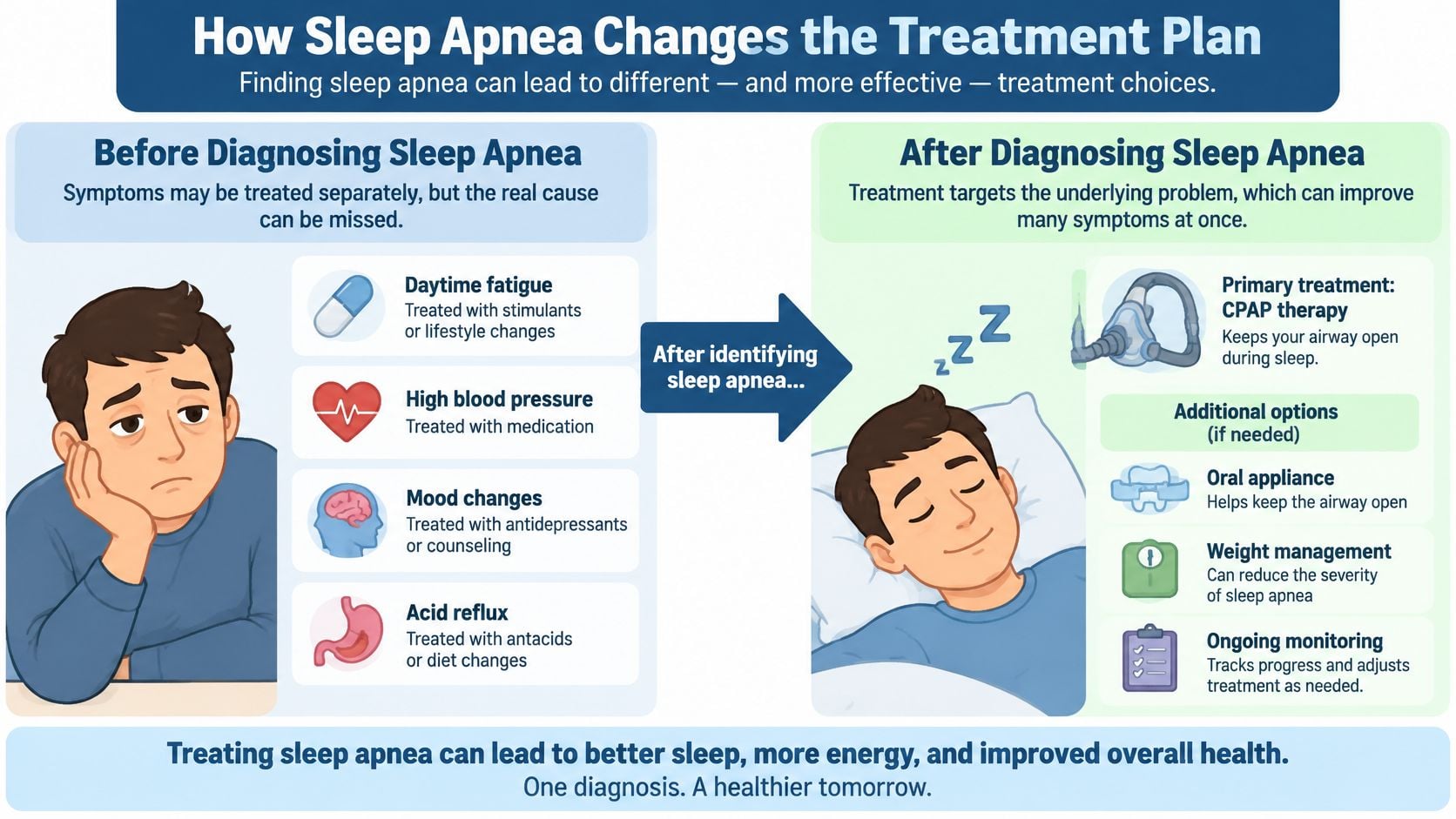
Here's the statistic that changes how nighttime jaw devices should be prescribed: more than 60% of patients with TMJ issues have obstructive sleep apnea (OSA), which is why a sleep study may be suggested during TMJ therapy. Obstructive sleep apnea is a condition where the airway repeatedly narrows or closes during sleep, interrupting breathing and fragmenting rest.
The risk of skipping that step is concrete. A nighttime appliance is a hallmark maintenance therapy for TMJ, and one that isn't built to control sleep apnea can double the severity of a patient's sleep apnea. The jaw gets quieter while the breathing gets worse.
Snoring alone can't settle the question. The American Academy of Sleep Medicine guidance on oral appliance therapy states that polysomnography is the standard diagnostic test for adults with concern for OSA after a thorough sleep evaluation. A physician may order a technically adequate home sleep apnea test in some circumstances, but a sleep study is still required to establish whether clinically significant sleep-disordered breathing is present, because snoring happens with and without apnea.
Why a jaw device isn't a substitute for a diagnosis
Oral appliance therapy may be considered for adults with OSA who prefer an alternative to CPAP or can't tolerate CPAP. It isn't a universal replacement, and CPAP remains the preferred therapy for many people. The joint AASM and AADSM guideline recommends a custom, titratable appliance from a qualified dentist, meaning it can be adjusted gradually, after a sleep physician prescribes it, with ongoing medical and dental follow-up and follow-up sleep testing to confirm it's working rather than relying on how someone feels.
If snoring or unrefreshing sleep has become part of the jaw pain story, whether TMJ can cause sleep apnea is worth reading before any nighttime device is ordered. For people already diagnosed and working on sleep positioning at home, better rest with an adjustable bed can support comfort, though no mattress replaces a sleep study. Ask one question before starting any appliance: has a sleep study been discussed?
Reversible Steps to Try Before Anything Permanent
Reversible care isn't a delay tactic. It's the part of treatment most likely to produce change with the least risk, and it follows a logical order rather than a random list of remedies.
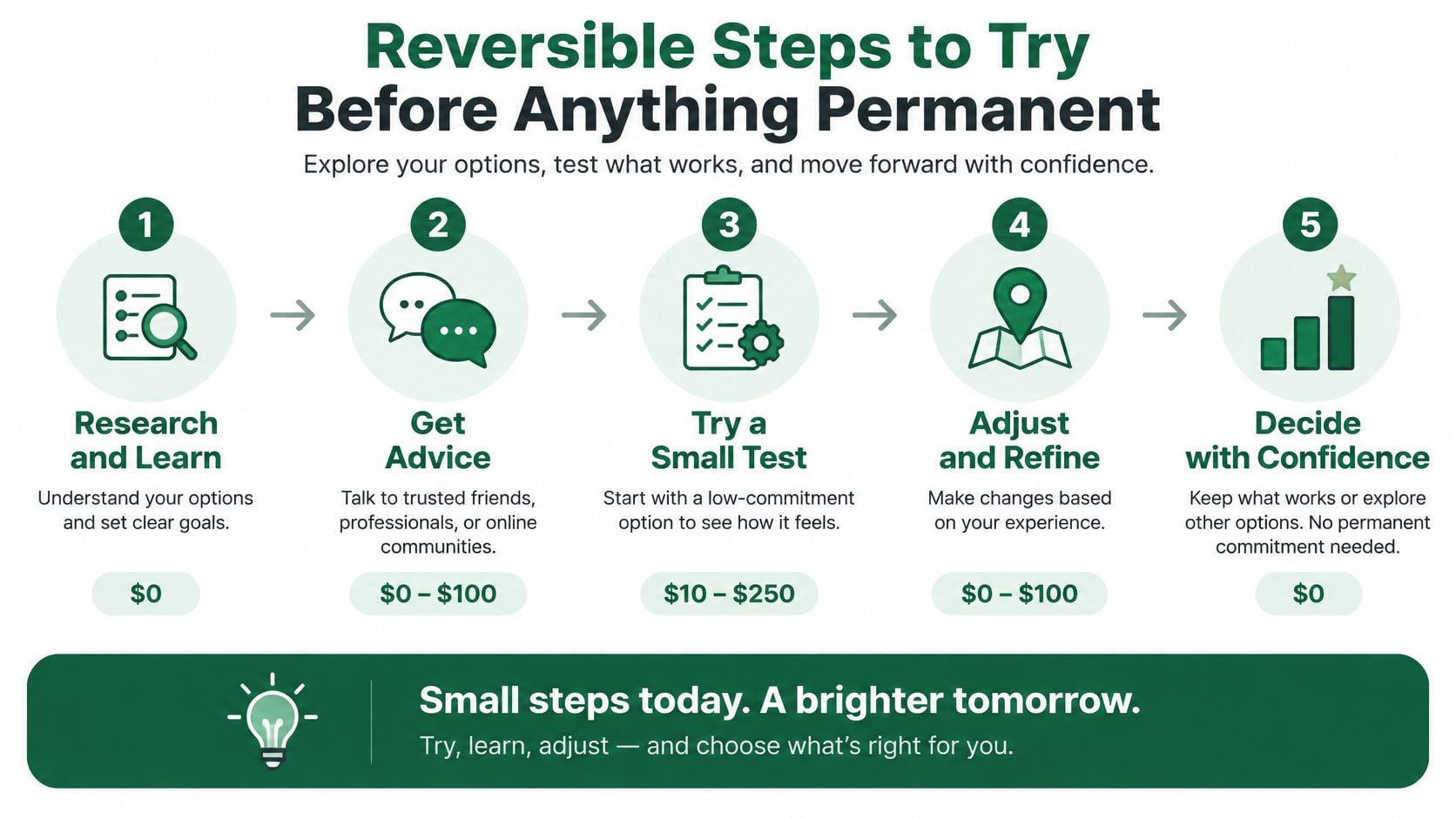
Confirm the diagnosis and record a baseline. Note your pain level, widest comfortable opening, which foods hurt, and headache days per week. Without a starting line, there's no way to tell whether a treatment worked or the flare passed.
Match the first measures to the pattern. Soft foods during flares, heat or cold, gentle jaw stretching and strengthening, and cutting back on clenching and gum chewing. These cost little, and for muscle-driven pain they often produce noticeable change within a few weeks.
Add habit coaching, and consider an appliance only after a sleep evaluation. A 2025 clinical intervention study of 36 adults found muscle pain scores fell from 4.6 at baseline to 1.1 after three months of stabilization-splint treatment, with mouth opening also improving, per the published trial. Individual results vary, and evidence for many interventions remains limited. Appliances aren't risk-free either, and TMJ splint therapy side effects can include bite changes that make follow-up appointments essential.
Set measurable goals for four to eight weeks. Headache response lags behind jaw pain response. A 2025 meta-analysis of occlusal stabilization appliances found low-certainty evidence that these appliances didn't clearly reduce headache frequency or intensity in the first one to three months, while possible frequency benefits appeared at four to nine months.
Reassess at scheduled visits, not by feel alone. Compare opening measurements, pain scores, and headache days against the baseline you wrote down. Memory is unreliable during a good week.
Escalate only when symptoms, function, or joint findings justify it. If measurable goals aren't met after a fair trial, the next step is a different therapy rather than a bigger version of the same one.
Expectation to hold onto: an appliance won't guarantee that headaches stop, but headache occurrence frequently improves with therapy. Judge the plan on trends across weeks, not on a single rough morning.
When Surgery Comes Up and Why It Is Rarely First
Surgery earns a place only when symptoms are severe and persistent, or when the joint itself is damaged beyond what conservative care can reach. The numbers show how rarely that happens. A multi-site analysis cited in the BMJ's five-year follow-up of TMD outcomes found that fewer than 3% of 2,104 treated individuals underwent open surgery, and the same summary estimates that about 5% may require surgery when conservative therapy is insufficient.
That follow-up also offers the most useful reassurance in this conversation. Pain improvement was largely independent of changes in clinical signs such as jaw range of motion, and people who became pain-free could still have joint sounds. Restoring comfortable function is a different goal from eliminating every click. A knee that works well can still pop going downstairs, and a jaw is no different.
Long-term cohort data tells a similar story from another angle. The OPPERA study followed people with chronic TMD pain for five years and found that complete remission happens for a meaningful minority, though heavy loss to follow-up limits how far the result stretches. Hope is justified. Certainty is not.
Risk deserves plain language too. Every possible precaution is taken to prevent harm to a patient's occlusion and TMJ, but some consequences in those areas are still possible even with careful planning. Procedures that alter the bite or open the joint can leave lasting effects, which is exactly why informed consent matters and why the sensible sequence runs reversible first. More than 60% of patients with TMJ issues have obstructive sleep apnea (OSA), so a sleep study may be suggested during TMJ therapy before any permanent option enters the discussion.
Before consenting to anything irreversible, ask what the diagnosis is, which reversible steps have been tried and for how long, what measurable result counts as success, and what the specific risks are.
Bring those questions to any provider. A second opinion from another specialist is a reasonable request that a careful provider welcomes. And when an oral appliance falls short of treatment goals, the right response is active support in finding other effective therapies rather than a repeat of the same prescription.
Schedule a Root-Cause Evaluation Near You
A first visit exists to answer three questions: what is driving the pain, whether sleep is part of the picture, and which reversible option to try first. The evaluation itself is straightforward. It combines a physical examination, range-of-motion testing, listening for joint sounds and vibrations, imaging of the joint's hard tissue, and a detailed history and interview. Some patients are referred to a diagnostic imaging center for a 3D CBCT scan of the jaw joint. Because greater than 60% of patients with TMJ issues also have obstructive sleep apnea, a sleep study may be suggested before the plan is finalized.
Three steps get the process started:
- Take the online sleep quiz if snoring or unrefreshing sleep is part of your symptoms.
- Request an appointment through the website for the Newark, Delaware or Bryn Mawr, Pennsylvania office.
- Bring your symptom log, medication list, and any prior imaging so the review starts on day one.
Pain and Sleep Therapy Center evaluates and treats TMJ-related head and facial pain, sleep disorders, and tongue-tie conditions. The practice was founded by Dr. Ryan Robinson, a triple board-certified specialist in craniofacial pain and dental sleep medicine who now practices part-time at the Newark clinic and spends much of his time training doctors worldwide to screen for and treat TMJ and airway problems. Treatment plans lean on orthotic therapy, cold laser therapy, lifestyle modifications, and coordinated care with other health professionals. Permanent options enter the conversation only after reversible care has had a fair trial.
Fixed means sleeping through the night, chewing without wincing, and headaches that fade into the background. A flawless joint image is a bonus, never the requirement. If jaw pain has left you with more questions than answers, the team at Pain and Sleep Therapy Center can map your symptoms, review your sleep, and set measurable goals with you.