

A posterior tongue tie describes a suspected restrictive lingual frenulum, the tissue under the tongue, located farther back rather than forming an obvious band near the tip. Major clinical bodies disagree about whether “posterior tongue tie” is a clearly defined diagnosis, so the label alone doesn't show that a person's tongue is functionally restricted or that surgery is needed.
Online advice can make the condition sound settled: find a hidden tie, release it, and feeding or other symptoms will improve. The clinical picture is more careful. The central question isn't what the tissue looks like, but whether tongue movement is limited and whether that limitation is connected to a real problem.
Table of Contents
- Why the Term Itself Is the Hardest Part
- How Clinicians Have Tried to Classify It
- Why Diagnosis Rates Have Risen So Sharply
- Functional Symptoms That Actually Matter
- How a Real Assessment Actually Works
- What to Try Before Any Release Procedure
- Building a Shared Plan and When to Seek an Evaluation
Why the Term Itself Is the Hardest Part
Ask three experienced clinicians to define posterior tongue tie, and you may hear three different answers. The American Academy of Pediatrics describes "posterior ankyloglossia" as poorly defined and cautions that the term alone should not justify surgery in an infant. A consensus review from the American Academy of Otolaryngology-Head and Neck Surgery reached a similar position: no shared definition exists. Some specialists go further, questioning whether "posterior" describes the anatomy accurately at all. (AAP clinical report on ankyloglossia; AAO-HNS consensus review)
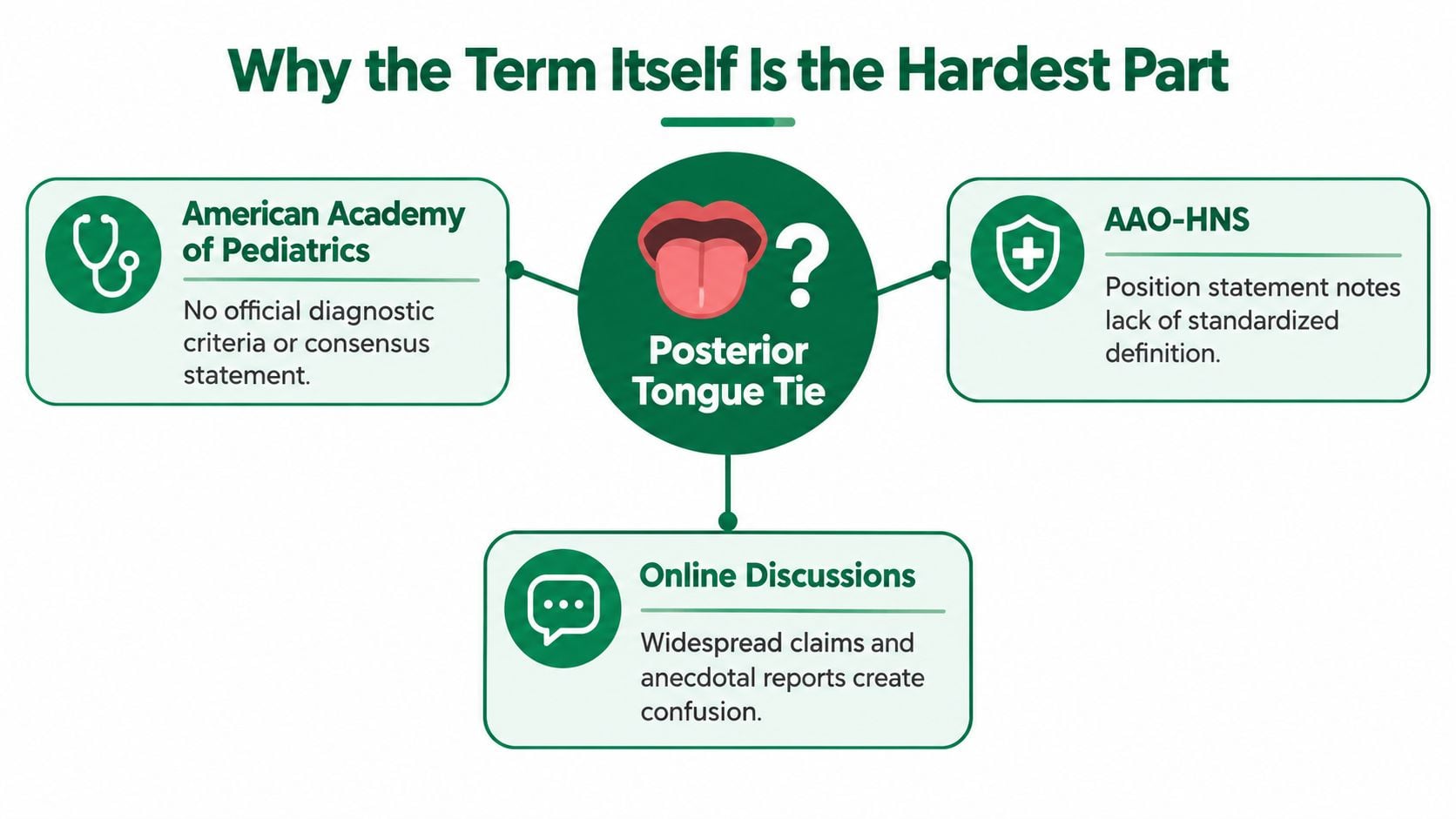
This disagreement is more than a wording problem. When experts cannot agree on what a label means, the label can create a confidence it has not earned. A frenulum works like a shoelace: it can look tight while the shoe still fits comfortably, and it can look perfectly ordinary while the foot barely moves at all. Tissue beneath the tongue follows the same logic, so appearance alone cannot confirm or rule out a restriction that matters.
Appearance and function answer different questions
A visual exam answers one question: where does the tissue appear to attach, and what does it look like? A functional assessment answers another: what can this tongue do? Clinicians consider elevation, side-to-side movement, suction, swallowing, and how feeding is going in practice rather than relying on what they see. A clinical review of ankyloglossia makes the same point, noting that oral frenula vary widely without causing functional problems, and that a diagnosis should connect restricted anatomy to a limitation the clinician can observe. (Clinical review of ankyloglossia)
This distinction keeps the conversation calmer. A label opens a question; it never closes one. When a baby feeds comfortably and grows well, the name attached to the frenulum carries little weight. When feeding or tongue movement is difficult, a careful evaluation looks for the cause and weighs conservative support before anyone discusses a release.
How Clinicians Have Tried to Classify It
A clinic note might call a tie "Type III" or grade it as "moderate," and the wording can sound more conclusive than it really is. Behind those labels sit two grading systems built to describe the lingual frenulum, the fold of tissue that connects the tongue to the floor of the mouth. Both systems record anatomy. Whether the anatomy is limiting the tongue is a question they were never designed to answer.
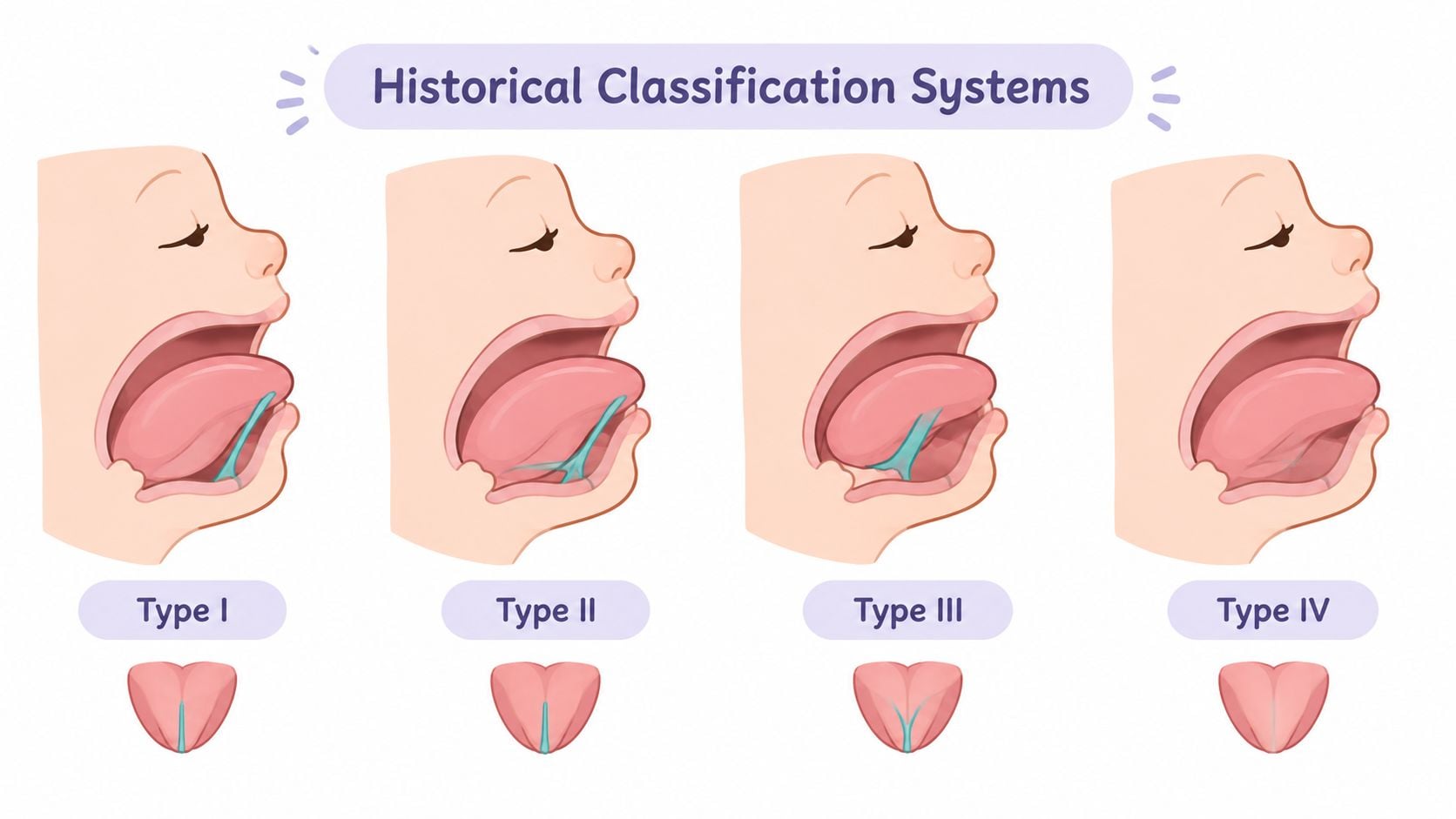
Coryllos describes attachment location
The Coryllos system groups tongue ties by where the frenulum appears to attach along the underside of the tongue. Types III and IV are the categories clinicians most often connect to posterior patterns. Type III generally anchors around the middle of the tongue's underside where it meets the floor of the mouth. Type IV may sit far enough back that it escapes a quick visual exam and shows up only on palpation, when the clinician feels beneath the tongue rather than looking at it.
A Coryllos label answers a geography question: where does the tissue sit? Whether a baby can lift the tongue to the palate, hold suction, or feed without fatigue is a different question, and the letter grade alone can't answer it.
Kotlow describes free tongue length
Kotlow's earlier system grades restriction by a number: the length of the tongue's free portion, the part extending past where the frenulum attaches. Under that scheme, 12–16 mm counts as mild, 8–11 mm moderate, 3–7 mm severe, and under 3 mm complete restriction. (Kotlow's original classification study)
The precision is appealing. A millimeter reading still can't settle whether feeds hurt, whether milk transfers well, or whether a release would change any of it.
Classification labels work like a floor plan: they mark where the walls sit without showing whether someone can move comfortably through the rooms. Two babies can carry the identical label and have completely different feeding experiences, which is why a category works best as a starting point for evaluation.
Why Diagnosis Rates Have Risen So Sharply
A diagnosis rate measures what clinicians do, not how many infants have a problem. That distinction explains most of what happened with tongue tie over recent decades: the term reached more families, more clinicians looked for it, and more procedures followed, while the definition of who qualifies stayed inconsistent.
As noted earlier, reported ankyloglossia diagnoses and frenotomy rates rose nearly tenfold between 1997 and 2012 and then doubled again between 2012 and 2014, according to the AAP clinical report. The same report points out that diagnostic criteria and the evidence for breastfeeding benefit remained limited through that period. Counts of diagnoses and procedures can document growing attention to the condition. They cannot show that the share of infants who needed a release grew at the same pace.
Prevalence depends on how clinicians look
Published estimates of ankyloglossia in newborns range from 4.2% to 10.7% in the clinical overview cited earlier, and the spread reflects real differences in definitions, examination technique, and the populations studied. A systematic review put overall prevalence at about 8% in children younger than one year, and an international summary reported roughly 10% when standardized assessment tools were used, compared with 7% when clinicians relied on visual examination alone.
The method shapes the count.
| Metric | Figure | Source | What it means |
|---|---|---|---|
| Diagnoses and frenotomy rates | Nearly tenfold, 1997–2012 | AAP clinical report | Rates climbed, though the trend alone can't show how many infants needed a procedure. |
| Diagnoses and frenotomy rates | Doubled, 2012–2014 | AAP clinical report | Growth continued while criteria and evidence stayed limited. |
| Newborn prevalence estimates | 4.2%–10.7% | Clinical overview | Different definitions and examinations produce different counts. |
| Prevalence under one year | About 8% | Systematic review | An estimate of how often the label is applied, not how many children need treatment. |
| International prevalence | About 10% with standardized tools; 7% with visual exam | International summary | Assessment method changes what clinicians find. |
Prevalence is not a treatment list. A percentage describes how often clinicians attach the label, while the question that matters for one family is narrower: whether this baby's frenulum limits feeding, and whether a release would change that. Those questions belong to the functional picture, not the diagnosis count.
Functional Symptoms That Actually Matter
A feeding concern becomes more useful to assess when a family can describe what happens during a feed. A baby may repeatedly lose a shallow latch, make clicking sounds, or take a long time to feed without transferring enough milk. A nursing parent may have persistent nipple pain or damage. Poor weight gain calls for prompt attention from the baby's care team, whether or not a tongue tie is suspected.
These signs can raise a question about tongue function, but they don't confirm the cause. A family and clinician need to consider how the baby latches, sucks, swallows, and gains weight together, rather than treating one symptom as a diagnosis.
Symptoms look different across ages
Older children may have restricted tongue elevation or difficulty with particular speech sounds. Adults may seek an evaluation for tongue movement limits, speech concerns, mouth breathing, snoring, or head, neck, or jaw muscle strain that seems connected to swallowing or other compensations. These experiences deserve attention, but none proves that a posterior tongue tie is responsible.
Consider a family who notices that a baby clicks at the breast, slips off the latch, and leaves the nursing parent sore. Those details give a clinician something concrete to observe. If the baby also has trouble gaining weight, that makes timely feeding and medical assessment important. The evaluation still needs to look beyond the frenulum for other contributors.
A useful observation: Note what happens during a feed, how long the difficulty lasts, and whether the baby can stay latched and transfer milk. Specific observations are more informative than the label alone.
Positioning, latch technique, reflux, nasal obstruction, and differences in oral-motor coordination can also affect feeding. Mouth breathing may have several possible contributors as well; families seeking general information can read about mouth breathing and ways to address it. A thorough assessment helps determine whether restricted tongue movement is likely to be part of the problem.
How a Real Assessment Actually Works
A useful evaluation begins with the person's history and the problem they want help with. For an infant, that can include feeding difficulty, weight gain, and maternal nipple pain. The clinician should then observe tongue movement and, when relevant, watch the baby latch and feed. A quick look under the tongue may describe appearance, but it can't answer all those questions.
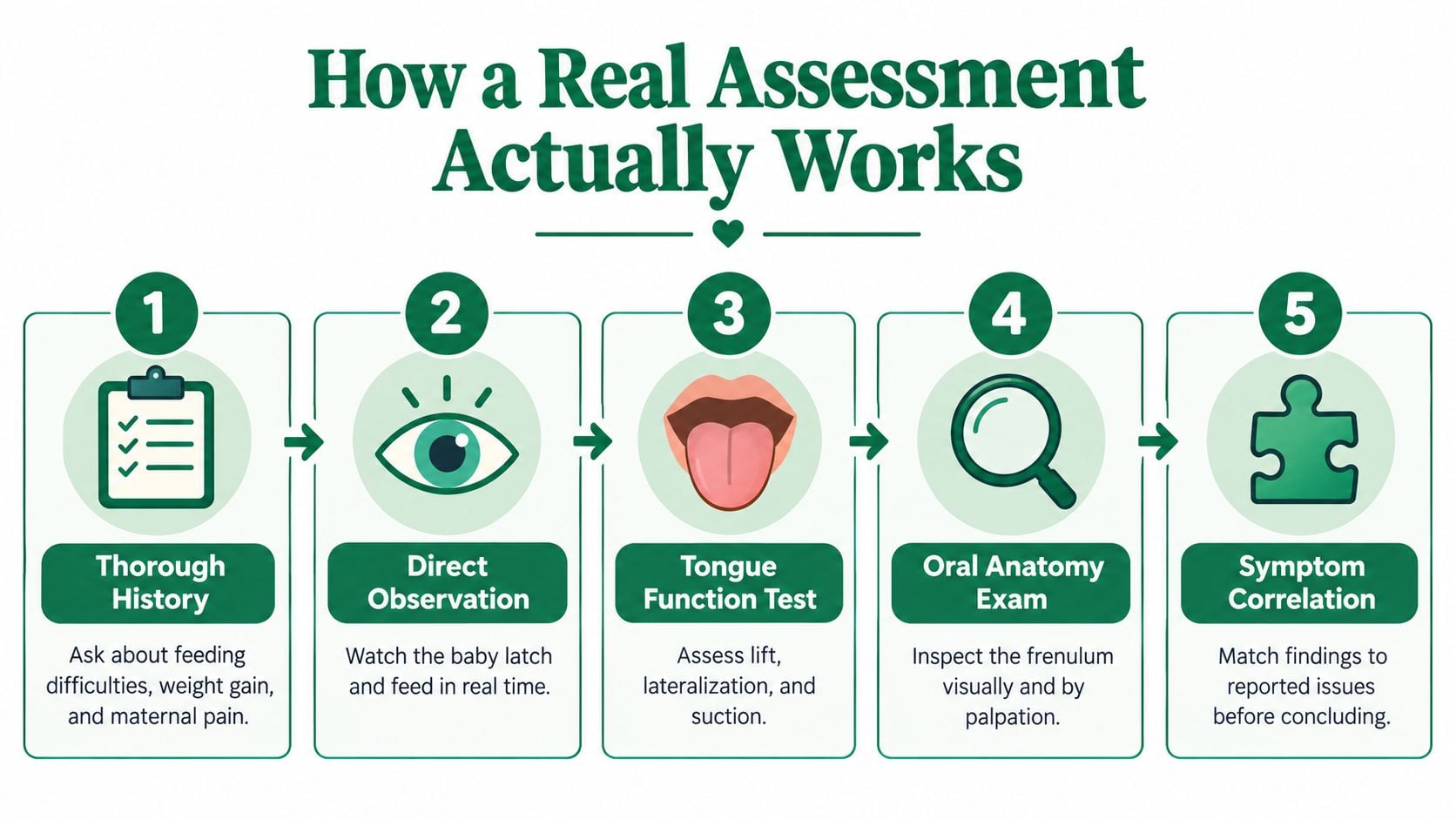
During an examination, a clinician may assess whether the tongue can lift toward the palate, move from side to side, cup during sucking, and extend past the lower gum. They may also consider coordination during swallowing and feeding. The findings matter most when they connect to a reported problem, rather than appearing as isolated observations.
Tools add information, but don't make the decision
The Hazelbaker Assessment Tool for Lingual Frenulum Function is one example of an infant assessment tool. It considers both appearance and function, including the tongue tip, frenulum attachment near the lower gum ridge, tongue lift when the infant opens the mouth, and tongue protrusion. However, commonly used diagnostic tools haven't been validated in large samples as reliable predictors of who will respond to frenotomy. A score can support an assessment, but it shouldn't replace a feeding evaluation and clinical history. (Review of infant ankyloglossia assessment and treatment)
| Assessment approach | What it can show | What it can't establish alone |
|---|---|---|
| Visual check | The visible appearance and apparent attachment of the frenulum | Whether the tongue's function is impaired |
| Scoring tool | Structured observations of selected anatomy and movement | Whether a procedure will improve symptoms |
| Full feeding evaluation | How tongue movement relates to latch, sucking, swallowing, and feeding concerns | The cause of every feeding issue without considering other factors |
For older patients, the same function-first approach applies to the symptoms being evaluated. A clinician can ask how tongue movement relates to the reported difficulty and consider other possible causes. Adults interested in the signs that may prompt assessment can review tongue-tie symptoms in adults. The aim is to understand function and context before discussing treatment.
What to Try Before Any Release Procedure
For an infant with feeding difficulty, a conservative-first plan starts with skilled support for latch and positioning, often with a lactation consultant. That support can make a meaningful difference, and Royal College of Physicians of Ireland guidance reports that latch optimization and positioning support may allow up to 50% of infants diagnosed with ankyloglossia to avoid frenotomy. (Royal College of Physicians of Ireland guidance on tongue tie in infants)

Make the decision with the whole feeding picture
Families can ask what support is available, what changes the care team will track, and when they should check in again. There isn't one timeline that fits every baby. The plan should account for the severity of feeding difficulty and the baby's health, with prompt medical review if weight gain is inadequate or feeding concerns are persistent. Ongoing maternal pain also deserves attention rather than being dismissed as something a parent must tolerate.
Other possible contributors should be considered alongside tongue function. These include nasal or airway obstruction, reflux, prematurity, and craniofacial differences. Finding one doesn't automatically rule out another; the goal is to understand which factors may be affecting feeding and what support is appropriate.
Weigh possible benefits against uncertainty
A randomized trial summarized in an NIH review included 60 breastfed infants with feeding problems and ankyloglossia. Subjective improvement was reported by 78% of mothers in the group offered immediate frenotomy and 47% in the comparison group. But objective observer ratings showed improvement in 50% versus 40%, and that difference wasn't statistically significant. Many families in the comparison group later chose the procedure, which also makes longer-term comparisons difficult. (NIH review of frenotomy evidence)
That evidence supports discussing frenotomy as a possible option for carefully selected symptomatic infants after skilled feeding support. It doesn't show that every infant with a suspected posterior tie needs a procedure, or that a release will resolve every feeding problem. Families can ask what functional limitation was observed, what other causes were considered, what risks and aftercare involve, and what outcome would count as meaningful improvement.
Building a Shared Plan and When to Seek an Evaluation
The label "posterior tongue tie" is contested. Its clinical importance depends on whether tongue function is limited and whether that limitation fits the symptoms. A careful plan starts with a history and functional assessment, includes feeding support and consideration of other causes, then weighs any procedure against its possible benefits and uncertainties.
A laser frenectomy may be considered for carefully selected infants, children, or adults when an evaluation supports it. Outcomes vary, and current evidence doesn't support promises that a release will permanently resolve later speech, sleep, or jaw symptoms. Aftercare is part of treatment planning; families can review post-frenectomy care considerations.
Pain and Sleep Therapy Center serves patients in Newark and Wilmington, Delaware, and Bryn Mawr and the Philadelphia Main Line. The practice's multidisciplinary approach considers tongue function alongside related concerns, with conservative care and collaborative planning part of the discussion. Sleep apnea requires diagnosis through a sleep study and physician evaluation.
If feeding, tongue movement, jaw discomfort, or snoring is a concern, Pain and Sleep Therapy Center offers individualized evaluations and treatment planning, including tongue-tie assessment and consideration of laser frenectomy when appropriate. Request an appointment or take the Sleep Quiz to explore next steps, or call the Newark office at (302) 239-1757.