
If the wound looks closed on day three, is recovery finished? For many families and adults, that question causes the most confusion after a tongue-tie release. Lingual frenectomy recovery isn't judged by appearance alone. Pain, tongue movement, feeding, speech, and comfort matter just as much, and they often change over several weeks. A calm plan helps patients tell normal soreness from signs that need review, without promises that a release alone will fix every related concern.
Table of Contents
- Recovery Timeline From Day One Through the First Month
- Managing Pain, Bleeding and Warning Signs at Home
- Feeding Support for Infants After Release
- Eating, Speech and Oral Care for Adults
- Gentle Oral Exercises and What the Evidence Shows
- Scheduling Follow-Up Care and Next Steps
Recovery Timeline From Day One Through the First Month
How can you tell whether recovery is progressing? Track comfort and everyday function over the weeks after release. Soreness often eases within days, while tongue movement, eating, feeding, or speech may take longer to improve. The area's appearance is only one part of the picture.
Timing varies with the technique, patient age, wound size, and aftercare. A lingual frenectomy releases the lingual frenulum, the band of tissue under the tongue. Swelling and closure of the moist surface tissue are separate healing steps, so they may progress at different rates.
What each stage usually means
| Stage | Typical timing | What is usually seen |
|---|---|---|
| First 24 hours | Day 0 to 1 | Soreness, possible numbness at the tongue tip, light bleeding that slows |
| Pain window | About 3 days in people who have pain | Discomfort that eases day by day |
| Wound healing | 10 to 14 days in published laser case reports | Surface tissue closing; some reports describe healing without sutures |
| Early functional recovery | Often the first 1 to 2 weeks | Tongue lifting and eating may feel easier |
| Complete tissue maturation | Several weeks beyond early recovery | Tissue continues to settle and soften |
| Functional review | Around 1 month, later if symptoms persist | Speech, feeding, and tongue movement checked |
On day one, soreness under the tongue is common. The tip may also feel numb briefly from local anesthetic or tissue irritation. Light oozing can occur; it should slow rather than build. Rest, cool soft foods, and the treating clinician's instructions can guide care during this early stage.
Over the next few days, look for a gradual easing of discomfort. A 2020 diode-laser report involving children and young adults described complete surface healing within 10 days. Another case in the report documented wound healing by 14 days, with reduced pain and swelling and restored tongue mobility.
These are small case reports, so their timelines may not apply to every patient. A deeper or wider release, an older patient, or a different technique may mean healing takes longer. General tips for smoother surgical recovery can help with planning rest, food, and mouth care; follow the treating clinician's instructions for your specific procedure.
Practical rule: Track comfort, movement, eating, and speech over time rather than relying on one check in the mirror.
By weeks one to two, some patients find that lifting the tongue or eating takes less effort. Tissue continues to mature for several weeks after early recovery. Around one month, a functional review can check whether movement gains are holding and whether feeding or speech support is still needed.
Managing Pain, Bleeding and Warning Signs at Home
Soreness is common after a tongue-tie release, and its intensity varies. In a retrospective study of 348 patients who underwent lingual frenuloplasty with myofunctional therapy, 45.1% reported postoperative pain. Among those patients, pain lasted an average of 3.3 days and averaged 6.5 on a 0-to-10 scale. Frenuloplasty involves a more extensive release and repair than a simple cut, so these figures may not predict an individual frenectomy recovery. They can, however, help families plan for several sore days.
The American Academy of Pediatric Dentistry's oral surgery guidance discusses postoperative bleeding and care. Separately, the AAPD summary published on Wiley Online Library reports that some studies found moderate pain averaging 6.5 on a 10-point scale and lasting about three days. For many patients, soreness is most noticeable when the tongue moves and then eases.
Steps for pain control
- Confirm medication instructions: Ask the clinician which pain reliever to use and how much. Acetaminophen and ibuprofen are commonly used when appropriate, following the product directions or the clinician's advice.
- Dose children by weight: Use the child's weight and the product directions or clinician guidance. Do not give aspirin to children or teens.
- Choose soothing foods: Cool, soft foods may feel more comfortable. Avoid hot, sharp, or crunchy foods for several days, since they can irritate the area.
- Track the pattern: Note whether pain is easing each day. A brief written record can help the clinician assess recovery at follow-up.
Following the recommended schedule on the first day may help keep soreness manageable. Do not take extra doses beyond the directions. Patients taking other medicines, and caregivers of infants, should ask the treating clinician or pediatrician for specific advice.
First aid for bleeding
Lightly pink saliva soon after the procedure can differ from steady red bleeding that fills the mouth. If bleeding occurs, stay upright and apply steady pressure.
- Sit upright and stay calm: This makes it easier to apply pressure and see the area.
- Press with clean gauze: Hold clean gauze firmly against the site for several minutes. Avoid lifting it repeatedly to check.
- Get help if bleeding persists: Bleeding that does not stop with firm pressure needs urgent clinical advice.
Sorting warning signs
Complications are uncommon, and the signs below warrant a call. Reported problems can include excessive bleeding, a hematoma (blood collecting under the tissue), infection, scarring, numbness, restricted movement, or reattachment. The right response depends on the symptom.
| Sign | Why it matters | What to do |
|---|---|---|
| Breathing difficulty or noisy breathing | Swelling or a collection under the tongue can affect the airway | Call 911 or go to the nearest emergency department |
| Bleeding that continues or is heavy | Bleeding may persist after the procedure | Apply firm pressure with clean gauze; seek urgent care if it does not stop |
| Rapidly increasing swelling | May signal a hematoma or infection | Seek emergency care if breathing is affected; otherwise call the clinician the same day |
| Fever | May signal infection | Call the clinician promptly |
| Pain that worsens after the first few days | Increasing pain may need review | Call the clinician rather than taking more medicine than directed |
| Persistent numbness or changed sensation | A change in sensation should be assessed | Contact the clinician for advice about when to be seen |
| Tongue restriction that returns | Reattachment or scar tissue may be involved | Request a reassessment visit |
Trouble breathing, bleeding that will not stop with firm pressure, or rapidly growing swelling under the tongue requires emergency care. For fever, worsening pain, or new numbness, contact the treating clinician the same day. If pain or bleeding increases instead of easing, call for guidance rather than adding medication or stretching the wound without instructions. Before leaving the appointment, write the after-hours contact number on the home-care sheet.
Feeding Support for Infants After Release
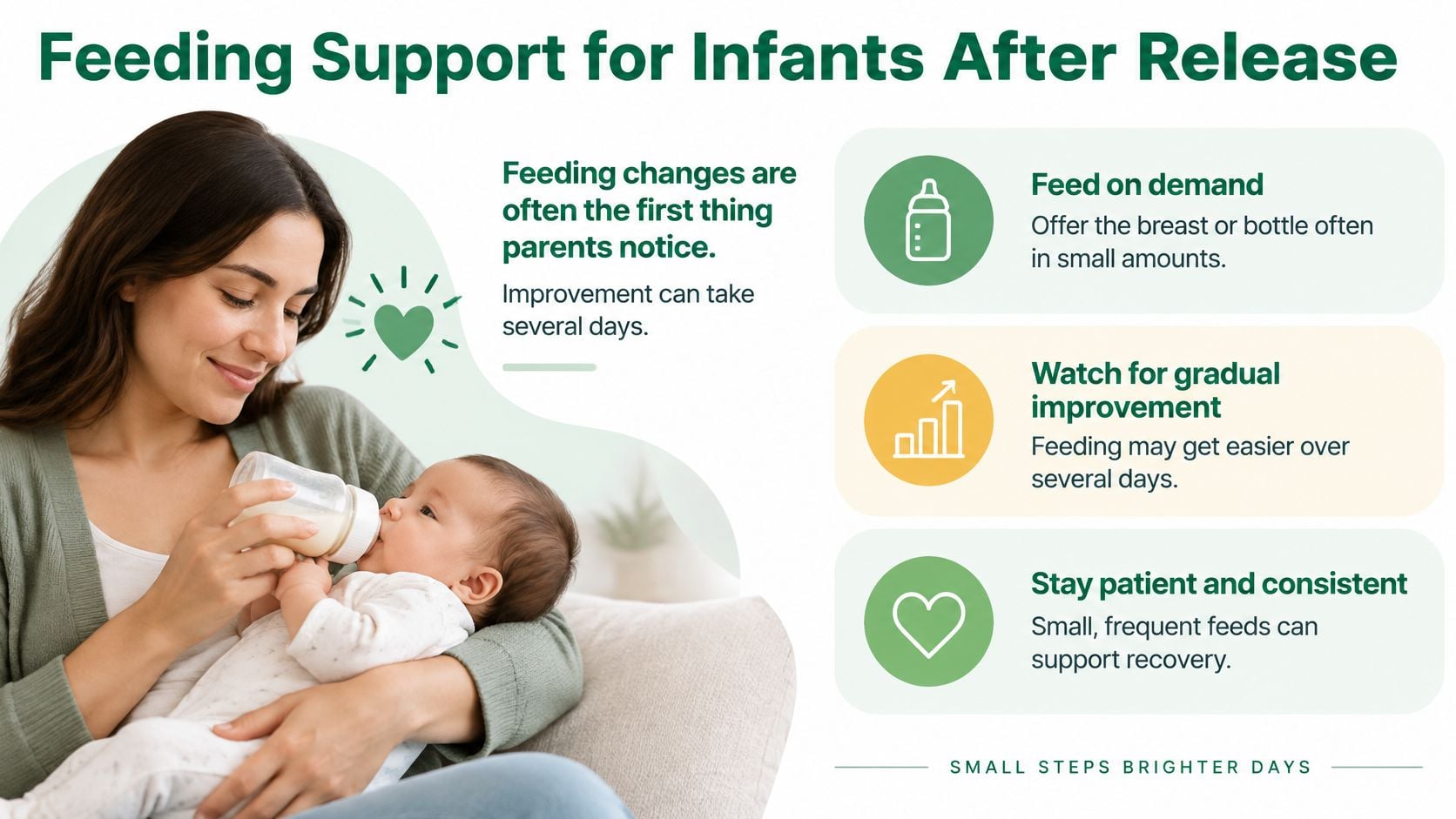
Feeding changes are often the first thing parents notice, and improvement can take several days. A baby has to learn how to use new tongue movement, so the first feed after a release doesn't predict the final result. Some infants latch more comfortably right away. Others need patience, positioning help, and follow-up.
Simple feeding tips for the first days
- Feed on demand: Offer the breast or bottle often in small amounts, following hunger cues rather than a strict clock.
- Check latch and positioning: A feeding professional can adjust positioning if the latch doesn't improve or feeding stays painful.
- Watch for effective feeding: Audible swallowing, a relaxed jaw, and steady weight gain tracked by the pediatrician are useful signs.
- Pace bottle feeds: A paced technique and a nipple suited to the baby's coordination reduce gulping and fatigue.
- Keep feeds calm and short when needed: A tired baby can pause and resume later, rather than pushing through a long, upset feed.
Parents searching online for procedure basics can also find local tongue-tie laser treatment information to understand terms before a visit, but feeding advice still needs to fit the individual baby. At Pain and Sleep Therapy Center, families can review tongue-tie care for infants, children, and adults and ask how feeding support fits into aftercare. Dr. Joanna Green specializes in infant and family oral health, including laser frenectomy and infant tongue tie care.
Warning signs need prompt advice. A latch that stays poor, repeated coughing or choking during feeds, fewer wet diapers, weight loss, or refusal to feed shouldn't be watched for weeks. The pediatrician tracks growth and hydration. A lactation consultant helps with latch and milk transfer. A feeding therapist or speech-language pathologist can assess sucking, swallowing, and oral coordination.
Forceful mouth stretching can make feeding harder by causing pain or oral aversion, which means a baby starts resisting touch near the mouth. Gentle, clinician directed care protects feeding trust. If feeding isn't moving in the right direction within several days, earlier follow-up beats waiting for the routine visit.
Eating, Speech and Oral Care for Adults
Adults often notice eating and speech changes first, and comfort usually returns over days to weeks. The tongue may feel freer but uncoordinated at first. That new movement takes practice, especially after years of compensating with the jaw, lips, or floor of the mouth.
Eating, speaking, and cleaning the mouth
- Start soft and cool: Yogurt, eggs, and room temperature soups are practical first choices.
- Skip irritants for now: Hot, spicy, acidic, or crunchy foods can sting or scrape until the mouth feels comfortable.
- Advance textures gradually: Return to regular foods as comfort allows, pausing if chewing or swallowing causes sharp pain.
- Talk normally as tolerated: Regular speech soon after the procedure helps the tongue use its new range.
- Note tricky sounds: Sounds such as t, d, l, or n may feel different. Mention them at follow-up instead of forcing practice through pain.
- Brush gently: Gentle brushing and rinsing as the clinician directs keep the area clean and support healing.
Older patients may need a soft diet, regular oral hygiene, and pain relievers as needed during early recovery. Adults who want background before a visit can read about tongue-tie symptoms in adults and bring a list of eating, speech, jaw, or sleep concerns to discuss.
Ask the clinician before attempting any mouth stretching. Difficulty swallowing, or speech or eating problems that aren't improving by the functional review, are reasons to contact the treating clinician. Persistent trouble may reflect scar restriction, old movement habits, or a separate speech or swallowing issue that needs its own evaluation.
Gentle Oral Exercises and What the Evidence Shows
How should exercises fit into recovery when the right routine is still uncertain? A healing wound can look different from day to day, but its appearance alone does not show whether tongue function is improving. Recovery is better judged over several weeks by comfortable movement and everyday function.
The American Academy of Pediatric Dentistry frenulum policy page reflects the Australian and New Zealand multidisciplinary consensus position that scientific evidence does not support routine wound stretches. The consensus also warns that stretching may prolong healing and increase the risk of scarring and infection.
Gentle movement directed by the treating clinician differs from forcefully pulling a healing wound apart.
A 2025 systematic review of pediatric ankyloglossia care identified 23 studies, but only three examined whether postoperative care was associated with recovery outcomes. Exercise types, frequency, duration, and intensity varied substantially. As a result, there is no established exercise routine that applies to every age or type of release.
Gentle movements some clinicians prescribe
When a treating clinician recommends movement, it may involve low-force practice such as:
- Tongue tip lift: Raise the tongue tip toward the roof of the mouth and hold briefly.
- Side-to-side slide: Move the tongue gently along the upper teeth from one side to the other.
- Slow jaw opening and closing: Open the mouth within a comfortable range, then close slowly.
- Gentle protrusion: Extend the tongue slightly and bring it back without straining.
Published protocols differ. One reported protocol used three exercise sequences 15 times daily during the early phase. That example describes one protocol, not a routine for families to copy. A clinician's recommendation should account for the person's age, wound, comfort, and functional goals.
Coordinated, comfortable movement is the goal, and tissue should not be pulled apart. Stop an exercise if it causes sharp pain, bleeding, or swelling, and contact the treating clinician for guidance. For infants, parent-led movements should be discussed with the clinician because babies cannot describe discomfort, and repeated distress may interfere with feeding.
A speech-language pathologist or myofunctional therapist can help retrain movement patterns when needed. Myofunctional therapy teaches tongue placement, nasal breathing, and chewing and swallowing patterns. Evidence on postoperative exercises remains limited, so progress should be judged over weeks by function rather than by how the wound looks on a single day.
Scheduling Follow-Up Care and Next Steps
A wound's appearance on day three cannot show whether tongue movement will keep improving. Recovery is better judged by function over the following weeks: whether elevation, protrusion, feeding, speech, or swallowing are becoming easier, depending on the reason for treatment.
Changes in movement can relate to scar formation, tissue stiffness, or learned movement patterns. A small five-patient diode-laser case series reported reattachment or adhesion in one patient at six months, despite satisfactory early healing. That finding illustrates why a later review may be useful if restriction returns, but it does not establish how often reattachment occurs.
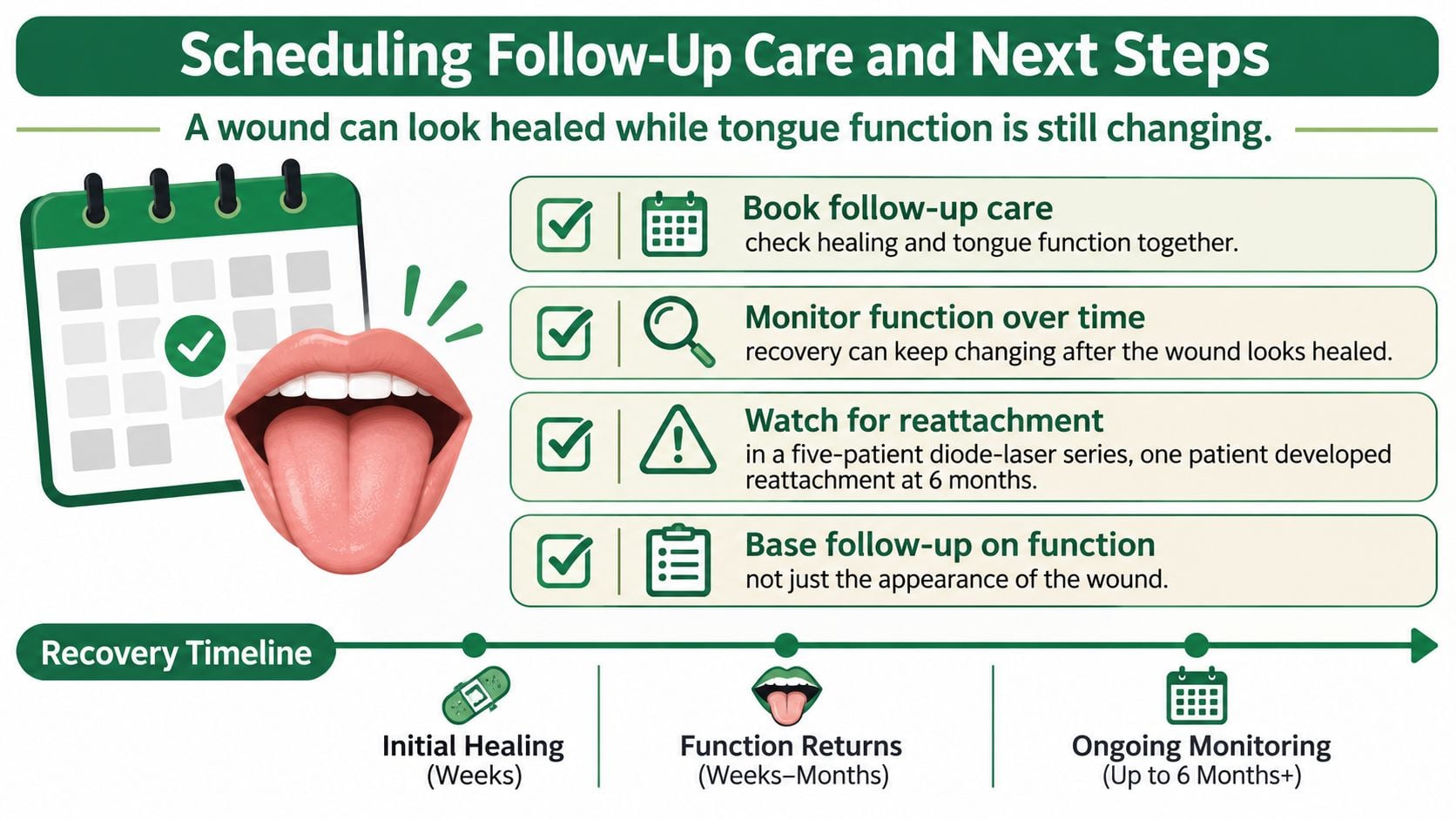
Follow-up commonly includes a visit around one to two weeks, another around one month, and further review if symptoms persist. Ask the treating clinician which schedule fits your situation, and record the appointments before leaving. For more on anatomy that can affect tongue movement, see this guide to posterior tongue tie.
At follow-up, the clinician may assess:
- Movement: Tongue elevation, protrusion, and side-to-side motion.
- Comfort: Changes in pain, floor-of-mouth comfort, or numbness.
- Function: Feeding, speech, and swallowing, as relevant to the patient.
- Restriction: Scar-related tightness or loss of movement gained earlier.
Care may involve the clinician who performed the release and, depending on the patient's needs, a pediatrician, speech-language pathologist, myofunctional therapist, or lactation consultant. A frenectomy by itself may not resolve sleep apnea, jaw pain, or speech difficulties. Snoring and daytime fatigue warrant assessment for sleep-disordered breathing rather than assumptions about the cause.
Pain and Sleep Therapy Center evaluates tongue ties alongside sleep disorders and craniofacial pain, with care focused on individual needs and coordinated options. Patients can request an appointment to discuss evaluation and follow-up.