
Pushing a painful jaw sideways until it clicks isn't a safe way to restore alignment. For someone searching for how to realign jaw problems, the safest starting point is finding out what feels wrong: overworked muscles, a moving joint disc, a changed bite, or a sleep-breathing concern. Comfort and function matter more than a straighter-looking bite, and each category calls for a different response.
Table of Contents
- What a Misaligned Jaw Usually Means
- How Clinicians Check the Jaw Before Changing It
- Safe Home Steps That May Ease Jaw Strain
- How Orthotic Therapy Is Used and Watched
- Moves and Dental Changes That Can Backfire
- When to Book a TMJ Evaluation and Follow Up
What a Misaligned Jaw Usually Means
The feeling of a misaligned jaw can come from several different problems, and each calls for a different safe response. Soreness, clicking, uneven tooth contact, or facial asymmetry may feel like one issue, but they do not point to a single cause. The first step is to match the symptom to a likely category, such as muscle overload, a disc problem, a bite change, or sleep-related strain.
What feels misaligned and the safe first step
| What you notice | Likely category | Safe first step | Avoid |
|---|---|---|---|
| Ache after chewing, clenching, or gum | Muscle-related TMD | Softer foods, jaw rest, heat or cold | Forcing the jaw or grinding teeth |
| Click or pop without locking or severe pain | Disc movement that may be stable | Track pain and opening; get checked if it worsens | Ignoring new pain or reduced movement |
| Locks open or closed, or opening drops sharply | Joint dysfunction or disc displacement | Same-day professional exam | DIY manipulation |
| Bite suddenly feels different | Occlusal change or joint inflammation | Stop new devices and get an exam | Crowns or orthodontics for pain alone |
| Snoring, gasping, or unrefreshing sleep with jaw pain | Possible sleep-disordered breathing plus TMD | Ask a physician about a sleep study | A store-bought device that pulls the jaw forward |
| Trauma, swelling, fever, numbness, or unexplained weight loss | Red flag | Urgent medical or dental care | Any home realignment |
These categories guide what to consider, but they are not diagnoses. Temporomandibular disorders, or TMDs, include more than 30 conditions affecting the jaw joints, chewing muscles, or both, according to the National Institute of Dental and Craniofacial Research. The institute estimates that TMD affects approximately 5%–10% of the U.S. population and is at least twice as common in women as in men.
The temporomandibular joint, often called the TMJ, sits just in front of each ear. TMD refers to disorders involving the joint area, while TMJ names the joint itself. Everyday conversation often uses the terms interchangeably, which can make treatment descriptions confusing.
Similar symptoms can have different causes
An ache after prolonged gum chewing may reflect muscle overload rather than a change in jawbone position. Muscles may also tighten around a painful area to protect it, a response called guarding. That tension can change how opening or closing feels. Dental malocclusion, meaning teeth that do not meet in their usual intended relationship, and differences in jawbone structure need separate assessment.
A click without pain or restricted movement may be a sound to monitor. Locking matters more because it limits function. Learning about possible causes of jaw locking can help clarify why a lock is different from an occasional click.
For clenching-related soreness, the ways to reduce teeth grinding can help identify habits to discuss during an evaluation. Noticing a habit can guide the conversation, but it does not establish the cause of nighttime grinding.
Snoring with gasping or unrefreshing sleep alongside jaw pain may point to a sleep-breathing concern. Sleep apnea is diagnosed with a sleep study, and jaw appearance cannot substitute for one.
How Clinicians Check the Jaw Before Changing It
A useful evaluation answers a practical question: What is driving the symptoms? The possibilities include chewing-muscle pain, joint pain or arthritis, disc displacement, a true skeletal bite difference, or mixed causes.
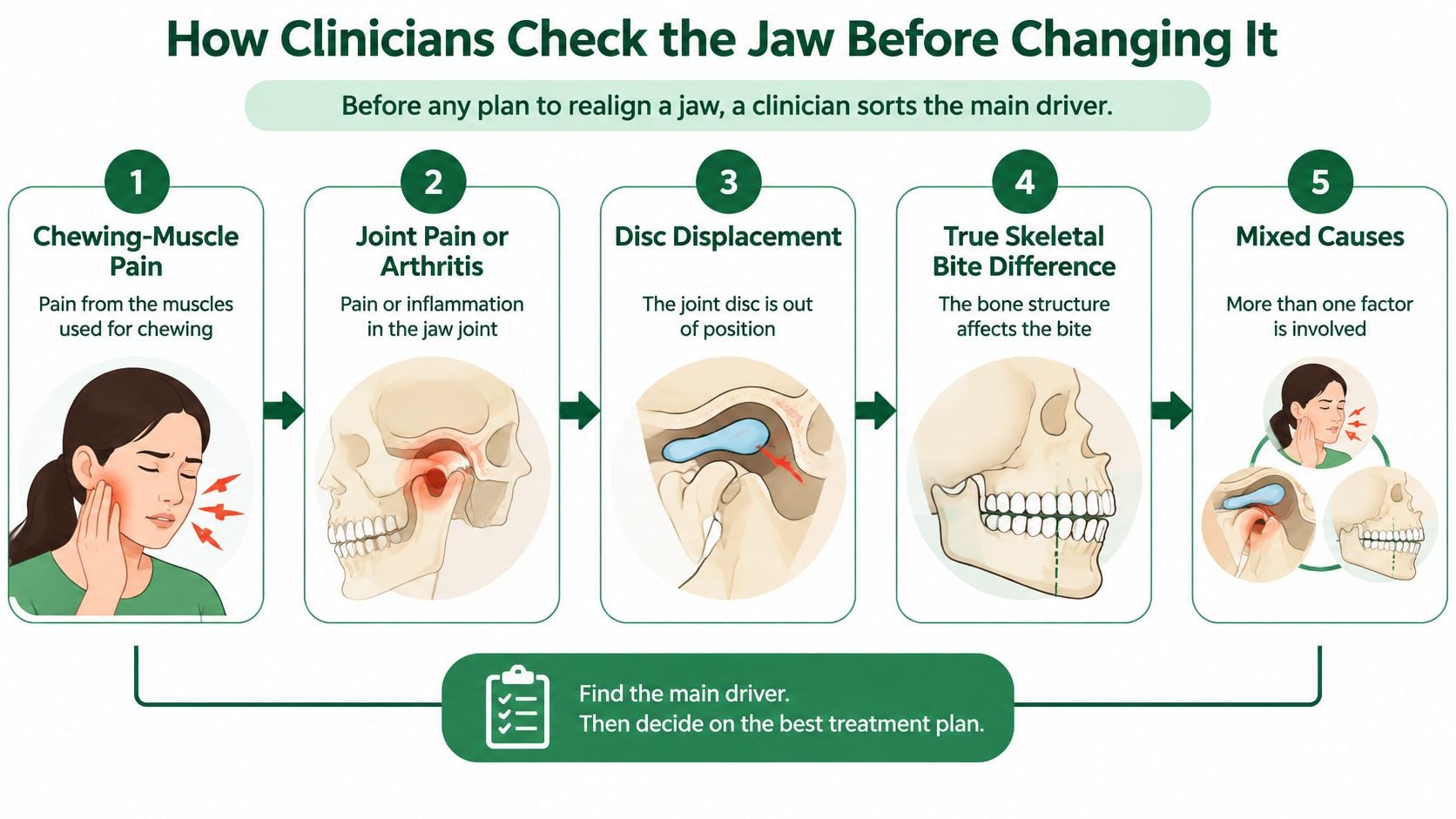
The National Academy of Medicine's clinical pathway for TMD care emphasizes history and physical examination rather than assuming that a visible bite difference proves the source of pain. The visit is an investigation, not a commitment to reposition the jaw.
The examination in plain language
Review the pattern. The clinician asks about pain, locking, headaches, injury, recent dental work, clenching, and sleep symptoms. Whether discomfort begins with chewing, develops on waking, or follows an injury helps guide the examination.
Check muscles and joints. Gentle palpation, meaning examination by touch, identifies tenderness in the chewing muscles and around the joints. Joint sounds and vibrations are also assessed, but a sound isn't interpreted separately from pain and movement.
Measure movement. Range of motion includes comfortable opening and side-to-side movement. The clinician notes whether the jaw shifts during opening or remains off to one side, rather than asking the patient to force a straight path.
Examine tooth contact. The bite is checked for changes, wear, and dental problems. A deep bite, in which the upper front teeth excessively overlap the lower front teeth, may deserve a dental assessment without being the explanation for facial pain. Paul L. Gregory, DDS's discussion of clinical evidence for deep bite correction addresses a distinct bite-correction question, not proof that orthodontics treats TMD.
Choose imaging for a reason. Routine imaging generally isn't necessary for uncomplicated early TMD. Magnetic resonance imaging, or MRI, can assess soft tissues such as the joint disc; computed tomography, or CT, assesses bone. Testing becomes useful when suspected trauma, inflammatory disease, progressive dysfunction, or surgical planning could change care.
Screen sleep and breathing. Gasping, snoring, and unrestful sleep may prompt physician-directed testing. Polysomnography is an overnight sleep study; an appropriate home sleep apnea test may be another option.
How the center approaches diagnostic testing
Pain and Sleep Therapy Center uses patient history and interview, physical examination, range of motion, joint sounds or vibrations, and joint hard-tissue images to evaluate TMJ disorders. Some cases also require sleep diagnostics or hospital-based soft-tissue diagnostics.
A three-dimensional cone beam computed tomography scan, called CBCT, is frequently needed in the center's diagnostic process, and patients may be referred to a diagnostic imaging center. That practice-specific need doesn't mean every person with an early, uncomplicated jaw complaint requires a scan.
A useful testing question: What finding would change the treatment decision?
Safe Home Steps That May Ease Jaw Strain
Home care may reduce strain while an assessment is arranged. It doesn't establish a diagnosis or physically reset a joint, and worsening symptoms are a reason to stop rather than stretch harder.
The NIDCR guide to keeping TMD treatment conservative.pdf) favors simple measures before treatments that permanently alter teeth or enter the chewing muscles or joints. A conservative trial is active care: it changes aggravating habits while preserving options.
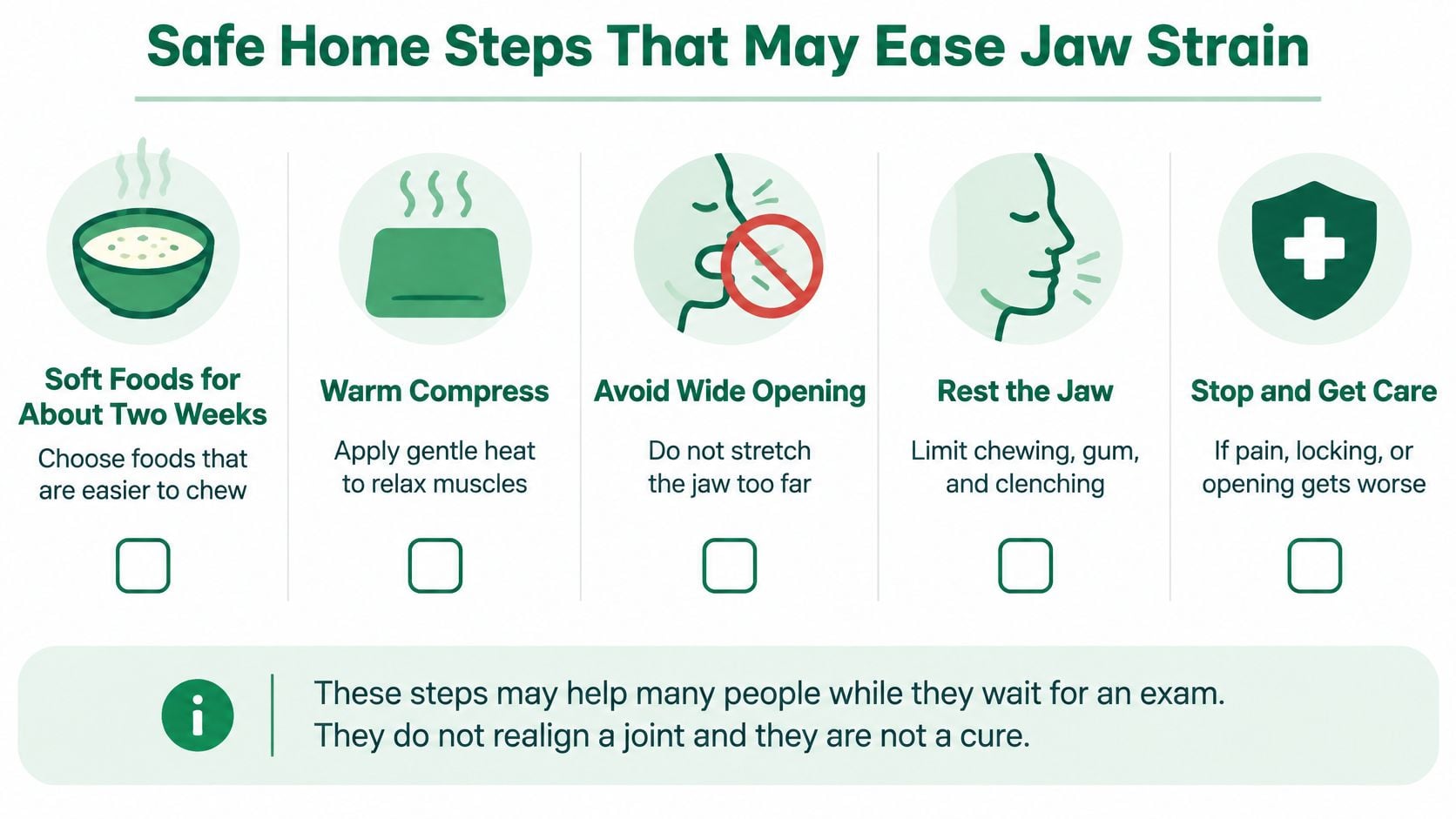
A gentle routine matched to muscle strain
Reduce chewing load temporarily. Softer choices such as eggs, oatmeal, cooked vegetables, and tender fish require less effort than chewy bread or tough meat. Smaller pieces also reduce the need for wide opening. The unsafe slip is continuing gum chewing, nail biting, or repeated wide-open yawns while expecting sore muscles to settle.
Make screen-time posture comfortable. A screen near eye level and relaxed shoulders may help avoid sustained neck and jaw tension. Teeth should rest apart, with the tongue resting gently rather than pressing hard against the palate. Nasal breathing should remain comfortable; forcing the lips shut when the nose is blocked isn't an appropriate exercise.
Use gentle warmth or a protected cold pack. Moist heat may feel soothing over aching chewing muscles, while cold may feel better during a brief joint flare. A cloth barrier protects the skin, and the application should stop if it causes burning, marked numbness, or increased discomfort. Neither treatment should be used to postpone assessment of swelling or fever.
Practice only clinician-taught movement. A dentist or physical therapist can demonstrate controlled opening or stretching appropriate to the diagnosis. Movement should stay within the prescribed comfortable range. Levering the jaw with fingers, chasing a click, or pushing through sharp pain turns a gentle exercise into an unmonitored manipulation.
Notice daytime tooth contact. During concentrated work, some people discover that their teeth remain pressed together. A reminder near the screen can prompt relaxed shoulders and separated teeth without repeated jaw checking. Constantly testing whether the bite feels even can itself keep the muscles busy.
Check medication safety. An over-the-counter pain reliever or anti-inflammatory may be appropriate after review by a physician or dentist. Other medicines, stomach problems, kidney disease, and other health conditions can affect that choice. Taking extra doses to tolerate painful exercises isn't a safe substitute for changing the routine.
Compare function rather than appearance. Useful changes include easier chewing, less morning soreness, and more comfortable opening. A clinician can set the reassessment point rather than leaving self-care open-ended. Continuing an ineffective routine indefinitely can delay a more useful evaluation.
For soreness centered in the masseter, the large chewing muscle along the side of the jaw, guidance on relaxing the masseter muscle can support awareness. Deep pressure over a painful area isn't automatically better than gentle care.
Stop rules during home care
| Change you notice | What to do |
|---|---|
| Pain or opening gets worse during the trial | Stop the routine and book an exam |
| Locking or a sudden bite change | Same-day professional exam |
| Swelling, fever, or numbness | Urgent medical or dental care |
| Pain eases and chewing improves | Continue, then reassess after the trial |
Less discomfort during normal meals is a more useful sign of progress than a jaw that looks centered in a photograph.
How Orthotic Therapy Is Used and Watched
A jaw appliance should have a defined purpose, a review point, and clear instructions about when to stop. Orthotic therapy means treatment with a supportive appliance; the name alone doesn't indicate whether the device is intended for muscle loading, tooth protection, or sleep breathing.
A stabilization splint is a removable plastic appliance worn over the upper or lower teeth. A clinician may consider it when clenching or muscle overload contributes to symptoms, but its use should be a monitored trial rather than a promise of structural correction.
The NIDCR patient guide to TMJ disorders describes evidence for splint-related pain relief as inconclusive and advises that an appliance shouldn't permanently change the bite. Increased pain or a change in how the teeth meet calls for stopping the device and contacting the treating clinician.
Different appliances have different jobs
Three jaw treatments and how they differ
| Option | Purpose | Evidence stance | Who directs it | Main risk |
|---|---|---|---|---|
| Stabilization splint | Short trial to reduce loading | Pain relief evidence inconclusive | Dentist with TMJ training, with fit checks | Bite change or more pain if unmonitored |
| Grinding teeth, crowns, or braces for ordinary TMD | Intended permanent bite change | Not supported as routine TMD care | Should not be the default | Loss of healthy tooth material with some procedures, or worsening symptoms |
| Custom adjustable oral appliance | May help confirmed obstructive sleep apnea | Supported for selected adults as a CPAP alternative | Physician diagnoses apnea; qualified dentist fits and follows | Bite side effects or ineffective treatment without appropriate testing |
The distinction matters when exploring non-surgical TMJ treatment. An appliance's appearance doesn't establish its purpose, and wearing a nighttime device doesn't mean breathing has been assessed.
Pain and Sleep Therapy Center regards nighttime appliances as a hallmark maintenance approach for TMJ care. The center also cautions that an appliance not designed to control sleep apnea can, in some patients, double apnea severity. Its clinical information reports that greater than 60% of patients with TMJ issues have obstructive sleep apnea; that figure shouldn't be treated as an individual diagnosis or a universal prevalence estimate.
Sleep testing comes before apnea treatment
Obstructive sleep apnea, or OSA, involves repeated upper-airway obstruction during sleep. A physician establishes the diagnosis using a sleep study, not snoring alone.
The American Academy of Sleep Medicine's oral appliance guideline supports custom, titratable appliances for selected adults with confirmed OSA who prefer an alternative to continuous positive airway pressure, or CPAP, cannot tolerate it, or haven't responded adequately. Titratable means gradually adjustable for comfort and treatment effect.
CPAP remains a standard treatment option. Dental fit checks and physician follow-up address different safety needs, while follow-up sleep testing verifies whether an oral appliance controls the breathing disorder. More advancement isn't automatically better, and an appliance that misses its goal calls for reassessment rather than endless adjustment.
Moves and Dental Changes That Can Backfire
Permanent changes to how teeth meet deserve particular caution. A 2003 Cochrane review of six randomized trials involving 392 patients found no randomized-trial evidence that occlusal adjustment treats or prevents TMD, and concluded it could not be recommended for that purpose.
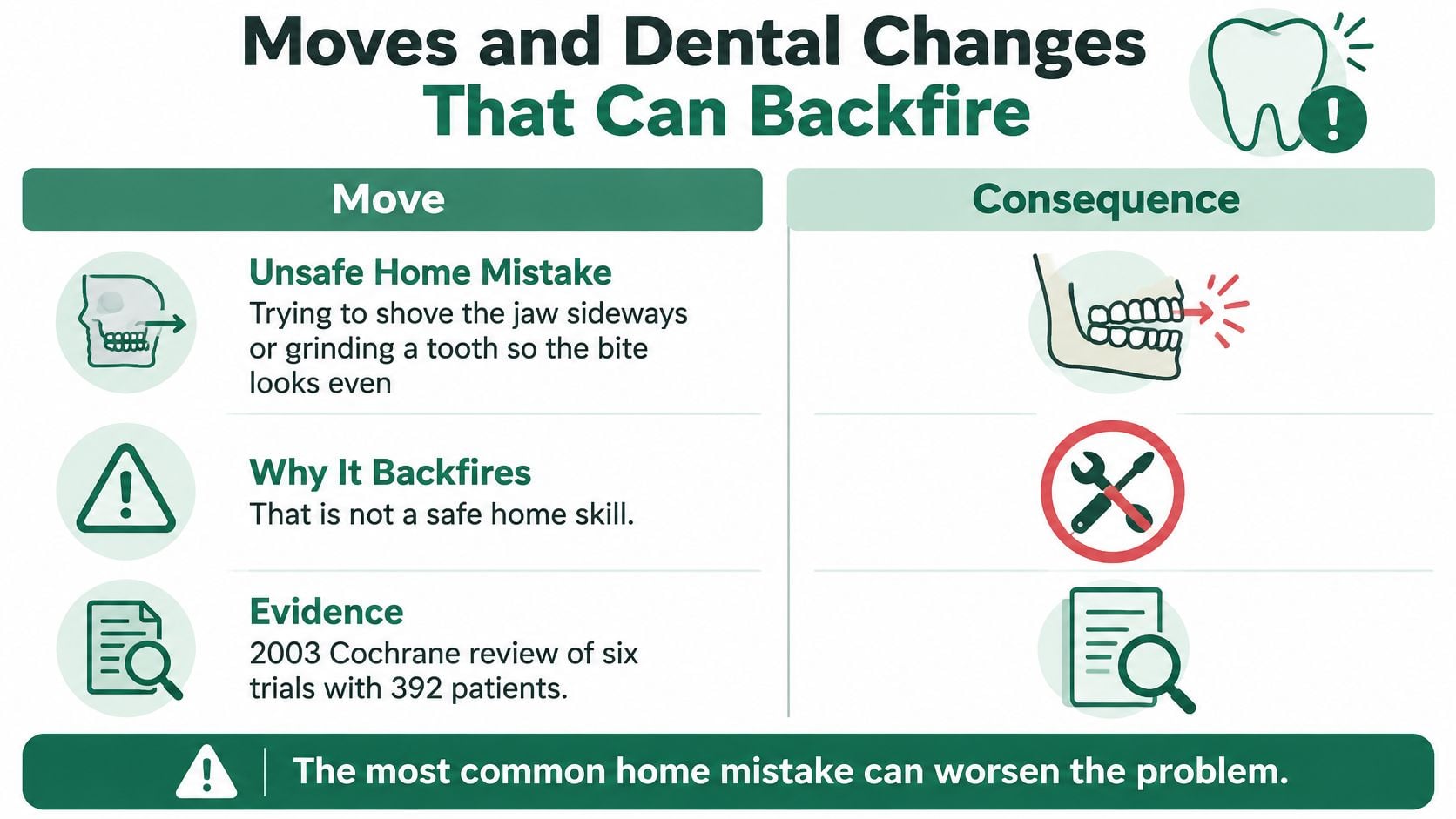
Occlusal adjustment is the selective grinding or reshaping of tooth surfaces to change how they meet. Because removed tooth material cannot grow back, the result is permanent. It may also leave the original source of discomfort untouched. Muscle overload, joint-disc problems, and sleep-breathing concerns call for different assessment and care; changing tooth contacts does not identify which category is involved.
Orthodontics, crowns, and jaw surgery can have a role for separately diagnosed dental or skeletal conditions. The key is matching the procedure to a specific diagnosis and explaining why it is expected to improve comfort or function, rather than treating a straighter-looking bite as proof that ordinary TMD pain has been addressed.
Before an irreversible procedure, ask for a clear explanation of:
- The diagnosis being treated. The explanation should identify the problem, rather than rely only on a general claim that the jaw is misaligned.
- The expected functional benefit. Easier eating or improved movement is a clearer goal than an unspecified ideal jaw position.
- Alternatives and uncertainties. A second opinion is reasonable when a proposed treatment changes the teeth or joint permanently.
- What happens if treatment stops. A removable trial and tooth reshaping leave very different options if symptoms worsen.
Escalation needs a reason
The NIDCR treatment summary for TMDs places invasive joint treatments after nonoperative options have not worked, with decisions guided by diagnosis, risks, and expected benefit. Arthrocentesis flushes a joint; arthroscopy uses a small instrument to examine or treat its interior. These procedures are not automatic next steps after an unsuccessful home exercise.
There is no single success rate for jaw realignment across different disorders. A more useful measure is whether the chosen care improves comfort and function without creating an unwanted bite change.
A safety boundary: A clinician-directed procedure for a confirmed problem is different from attempting to reproduce it at home.
Progressive locking, markedly restricted opening, trauma, swelling, fever, neurological changes, or unexplained weight loss warrant prompt assessment. Continued manipulation could delay care for a problem that is not routine muscle strain.
When to Book a TMJ Evaluation and Follow Up
A jaw that feels out of line may reflect muscle overload, a joint-disc problem, or sleep-related breathing issues. The right next step depends on the symptom pattern, so arrange an evaluation when jaw pain persists, headaches repeatedly accompany jaw activity, or your bite changes. For other stop rules, see the previous section.
Preparing for a useful appointment
A brief symptom log helps make the history specific. Describe ordinary activities, rather than repeatedly testing movements that provoke pain.
- Pain pattern. Note whether discomfort occurs on waking, during meals, after concentrated work, or at bedtime.
- Comfortable movement. Record whether opening feels easier or harder, without forcing a maximum stretch.
- Food tolerance. List foods that have become difficult to chew and whether you avoid one side.
- Habits and sleep. Include noticed clenching, reported grinding, snoring, gasping, and morning headaches.
- Current care. Bring a medication list, any oral appliance, and relevant prior imaging or reports when available.
Dr. Ryan Robinson, who leads Pain and Sleep Therapy Center, is triple board-certified in craniofacial pain and dental sleep medicine. Craniofacial pain involves the head, face, and related structures, not only the jaw joint.
Follow-up should answer whether care is helping
At follow-up, compare pain, opening, chewing tolerance, and appliance effects with your starting point. A device that raises new bite concerns needs review, even if another symptom has improved.
Treatment plans may include orthotic therapy, cold laser therapy, lifestyle modifications, and collaborative care with healthcare professionals. The center evaluates the likely causes before selecting care, and when an oral appliance does not meet treatment goals, it supports patients in obtaining other effective therapies. Any consideration of surgery calls for discussion of the diagnosis, expected benefit, and risks. The aim is care matched to the problem and your goals.
Results vary, and no treatment can promise complete relief. Pain and Sleep Therapy Center has offices in Newark, DE, and Bryn Mawr, PA.
The center offers root-cause evaluation of jaw, head, and facial pain, with conservative care and coordinated sleep assessment when indicated. Visit Pain and Sleep Therapy Center to Request an Appointment. Its triple board-certified leadership, conservative approach, and follow-up for oral appliances can help guide care over time. If you have snoring or unrefreshing sleep, Take our Sleep Quiz as a screening step, not a substitute for a physician's diagnosis.