
An ache under the right ribs interrupts dinner. Or a sore jaw, tight neck, and aching shoulder are still present after waking. The discomfort may be easy to locate, but deciding whether it comes from a muscle, an organ, a nerve, or somewhere else isn't as simple.
Right-sided pain deserves a careful explanation, not a diagnosis based on a body map. The safest starting point is to check for warning signs, then consider the exact location, timing, triggers, and symptoms that travel with it.
Table of Contents
- Red Flags That Need Urgent Care Today
- Causes of Right-Side Pain by Body System
- What Location, Timing and Triggers Reveal
- Jaw, Neck and Muscle Sources That Refer Pain
- When Breathing During Sleep Plays a Role
- Safe Self-Care Steps While You Wait for Care
- Which Specialist and Tests to Expect
- Book an Evaluation If Right-Side Pain Keeps Returning
Red Flags That Need Urgent Care Today
Sudden one-sided weakness, facial droop, or trouble speaking calls for 911 right away. Pain accompanied by these symptoms can signal a stroke. Treatment is time-sensitive, so waiting for the pain to settle or arranging a routine appointment isn't appropriate.
A peer-reviewed review of posterior-circulation stroke reports that these strokes account for approximately 20%–25% of acute strokes and describes a 2012 registry of 207 patients in which dizziness occurred in 47%, one-sided limb weakness in 41%, and dysarthria, meaning difficulty speaking clearly, in 31%. Posterior-circulation strokes affect the brain's back circulation, so balance, vision, and coordination problems can be important clues.
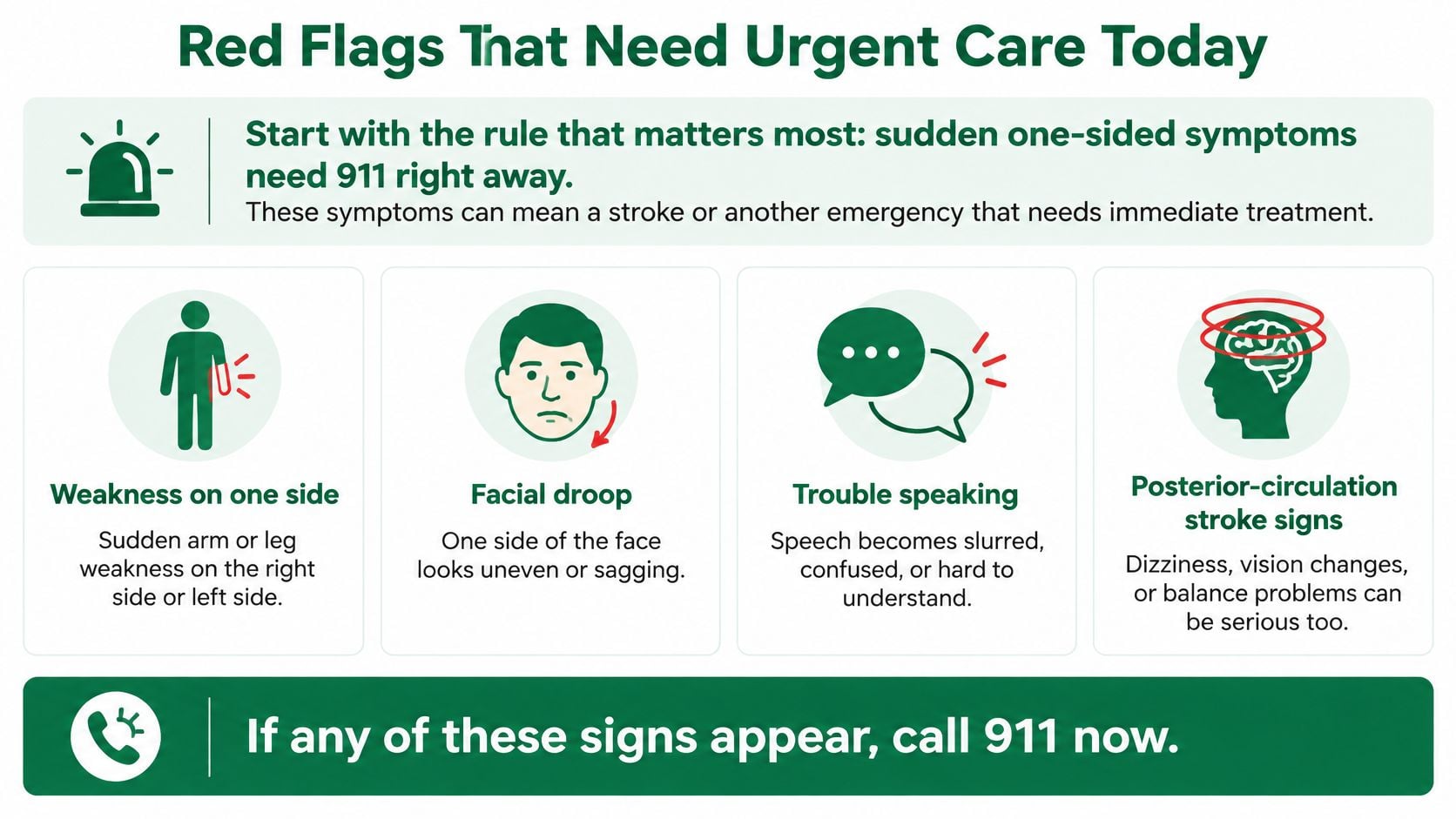
Warning signs and the right level of care
| Warning sign | Why it matters | Action |
|---|---|---|
| Facial droop, arm or leg weakness, trouble speaking | Possible stroke | Call 911 now |
| Sudden vision change or severe dizziness with imbalance | Possible stroke or other brain-related cause | Call 911 now |
| Sudden severe pain that peaks within minutes | May signal a serious organ problem | Emergency care now |
| Fever with severe belly pain or a rigid, tender abdomen | Possible infection or inflammation needing surgery | Emergency or same-day evaluation; emergency care for severe pain or rigidity |
| Repeated vomiting or unable to keep fluids down | Dehydration or possible blockage | Same-day urgent care |
| Fainting, confusion, pale or clammy skin | Possible shock or severe blood loss | Call 911 now |
| Blood in stool, vomit, or urine | Possible bleeding | Emergency care now |
| Chest pain, pressure, or shortness of breath | Possible heart or lung cause | Call 911 now |
| One-sided pelvic or belly pain with possible pregnancy | Possible ectopic pregnancy | Emergency evaluation now |
| Pain steadily worsening over hours | Condition may be evolving | Same-day evaluation |
| Unable to pass urine, stool, or gas | Possible obstruction | Emergency care now |
An ectopic pregnancy is a pregnancy growing outside the uterus. It can cause internal bleeding and needs emergency assessment, even when pregnancy hasn't yet been confirmed.
These stroke figures don't mean most right-sided pain is caused by stroke. They establish a safety rule for sudden one-sided neurological symptoms, meaning symptoms involving brain or nerve function.
Practical rule: A warning sign doesn't need a confirmed diagnosis before emergency action is appropriate.
Someone with suspected stroke, fainting, or serious chest symptoms shouldn't drive. Emergency responders can begin assessment and arrange safe transport.
Causes of Right-Side Pain by Body System
Right-sided pain is a location, not a diagnosis. Muscles, nerves, abdominal organs, reproductive organs, and structures in the chest can all produce discomfort on the right, while pain from another area can be felt there.
The American Academy of Family Physicians review of acute abdominal pain describes a large study in which 20 conditions explained up to 70% of recent abdominal-pain cases, but clinicians identified more than 150 possible causes. That range makes a symptom table a map for evaluation, not a verdict.
Possible causes of right-side pain by body system
| Body system | Common examples | Typical pattern | Key differentiator |
|---|---|---|---|
| Musculoskeletal | Muscle strain, rib injury, costochondritis | Aching that shifts with movement and can reproduce on pressure | Pain changes with posture or twisting |
| Neurological | Nerve irritation, shingles | Burning, tingling, or band-like pain | A rash on the same side supports shingles |
| Gallbladder and liver | Gallstones, gallbladder inflammation | Pain under the right ribs, often after fatty meals | Upper right location with nausea |
| Appendix and bowel | Appendicitis, constipation | Appendicitis may start near the navel and move lower right; constipation more often causes cramping | Appendicitis pain may worsen with coughing, walking, or pressure |
| Kidney and urinary | Kidney stone, urinary tract infection | Stones may cause colicky flank pain radiating to the groin | Painful urination, blood in urine, or fever |
| Reproductive | Ovarian cyst, ectopic pregnancy | Lower right pain, sometimes sudden | Possible pregnancy changes the urgency |
| Lung and pleura | Pneumonia, pleurisy | Sharp pain with breathing or coughing | Cough, fever, or shortness of breath |
| Referred | Jaw joint problems, shoulder conditions | Pain felt away from where it starts | Jaw movement or pressure may change the pain |
Costochondritis means inflammation of the cartilage joining ribs to the breastbone. Colicky pain comes in waves; the flank is the side between the lower ribs and hip. The pleura is the thin lining around the lungs.
The abdominal pain clinical guide distinguishes groin-radiating urinary pain from prolonged severe pain beneath the right ribs and emphasizes that warning signs matter more than the side alone. Pain that changes with movement can suggest a muscle source, but that feature doesn't rule out an internal problem.
For older adults whose symptoms appear centered on joints and movement, Thermo Recovery Wear's joint pain guidance for older adults offers additional reading about back and knee discomfort. It isn't a substitute for assessing new abdominal, chest, or neurological symptoms.
The useful distinction is the combination: where pain occurs, what changes it, and which other symptoms accompany it.
What Location, Timing and Triggers Reveal
Consider someone who first notices vague discomfort near the belly button. Over several hours, the discomfort moves into the lower right abdomen, becomes stronger, and hurts more during walking or coughing. Location alone says little. The sequence says a great deal.
That migrating, worsening sequence matches the pattern the NHS appendicitis guidance describes as typical of appendicitis, though not every person develops it. The broader lesson applies well beyond the appendix: how pain moves, builds, and responds to activity often matters more than where it sits at any single moment.
Details worth recording
A short symptom log helps a clinician reconstruct the sequence without relying on memory. This list is the record worth keeping and bringing to any appointment.
- Starting point and travel: The exact spot where pain began, where it is now, and whether it spreads toward the back, groin, shoulder, or face.
- Timing and rhythm: When it began, whether it stays constant or arrives in waves, and whether episodes follow a recognizable activity.
- Severity and function: A rating from 0 to 10, along with concrete limits such as difficulty walking, chewing, sleeping, or sitting upright.
- Triggers: Changes with meals, twisting, breathing, urination, or the menstrual cycle.
- Tenderness: Whether ordinary touch or movement hurts. Repeated deep pressing isn't a useful home test.
- Associated symptoms: Fever, nausea, vomiting, appetite loss, bowel changes, urinary changes, and any possibility of pregnancy.
Severity works best as a trend rather than a snapshot. A rating that climbs from 4 to 7 within two hours calls for faster evaluation than a steady 4, even when the painful spot has not moved. A familiar muscle ache that stays flat for days reads differently to a clinician than moderate pain that keeps intensifying.
Similar location, different clues
Pain under the right ribs after a fatty meal suggests a different evaluation from pain that migrates toward the lower right abdomen. Burning skin sensitivity suggests another pathway, especially if a rash appears.
The same questions apply when pain centers on the jaw or neck, or when it is worst on waking. Those patterns are easy to dismiss as unrelated to the rest of the body, yet chewing, head position, and overnight habits can change symptoms just as meals or movement do. Noting them in the log gives the evaluation a wider lens.
A clinician uses these differences to choose an examination and decide whether blood tests, urine testing, or imaging may help. Sorting which organ is involved is the clinician's task; the patient's contribution is an accurate timeline. Adjacent organs, blood vessels, the abdominal wall, and referred pain can all create right-sided symptoms, and a clear sequence keeps an early assumption from narrowing the evaluation too soon.
Jaw, Neck and Muscle Sources That Refer Pain
A right-sided temple ache and a sore neck don't always represent separate problems. Pain can begin in a chewing muscle or jaw joint and be felt elsewhere, although that connection must be established rather than assumed.
The National Institute of Dental and Craniofacial Research describes temporomandibular disorders (TMDs) as more than 30 conditions affecting the jaw joint and chewing muscles. It also describes myofascial pain with referral, meaning muscle-related pain felt beyond its starting point, and notes that there's no single widely accepted diagnostic test for TMD.
Clues that deserve a jaw and neck assessment
- Jaw sounds: Clicking or popping, especially when accompanied by pain or catching.
- Restricted movement: Difficulty opening comfortably or a feeling that the jaw locks.
- Chewing fatigue: An ache that builds during meals.
- Morning symptoms: Headache, jaw soreness, or awareness of overnight grinding.
- Daytime habits: Clenching during concentration, frequent gum chewing, or sustained neck strain.
- Muscle tenderness: Soreness around the temples, cheeks, neck, or shoulders.
For example, chewing may bring on a temple ache while gentle pressure over a chewing muscle reproduces familiar discomfort. That pattern gives a clinician something specific to examine; it doesn't prove that the jaw explains every painful area.
The educational guide on why jaw pain develops outlines jaw-related concerns that can be discussed during an assessment. For symptoms centered on the neck and head, MedAmerica Rehab Center's resource on understanding headaches caused by neck pain provides additional context.
What a careful evaluation checks
A qualified clinician reviews the symptom history, jaw movement, muscle tenderness, and possible dental or medical causes. Imaging is used when findings suggest it would change care, rather than automatically for every click.
Conservative care may include changing aggravating habits, guided exercises, physical therapy, or an appropriately selected dental appliance. Irreversible bite changes and surgery aren't routine starting points for uncomplicated muscle-related symptoms.
Useful appointment question: Does the pain travel, and do jaw movement or pressure change it?
One-sided face, temple, neck, or shoulder pain shouldn't automatically be treated as an isolated jaw problem. A jaw cause also shouldn't be used to explain pain throughout the entire right side without medical assessment.
When Breathing During Sleep Plays a Role
Obstructive sleep apnea (OSA) occurs when the upper airway repeatedly narrows or closes during sleep. It doesn't usually cause one-sided pain directly, but disrupted sleep can accompany fatigue, morning headaches, and diffuse muscle discomfort.
Snoring alone doesn't establish OSA. Loud snoring, witnessed breathing pauses, gasping, unrefreshing sleep, daytime sleepiness, and morning headaches warrant discussion with a physician. Background reading on sleep-disordered breathing can help patients describe those concerns.
From symptoms to a confirmed diagnosis
A physician diagnoses sleep apnea through a medical evaluation and sleep testing. Polysomnography is an overnight sleep study that records breathing and other body functions; selected adults may instead qualify for a prescribed home sleep apnea test.
The American Academy of Sleep Medicine oral appliance guideline recommends a custom, titratable oral appliance provided by a qualified dentist for appropriate adults with OSA who can't tolerate continuous positive airway pressure (CPAP), or prefer an alternative after discussing options. Titratable means the appliance can be adjusted.
- Treatment selection: CPAP remains a well-established option that a physician may recommend. An oral appliance isn't the right choice for every patient.
- Effectiveness checks: Follow-up sleep testing assesses whether treatment controls the breathing disorder.
- Dental monitoring: Follow-up visits check comfort, side effects, and bite changes.
Tongue movement needs a separate assessment
Tongue-tie, a restriction in tongue movement, shouldn't be assumed to explain adult right-sided body pain or sleep symptoms. Any consideration of release should follow documented functional findings and discussion of benefits, limitations, risks, and alternatives.
Laser treatment describes a technique, not proof that a procedure is necessary or that sleep symptoms will resolve. Take our Sleep Quiz can serve as a screening step for sleep concerns, but it isn't a diagnosis or a replacement for physician-led testing.
Safe Self-Care Steps While You Wait for Care
These measures apply only to stable pain without warning signs. If a warning sign appears, home care should stop and the appropriate urgent or emergency assessment should take priority.
Self-care here works like a waiting room: it keeps you comfortable while you wait, but it is not the appointment itself. Because right-sided pain can come from the abdomen, the urinary tract, or the muscles of the jaw and neck, each step below notes where a measure fits and where it does not.
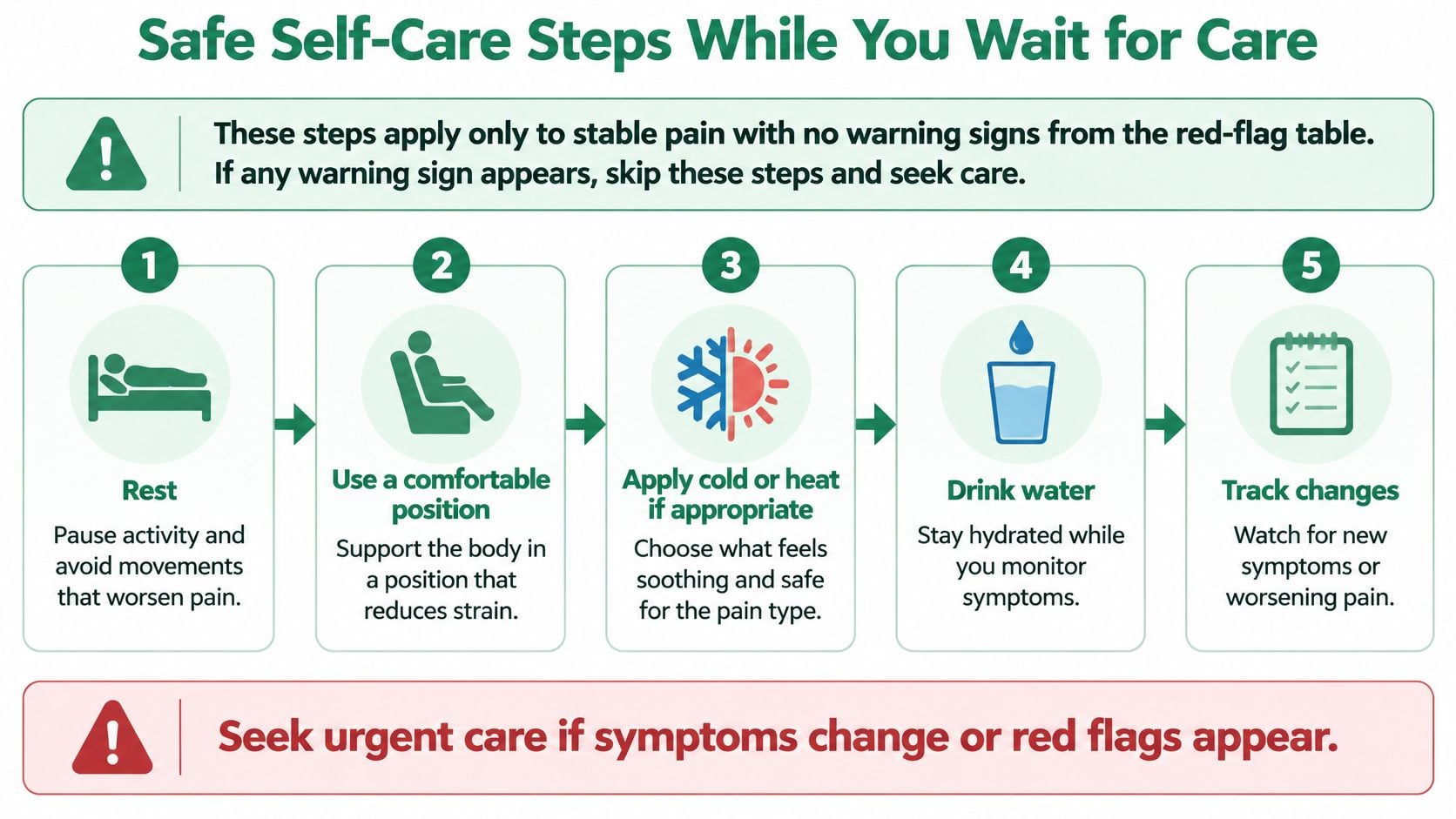
A cautious waiting routine
Rest comfortably. A supported position may reduce strain. Activities that clearly worsen symptoms should pause, but prolonged bed rest isn't a general solution for unexplained pain.
Keep the symptom log going. The log described earlier stays useful during the wait, so continue adding entries as symptoms change, ease, or return.
Use gentle warmth only for an appropriate muscle pattern. Tight jaw or neck muscles may feel better with warmth through a cloth barrier for 15 to 20 minutes. For jaw soreness, rest the warm pack over the cheek just in front of the ear, where the muscle that closes the jaw sits, rather than pressing it directly onto the joint. Heat shouldn't be used to manage unexplained abdominal pain with fever or vomiting, and it shouldn't be hot enough to burn skin.
Choose small meals and fluids if tolerated. Mild nausea may be easier to manage with bland food and small sips. Heavy, fatty meals are best avoided when they appear to trigger upper abdominal discomfort.
Reduce jaw and neck loading. Gum chewing, wide yawning, and holding a phone between the ear and shoulder can aggravate already sore muscles. Gentle movement is preferable to forceful stretching or repeated attempts to make a joint click.
Use nonprescription medicine cautiously. Label directions apply, and a pharmacist or clinician should check suitability during pregnancy or with kidney, liver, stomach, or bleeding conditions. Pain relief doesn't replace evaluation, and improvement after medicine doesn't identify the cause.
Arrange follow-up rather than extending home treatment. Stable discomfort that lasts beyond a few days or repeatedly returns deserves an appointment. New abdominal pain, a worsening trend, or new associated symptoms may require earlier assessment.
Which Specialist and Tests to Expect
Emergency symptoms belong in the emergency department. For non-urgent, unexplained pain, a primary care clinician often provides the most useful starting point because the assessment may need to span several body systems.
Specialists focus more narrowly. Gastroenterology evaluates digestive concerns; general surgery assesses conditions that may need an operation; urology focuses on urinary problems; and obstetrics and gynecology (OB/GYN) evaluates reproductive and pelvic concerns. Neurology assesses nerve-related symptoms, while sports medicine, orthopedics, and physical therapy address appropriate movement-related problems.
Where to start and which tests to expect
| Symptom pattern | Start with | Tests that may be discussed |
|---|---|---|
| Sudden, severe, or red-flag pain | Emergency department | Exam, blood tests, CT or ultrasound as needed |
| Lower right pain with fever, nausea, or worsening | Emergency or urgent evaluation, surgery consultation if needed | Blood tests, CT or ultrasound |
| Upper right pain after meals, with nausea | Primary care, then gastroenterology or surgery | Blood tests, abdominal ultrasound |
| Flank pain radiating to the groin, urinary changes | Primary care or urgent care, urology if stones are suspected | Urinalysis, CT or ultrasound |
| Jaw, face, temple, or neck pain with clicking or limited opening | Dentist or orofacial pain specialist | History and exam, imaging when appropriate |
| Muscle or joint pain worse with movement, no red flags | Primary care, physical therapy, or orthopedics | Physical exam, imaging only if indicated |
| Pain with loud snoring or witnessed breathing pauses | Primary care, then sleep medicine | Polysomnography or home sleep apnea test |
| One-sided pelvic pain with possible pregnancy | OB/GYN or emergency care | Pregnancy test, pelvic ultrasound |
Urinalysis examines urine for clues such as infection or blood. Ultrasound uses sound waves, while computed tomography (CT) produces detailed internal images using X-rays. Not every patient needs every test.
Patients considering a physician-directed home study can review home sleep apnea testing before discussing eligibility with the treating clinician.
Follow-up is part of the evaluation
A retrospective review in Emergency Medicine Journal found diagnostic errors in 35 of 100 high-risk emergency-department abdominal-pain cases, most frequently involving gallbladder disease and urinary infections, with more than two-thirds involving the clinical encounter or follow-up of diagnostic information. This selected high-risk group doesn't represent every emergency visit, but it highlights the importance of a clear follow-up plan.
- Keep the record: Request test results and discharge instructions.
- Clarify the remaining questions: Ask which conditions were excluded and which weren't assessed.
- Assign follow-up: Confirm which clinician will review pending results and when reassessment should occur.
- Report changes: Persistent, migrating, or worsening symptoms warrant another assessment.
A normal initial test doesn't always settle the question. Avoiding unnecessary imaging is reasonable; reassurance works best when paired with clear instructions about what happens next.
Book an Evaluation If Right-Side Pain Keeps Returning
Recurring pain is its own kind of information. Once urgent causes have been ruled out, right-sided discomfort that keeps coming back often traces to systems a general exam covers less directly: the jaw joint and its muscles, the neck, and the airway during sleep. These are easy to miss when attention stays on the abdomen.
Patterns centered on jaw function, facial pain, or breathing during sleep may warrant a focused craniofacial pain or sleep evaluation alongside appropriate medical care.
A focused path for jaw and sleep concerns
Pain and Sleep Therapy Center is a TMJ, craniofacial pain, and dental sleep medicine practice led by Dr. Ryan Robinson, triple board-certified in craniofacial pain and dental sleep medicine, with offices in Newark, Delaware, and Bryn Mawr, Pennsylvania.
The practice emphasizes root-cause evaluation and conservative, non-invasive care before surgery when appropriate. Services include TMJ/jaw, head, and facial pain evaluation; oral appliance therapy as a CPAP alternative; snoring care including Snorelase; cold laser therapy; and tongue-tie assessment with laser frenectomy when indicated. Pediatric airway and oral function services are delivered through an affiliated pediatric center.
Treatment choices depend on the diagnosis, functional findings, and patient goals. No outcome is guaranteed, but many patients find that a clear evaluation makes the next step easier to plan.
For recurring right-sided jaw, facial, or neck discomfort, or symptoms involving disrupted breathing during sleep, Pain and Sleep Therapy Center offers focused evaluation and individualized care. Request an Appointment by calling the Newark office at (302) 239-1757, or Take our Sleep Quiz as a screening step, not a diagnosis.