A home sleep apnea test can be a convenient, physician-directed way to evaluate many adults with symptoms of moderate-to-severe obstructive sleep apnea, but it is not a stand-alone screening tool. A qualified clinician has to order it and interpret it, because the numbers only make sense in context.
Waking up tired after a full night, snoring loudly enough to disturb a partner, or hearing that breathing seems to stop during sleep can make a person search for a sleep apnea test at home near me. That search usually starts with logistics, but the deeper question is clinical: what test is appropriate, what does it measure, and when is a lab study still the safer choice?
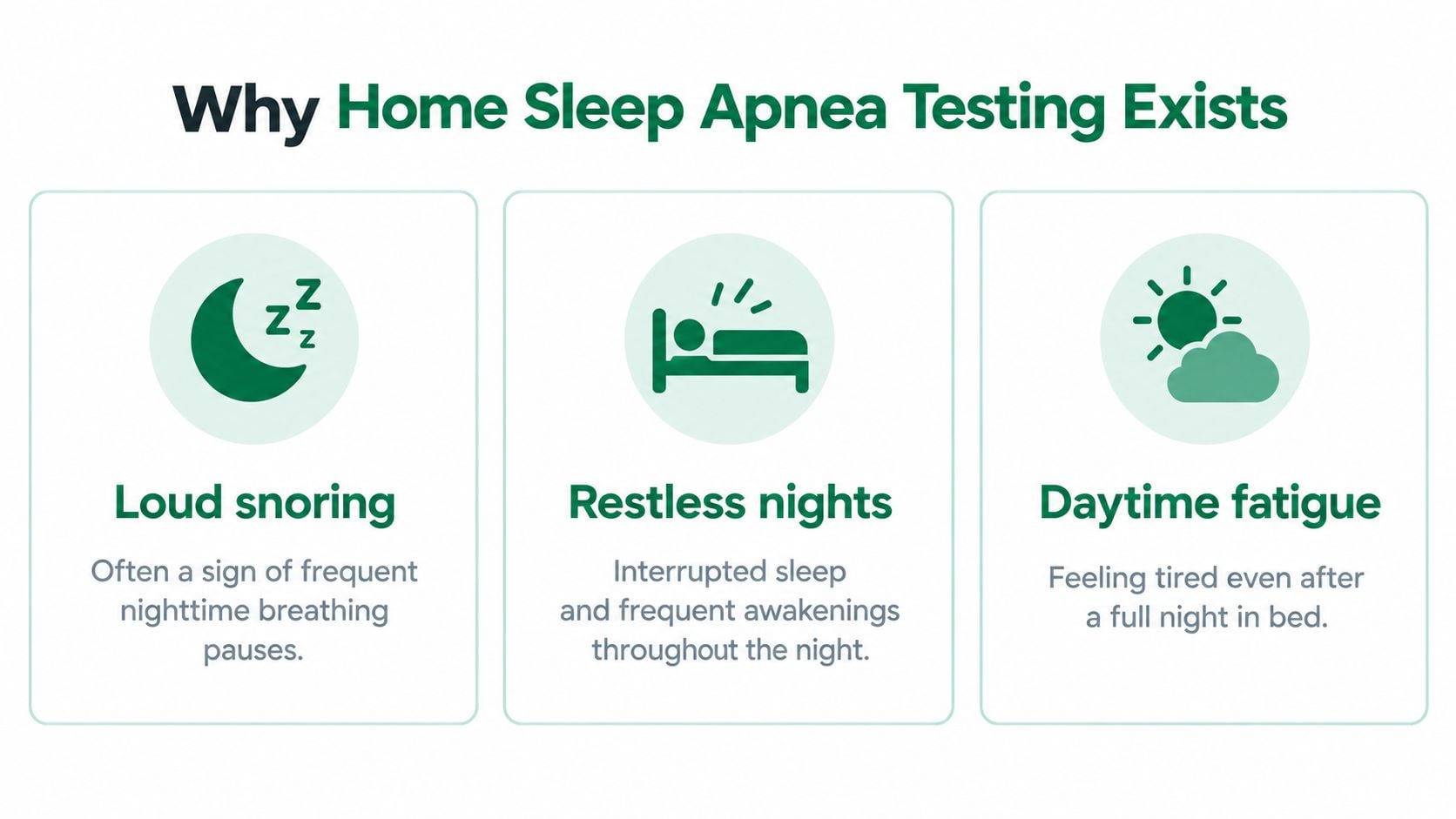
Table of Contents
- Why Home Sleep Apnea Testing Exists
- What Makes a Home Test Reliable
- How to Prepare and Complete a Sleep Apnea Test at Home
- Home Test Versus In-Lab Sleep Study
- Understanding Results and Next Steps
- Finding a Local Home Sleep Testing Provider
Why Home Sleep Apnea Testing Exists
Loud snoring, restless sleep, and daytime fatigue are common reasons people start looking for a sleep apnea test at home near me. Those symptoms can be easy to brush off, but the scale of obstructive sleep apnea makes them worth taking seriously. A 2019 analysis estimated that about 936 million adults worldwide have mild-to-severe OSA and about 425 million have moderate-to-severe disease, while U.S. estimates were about 54 million and 24 million respectively. U.S. survey data also showed how common warning signs are, with 41.1% of adults reporting loud snoring and 13.6% reporting that someone observed them stop breathing during sleep, which is why symptoms deserve clinical attention. AASM overview of OSA burden and symptoms
Who home testing is for
Home sleep apnea testing is meant for adults with a meaningful risk of moderate-to-severe OSA, not for broad population screening. A sleep physician or other qualified clinician uses the patient's history and examination to decide whether a home study fits the case, then interprets the raw recording alongside symptoms and medical history. That approach matters because sleep apnea isn't diagnosed by a feeling alone, it's diagnosed through clinical evaluation plus a sleep study.
Practical rule: if a patient has loud snoring, witnessed breathing pauses, or persistent daytime sleepiness, the next step is evaluation, not self-diagnosis.
A home study exists to reduce barriers. It lets many appropriate patients test in their own bed, but it still follows a medical pathway. For readers who want a plain-language overview of related symptoms and terminology, the What Is Sleep Disordered Breathing guide is a useful companion read.
What Makes a Home Test Reliable
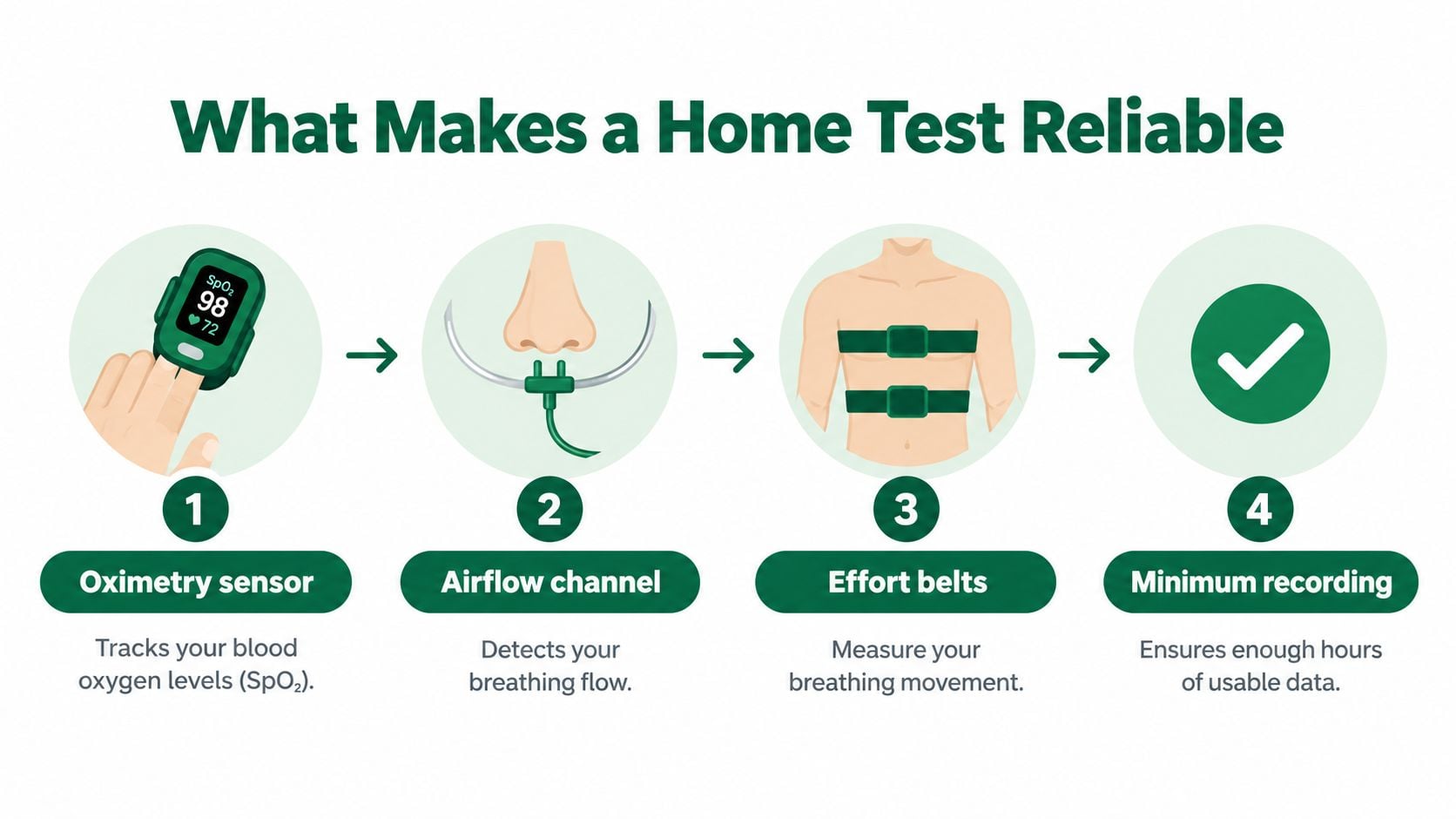
A reliable home sleep apnea test begins with the signals it can collect. Typical devices track airflow, respiratory effort, and oxygen saturation, and some also record body position or similar channels. That narrower sensor set can identify many cases of OSA, but it does not show the full sleep picture a lab study captures, so the result has to be interpreted with care.
The measurements that matter
Good home testing depends on clean data, not just a device being worn overnight. AASM guidance calls for at least 4 hours of technically adequate recording during the patient's usual sleep period, and the raw tracing should be reviewed by a qualified sleep physician. The limitation is straightforward. Home testing usually estimates breathing events from recording time, not verified sleep time, because it does not measure EEG sleep stages. If someone lies awake for part of the night, the apnea-hypopnea index can look lower than it really is. AASM diagnostic testing guideline
Accuracy also depends on who is being tested. In one peer-reviewed comparison, home testing showed high sensitivity and overall accuracy, but lower specificity, and performance dropped in moderate-to-severe OSA. A separate review found only moderate agreement with polysomnography. Those findings support home testing in the right patient, and they also explain why a negative result does not always end the workup. recent review of HSAT limitations
Why one night can miss the pattern
One night can miss the usual pattern. Sleep position, nasal congestion, alcohol, illness, medication, and fragmented sleep can all shift the result from night to night, the way a single snapshot can miss a moving subject. In a 2025 analysis of 4,527 patients using multi-night home testing, relying on the first night alone would have missed OSA in 11.8% of affected patients, and 26.4% had their severity rise by at least one category on later nights. 2025 multi-night home testing analysis
A home test is only as trustworthy as the signal behind it. If the oximeter slips, the nasal cannula shifts, or the effort belts loosen, the recording can become misleading instead of reassuring.
For practices publishing patient-education content like this guide, the guide to AI SEO tools can help structure clear local health content.
How to Prepare and Complete a Sleep Apnea Test at Home
A home sleep apnea test begins before the device reaches the bedside. A clinician should first screen for conditions that make home testing less suitable, including significant cardiopulmonary disease, suspected hypoventilation, neuromuscular weakness, stroke, chronic opioid use, or severe insomnia. When those issues are present, an attended study is often the safer choice because a home device can miss details that matter for diagnosis and treatment.
A simple checklist for a clean recording
A good recording comes from ordinary sleep, not from trying to “perform” for the test. The person should sleep during a usual sleep period, keep the oximeter attached, place the nasal cannula correctly, and make sure the effort belts stay secure through the night. The study also needs at least 4 hours of technically adequate airflow and oxygenation data, consistent with the AASM HSAT workflow guidance. AASM policy template on HSAT workflow
A practical setup usually looks like this:
- Confirm the device is recording: Check that the monitor has started before falling asleep.
- Place the nasal cannula carefully: If airflow sensing slips out of position, the breathing trace can become unreliable.
- Secure the chest effort belt: Loose contact can make the study hard to score.
- Keep the finger sensor on overnight: Oxygen trends help show whether breathing events are affecting gas exchange.
- Sleep as normally as possible: Unusual bedtimes and long wake periods can distort the result.
What happens after the night ends
The recording does not diagnose anything on its own. A sleep physician reviews the raw data and decides whether the study was adequate and how it fits the patient's symptoms and history. A single negative, inconclusive, or technically inadequate home test should not be treated as the final answer when suspicion remains.
Clinical safeguard: if symptoms continue after a negative home study, the safer next step is usually an attended polysomnogram.
That matters most when loud snoring, witnessed apneas, excessive sleepiness, resistant hypertension, or unexplained fatigue are still present. A short or messy recording can hide the problem, so the goal is not only to finish the test, but to finish it well.
Home Test Versus In-Lab Sleep Study
A home sleep apnea test and an in-lab sleep study serve different clinical needs. The home test is meant for uncomplicated adults with a strong suspicion of obstructive sleep apnea, while polysomnography is the fuller option when the case is medically complex or the first result does not answer the question clearly. AASM position statement on home sleep apnea testing
The main differences
| Feature | At-Home Test | In-Lab Study |
|---|---|---|
| Setting | The patient sleeps in their own bed | The patient sleeps in a monitored sleep lab |
| Sensor depth | Fewer channels focused on breathing | Full monitoring with more physiologic detail |
| Best fit | Uncomplicated adults with likely OSA | Complex cases, unclear results, or other sleep disorders |
The difference is not just location. A home test usually does not measure EEG sleep stages, so it cannot show exactly when sleep starts and ends. It also captures fewer physiologic signals, which means it may be less able to separate central apnea, obstructive apnea, hypopnea, and respiratory-effort-related arousal with the same detail as a lab study. That is why a home result should be read as part of the larger clinical picture, not as the whole story. Review of HSAT physiologic limits
A lab study becomes the better choice when breathing problems may be more complicated than routine OSA. The same is true when a home test is negative but the person still has loud snoring, witnessed pauses, excessive sleepiness, resistant hypertension, or unexplained fatigue. In that setting, a negative home test does not reliably rule out OSA, and AASM guidance supports attended polysomnography when suspicion remains. AASM diagnostic testing guideline
Understanding Results and Next Steps
A home study usually reports the apnea-hypopnea index, or AHI, which is the number of breathing events per hour. In adults, an AHI below 5 is generally considered normal, 5 to 15 is mild, 15 to 30 is moderate, and 30 or more is severe. Those thresholds help describe severity, but they don't make the treatment decision by themselves. AHI definitions and scoring overview
What treatment discussions often include
Once diagnosis is confirmed, treatment should follow shared decision-making. Continuous positive airway pressure (CPAP) remains first-line in general because it improves oxygen saturation and reduces AHI and arousal index better than oral appliances. For adults who can't tolerate CPAP or prefer an alternative, a custom, titratable oral appliance may be considered, with follow-up sleep testing often recommended to confirm whether it's working. AASM and AADSM oral appliance guideline
For readers looking into an airway-focused alternative pathway after diagnosis, the apnea treatment without CPAP page explains the oral-appliance approach in plain language.
A home result should lead to a plan, not a label. The right next step depends on symptoms, medical history, and whether the study was technically solid.
One thing matters more than the number on the page. AHI helps describe the problem, but symptoms, oxygen findings, comorbid conditions, and test quality still guide what happens next.
Finding a Local Home Sleep Testing Provider
A local search often starts with convenience, then the key question becomes who orders the study, who reviews it, and what happens if the result is unclear. A home sleep apnea test should come after a medical history and face-to-face examination, which can happen in person or through telemedicine. The recording should be interpreted by a physician board-certified in sleep medicine or working under that physician's oversight.
For patients who want a clinician-directed pathway, Pain and Sleep Therapy Center offers at-home sleep studies as part of its dental sleep medicine services, with interpretation and follow-up tied to the overall evaluation. Patient guides such as the 2026 patient guide to Southside show how a clear evaluation pathway and defined next steps reduce confusion after testing. Look for that same structure locally. A test result is only useful when a qualified clinician connects the data to symptoms, medical history, and the need for more testing if the picture is still incomplete. For readers also considering oral appliance care, the sleep apnea mouth guard dentist near me page is a practical next read.
Request an Appointment or Take our Sleep Quiz if snoring, witnessed pauses, or persistent fatigue are getting in the way of daily life. Pain and Sleep Therapy Center in Newark can help patients start with evaluation, choose the right test, and understand what the results mean before moving to conservative treatment.