A parent may be sitting beside a sleeping infant after a tongue-tie release, wondering whether the white patch under the tongue is normal. An adult may be studying a sore tongue in the mirror, waiting for easier swallowing or clearer speech and questioning whether tenderness means something went wrong. These concerns are common, especially during the first evening when the care plan feels more complicated than expected.
Post frenectomy care isn't one universal checklist. Recovery combines wound protection, age-appropriate feeding or speech support, oral-function rehabilitation, and follow-up with the clinician who performed the release. The right balance depends on the patient's age, the location of the frenum, the technique used, and whether myofunctional therapy is part of the plan. Movement may feel freer immediately, but functional retraining often takes longer.
Table of Contents
- What Post Frenectomy Care Really Involves
- The First 24 to 48 Hours of Wound Protection
- Stretches, Massage, and Myofunctional Exercises
- Feeding and Oral Function Across Age Groups
- Healing Milestones From Day One to Week Six
- Red Flags and When to Call Your Provider
- Putting It All Together and Next Steps
What Post Frenectomy Care Really Involves
A frenectomy releases a frenum, the band of tissue that may restrict movement beneath the tongue, inside the lip, or along the cheek. Laser and scalpel procedures can produce different wound appearances and instructions. Both require attention to comfort, oral hygiene, and function, with the treating clinician's plan taking priority.
The aftercare question changes with age. For an infant, the practical focus is usually calm feeding, latch, milk transfer, and whether the baby settles afterward. An older child may need help with chewing, swallowing, speech, or tongue posture. Adults may need support for swallowing patterns, oral posture, or speech adaptation. Wound care alone does not address every functional problem.
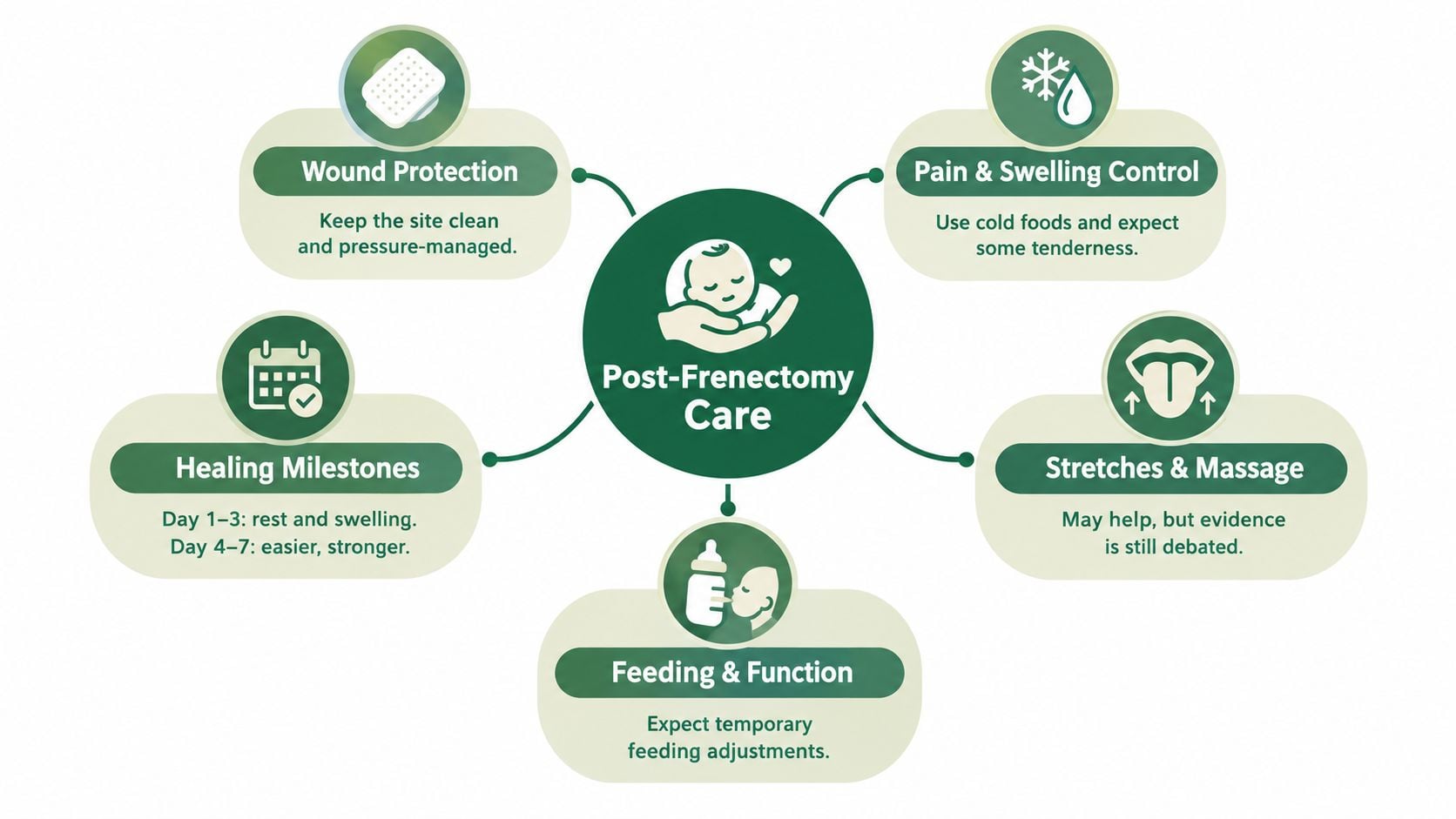
Protection comes before retraining
Early care should limit unnecessary pressure, heat, friction, and vigorous cleaning. Mild soreness, slight oozing, and a white or yellow healing layer can occur during recovery. This fibrin coating does not automatically indicate infection and should not be scrubbed away, as explained in clinical frenectomy aftercare guidance.
The wound and the function are connected, but they are different clinical tasks. A site that appears clean may still require work on feeding, swallowing, speech, or tongue posture.
Once the provider considers the wound sufficiently protected, the plan may shift toward useful movement. Depending on the patient, that may include feeding support, speech therapy, or exercises prescribed by the treating clinician. A 2021 review summarized in this overview of postoperative frenectomy care described aftercare that combined approaches such as lingual exercises, myofunctional therapy, wound care, speech therapy, breastfeeding sessions, oral hygiene, and diet advice. This supports a multimodal plan rather than one universal routine.
Practical rule: Treat wound protection and functional rehabilitation as related but separate goals. Healing tissue needs protection, while feeding, speech, swallowing, and oral posture may need guided retraining.
A personalized plan is safer than a rigid routine
Evidence for stretching and other exercises remains unsettled, and providers may reasonably differ. One clinician may recommend gentle movement, another may advise minimal manipulation, and a third may refer the patient to a feeding, speech, or myofunctional specialist.
Do not add forceful stretches or change the schedule without discussing it with the treating team. The appropriate plan depends on age, the frenum released, the procedure used, current symptoms, and the function being treated. Recovery is more reliable when those factors guide care instead of an identical checklist for every patient.
The First 24 to 48 Hours of Wound Protection
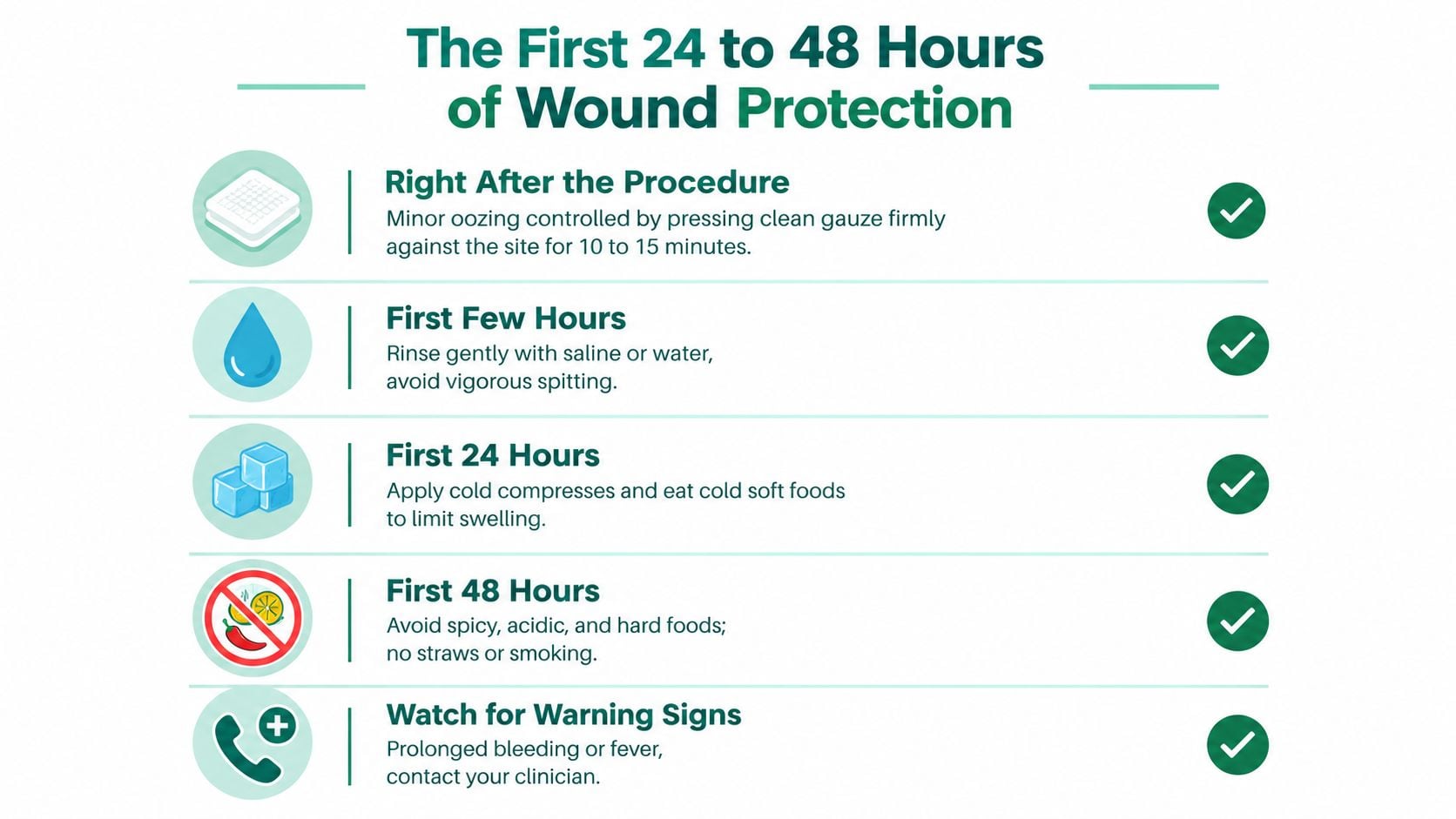
A fresh release can look calm and then ooze after feeding, eating, crying, or talking. During the first day or two, protect the site, observe changes, and follow the treating clinician's written instructions for medication, feeding, and cleaning. The plan may differ according to the patient's age, the location of the frenum, and whether the procedure involved the tongue, lip, or another oral site.
Immediately after the release
For minor oozing, place clean gauze over the area and apply steady, direct pressure without repeatedly lifting it to check. Follow the pressure duration provided by the clinician. If bleeding continues despite consistent pressure, contact the care team or seek urgent advice. The hospital's tongue-tie aftercare leaflet also recommends firm gauze pressure when bleeding does not settle.
A cold pack wrapped in cloth may help reduce swelling when placed against the outside of the cheek, jaw, or under the chin. It should not touch skin directly. Infants need close supervision during any comfort measure. Keep older children and adults comfortably upright if that reduces throbbing, but infants should sleep only in a safe, approved position, never on an improvised incline.
Avoid hot foods and drinks, vigorous rinsing, forceful spitting, straw use, and strenuous activity during this early period. Adults and older children can usually choose soft, cool, or lukewarm foods when permitted by their clinician. Infants should resume feeding according to the individualized plan, especially if sucking was difficult before treatment or the release affected feeding mechanics.
Cleaning without disturbing the wound
Cleaning instructions vary by age and procedure. Adults and older children may be advised to use a lukewarm salt-water rinse after meals. The rinse should be gentle, with no forceful swishing or spitting. For an infant, a caregiver may wipe nearby surfaces with damp gauze if instructed, while avoiding direct contact with the wound.
As noted in the overview, do not scrub the fibrin coating if present. Focus on keeping surrounding areas reasonably clean and avoid probing the site with a toothbrush, finger, or cotton swab unless the treating clinician has demonstrated that technique.
Pain relief may include an age- and weight-appropriate over-the-counter medicine when the treating clinician approves it. Children should not receive aspirin unless a physician specifically prescribes it. Check dosing and suitability with the patient's care team, particularly when allergies, health conditions, or other medicines are involved.
Stretches, Massage, and Myofunctional Exercises
The question about wound stretching deserves a direct answer: there isn't a universally accepted exercise protocol after frenectomy. Cleveland Clinic states that current evidence doesn't support routine stretching or massaging of the wound after infant frenotomy. At the same time, some clinicians prescribe gentle lifts or other movements because they believe selected patients may benefit from maintaining mobility during healing.
The American Academy of Pediatric Dentistry summary cited in this professional guidance publication describes the evidence as limited. Only a small number of studies have directly examined the relationship between postoperative care and outcomes, so comparisons between stretching and non-stretching plans remain difficult.
Wound manipulation requires restraint
When a provider prescribes an infant exercise, the caregiver may be shown how to lift the tongue or lip gently enough to view the healing site. Some plans use a clean fingertip or cotton swab, while others use light side-to-side movement. The treating clinician should demonstrate the exact technique, because anatomy, wound depth, procedure type, and the infant's response all affect what is appropriate.
Forceful lifting, deep rubbing, or repeated attempts to “open” the wound can create bleeding and distress. A small streak may occur with some prescribed movements, but active bleeding, escalating pain, or a caregiver who can't perform the exercise calmly warrants a call to the provider.
The useful distinction is function versus force. A movement intended to support tongue mobility isn't the same as repeatedly pulling on a healing wound to prevent imagined closure.
Myofunctional therapy has a different purpose
Myofunctional therapy uses structured movements to improve oral function, including tongue-to-spot holds, lateral tongue sweeps, and controlled swallows. These exercises target resting posture, coordination, and swallowing patterns. They aren't automatically required for every patient, and they should be matched to age and functional needs.
An older child or adult may benefit from a broader plan that includes speech or feeding therapy. Resources such as exercises that may support oral function and breathing patterns can be discussed with the care team, but online exercises shouldn't replace an individualized assessment.
The main trade-off is clear. Too little movement may leave a patient with unresolved functional habits, while excessive manipulation can increase discomfort, bleeding, anxiety, or feeding aversion. The safest plan is the least aggressive approach that addresses the patient's actual functional goals.
Feeding and Oral Function Across Age Groups
Recovery looks different for a breastfed newborn, a toddler learning to chew, and an adult adapting to a new tongue position. The release changes tissue restriction, but the nervous system and muscles still need time to learn a different movement pattern.
Expectations by age
| Age Group | First Week Focus | Weeks 2-4 Focus | Weeks 4-6+ Focus |
|---|---|---|---|
| Infants | Calm feeding, latch observation, comfort, and signs of adequate intake | Feeding support and gradual adjustment of tongue movement | Reassessment if transfer, latch, or comfort remains limited |
| Older children | Soft foods, chewing comfort, drooling, and gentle oral hygiene | Integration of feeding, speech, and oral-function support when indicated | Continued skill development and review of persistent restriction |
| Adults | Soft diet, comfort, swallowing awareness, and speech adaptation | Guided tongue posture, controlled swallowing, and functional practice | Review of progress, residual restriction, and broader breathing or jaw concerns |
An infant may feed immediately after a frenotomy. Cleveland Clinic notes that some families notice improved comfort or milk transfer right away, while others see changes over one to two weeks in its frenotomy recovery guidance. Relief in breastfeeding pain may occur before measurable intake improves, so lactation support can remain valuable even when the wound appears healthy.
Older children may need help with chewing, drooling, articulation, or oral posture. Adults may notice speech or swallowing changes gradually as the tongue learns a new resting position. A guide to adult tongue-tie surgery recovery can supplement, but not replace, the patient's individualized instructions.
A stalled recovery deserves evaluation rather than blame. Feeding refusal, continued inefficient transfer, persistent chewing difficulty, or a sense that the tongue remains restricted may reflect an unresolved functional pattern, scarring, another oral issue, or a need for coordinated therapy.
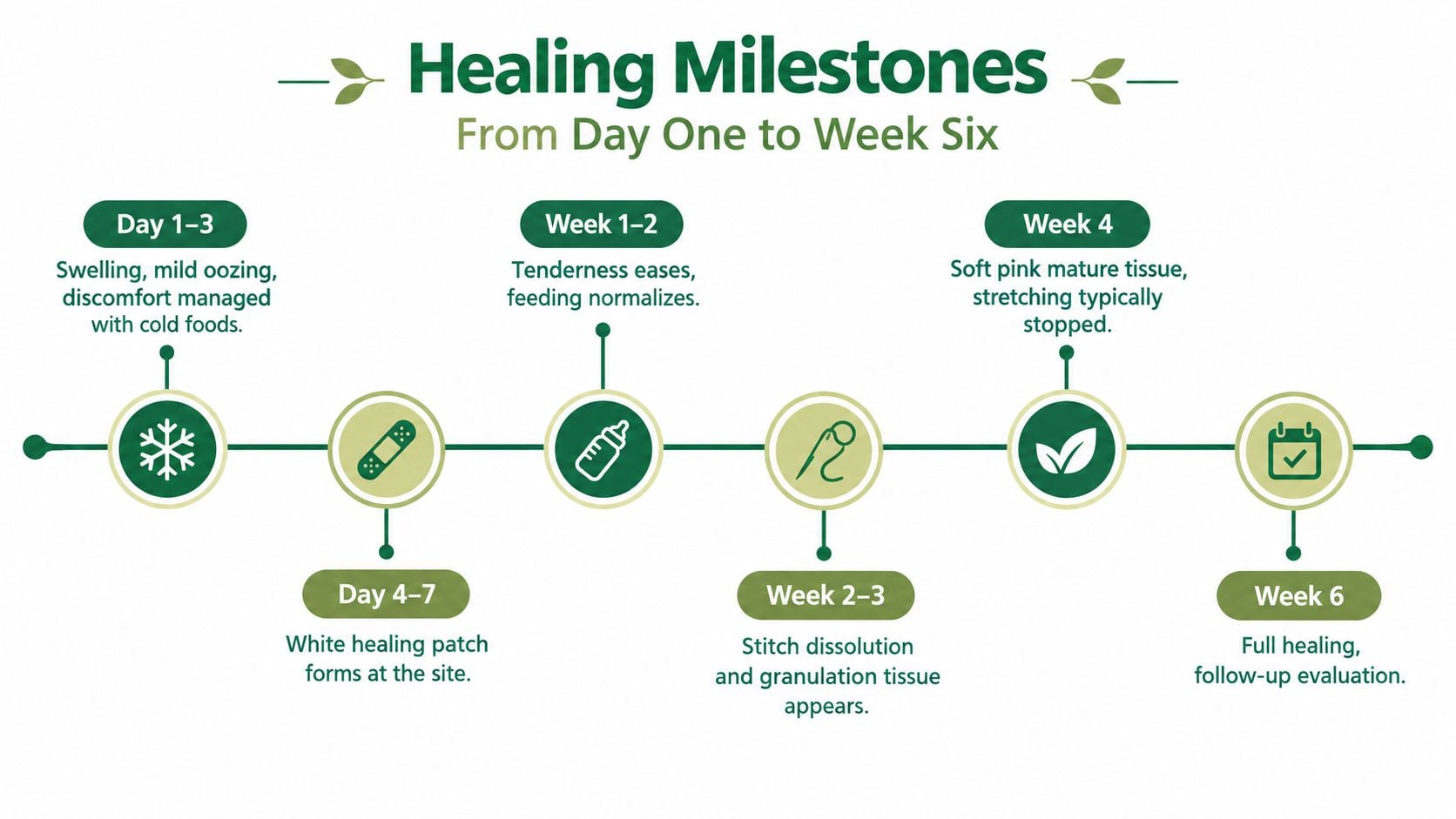
Healing Milestones From Day One to Week Six
A healing timeline offers orientation, not a promise. Wound appearance and function can progress at different speeds, and a provider's examination matters more than a photograph or a single symptom.
Early healing
During the first several days, mild swelling, tenderness, and slight oozing can occur. Cold foods may be more comfortable for older patients, while infants may prefer feeding and soothing measures recommended by the clinician. Bleeding is the most common complication of tongue-tie release and is usually controlled with local pressure, according to this NIH clinical reference on ankyloglossia.
As the first week progresses, the release site may develop a soft white or yellow fibrin layer. This can look alarming but often reflects normal healing. The tissue shouldn't be scraped, peeled, or aggressively massaged.
Later remodeling
During the following weeks, tenderness generally becomes less prominent while movement and function receive more attention. Granulation and tissue remodeling can change the color and texture of the site. A tongue release may feel more noticeable during speech, swallowing, or exercises than an upper-lip release, while lip sites often create fewer movement demands during daily function.
The pace also differs by procedure and patient. Laser treatment doesn't eliminate the need for follow-up, and a healthy-looking surface doesn't prove that the functional goal has been reached. Some patients may need additional therapy or reassessment if movement remains limited.
A second release may be discussed in selected pediatric cases when restriction returns or function remains affected. However, the requested figure of roughly two to six percent isn't supported by the verified sources available for this article, so it shouldn't be presented as a general benchmark.
What follow-up should assess
A useful follow-up examines more than wound closure. The clinician may assess tongue elevation, lateral movement, resting posture, feeding, swallowing, speech, scar tissue, and the patient's comfort with the assigned home plan. If the frenum was released as part of a broader breathing, jaw, or sleep evaluation, those goals should be reviewed separately rather than assumed to improve automatically.
Red Flags and When to Call Your Provider
A white or yellow coating can be normal. Mild swelling, low-grade discomfort, and slight bleeding early in recovery can also occur. The mistake is not noticing a normal healing patch. The mistake is treating every worsening symptom as normal because the site looks unusual.
Same-day concerns
Patients or caregivers should contact the treating clinician promptly for:
- Bleeding that persists: Bleeding that doesn't settle with steady, direct gauze pressure requires clinical advice.
- Worsening swelling: Swelling that increases rather than improves after the early recovery period deserves assessment.
- Fever or foul drainage: Fever, pus, or a foul odor can signal a problem that needs examination.
- Feeding refusal: An infant who refuses feeds, appears unusually weak, or shows signs of inadequate intake needs prompt medical guidance.
- Breathing changes: Any airway concern, noisy breathing that is new or worsening, or difficulty breathing requires urgent attention.
The verified guidance doesn't establish a universal fever threshold for every patient, so families should use the threshold supplied by the treating clinician and seek advice for fever after the procedure. Severe symptoms shouldn't be managed by waiting for a scheduled appointment.
Reattachment isn't always an emergency
A healing frenum can appear tighter or uneven as tissue remodels. Partial reattachment may be observed and reviewed rather than treated as an emergency. The concern becomes more significant when scar tissue restricts function, feeding, speech, swallowing, or tongue movement.
The medical literature review on ankyloglossia surgery and postoperative care describes potential complications including bleeding, hematoma, infection, recurrence of attachment, scarring, and altered speech restriction from scar tissue. A low overall complication rate in selected studies doesn't remove the need for clear triage.
When symptoms are getting worse instead of gradually settling, a phone call is appropriate. Early assessment can prevent a manageable concern from becoming an urgent one.
Putting It All Together and Next Steps
Effective post frenectomy care has layers. The wound needs protection during the early phase, the mouth needs gentle hygiene, and the patient may need feeding, speech, or myofunctional support as movement becomes familiar. Stretching and massage should follow the treating provider's specific plan, because evidence and clinical preferences vary.
A short recovery log can make follow-up more useful. Caregivers can record feeding comfort, latch, intake concerns, bleeding, swelling, sleep disruption, and the exercises completed. Adults can note swallowing, speech, tongue posture, pain, and any change in jaw or facial symptoms.
Follow-up should confirm that the site is healing without excessive scarring and that the original functional goal is being addressed. A frenectomy may be appropriate for one patient and unnecessary for another, which is why evaluation should include symptoms, anatomy, function, and conservative options before surgery. Questions about tongue-tie laser surgery and treatment planning should be discussed directly with a qualified clinician rather than answered through a generic checklist.
Pain and Sleep Therapy Center serves patients in Newark and Wilmington, Delaware, and Bryn Mawr and the Philadelphia Main Line with evaluation for tongue-tie, TMJ and craniofacial pain, sleep-disordered breathing, and related oral-function concerns. Patients considering laser frenectomy, coordinating aftercare, or seeking a second opinion can request an evaluation and share the resulting plan with the existing care team.
Pain and Sleep Therapy Center offers tongue-tie assessment, laser frenectomy treatment planning, and coordinated recovery support for infants, children, and adults. Patients can visit Pain and Sleep Therapy Center or call Newark at (302) 239-1757 to Request an Appointment or Take the Sleep Quiz.