A deep yawn starts during a conversation, the mouth opens wider than expected, and suddenly the jaw feels caught. Sometimes it clicks and closes normally. In a more serious episode, the mouth stays open, speech becomes difficult, and the person can't bring the teeth together. That difference matters.
Jaw locking when yawning can come from a strained joint, tight muscles, intermittent catching, or a true temporomandibular joint dislocation. Understanding the pattern helps a person respond calmly, protect the joint, and recognize when professional care is needed.
Table of Contents
- Why Your Jaw Gets Stuck When You Yawn
- Understanding TMJ Anatomy and Dislocation Mechanics
- Differentiating Joint Noise from True Locking
- Conservative Strategies to Prevent Jaw Locking
- The Connection Between Jaw Locking and TMD
- When to Seek Professional Evaluation and Treatment
Why Your Jaw Gets Stuck When You Yawn
A yawn places the jaw near the end of its normal range. For someone with an irritated temporomandibular joint, tight chewing muscles, clenching habits, or loosened joint-supporting tissues, that extra opening can expose a mechanical problem that isn't obvious during ordinary talking or eating.
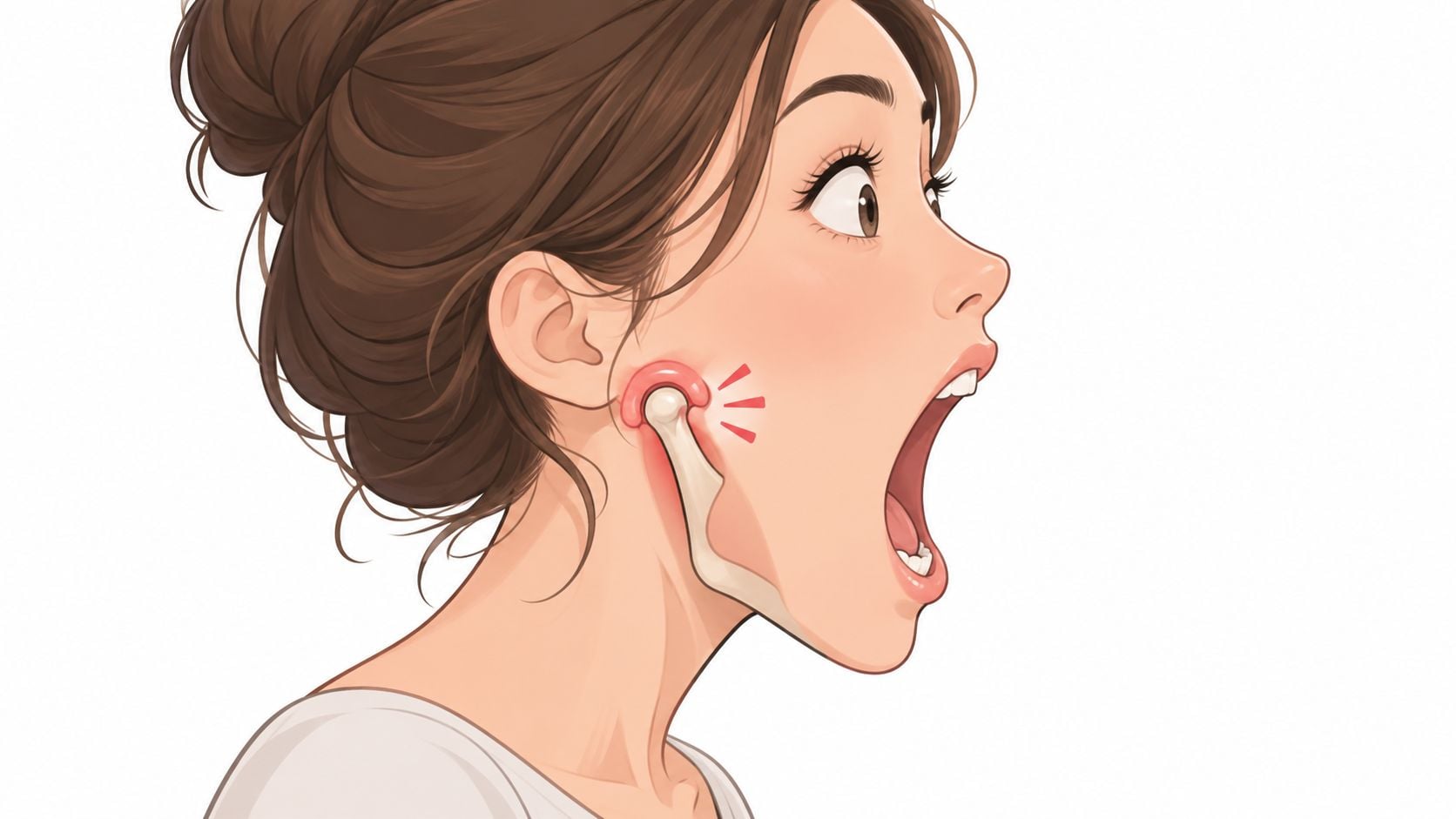
Consider two different episodes. In the first, a person yawns, hears a soft click, feels brief soreness, and closes the mouth without help. The joint may be irritated, or a small cartilage disc may be moving out of position and then returning as the jaw closes. In the second, the mouth remains wide open and the lower jaw seems fixed. That pattern is much more consistent with an anterior TMJ dislocation, where the jawbone moves too far forward and becomes trapped during extreme mouth opening.
The main patterns to notice
The feeling of “locking” can describe several experiences:
- Brief catching: The jaw hesitates, then moves again. Pain may be mild or absent.
- Painful restriction: The mouth doesn't open as widely as usual, often with tenderness near the joint or cheek.
- Open lock: The mouth stays open and won't close. Speech and biting become difficult.
- Closed lock: The jaw won't open normally, which can occur with muscle spasm, joint inflammation, injury, or disc-related problems.
A true open lock isn't just a louder click. It means the jaw has become physically fixed in an open position. Clinical descriptions identify inability to close the jaws, pain, and impaired biting or speech as typical features of TMJ dislocation in a clinical review.
A single mild click doesn't automatically mean that the joint is damaged. Repeated catching, increasing pain, reduced movement, bite changes, or episodes that leave the mouth stuck deserve more attention. The symptom pattern, rather than the sound alone, helps determine whether the joint needs evaluation.
Understanding TMJ Anatomy and Dislocation Mechanics
The temporomandibular joint, or TMJ, connects each side of the lower jaw to the temporal bones of the skull. It works partly like a hinge and partly like a sliding track. The jaw first rotates, then glides forward as the mouth opens wider.
A small articular disc sits between the jawbone and skull. The disc acts as a movable cushion that helps distribute force and guide movement. Ligaments help limit excessive motion, while muscles around the jaw control opening, closing, chewing, and stabilization.
A useful analogy is a drawer sliding along a track. A healthy drawer rotates and glides within its designed path. If the track becomes irritated, the guide becomes loose, or force pushes the drawer too far forward, the drawer may catch beyond the stop. The jaw can behave in a similar way during a forceful yawn.
What happens during an open lock
The rounded end of the jawbone is called the mandibular condyle. During very wide opening, the condyle rotates and then glides forward past a bony ridge called the articular eminence. When the condyle passes beyond that ridge, the surrounding muscles may tighten suddenly. That spasm can hold the condyle forward, leaving the mouth stuck open as described in clinical guidance.
The movement is usually called an anterior dislocation, meaning that the condyle has moved forward from its usual position. Yawning is a recognized trigger, along with laughing, dental procedures, vomiting, and other actions that force the mouth open widely according to the TMJ Association's clinical explanation.
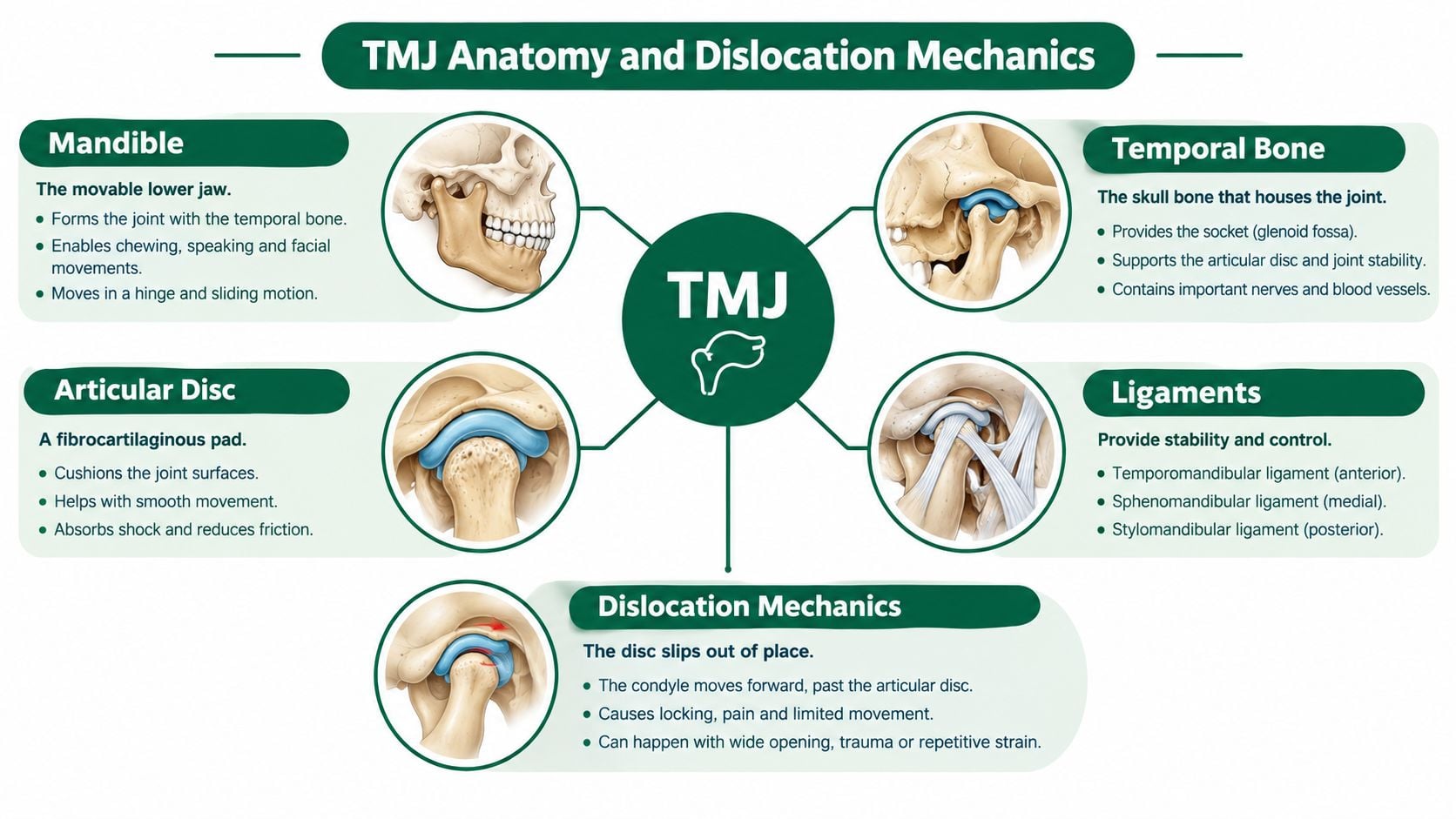
Repeated wide opening may place ongoing stress on the tissues that help restrain forward movement. Over time, stretched or lax ligaments can provide less resistance, making another episode easier to trigger. This can create a cycle: a person yawns widely, the joint slips too far, the muscles spasm, and repeated events gradually make the joint feel less stable.
That cycle doesn't mean surgery is automatically necessary. Many cases can be assessed and managed conservatively, especially when a clinician identifies the movement pattern, muscle involvement, clenching, bite changes, or other contributing factors early.
Differentiating Joint Noise from True Locking
A clicking jaw and a dislocated jaw are not the same problem. Confusing them can lead either to unnecessary alarm or to delayed care when the mouth is genuinely stuck.
| Jaw experience | What it may feel like | Appropriate response |
|---|---|---|
| Occasional painless click | A brief sound with normal opening and closing | Track the pattern and mention it during a routine evaluation if it persists |
| Catching or hesitation | The jaw briefly sticks, then moves again | Arrange an assessment if episodes recur, become painful, or limit eating |
| Painful grinding or popping | Noise combined with soreness, stiffness, or fatigue | Seek evaluation for possible TMD, muscle overload, or joint irritation |
| True open lock | The mouth stays open and won't close | Seek prompt medical care rather than trying to force the jaw back |
| True closed lock | The mouth won't open normally | Arrange prompt evaluation, especially after injury or with severe pain |
A painless pop can occur when the articular disc moves and returns during jaw motion. This is often called disc displacement with reduction. The disc changes position during opening or closing, then moves back into a more functional relationship. The sound may be noticeable without causing meaningful limitation.
Catching is different because movement becomes interrupted. The jaw may need a small shift before it opens or closes. Painful popping, stiffness, headaches, facial pain, or a change in the way the teeth meet makes reassurance alone less appropriate. A person exploring the difference between facial nerve pain and joint-related symptoms can also review how TMJ symptoms differ from trigeminal neuralgia.
Emergency distinction: If the mouth is visibly stuck open, the person can't close the jaw, speech is impaired, or biting is suddenly impossible, the episode should be treated as a possible dislocation.
A person shouldn't try to forcefully push, twist, or “pop” a dislocated jaw back into place. Manual reduction is considered emergency treatment for a true TMJ dislocation, and a major review supports performing reduction promptly after diagnosis because delay can make the process more difficult.
Conservative Strategies to Prevent Jaw Locking
Protection starts with reducing extreme jaw movement. A person who feels a yawn building can support the underside of the chin with a hand, keeping the mouth from opening to its widest point. The support should guide the movement gently, not press hard against the jaw.
Small daily changes can also reduce strain while the joint settles:
- Choose easier chewing: Softer foods and smaller bites may reduce force during a painful period. Tough, sticky, or very chewy foods can place more demand on an already sensitive joint.
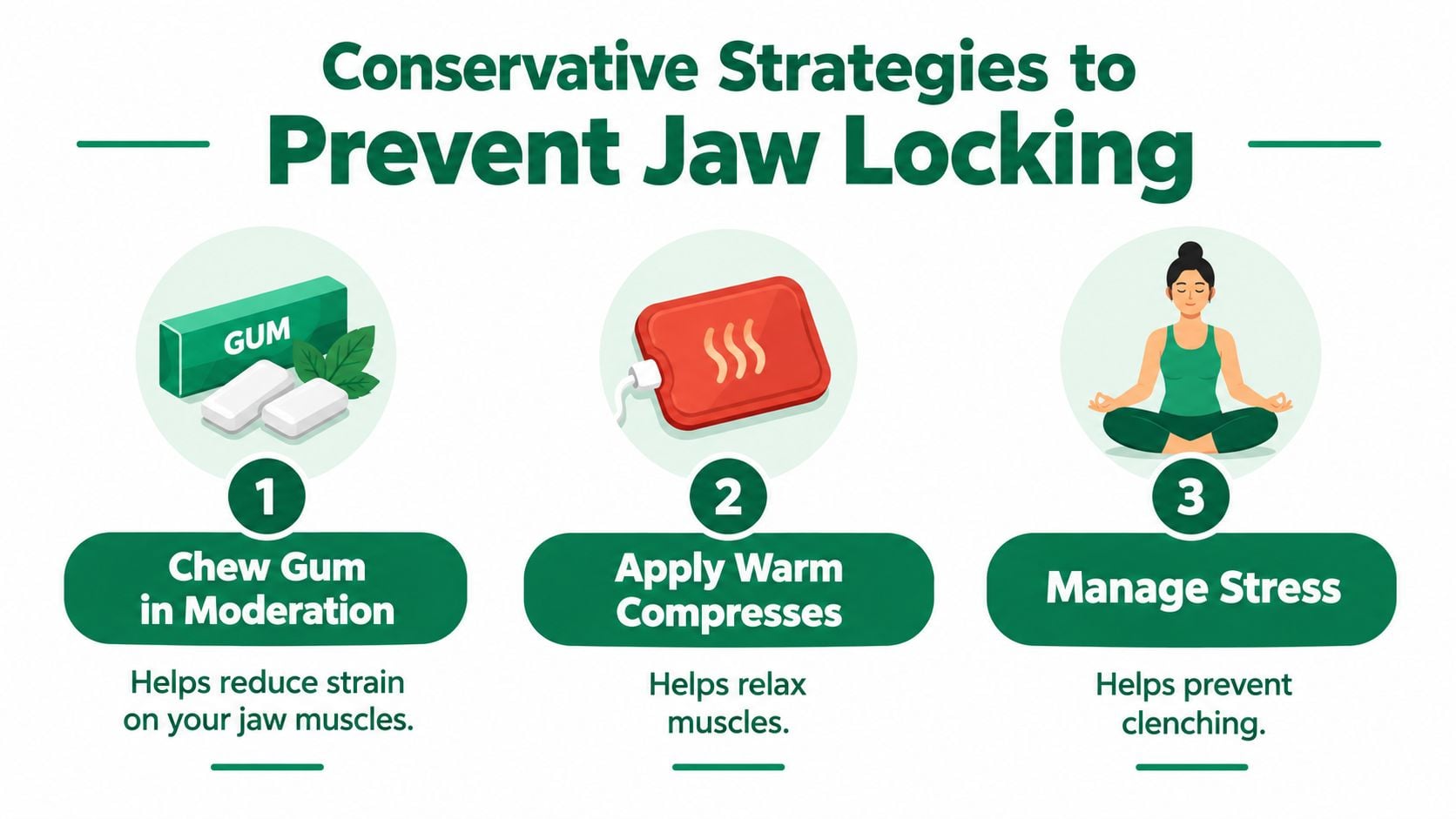
- Limit prolonged chewing: Gum and repetitive chewing may fatigue the jaw muscles. The practical goal isn't complete avoidance forever, but reducing activities that repeatedly provoke symptoms.
- Notice clenching: Many people hold the teeth together during concentration, stress, or physical effort. Resting with the teeth slightly apart and the jaw relaxed can reduce muscle loading.
- Use comfortable warmth: A warm compress may help tight muscles relax. It should feel soothing rather than hot enough to irritate the skin.
- Support a neutral posture: Forward head posture can increase tension through the neck, jaw, and facial muscles. Comfortable head and neck alignment may make relaxed jaw movement easier.
Stress management matters because stress can increase daytime clenching and nighttime grinding. Slow breathing, regular breaks, and awareness of tooth contact can help a person identify habits that might otherwise go unnoticed. Guidance on improving mobility with these tips can complement a broader plan for reducing strain around painful joints.
These measures may lower irritation, but they won't correct every cause of locking. A person with repeated open locks, a changing bite, significant movement restriction, or worsening pain needs more than a self-care checklist. Conservative care works best when it follows an evaluation that identifies which tissues and habits are contributing to the problem.
The Connection Between Jaw Locking and TMD
Temporomandibular disorder, or TMD, is a broad term for conditions affecting the jaw joints, chewing muscles, or related structures. Jaw locking can be one sign within a larger pattern that includes joint noises, facial pain, headaches, stiffness, limited opening, bite changes, or muscle fatigue.
In a large U.S. electronic health-record study of children and adolescents with TMD-related symptom data, jaw locking was reported by 1.1%, compared with 8.2% reporting TMJ noises and 13.1% reporting teeth grinding in the same dataset. Those findings show that locking is less common than some other TMD symptoms, but it remains a documented clinical sign in younger patients.
The same study found higher reported locking in older children and teens than in younger children, with comparisons of 3.5% versus 2.1% and 2.1% versus 1.3% depending on the age grouping. The practical meaning isn't that every young person with a click will develop a dislocation. It's that age, joint development, muscle habits, and symptom progression can influence how the problem presents.
Why recurrence deserves attention
A prospective cohort followed 2,737 people who initially had no TMD for 7,404 person-years, with a median follow-up of 2.8 years per person. Researchers recorded 260 first-onset TMD cases, corresponding to an annual incidence rate of 3.5% in that cohort.
A separate analysis in the same source reported annual incidence rates for jaw catching or locking of 1.1% in women and 0.5% in men, while persistent catching or locking occurred at 0.5% in women and 0.2% in men as a historical population benchmark. These figures don't predict an individual outcome, but they show why repeated locking should be characterized rather than dismissed as ordinary clicking.
Teeth grinding, also called bruxism, may add repetitive force to the joints and muscles. Sleep-related breathing concerns can also coexist with jaw tension, snoring, dry mouth, restless sleep, or morning headaches. Sleep apnea is diagnosed through a sleep study and physician-led assessment, not by jaw symptoms alone. A person with facial pain and sleep concerns can learn more about whether TMD may contribute to facial pain while arranging appropriate evaluation.
When to Seek Professional Evaluation and Treatment
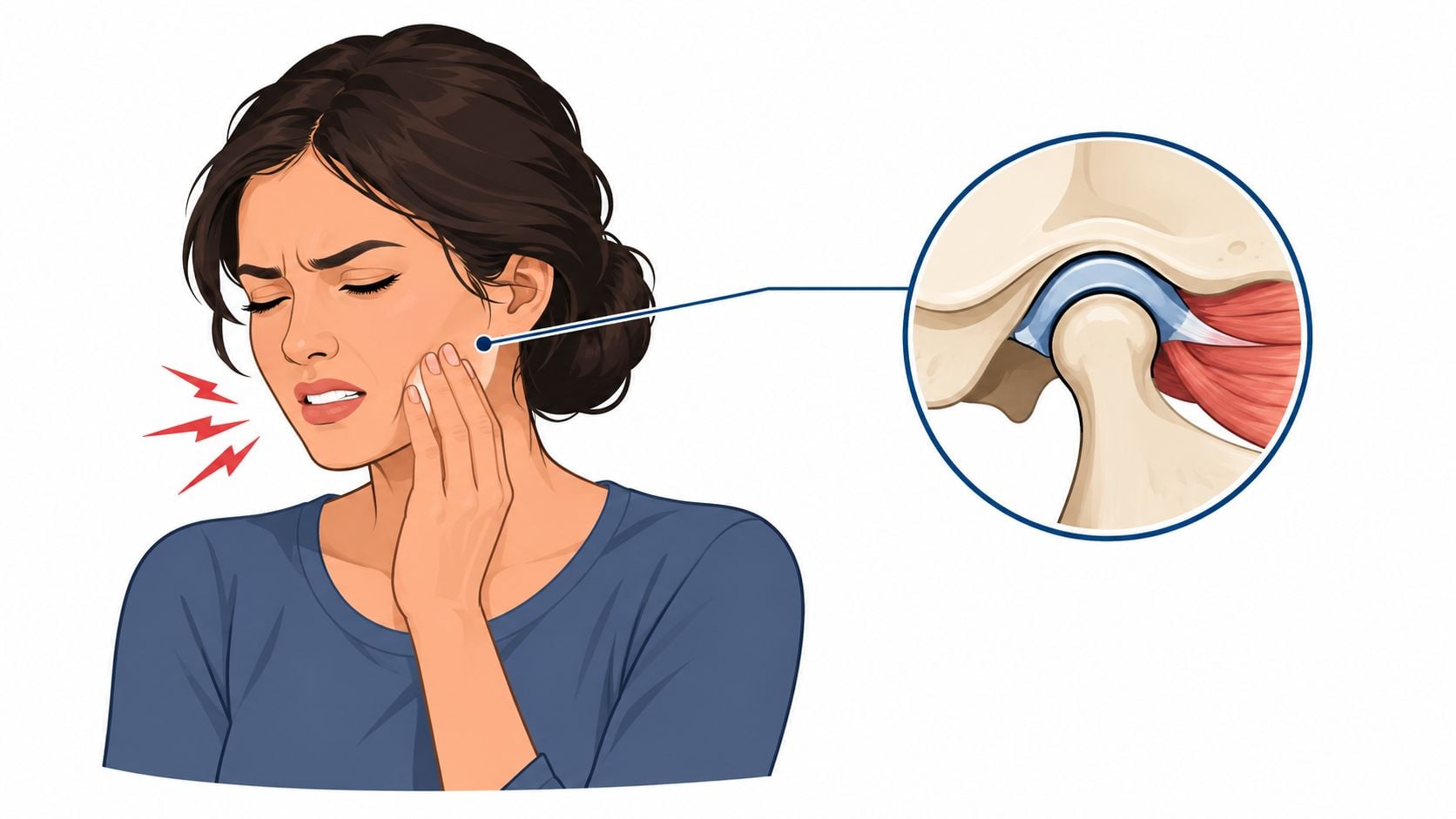
Professional evaluation is appropriate when jaw locking repeats, interferes with eating or speaking, causes notable pain, or changes the bite. A mouth stuck open requires prompt medical attention because a suspected dislocation may need timely reduction. A mouth stuck closed also deserves assessment, particularly when the limitation follows an injury or becomes progressively worse.
A thorough visit usually includes a symptom history and an examination of jaw movement, joint sounds, chewing muscles, bite, opening range, and the circumstances surrounding each episode. The clinician may ask whether locking happens during yawning, chewing, waking, stressful tasks, or sleep-related clenching. Imaging may be considered when the history and physical findings suggest that a closer view of the joint is needed.
The purpose isn't to rush a patient toward surgery. It's to identify the driver and choose the least invasive option that fits the findings. Depending on the situation, care may include movement guidance, habit changes, muscle-focused therapy, stabilization with an orthotic, coordinated dental or medical care, or adjunctive approaches such as low-level laser therapy for TMJ concerns.
Before an appointment, a person can record:
- The exact movement: Whether the episode follows a yawn, laugh, bite, dental procedure, or another wide opening.
- The lock position: Whether the mouth stays open, stays closed, or catches briefly.
- Associated symptoms: Pain, swelling, headaches, joint noise, muscle fatigue, bite changes, or speech difficulty.
- The recovery pattern: Whether the jaw returns to normal on its own or requires medical assistance.
A repeated pattern is useful clinical information. Early assessment can help distinguish a manageable joint noise from instability, muscle dysfunction, disc-related catching, or true dislocation.
Pain and Sleep Therapy Center evaluates TMJ, jaw, head, and facial pain with a root-cause focus and conservative care options before invasive treatment is considered. Readers in Newark and Wilmington, Delaware, Bryn Mawr, and the Philadelphia Main Line can visit Pain and Sleep Therapy Center to Request an Appointment or call (302) 239-1757.