
How can two clinicians examine the same mouth and reach opposite conclusions about tongue-tie? It happens often enough that parents and adults alike end up confused, and prevalence estimates reflect that confusion: depending on how a study defines and measures restriction, ankyloglossia has been reported in anywhere from a small fraction of the population to as many as one in five people. That kind of disagreement is the first clue that this is a condition defined as much by how a tongue moves as by how a band of tissue looks.
So why does one clinician describe an obvious tongue-tie while another finds nothing worth treating? Usually because they are measuring different things. One is grading the appearance of the frenulum. The other is testing what the tongue can do, then asking whether the person in front of them has a symptom that traces back to that limit. Those are two very different questions, and which one a clinician asks shapes everything that follows, from the diagnosis itself to whether any treatment is recommended at all.
Table of Contents
- What Ankyloglossia Is and How It Limits the Tongue
- Why It Happens and How Common It Is
- Signs of Tongue-Tie and When to Get Checked
- How Clinicians Assess Tongue Function
- Treatment Options from Feeding Support to Release
- What Release Involves and What the Evidence Shows
- Getting Evaluated in Newark and Bryn Mawr
What Ankyloglossia Is and How It Limits the Tongue
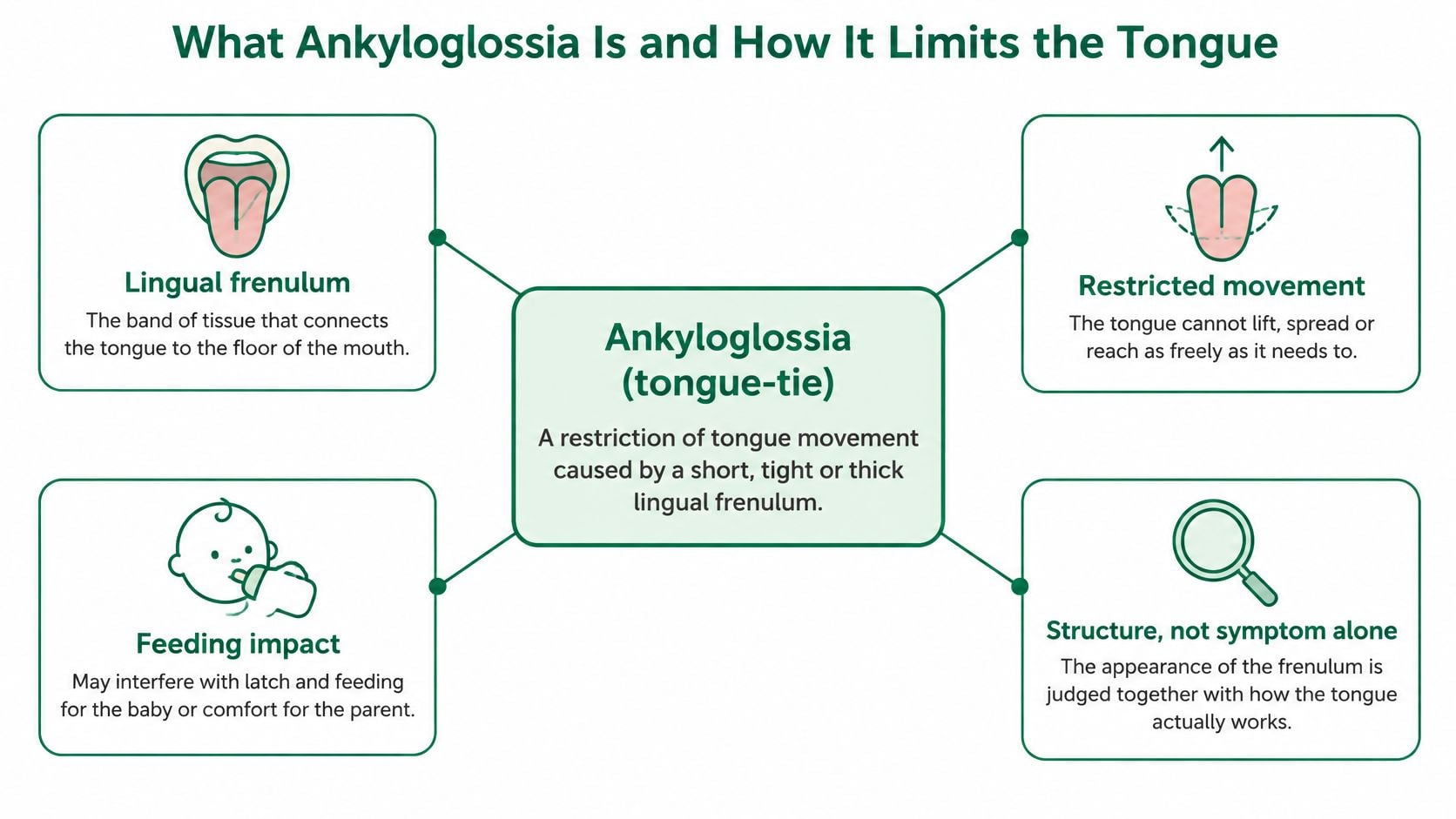
Ankyloglossia, usually called tongue-tie, is a restriction of tongue movement caused by a short, tight or thick lingual frenulum, the band of tissue that connects the underside of the tongue to the floor of the mouth.
The clearest way to picture it is a tongue on a short leash. A dog on a two-foot leash can still run, turn and sniff, but it can't reach the far side of the yard no matter how hard it pulls. A tongue with a tight frenulum behaves the same way. It can lift a little, spread a little, and reach forward a little, but the leash sets the limit. And here's the part that trips people up. The leash's appearance tells you very little about the reach. A thin, pale band can be brutally tight. A thick, prominent one can be loose enough that the tongue moves freely.
Everyone has a lingual frenulum. What varies from person to person is where it attaches, how long it is, how thick it is, and how far forward toward the tongue tip it runs. That variation is why ankyloglossia is better understood as a range of restriction than as one fixed condition with one fixed look.
Why the definition keeps shifting
There's no single agreed standard for what counts. A review of ankyloglossia definitions and prevalence describes it as a congenital or developmental restriction of tongue movement and notes that clinical studies have used anatomical features, such as a short frenulum or a heart-shaped tongue on protrusion, alongside functional signs, like the inability to extend the tongue beyond the gum line. The same review found five studies using different diagnostic criteria reporting prevalence from 4% to 10%, and concluded the spread reflects inconsistent definitions rather than real biological variation.
That's an important finding. Two studies can disagree about how common tongue-tie is without either being wrong about the patients in front of them. They drew the line in different places.
A heart-shaped notch at the tip when the tongue extends is one descriptive sign clinicians record. It happens because the tight band pulls the center of the tongue back while the sides move forward. It's a useful observation. It is not, by itself, a verdict.
The distinction that matters most: A visible frenulum alone is not a diagnosis. What matters is whether the tongue can lift, spread and reach far enough to do its job, and whether a real symptom traces back to that limit.
Why It Happens and How Common It Is
Tongue-tie is developmental: it's present at birth, and it isn't caused by anything a parent did or didn't do. The exact mechanism isn't fully understood. The frenulum's attachment and thickness differ from person to person, and some of those differences limit movement.
That leaves two separate questions: how often clinicians identify tongue-tie, and how often that finding causes difficulty. Reported rates depend on who gets examined and what counts as a case.
| Study or source | Population | Reported finding |
|---|---|---|
| Early newborn study (2000), reported in JAMA Otolaryngology | 1,041 newborns | 4.8% (50 infants); male-to-female ratio 2.6:1 |
| Canadian population study | Live births recorded across a population | Recorded diagnoses, rather than findings from examining every newborn |
| Spanish multicenter study | Newborns | Findings depend on the diagnostic criteria used |
| Hospital study | Infants | Findings reflect the infants assessed in that setting |
| Portuguese newborn study (2025) | Newborn participants | 13.8% (69 infants) |
| Multicenter birth-cohort study (2024) | Infants | 1.0% defined ankyloglossia; 4.8% suspected; 5.8% combined |
| Meta-analysis | Multiple studies | Estimates depend on the assessment tool and studies included |
Reading the table without getting fooled
A study's method acts like a filter. Examining newborns directly, counting recorded diagnoses and including suspected cases can produce different totals, even when each study is describing tongue-tie.
The Canadian population study and the early newborn study therefore answer somewhat different questions. One counts diagnoses recorded across a population; the other reports findings from newborn examinations. Comparing their totals as though the assessment process were identical would hide that distinction.
The birth-cohort results show another source of variation within the same group: confirmed and suspected findings are separate categories. Combining them broadens the count without establishing that every infant has the same degree of restriction or feeding difficulty.
Keep screening intensity, diagnostic thresholds, population characteristics and recording practices in mind. A larger total alone doesn't establish a greater need for treatment.
What the 34% figure actually says
A 2025 systematic review of 12 studies covering 8,538 infants estimated that 34% of infants with breastfeeding difficulties had ankyloglossia when both tongue-tie and feeding-difficulty assessment tools were used.
The denominator matters. These infants already had feeding problems, so that estimate cannot describe all babies. It also doesn't establish that tongue-tie caused every feeding problem or that every affected infant needed release.
For families, prevalence is background information rather than a treatment decision. The practical question is whether tongue movement is functionally affected and whether that limitation helps explain the difficulty being assessed. A visible frenulum, a suspected diagnosis and a restriction linked to symptoms shouldn't be treated as interchangeable findings.
Signs of Tongue-Tie and When to Get Checked
Symptoms look different at different ages, which is why parents and adults often get conflicting information. The visible band under the tongue can be part of the picture, but the practical question is whether tongue movement is working well enough for feeding, speech, breathing, posture, or comfort. Use the table as a starting lookup, then read the age notes below it.
| Age group | Common signs | Who can evaluate |
|---|---|---|
| Newborns and infants | Poor latch; prolonged feeds; persistent maternal nipple pain; inadequate milk transfer; heart-shaped tongue on extension | Pediatrician with lactation support |
| Children | Trouble with chewing, swallowing or tip-of-tongue speech sounds; mouth breathing; low resting tongue posture | Pediatrician, speech-language pathologist |
| Adults | Snoring, unrefreshing sleep, sleep-disordered breathing, head, neck or shoulder pain; restricted tongue mobility | Physician, sleep specialist, dental sleep medicine provider |
Infants
For feeding, function matters more than appearance. A Canadian Paediatric Society review recommends combining medical and feeding history with direct examination of tongue movement, and treats persistent nipple pain, prolonged feeds, poor latch and inadequate milk transfer as actionable findings.
For the nursing parent, the tip-off is often pain that doesn't settle after the first week or that returns, nipples that look compressed or creased after a feed, and a baby who feeds for a long time and still seems hungry. Another clue is a feed that seems to depend more on suction at the breast than on a steady, effective latch. Dr. Joanna Green specializes in infant and family oral health, including laser frenectomy and infant tongue tie care, for families working through exactly this picture.
Children and adults
In children, look for chewing that stalls on tough textures, swallowing that needs extra effort, mouth breathing, and speech sounds that stay imprecise at the tip of the tongue, particularly t, d, n and l. These signs matter most when they persist across ordinary tasks, such as meals, conversation, and rest, rather than showing up once during a rushed moment.
In adults, tongue-tie can contribute to sleep-disordered breathing, snoring, sleep apnea, and head, neck and shoulder pain. The tongue works like a steering wheel for the upper airway and the muscle pattern of the head and neck. When its resting position or range is restricted, breathing and muscular effort can be affected.
Pain and Sleep Therapy Center evaluates and treats tongue ties, which can include tongue tie release. In adults, tongue ties can cause sleep-disordered breathing, snoring, sleep apnea, and head, neck and shoulder pain. Lauren Reinholt teaches patients awareness of proper tongue placement, nasal breathing, and correct chewing and swallowing patterns through myofunctional therapy. Kate Bruni treats children and adults who have nasal breathing, oral rest posture, and chewing and swallowing difficulties.
When to act
- Babies: poor latch, slow weight gain, or any trouble breathing during feeds needs prompt review by a physician. Don't wait on a scheduled well visit for breathing concerns.
- Children: trouble with chewing, swallowing or speech sounds that lasts beyond the expected age is a reason to request an evaluation.
- Adults: loud snoring, unrefreshing sleep or persistent head and neck pain is a reason to talk with a physician or sleep specialist.
Bring a feeding or symptom log, the birth and medical history, and a written list of questions. For infants, note feed length, nipple pain, milk transfer, and whether the baby still seems unsettled after feeding. For older children and adults, write down when symptoms occur, what makes them better, and which daily tasks are affected. Sleep apnea is diagnosed through a sleep study and a physician, not by looking under the tongue.
Treat the appointment as a chance to gather evidence before choosing a path. The American Academy of Pediatrics states that surgery to prevent future speech problems or obstructive sleep apnea is not evidence-based, so prevention is not a reason to operate on appearance alone.
Practical rule: Bring the symptoms, timing, and functional changes you have observed, then ask what the examination adds to that picture. That gives the clinician something concrete to work with and helps keep the decision tied to the person, not just the anatomy.
How Clinicians Assess Tongue Function
Diagnosis is a structure-function assessment. No single bedside measurement reliably separates a merely prominent frenulum from clinically significant ankyloglossia, and a methodological review of assessment approaches found no well-validated diagnostic method, with prevalence across studies ranging from 4.2% to 10.7% depending on criteria.
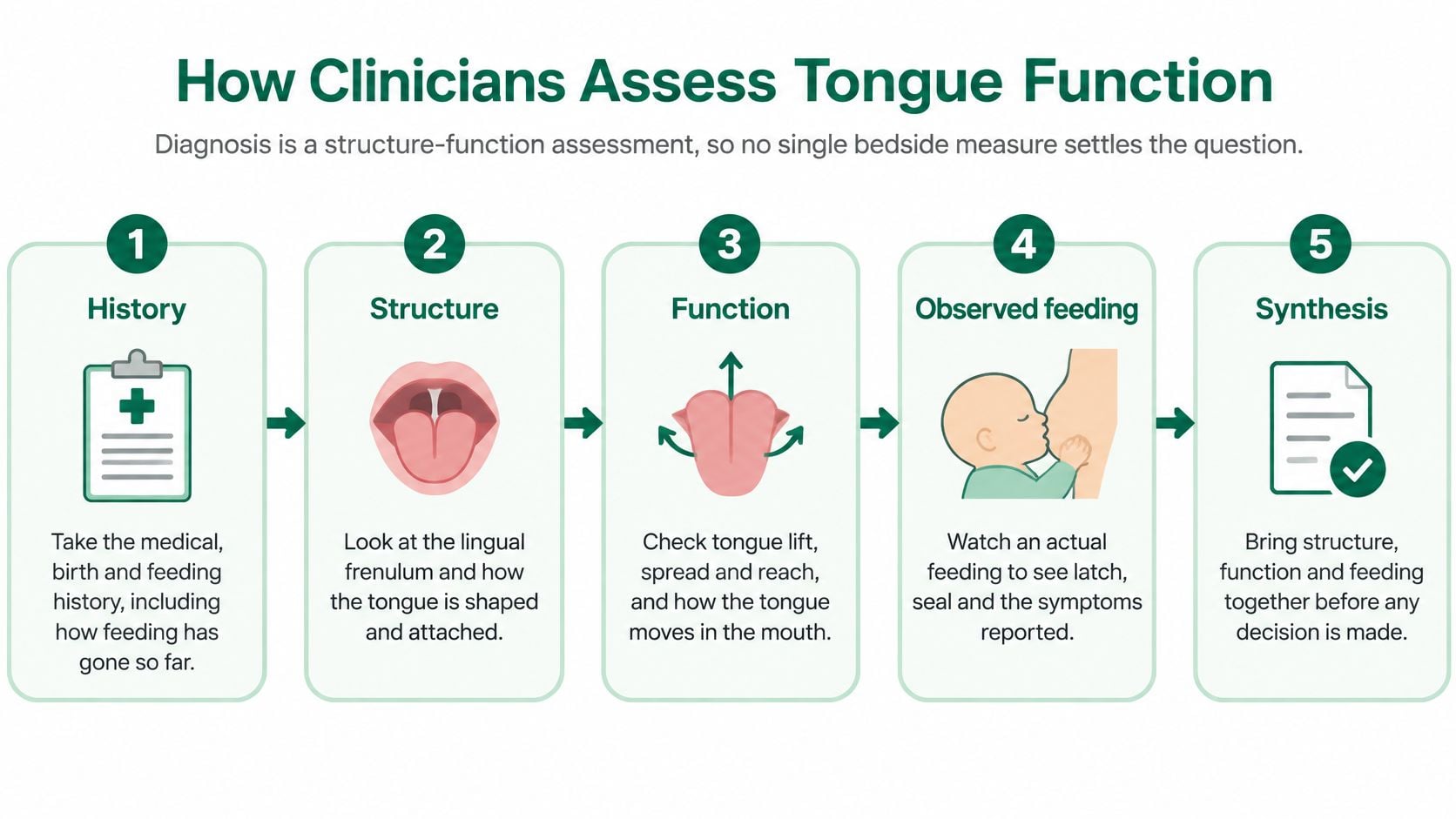
- History. Pregnancy, delivery, early feeding experiences, and the specific symptoms that prompted the visit. The complaint itself narrows what to look for, so a vague "check for tongue-tie" is less useful than "feeds take 50 minutes and the left nipple is cracked."
- Structure. Frenulum length, thickness and attachment point. This is the piece families see, and it's only one input.
- Function. Elevation toward the palate, protrusion past the gum line, and side-to-side movement. A tongue that lifts well and sweeps the molars is doing its job regardless of what the band looks like.
- Observed feeding. Watch a real feed for latch depth, suck pattern, milk transfer, and any nipple pain or trauma. This converts anatomy into evidence.
- Duration and growth. Feeding length, fatigue, choking, and weight gain, including pre- and post-feed weights when clinically indicated.
- Alternative explanations. Latch mechanics, oral-motor coordination, reflux, and other causes of the same symptoms need ruling out before the frenulum takes the blame.
- Documentation with a standardized tool. The Lingual Frenulum Protocol for Infants showed the strongest reported reliability and validity among reviewed tools. Commonly used systems such as Coryllos, Kotlow and the Hazelbaker Assessment Tool for Lingual Frenulum Function have not been shown to reliably predict who benefits from frenectomy, which is why a score never stands alone.
Adults follow the same logic with different symptoms. Findings get tied to specific complaints, such as snoring, jaw fatigue, or a tongue that can't clear food from the palate. For a closer look at how attachment location changes the picture, see this explanation of a posterior tongue tie.
A complete assessment report should contain documented findings, the functional impact in plain language, and a follow-up plan. Whether release belongs in that plan depends on evidence reviewed below.
Treatment Options from Feeding Support to Release
Options run from least invasive to most, and the right entry point is usually earlier in that sequence than families expect.
| Option | Typical use | Key consideration |
|---|---|---|
| Skilled feeding or lactation support | Infants with breastfeeding difficulty; usually the first step | Recommended before release is considered, per AAP guidance |
| Myofunctional therapy | Children and adults with chewing, swallowing, tongue posture or breathing concerns | Works on movement patterns over time; results vary by person |
| Frenotomy or frenectomy (clip or laser) | Clearly restrictive frenulum with persistent breastfeeding dysfunction despite skilled support; selected adults with documented functional limits | Individualized decision; technique choice based on clinical judgment and follow-up |
| Monitoring and follow-up | Infants who feed normally or cases that remain unclear | Many infants with a visible frenulum need no intervention |
Start with feeding support
When breastfeeding hurts or a baby isn't gaining, a lactation consultant or feeding specialist can adjust positioning, latch depth and pacing. Some of these problems resolve completely with that help, which is why the American Academy of Pediatrics frames nonsurgical options first. A useful resource for understanding what a lactation consultant does with a painful latch is this guide to fixing a painful latch, which walks through the assessment and the adjustments that come before any procedure is discussed.
Myofunctional therapy for older children and adults
Myofunctional therapy trains tongue posture, nasal breathing, and chewing and swallowing patterns. It's slow, deliberate work with measurable checkpoints. Lauren Reinholt teaches patients awareness of proper tongue placement, nasal breathing, and correct chewing and swallowing patterns through myofunctional therapy, and Kate Bruni, a Pennsylvania licensed speech-language pathologist with a Certificate in Clinical Competence through ASHA, treats children and adults with nasal breathing, oral rest posture, and chewing and swallowing difficulties.
Release, when the findings support it
Frenotomy, the division of the lingual frenulum, is not automatically indicated for every visible tongue-tie. An AHRQ systematic review of nonbreastfeeding outcomes located only two randomized trials, two cohort studies and 11 case series covering speech, social effects and feeding beyond breastfeeding, and concluded the data were insufficient to determine benefit for those outcomes. Current tools also haven't established a reliable relationship between how severe a tongue-tie looks and who will benefit from release.
That leaves individualized judgment based on documented functional limits, the alternatives tried, and the risks accepted. Recovery and aftercare matter as much as the procedure itself, so plan for the follow-up schedule described in this guide to lingual frenectomy recovery.
Three questions worth asking any provider: Which specific symptom does this option target? What follow-up is planned and when? How will we measure whether it worked?
What Release Involves and What the Evidence Shows
The common assumption is that laser release is automatically better, safer and more precise than a clip. It sounds modern and it's repeated often. The evidence doesn't back the claim as stated.
A 2025 systematic review of the ankyloglossia literature identified 462 publications but only 13 randomized controlled trials, which is 2.8% of the included literature, and concluded that publication volume has grown faster than evidence resolving the key controversies. The AAP reports no comparative evidence supporting routine laser frenotomy over clipping in infants younger than six months, and cites insufficient evidence that any technique is superior. Laser is a technique choice that requires individual clinical judgment. It isn't safer or more effective.

The sequence, step by step
- Confirm the functional need. Evaluation and documented feeding or symptom problems come first, not the calendar.
- Discuss technique. Clip release or laser release, with the tradeoffs of each explained in plain terms.
- Review risks. Bleeding, pain, and the possibility that the frenulum reattaches are the main concerns. Effects on the bite and jaw joint are possible and less well studied. Every possible precaution is taken to prevent harm to the patient's occlusion and TMJ, but some consequences in these areas are still possible.
- Perform the release. Usually a short in-office procedure.
- Check at follow-up. Feeding, comfort and tongue movement get reassessed rather than assumed.
- Continue prescribed exercises. Stretching or therapy as directed by the treating provider supports healing and function.
What the research still can't answer
Most studies measure short-term outcomes such as maternal nipple pain scores or feeding ratings. Breastfeeding duration, exclusive breastfeeding rates, speech, sleep and long-term oral function are far less firmly established. That's a real limitation, not a marketing gap, and it's why a release shouldn't be sold as prevention for problems that may never appear.
In the first days after a release, watch feeding changes, any bleeding, and signs the tissue may be reattaching, such as the tongue losing range it had gained. Call the treating provider with questions rather than waiting for the next scheduled visit. Adults considering release can read more about laser frenectomy for adults and what recovery involves at that age.
Getting Evaluated in Newark and Bryn Mawr
A visible frenulum at home tells you very little on its own. What matters is whether the tongue can do its jobs, and answering that takes a structured evaluation. Pain and Sleep Therapy Center is a TMJ, craniofacial pain and dental sleep medicine practice that evaluates tongue-tie and offers tongue-tie treatment, which can include laser frenectomy. Pediatric airway and tongue-tie care for infants and children is delivered through a specialized partner center, while adults are evaluated at the practice directly. Care is root-cause focused, with conservative and non-invasive options considered before surgery. The practice is led by Dr. Ryan Robinson, who is triple board-certified in craniofacial pain and dental sleep medicine.
Offices are located in Newark, Delaware and Bryn Mawr, Pennsylvania.
What the visit covers
An evaluation typically includes a medical and feeding history, a review of the symptoms that prompted the visit, an examination of tongue structure and movement, and a written plan with follow-up. Structure and function get assessed together, because a frenulum that looks prominent may move freely while a subtle one may restrict. That distinction is exactly why appearance alone never settles the question.
For adults, the same visit can connect tongue mobility to snoring, sleep-disordered breathing or head, neck and shoulder pain. An evaluation doesn't promise treatment or a particular result. Sleep apnea is a medical condition diagnosed through a sleep study and a physician, not in a dental chair, and because it is a medical condition, only medical insurance covers its treatment with a dental device, subject to the patient's annual medical insurance deductible.
If you're unsure whether sleep is part of the picture, the online sleep quiz can help you decide whether a conversation with a physician about a sleep evaluation is worth having.
To schedule, Request an Appointment or Take our Sleep Quiz through the practice website.
Pain and Sleep Therapy Center evaluates tongue-tie across the lifespan, from infants with feeding difficulty (through its specialized partner center) to adults whose tongue mobility may be contributing to snoring, sleep-disordered breathing or head and neck pain. A root-cause evaluation with Dr. Ryan Robinson and the team starts with structure, function and symptoms together, so any decision about care follows documented findings rather than appearance alone. Given how much of the evidence on diagnosis and release remains uncertain, that discipline protects you. Visit Pain and Sleep Therapy Center to request an appointment at the Newark, Delaware or Bryn Mawr, Pennsylvania office.