If a tight band of tissue under the tongue has been there since birth, why do so many adults only hear about it after years of snoring, jaw tension, or morning headaches? That gap is where most confusion about laser frenectomy for adults begins. A frenectomy releases the frenulum, the small band of tissue that tethers the tongue to the floor of the mouth (a tongue tie, or ankyloglossia) or the lip to the gum (a lip tie).
Two separate questions get tangled together. The first is about the procedure itself: does a laser make the release quicker, less bloody, and more comfortable than a scalpel? The second is about function: will releasing that tissue change how a person breathes at night, swallows, speaks, or feels in the jaw? Research answers the first question far better than the second, and adults deserve to hear both answers plainly.
Table of Contents
- Laser and Scalpel Frenectomy Compared at a Glance
- What Laser Frenectomy Can and Cannot Address in Adults
- Signs That Justify an Adult Tongue-Tie Evaluation
- How the Laser Frenectomy Procedure Works Step by Step
- Recovery Timeline and Aftercare Exercises for Adults
- Risks, Limits and Questions to Ask Before Treatment
- Request an Appointment to Confirm Your Next Step
Laser and Scalpel Frenectomy Compared at a Glance
A 2024 randomized clinical trial of 26 adults undergoing maxillary labial frenectomy, published by researchers from Jundishapur Dental School of Ahvaz, recorded a mean procedure time of 341.46 seconds with a diode laser compared with 675.00 seconds for conventional surgery. The table below sets that finding beside pooled results from a broader review.
| Outcome | Laser frenectomy | Scalpel frenectomy | Evidence note |
|---|---|---|---|
| Procedure time (maxillary labial frenectomy) | 341.46 seconds (mean) | 675.00 seconds (mean) | 2024 randomized trial of 26 adults |
| Postoperative analgesic use | 5% of patients needed analgesics | 92.5% of patients needed analgesics | Systematic review of 10 studies |
| Postoperative complications | 2 cases across the review | 1 case across the review | Uncommon in both groups |
| Sutures | Often not required | Commonly required | Varies by case and protocol |
| Intraoperative bleeding | Reduced, because laser coagulates small vessels | Standard bleeding | Consistent across reviewed studies |
The analgesic and complication figures come from a 2022 systematic review in the Journal of Oral Medicine and Oral Surgery, which synthesized 10 clinical studies involving 375 patients, with follow-up periods ranging from 7 days to 3 months.
How to read these numbers
Translated into a real appointment, the time difference means roughly six minutes in the chair instead of eleven for that particular lip procedure. The analgesic gap means most laser patients in those studies didn't reach for pain medication at all, while nearly all scalpel patients did. Fewer stitches means one less visit and nothing to work around while brushing.
The instrument is a detail. The diagnosis is the decision.
Caution belongs beside every row. The studies were small, protocols differed, and outcomes were defined in different ways, so the results point to possible advantages rather than guaranteed ones. Laser type matters too: in a 2024 randomized controlled trial published in the Journal of Clinical Pediatric Dentistry, adult frenectomy patients reported mean day-one pain scores of 1.1 ± 1.1 with a diode laser and 1.9 ± 1.4 with an Er:YAG laser.
Adults exploring light-based care sometimes also read about deep tissue laser treatment in Sandy, which applies a different class of laser to muscle and joint discomfort rather than cutting soft tissue. Same word, different job. The right choice for a frenulum release rests on an individual exam, not on the instrument alone.
What Laser Frenectomy Can and Cannot Address in Adults
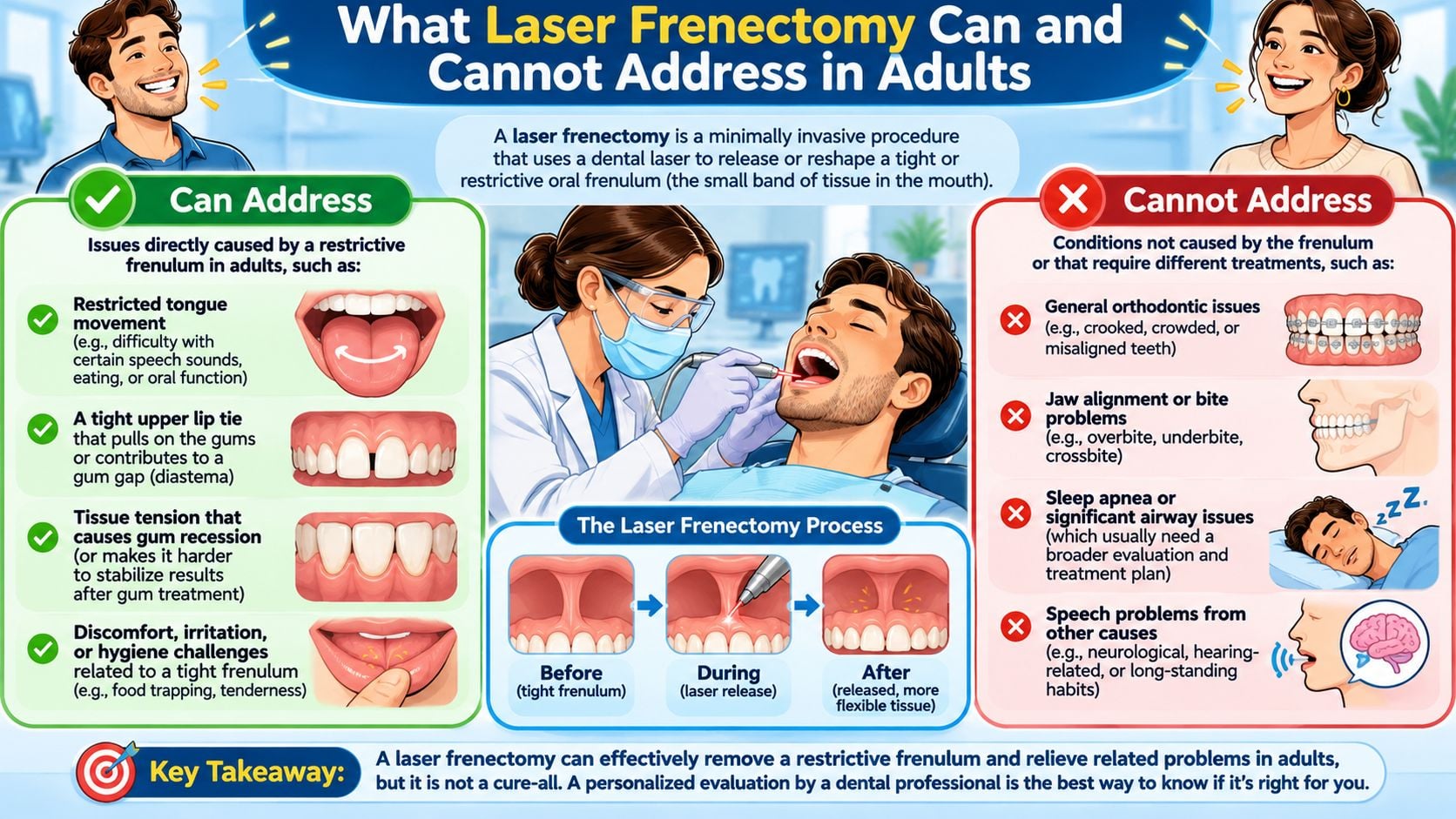
The most common assumption sounds reasonable: a tight tongue pulls backward during sleep, so cutting it free should stop the snoring. In adults, tongue ties can cause sleep-disordered breathing, snoring, sleep apnea, and head, neck and shoulder pain. That's a real clinical link. It isn't a promise that one release resolves those problems.
Why function needs its own plan
A 2022 systematic review on laser treatment for ankyloglossia emphasized that laser release doesn't remove the need for postoperative myofunctional exercises (targeted drills that retrain tongue posture, swallowing, and breathing) or collaboration with a speech therapist. Adults have spent decades compensating. Say a person has always swallowed by pressing the tongue forward against the front teeth instead of lifting it to the palate. Release the band, and that habit is still there the next morning, now with more room to move but no new instructions.
The same review noted practical limits: laser work requires specialized, relatively expensive equipment, operators trained in laser safety, and protective eyewear for the patient, caregiver, clinician, and assistant. Those requirements shape who should perform the procedure, not whether the tissue needs releasing.
Releasing a restriction changes what the tongue can do. Retraining changes what it actually does.
Root cause first, and a clear boundary on diagnosis
Sleep apnea is diagnosed through a sleep study interpreted by a physician, not by a mouth exam or a frenectomy. Jaw pain, headaches, and facial pain call for their own assessment of jaw function, bite, and joint symptoms. At Pain and Sleep Therapy Center, Dr. Ryan Robinson, triple board-certified in craniofacial pain and dental sleep medicine, aims to help people avoid invasive, surgical procedures whenever possible.
That means starting with a root-cause evaluation and conservative care, including oral appliance therapy as a CPAP alternative, lifestyle changes, and breathing retraining. CPAP delivers steady air pressure through a mask and helps many patients; it isn't something to abandon on a hunch. When physical barriers in the airway prevent CPAP and oral appliances from helping, the center works with the appropriate physician to create a plan for the best possible outcome. A release may help when examination shows meaningful restriction tied to the person's symptoms, and nothing more should be claimed for it.
Signs That Justify an Adult Tongue-Tie Evaluation
| Concern | What an evaluation checks | Who may need to be involved |
|---|---|---|
| Snoring, loud breathing or unrefreshing sleep | Airway, tongue range and sleep study results | Sleep physician with a dentist trained in sleep medicine |
| Speech difficulty linked to tongue movement | Tongue lift, range and speech patterns | Speech-language pathologist and a dentist |
| Difficulty chewing or swallowing | Tongue posture and chewing and swallowing patterns | Feeding or swallowing therapist and a dentist |
| Jaw pain, headaches or facial pain | Jaw function, bite and joint symptoms | Dentist trained in TMJ and craniofacial pain |
Each row exists because the same symptom can come from several places. Morning headaches might track with disrupted breathing, with clenching, or with both. Matching the concern to the right evaluation keeps a person from having tissue released for a problem that lives somewhere else.
Signs worth writing down before a visit
- Movement limits: the tongue won't lift to the roof of the mouth or sweep side to side comfortably.
- Shape clues: a notched or heart-shaped tip when the tongue is extended.
- Speech and eating: certain sounds take extra effort, or chewing and swallowing feel awkward.
- Night and morning patterns: loud snoring, sleep that doesn't refresh, headaches on waking.
- Ongoing pain: jaw or facial discomfort that keeps returning.
A thorough exam looks at tongue range and resting posture, frenulum anatomy, speech and swallowing patterns, bite and jaw function, and sleep testing when breathing is a concern. Readers who want a fuller symptom checklist can review this overview of tongue tie symptoms in adults before booking.
No article can diagnose a condition, and only an examination can judge whether a restriction is clinically meaningful. At Pain and Sleep Therapy Center, patients are seen by a dentist with advanced training in treating sleep apnea, and the treatment goal is the least invasive treatment that's both effective and something the patient can stick with.
Two questions sharpen the decision. Does the restriction match the symptoms present? And would non-surgical options be worth trying first?
How the Laser Frenectomy Procedure Works Step by Step
Adults rarely know what happens between sitting down and walking out. Here's the sequence a careful clinician follows, with the reason behind each step.
- Review history, goals, and symptoms. The clinician confirms whether the person may be a candidate and obtains informed consent covering both the possible benefits and the limits. Consent that skips the limits isn't informed.
- Measure the restriction. The examiner records how far the tongue or lip moves and how the frenulum limits it, creating a baseline for comparison at follow-up.
- Numb the area. Local anesthetic goes in before any cutting, so the release itself isn't felt as sharp pain.
- Set up safety and settings. Eye protection for patient and staff, high-volume suction, and a documented wavelength and power. According to a review of diode laser frenectomy evidence, diode lasers commonly studied at 980 nm and also evaluated at 445 nm cut soft tissue and coagulate small vessels at the same time, which explains the reduced bleeding and the frequent ability to skip sutures.
- Keep the fiber moving. A steady pass through the frenulum matters, because lingering in one spot can char tissue and delay healing.
- Confirm bleeding is controlled. In many cases no sutures are needed, which shortens the visit and simplifies the first week.
- Hand over written aftercare and arrange therapy. Exercises, cleaning instructions, and any speech or myofunctional referral are set before the patient leaves.
What the evidence supports about technique
That same review describes a randomized trial of 174 maxillary labial frenectomy patients with lower immediate and day-7 pain, less chewing and speaking discomfort, and faster early tissue healing after diode-laser treatment than after scalpel surgery. A separate randomized study including patients aged 14 to 51 years found less subjective discomfort and fewer functional complications with a 980-nm diode laser.
Practical rule: ask which wavelength and settings will be used, and ask how the operator was trained, because thermal injury risk depends on power, pulse mode, fiber movement, tissue thickness, and technique.
A good result looks like a healing site plus improved tongue range confirmed by the examiner. Speech and swallowing get assessed separately, on their own schedule.
Recovery Timeline and Aftercare Exercises for Adults
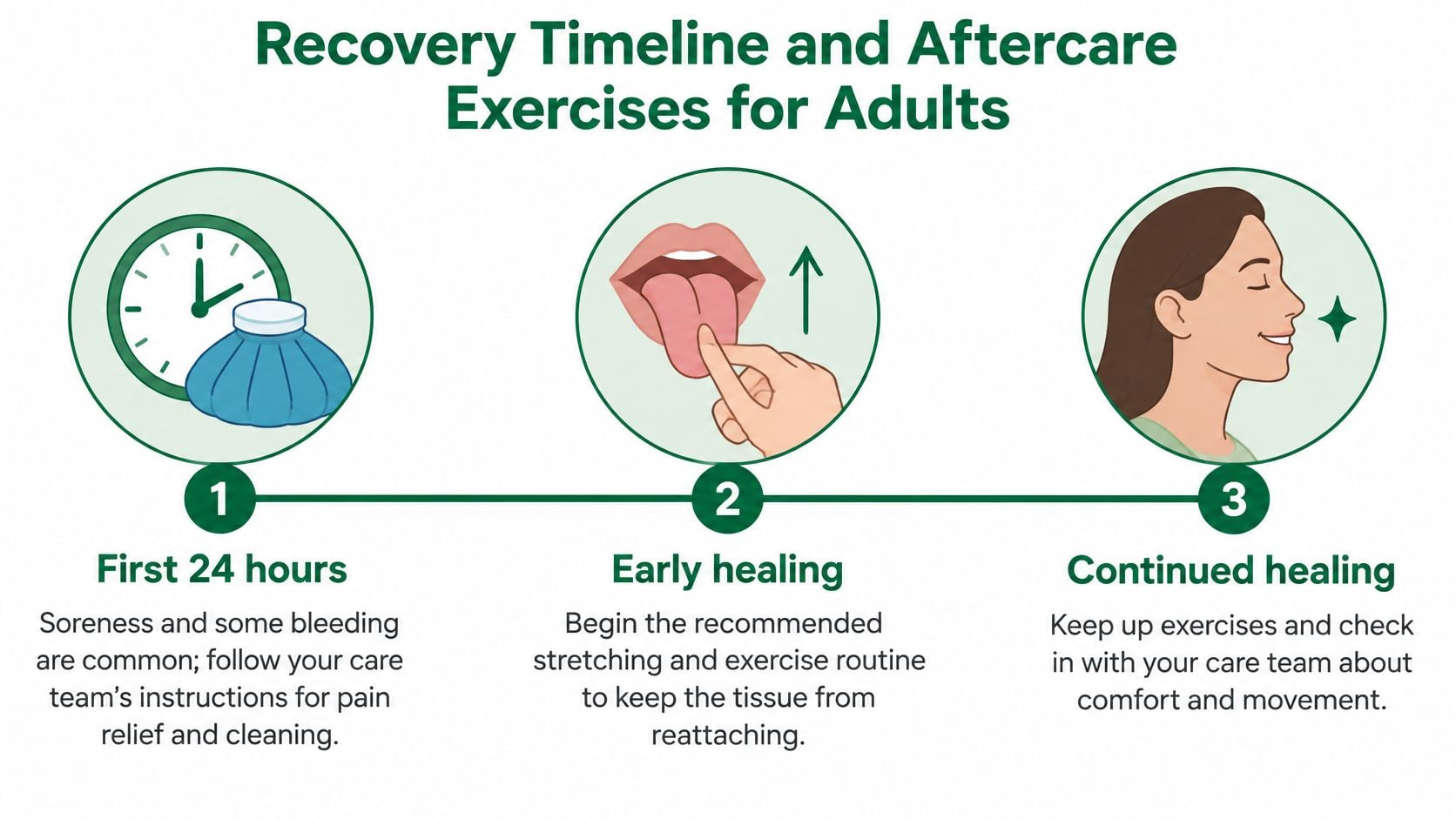
The first 24 hours are usually the most noticeable. Soreness and some bleeding are common, and pain relief and cleaning should follow the care team's written instructions rather than advice from a forum. Soft foods, gentle brushing away from the site, and no poking at the wound with the tongue are sensible defaults until the clinician says otherwise.
| Stage | What to expect | What to do |
|---|---|---|
| Days 2 to 7 | Early healing underway; the wound looks raw but tissue is closing | Begin prescribed stretching or myofunctional exercises as directed |
| Weeks 3 to 6 | Tissue healing typically completes within this window in reported cases | Continue exercises and report slow healing |
| Beyond 6 weeks | Speech, swallowing and sleep changes vary from person to person | Reassess function with the care team |
Healing and function run on different clocks
A published laser case report described healing progressing at 1 week and complete by 3 to 6 weeks, with tongue mobility increasing by at least 16 mm and speech improving after speech therapy. Comparative research in this literature points in the same direction: the tissue itself tends to finish healing within about a month, even when early healing pace differs between laser and scalpel techniques.
The wound closing is only half the story. Think of the release as loosening a stiff hinge: the hardware moves freely right away, but the muscle still has to learn a new way of swinging. The tongue has spent years compensating for restricted movement, so speech, swallowing, and nighttime breathing keep shifting after the site looks finished. That is why function gets reassessed rather than assumed, and why the exercises matter. Each stretch teaches the tongue to use its new range before the tissue tightens again, and adults who keep their exercises and follow-up visits give that range a chance to become a habit. Detailed guidance on lingual frenectomy recovery covers the day-by-day routine.
Warning signs to report
- Pain that grows instead of easing after the first days.
- Bleeding that doesn't stop with the instructed pressure.
- Signs of infection, such as spreading redness, pus, or fever.
- Tissue reattaching or tightening, which shows up as shrinking tongue movement.
- Changes in feeling in the lip or tongue.
A typical week-3 question sounds like this: a patient notices a sore spot and worries the tissue has reattached. Usually it has not. Tenderness during healing is expected, while reattachment shows up differently, as tongue movement that shrinks week over week rather than soreness at the site. Measuring range of motion at follow-up visits separates the two, which is one reason those appointments are part of treatment rather than an optional extra. Report any discomfort that interferes with eating or speech, and let the care team judge whether what you feel is normal healing or a reason to adjust the plan.
Risks, Limits and Questions to Ask Before Treatment
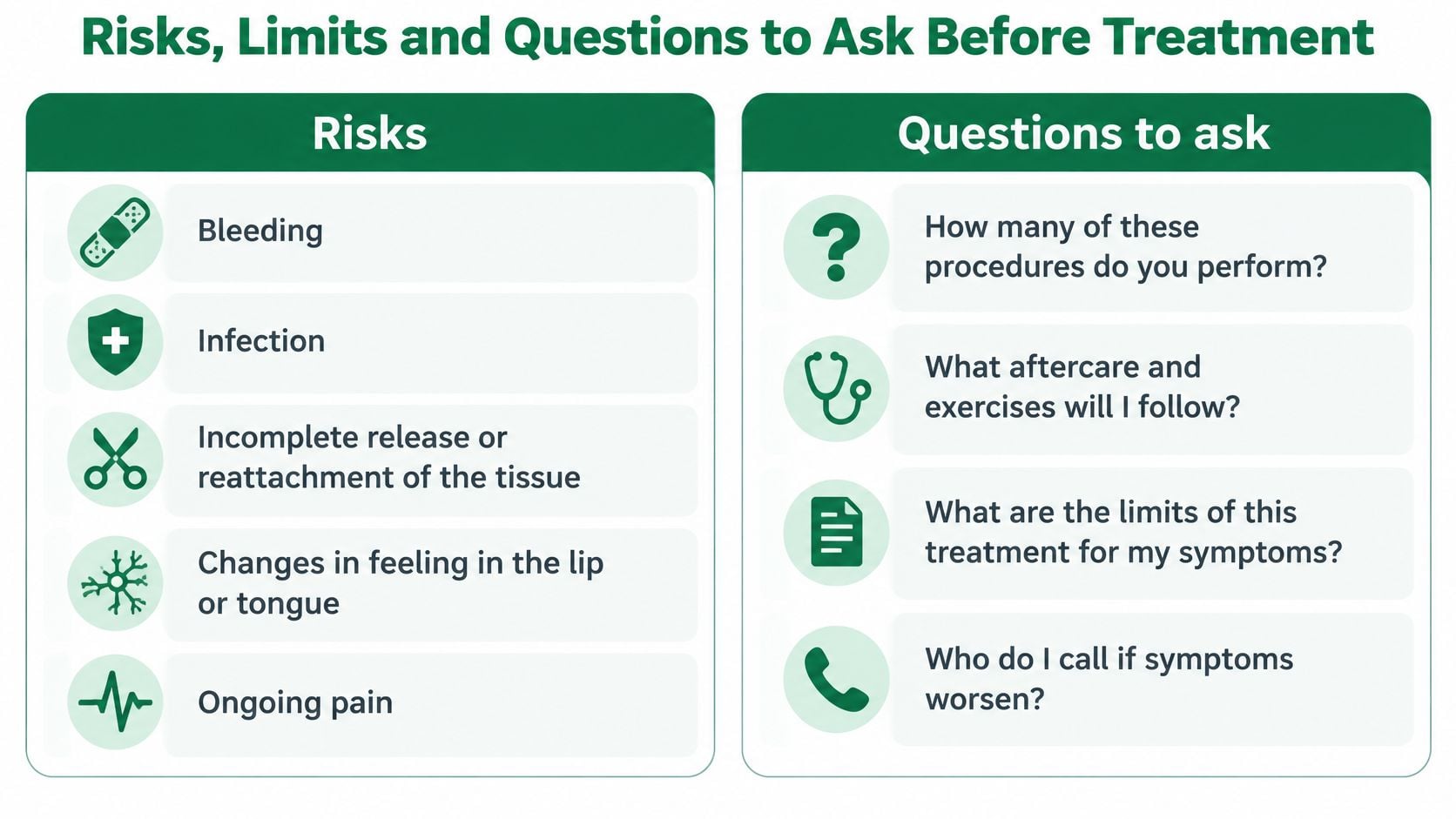
The risks are straightforward: bleeding, infection, incomplete release or reattachment of the tissue, changes in feeling in the lip or tongue, and ongoing pain. A systematic review of laser versus conventional frenectomy found that laser treatment generally shortens operative time, reduces early pain and discomfort during speech or chewing, and often eliminates suturing, while rating the evidence as limited because of high risk of bias and heterogeneous protocols. Fewer burdens, not zero risk.
Every possible precaution is taken at Pain and Sleep Therapy Center to prevent harm to the patient's occlusion (the way the teeth meet) and TMJ, the temporomandibular joint that hinges the jaw to the skull, but some consequences in these areas are still possible. That's a consent conversation worth having out loud. Reduced bleeding and pain also aren't evidence that a release treats snoring, sleep apnea, headaches, or TMD, so a release belongs on the table only when examination shows restriction linked to the person's goals. Practical planning questions, including those gathered around tongue tie laser surgery cost, are best raised before anything is scheduled.
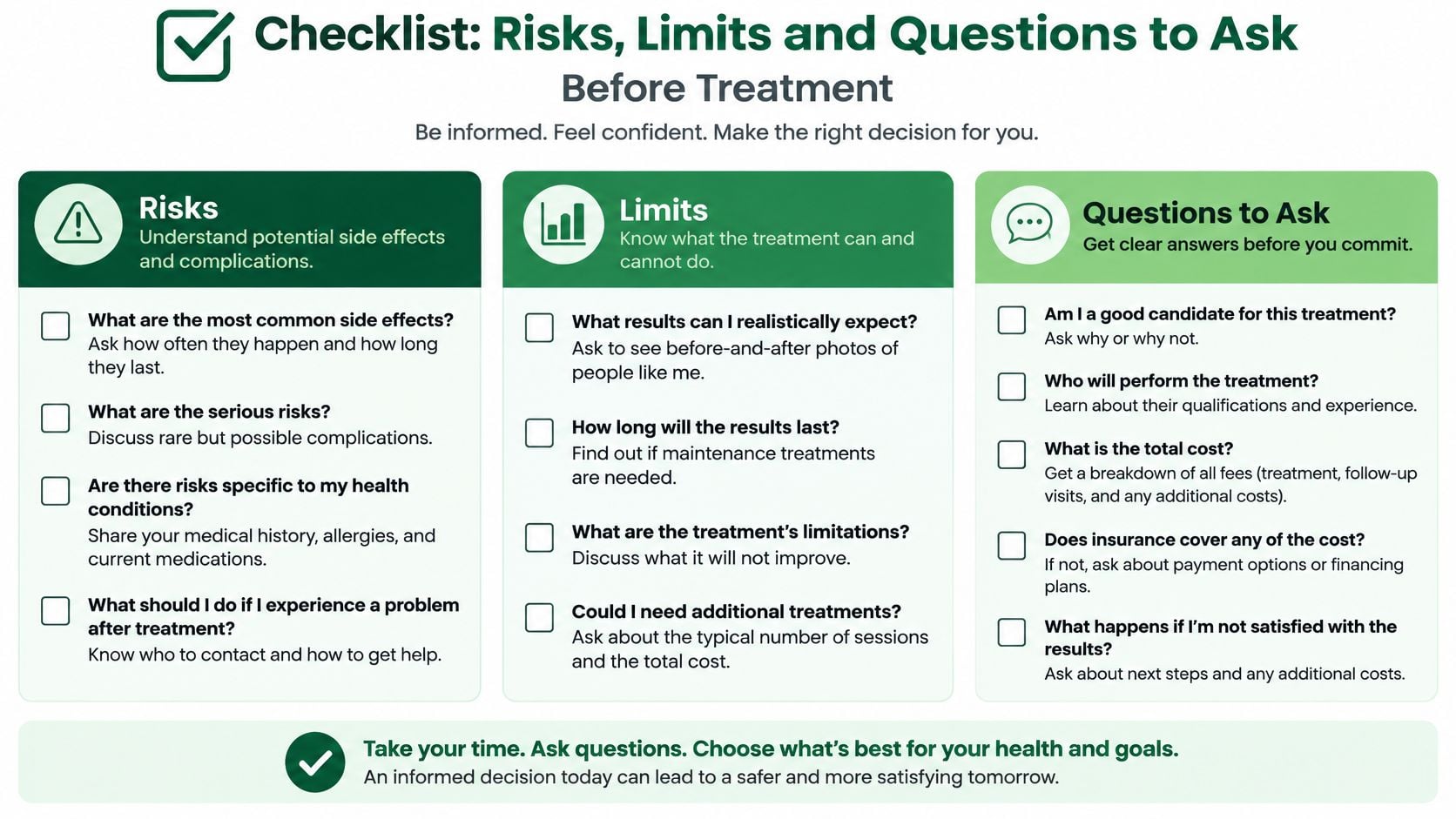
Bring these questions to the consultation: which laser and settings will be used; who performs the procedure and what training they have; what aftercare and therapy referrals are included; how healing and function will be checked; what happens if symptoms persist; and which non-surgical options were considered first.
Clear, unhurried answers signal a care team looking at the whole picture rather than at one band of tissue.
Request an Appointment to Confirm Your Next Step
The useful next action isn't booking a procedure. It's booking an evaluation, so the root cause gets identified before any treatment decision is made. A first visit at Pain and Sleep Therapy Center is about understanding the problem: what the tongue can and can't do, how the jaw and airway are functioning, and which conservative options deserve a trial first. That order matters, because the center's goal is the least invasive, least expensive treatment that is both effective and realistic for the patient to follow, and Dr. Robinson aims to help people avoid surgical procedures whenever possible.
Booking is simple. Patients can request an appointment online by choosing a preferred office, either Newark, DE or Bryn Mawr, PA, and stating whether they're a new or existing patient. Bringing a written list of symptoms, when each one started, and any sleep history makes that first conversation far more productive.
If snoring or unrefreshing sleep is the main concern, the center's Sleep Quiz is an optional first step that helps frame the conversation before anyone sits down in the chair.
So what does that first visit cover? The tongue's resting posture and range of motion. The way the teeth meet and how the jaw joints behave. Breathing patterns during sleep, and any history of head, neck, or shoulder pain. Each piece gets mapped against the symptoms that brought the person in, because a tongue tie only belongs on the treatment table when examination connects a restriction to those specific complaints. Sometimes the answer is a release with structured aftercare. Sometimes it's myofunctional therapy, an oral appliance, or a combination. Sometimes the exam points away from the tongue entirely, and that answer is just as valuable.
Pain and Sleep Therapy Center evaluates TMJ and craniofacial pain, snoring and sleep apnea, and tongue ties in infants, children, and adults, with laser frenectomy considered only when an exam shows a restriction that matches the person's symptoms. Adults weighing a tongue-tie release can start with a root-cause evaluation and a plain conversation about what a release may and may not change. Visit Pain and Sleep Therapy Center to request an appointment or take the Sleep Quiz.