
Could a blocked ear come from the jaw, and does a normal ear exam settle the question? TMJ and ear fullness can be connected, but neither jaw pain nor a normal-looking eardrum proves where the pressure starts. The safest approach considers the jaw and the ear together.
TMJ means temporomandibular joint, the joint connecting the lower jaw to the skull just in front of each ear. TMD, short for temporomandibular disorders, describes conditions affecting those joints, the chewing muscles, and nearby tissues. Understanding that difference helps patients describe symptoms without assuming a diagnosis.
Table of Contents
- How Often Ear Fullness Appears With TMD
- How a Jaw Problem Can Be Felt in the Ear
- Jaw Clues You Can Track at Home
- Other Causes That Can Mimic TMJ Ear Fullness
- Red Flags That Need Prompt Medical Care
- How a TMJ and Ear Evaluation Unfolds
- Conservative Care Options and What the Evidence Shows
- Schedule a Jaw and Ear Evaluation
How Often Ear Fullness Appears With TMD
Ear fullness is one of the most frequently reported ear symptoms among people with TMD. Patients may describe it as pressure, stuffiness, a plugged ear, or a feeling similar to being underwater. The sensation is real, even when its source isn't immediately clear.
A 2016 systematic review and meta-analysis of studies using standardized TMD criteria reported the pooled rates below, including ear fullness in 74.8% of reported cases, with study estimates ranging from 43.02% to 96.25%. The patient counts show how much information supported each estimate.
Ear symptoms reported in TMD research
| Ear symptom | Pooled rate in TMD studies |
|---|---|
| Ear fullness | 74.8%, based on 50 patients; studies ranged from 43.02% to 96.25% |
| Ear pain | 55.1%, based on 386 patients |
| Tinnitus | 52.1%, based on 1,293 patients |
| Vertigo | 40.8%, based on 374 patients |
| Hearing loss | 38.9%, based on 744 patients |
Tinnitus means hearing ringing, buzzing, or another sound without an outside sound source. Vertigo is a sensation of spinning or movement. Reported hearing loss in this table describes symptoms in the included study populations, not proof that jaw dysfunction caused measurable hearing damage.
What these findings mean for an individual patient
The fullness estimate came from selected clinical research groups, not everyone living with TMD. Its wide range and relatively small patient count make it unsuitable as a personal prediction. Differences in patient selection and assessment methods can produce very different results.
The central finding is more useful than any single percentage: ear complaints deserve attention during a jaw evaluation. A clinician who hears only about clicking may miss the patient's main concern, while a clinician who hears only about ear pressure may not know that chewing also hurts.
Association also isn't the same as causation. A patient can have TMD and a separate ear condition at the same time, just as a person can have both a headache and an unrelated sinus problem.
For someone whose blocked ear occurs alongside jaw pain, clicking, or headaches, the practical next step is to describe the whole pattern. Both areas need consideration rather than treating the ear sensation as an isolated complaint or automatically assigning it to the jaw.
How a Jaw Problem Can Be Felt in the Ear
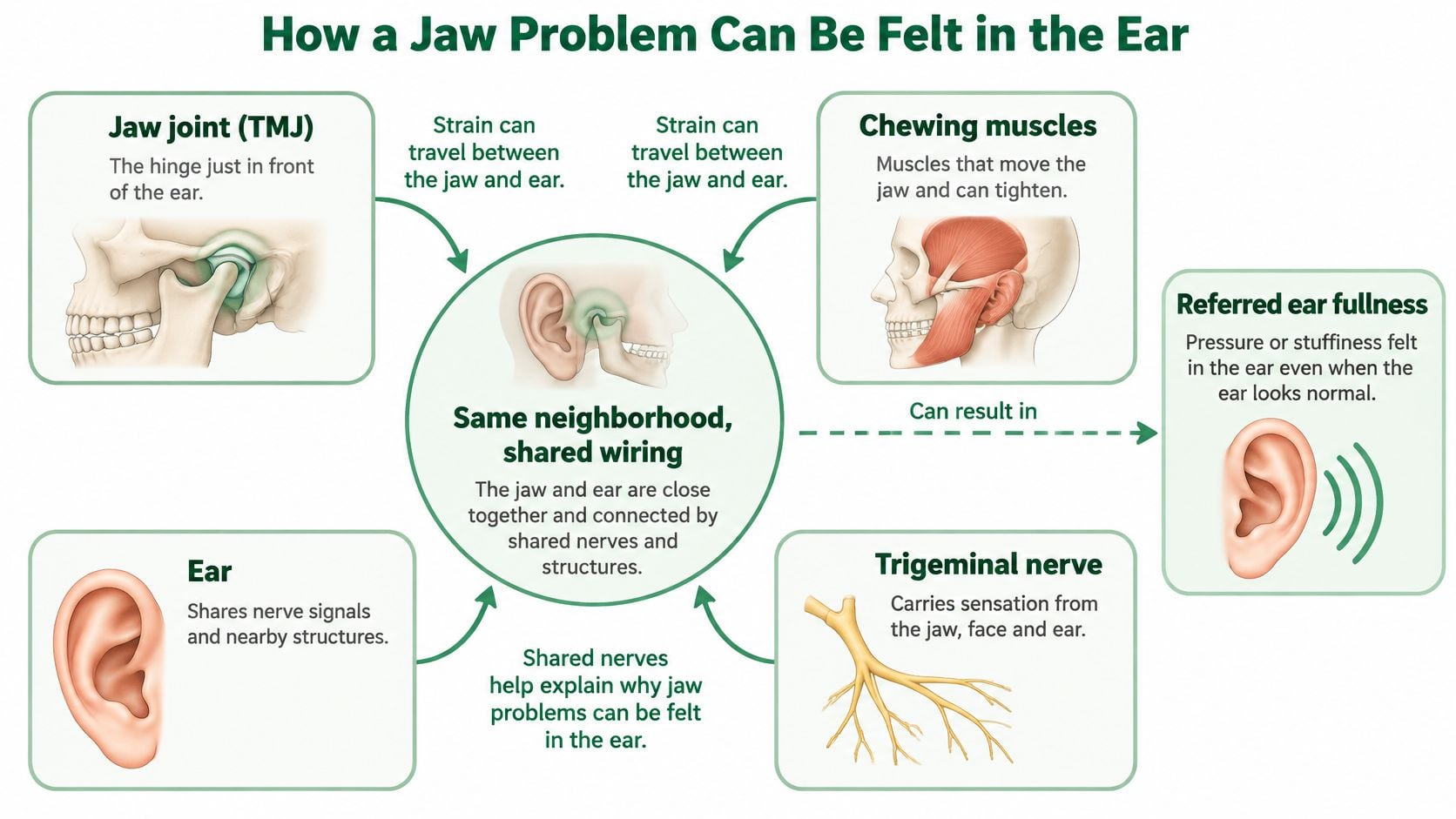
The jaw joint, chewing muscles, and ear occupy the same neighborhood and share parts of their nerve wiring. That arrangement helps explain why discomfort can be felt somewhere other than where it begins. A crowded phone line offers a useful comparison: overlapping signals can make the original caller harder to identify.
Say a person notices ear pressure after a meal that requires prolonged chewing. The pressure feels deep inside the ear, while the cheek also feels tired. That pattern gives a clinician a reason to examine the chewing muscles, but it doesn't establish the source on its own.
Shared signals and referred sensations
The trigeminal nerve is a major nerve carrying sensation from much of the face, jaw, and parts of the ear region. Signals from the jaw joint, chewing muscles, and upper neck can overlap with sensory and hearing-related pathways in the brainstem, the lower part of the brain.
Referred pain means pain perceived away from its original source. A related explanation for fullness is that overlapping sensory input may lead the brain to locate an uncomfortable sensation in the ear rather than the jaw.
A peer-reviewed review of otologic symptoms in TMD describes these overlapping pathways and possible effects involving the tensor tympani and tensor veli palatini muscles. These are proposed explanations, not settled proof of how every patient's fullness develops.
Small muscles may also play a role
The tensor tympani is a small middle-ear muscle involved in the ear's response to sound. The tensor veli palatini helps open the Eustachian tube, the passage that connects the middle ear with the back of the nose and helps balance pressure.
Changes in muscle activity may affect middle-ear mechanics or how that pressure-balancing system behaves. This offers a possible explanation for a blocked sensation without an obvious ear infection or wax blockage.
Important distinction: A plausible jaw-to-ear pathway explains why an evaluation may include the jaw. It doesn't replace an ear examination.
Fullness that changes during chewing, clenching, or jaw opening is worth recording. The useful observation is the relationship between activities and symptoms, not an attempt to force the jaw into a position that makes the ear pop.
Jaw Clues You Can Track at Home
A symptom diary helps a clinician understand what happens outside the examination room. It should record ordinary activities, not repeated attempts to provoke pain. A short period of observation is reasonable when symptoms are stable and no warning signs are present.
Patterns worth recording
- Changes with jaw use. Note whether chewing, clenching, yawning, or opening widely changes the fullness.
- Matching sides. Record whether the affected ear is on the same side as jaw or temple tenderness.
- Joint sounds. Clicking, popping, or grinding may help describe jaw movement. The guide to jaw clicking without pain explains why sound alone doesn't necessarily require treatment.
- Muscle tenderness. The masseter is the cheek muscle used for chewing, and the temporalis lies over the temple. Note tenderness noticed during ordinary touch, without pressing repeatedly.
- Restricted movement. Difficulty opening, catching, or locking deserves attention. A locked jaw shouldn't be forced open.
- Morning soreness or daytime clenching. Record waking jaw discomfort and moments when the teeth stay pressed together.
- Headache location. Note headaches near the temples or behind the ear, including whether they occur with jaw discomfort.
A clinical study of orofacial pain and dysfunction associated ear fullness with chewing-muscle tenderness, reduced opening, and oral habits such as clenching or grinding. Orofacial means involving the mouth and face.
However, a study of 197 older adults found no statistically significant association between ear fullness and temporomandibular-joint disorder, although earache was associated with it. This is an important reason not to label fullness alone as TMD.
A simple diary format
Each entry can contain the date, time, affected side, activity just before the episode, and a consistent severity rating. The following is a hypothetical recording format, not a patient story:
| Time and side | Activity | Description |
|---|---|---|
| Evening, left ear | Eating a chewy meal | Pressure increased; left cheek felt tired |
| Morning, right ear | Just after waking | Fullness with jaw soreness |
No self-test can confirm the diagnosis. Persistent one-sided fullness or a hearing change warrants an ear examination rather than waiting for a diary to be complete. The diary can still accompany the appointment, along with the history and medication checklist below.
Other Causes That Can Mimic TMJ Ear Fullness
Ear fullness has several possible sources, and more than one may be present. The useful clinical question is which contributors fit the history and examination, not which single explanation wins.
Possible causes of ear fullness and who evaluates them
| Possible cause | Typical clues | Usually evaluated by |
|---|---|---|
| Jaw joint or chewing-muscle dysfunction (TMD) | Fullness changes with chewing, clenching, or jaw movement; jaw pain or clicking | Dentist or orofacial pain specialist, with ENT input |
| Eustachian tube dysfunction | Pressure after colds, allergies, or air travel; popping sensations | ENT physician |
| Migraine | Headache, light or sound sensitivity, fullness during attacks | Primary care physician or neurologist |
| Anxiety | Sensation fluctuates with stress, sometimes without other ear findings | Primary care physician or mental health professional |
| Earwax or ear infection | Blockage found on examination, ear pain, drainage, or muffled hearing | ENT physician or primary care |
| Sleep-disordered breathing | Loud snoring, morning headaches, or unrefreshing sleep; a possible coexisting concern rather than a confirmed direct cause | Sleep physician, with sleep testing |
ENT means ear, nose, and throat. Sleep-disordered breathing describes breathing problems during sleep, including obstructive sleep apnea, or OSA, in which the upper airway repeatedly narrows or closes.
In a 2024 retrospective study of unexplained ear fullness, 263 patients had no objective ear cause, and 94.7% received a diagnosis involving a possible contribution from TMJ dysfunction, intermittent Eustachian tube dysfunction, migraine, anxiety, or combinations of these conditions. These were possible contributors identified in a selected patient group, not a formula for diagnosing every blocked ear.
Headache, dental pain, and stress need context
Migraine-related symptoms may be missed when an appointment focuses only on ear pressure. Recording light sensitivity, sound sensitivity, nausea, and headache timing can help; the discussion of facial pain with headache offers additional context for overlapping symptoms.
Dental pain can also be felt near the ear. The Houston guide to referred dental pain from All Stars Dental explains that overlap, which is particularly relevant when biting or a specific tooth triggers discomfort.
Stress-related symptoms aren't imaginary, but anxiety shouldn't become a default explanation before appropriate assessment. A clinician can consider stress while still checking hearing, ear findings, and jaw function.
Sleep symptoms deserve a separate assessment
Pain and Sleep Therapy Center may suggest sleep testing during TMJ evaluation when the history raises concern about breathing during sleep. Sleep apnea is diagnosed through a sleep study and a physician's assessment, not from snoring, jaw symptoms, or a quiz alone.
Before an appointment, useful notes include recent colds, seasonal allergies, flights, sleep quality, and headache patterns. Hearing changes should also be described specifically, such as difficulty following conversation or a new difference between ears.
Red Flags That Need Prompt Medical Care
A possible jaw connection should never delay assessment of a new hearing problem or another concerning symptom. Most ear fullness isn't an emergency, but certain accompanying signs change the next step. Jaw tenderness doesn't make those signs less important.
Warning signs that need prompt evaluation
| Warning sign | Why it matters | Next step |
|---|---|---|
| New or worsening hearing loss | Needs audiometry and medical ear review | Contact an ENT physician promptly; sudden loss requires immediate medical assessment |
| Persistent fullness on one side | Ear causes need to be excluded by examination | Book an ear examination |
| Drainage or bleeding from the ear | May signal infection or injury | Seek prompt medical care |
| Sudden vertigo or spinning | Can reflect inner-ear or neurologic causes | Seek urgent care |
| Facial weakness, double vision, or trouble speaking | Possible neurologic emergency | Call emergency services now |
| Fever with ear pain | May indicate infection | Obtain same-day medical evaluation |
A plugged sensation can include a hearing change
Patients may describe sudden hearing loss as blockage rather than recognizing it as a loss of hearing. A normal-looking ear canal doesn't establish that hearing is normal. Waiting for jaw exercises, an appliance adjustment, or an ear-popping maneuver isn't appropriate when hearing suddenly changes.
Audiometry, a formal hearing test, helps distinguish the feeling of muffled hearing from a measurable hearing deficit. A medical ear specialist interprets that result alongside the history and examination.
The same principle applies when symptoms progress. Increasing fullness, a growing difference between ears, or new balance trouble deserves reassessment even if an earlier visit was reassuring.
A warning sign is a reason to get checked, not a conclusion about the cause.
Jaw history still belongs in the medical visit
A patient seeking urgent ear care can still report recent jaw pain, clenching, dental treatment, or locking. That information may help the clinician, but it shouldn't determine the diagnosis before the ear and hearing findings are assessed.
For emergency symptoms such as facial weakness with trouble speaking, obtaining emergency care takes priority over arranging a routine dental appointment. For stable but persistent one-sided fullness, an ear examination is the appropriate starting point rather than prolonged self-monitoring.
Clear descriptions help: when the symptom began, whether onset was sudden, and what changed in hearing or balance. Bringing that information supports a focused assessment without requiring the patient to identify the cause first.
How a TMJ and Ear Evaluation Unfolds
A useful evaluation connects symptoms with findings from several sources. Ear tests and jaw tests answer different questions, so neither should be treated as a complete substitute for the other.
From history to targeted testing
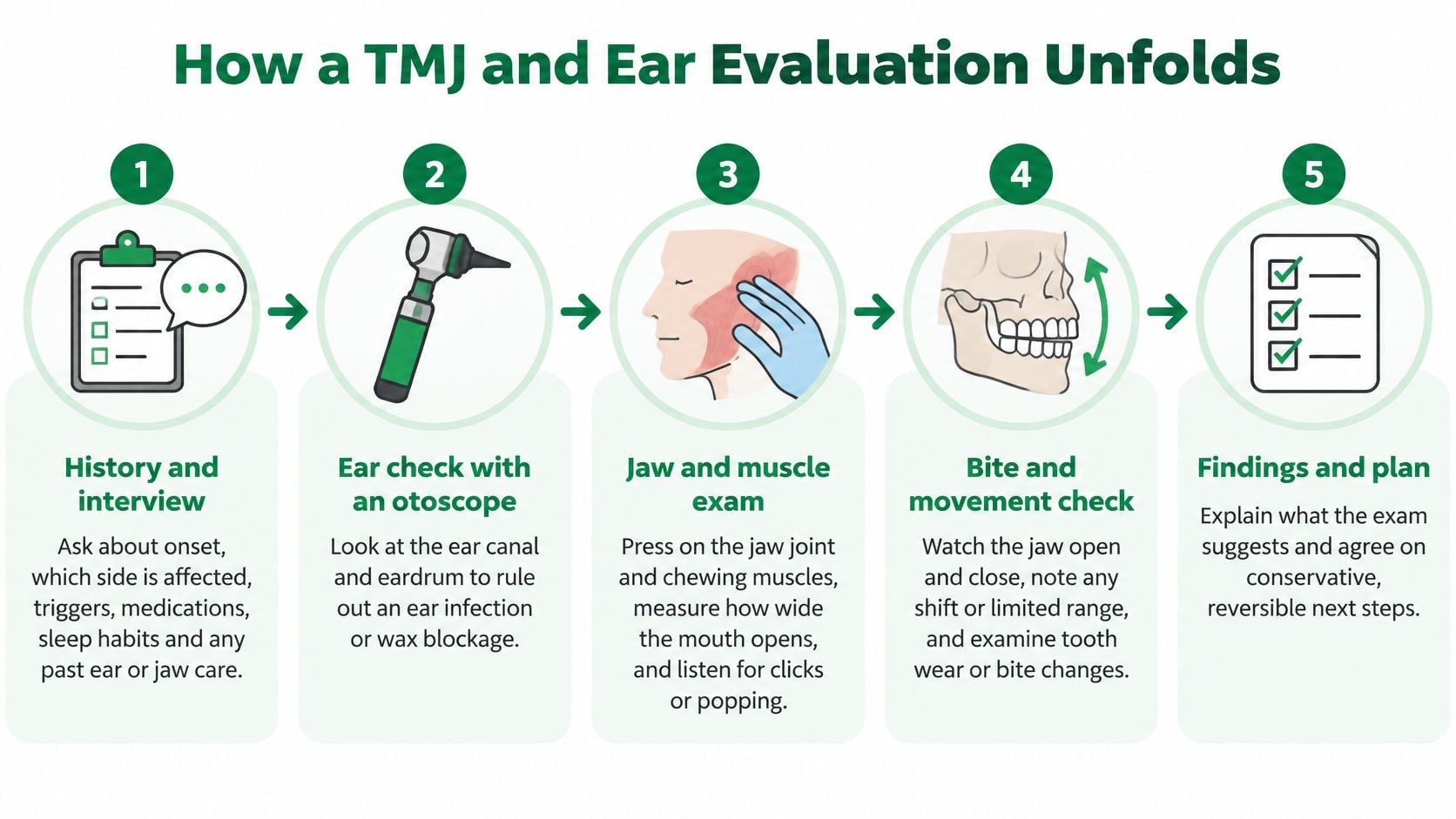
History and interview. The clinician reviews onset, affected side, triggers, medications, sleep habits, and previous ear or jaw care to understand the symptom pattern and avoid repeating unhelpful approaches.
Ear examination. An otoscope, a lighted instrument, allows examination of the ear canal and eardrum for wax, infection, and signs suggesting fluid or other ear disease.
Hearing and middle-ear testing when indicated. Audiometry measures hearing, while tympanometry assesses eardrum movement and middle-ear pressure to help identify problems that aren't clear from symptoms alone.
Structured jaw and muscle examination. The clinician measures opening, watches for sideways deviation, assesses joint sounds or vibrations, and gently checks muscle tenderness to see which findings fit the complaint.
Clenching, grinding, and movement review. Questions about bruxism, meaning teeth grinding or clenching, and other oral habits help identify repeated strain; tooth wear alone doesn't establish current sleep grinding.
Imaging when needed. A cone-beam computed tomography scan, or CBCT, provides three-dimensional views of the joint's hard tissues, while magnetic resonance imaging, or MRI, evaluates soft tissues such as the joint disc.
Pain and Sleep Therapy Center frequently uses jaw-joint CBCT imaging when needed and may refer patients to a diagnostic imaging center. Its assessment combines history, physical examination, range of motion, joint sounds or vibrations, and hard-tissue images, with sleep diagnostics or hospital-based soft-tissue diagnostics in selected cases.
A TMJ MRI study of 34 people representing 42 ears with nonspecific fullness and no detectable ear disorder found abnormalities in 34 ears, or 80.9%, but also found abnormalities in 7 of 9 ears from participants without clinical TMD signs. The study found no significant association between having clinical TMD signs and having an abnormal MRI.
That finding matters because an image can reveal a change without proving that the change causes the symptom. Imaging is most useful when it answers a specific clinical question, not when it becomes the diagnosis by itself.
- Sleep screening. Snoring, witnessed breathing pauses, and unrefreshing sleep can prompt physician-directed sleep testing because breathing concerns may affect treatment planning.
Normal results still require interpretation
A peer-reviewed investigation of dizziness and TMD discusses ear symptoms despite normal audiological testing and subtle middle-ear stiffness changes not detected by conventional tympanometry. A normal tympanogram therefore doesn't fully exclude a musculoskeletal contribution.
It also doesn't automatically confirm one. The clinician combines the examination, hearing findings, imaging when justified, and symptom history before deciding on care or referral.
A clear plan should explain what the findings support, what remains uncertain, and what change would warrant another medical assessment. That is more helpful than assigning every symptom to a scan result or a clicking joint.
Conservative Care Options and What the Evidence Shows
Conservative, reversible care is generally considered before invasive treatment. The plan should address findings from the evaluation rather than treating ear fullness with a standard appliance or exercise routine.
A 2024 systematic review of rehabilitative treatments found possible benefits for secondary ear pain and tinnitus but didn't establish a definitive treatment for ear fullness. The wider evidence for treating TMD-related ear symptoms remains limited, with low or very low certainty for several approaches.

Options matched to the findings
- Behavioral changes. Reducing clenching, resting with the teeth apart, and avoiding pen biting or prolonged gum chewing may reduce unnecessary jaw loading. These are reversible measures, not a proven cure for fullness.
- Targeted exercises. A clinician may prescribe jaw or neck exercises based on movement limits and muscle findings. Orofacial myofunctional therapy works on oral muscle coordination, including tongue position, chewing, and swallowing; evidence for relief of ear fullness is uncertain.
- Manual therapy. Hands-on jaw and neck treatment may be paired with exercise when muscle dysfunction contributes. Forceful self-manipulation isn't a substitute for assessment.
- Oral orthotic appliances. A fitted appliance may support joint management or reduce loading in selected patients. It requires monitoring rather than assuming that any night guard is suitable.
- Cold laser therapy. This may be used as an adjunct for pain management. Relief of pain shouldn't be presented as proof that it will resolve ear pressure.
- Sleep-directed care. Treatment for diagnosed breathing problems follows a physician-coordinated plan. CPAP remains an established option, and an appropriate oral appliance may be an alternative for selected patients.
The overview of non-surgical TMJ treatment provides context for combining approaches rather than relying on a single intervention.
Appliance safety and realistic expectations
A nighttime appliance is a common maintenance option for TMD, but a standard TMJ appliance isn't necessarily designed to treat sleep apnea. Some designs may worsen breathing in susceptible patients, making sleep assessment and appropriate appliance selection important before nighttime use.
Pain and Sleep Therapy Center doesn't guarantee that TMJ appliances will solve headaches, although headache occurrence frequently improves with therapy. Its medication policy uses drugs to support other TMJ treatments rather than treating medication alone as a complete solution.
Treatment goal: Improve function and symptoms while monitoring whether the proposed explanation still fits.
Ear fullness may improve when jaw or neck dysfunction contributes, but improvement isn't guaranteed. A treatment response also doesn't prove that the jaw was the only cause or remove the need to evaluate continuing ear symptoms.
Schedule a Jaw and Ear Evaluation
Persistent ear pressure can be frustrating, especially when earlier answers haven't explained the whole pattern. An appointment is most useful when the patient brings enough information to connect daily symptoms with examination findings.
What to bring
- A symptom diary. Include the affected side, timing, triggers, and any relationship to meals or waking.
- Ear, sleep, and headache history. Bring previous hearing-test results, relevant imaging reports, sleep-study results, and a summary of treatments already tried.
- A current medication list. Include prescribed medicines, over-the-counter products, and supplements.
Pain and Sleep Therapy Center's evaluation includes a history and physical examination of jaw movement and the joint, with imaging when needed. Care can be coordinated with ENT physicians, other physicians, and sleep specialists when the findings call for their input.
Dr. Ryan Robinson, triple board-certified in craniofacial pain and dental sleep medicine, leads the practice's root-cause approach. The practice has offices in Newark, Delaware, and Bryn Mawr, Pennsylvania, serving patients from Wilmington and the Philadelphia Main Line as well.
Choosing the next step
Treatment plans may include orthotic therapy, cold laser therapy, physical therapy, lifestyle changes, and collaborative medical care. The center also offers airway pressure machines and dental sleep medicine services, including oral appliance therapy as a CPAP alternative for suitable patients and Snorelase for snoring when indicated.
Its broader services include tongue-tie assessment and laser frenectomy for infants, children, and adults. Those services address separate clinical needs and aren't automatic treatments for ear fullness.
For persistent TMJ and ear fullness concerns, patients can Request an Appointment or call the Newark office at (302) 239-1757. Those with snoring or unrefreshing sleep can Take our Sleep Quiz as a screening step, not a diagnosis. An evaluation can clarify whether the jaw, ear, or another contributor needs attention, without promising a specific result.
Pain and Sleep Therapy Center offers root-cause evaluation and conservative care for jaw, head, and facial pain, with sleep assessment and coordinated referrals when appropriate. Visit Pain and Sleep Therapy Center to Request an Appointment for overlapping jaw and ear symptoms, or Take our Sleep Quiz if snoring and unrestful sleep are also concerns.