A partner has been nudging about the snoring. Mornings feel foggy, and a CPAP machine, short for continuous positive airway pressure, may already be sitting in a closet because the mask never felt workable. That situation is common. It doesn't mean treatment has failed.
The choice in an oral appliance vs CPAP comparison isn't a contest with one winner for every person. CPAP is often stronger at stopping breathing pauses. A custom oral appliance may help people who can't stick with a mask, as long as a sleep study and later testing show that it actually controls the problem. Jaw comfort and bite changes belong in that same conversation, not as a footnote.
Snoring by itself isn't a diagnosis. A physician and a sleep study come before either device.
Table of Contents
- How CPAP and Oral Appliance Therapy Treat Sleep Apnea
- Which Therapy Controls Sleep Apnea More Effectively
- Comfort, Noise, and Adherence in Everyday Life
- Side Effects and Long-Term Risks to Consider
- Who Is a Better Candidate for Each Treatment
- How to Choose the Right Therapy for You
- Common Questions About Oral Appliances and CPAP
How CPAP and Oral Appliance Therapy Treat Sleep Apnea
Obstructive sleep apnea, often called OSA, happens when the throat relaxes in sleep and partly or fully blocks airflow. An apnea is a pause in breathing. A hypopnea is a shallow breath that still cuts airflow enough to disturb sleep. The brain briefly wakes the body so breathing can restart. Those arousals can repeat all night, so someone may feel exhausted without remembering the wake-ups. What sleep-disordered breathing means explains how snoring, pauses, and poor sleep fit together.
Two different ways to hold the airway open
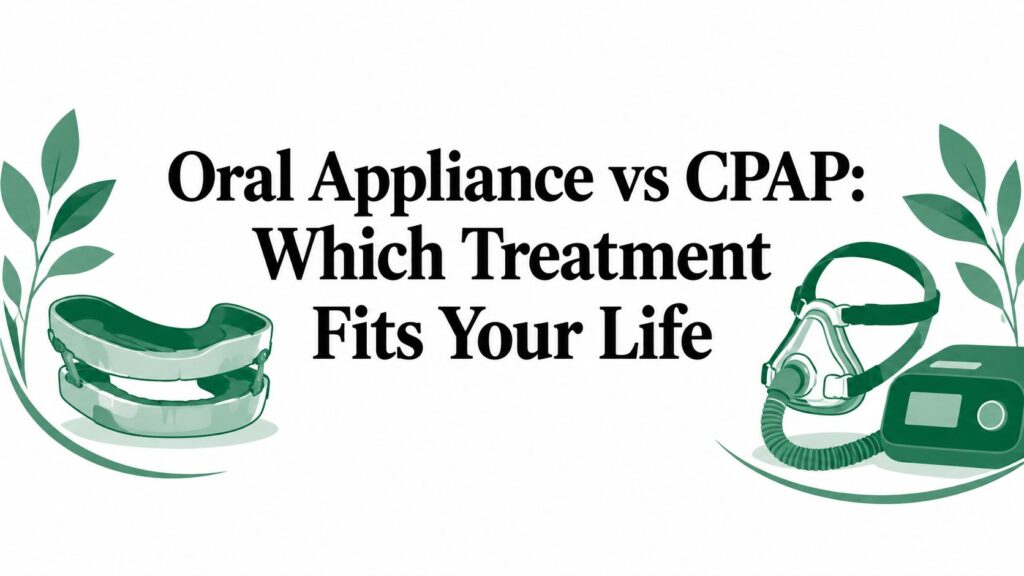
CPAP uses a small machine and a mask. Pressurized air gently splints the upper airway open, like a soft air stent, so tissue is less likely to collapse. The jaw stays where it is.
A custom oral appliance, usually a mandibular advancement device, fits over the teeth. It holds the lower jaw, and the tongue and nearby soft tissue with it, slightly forward. That forward position may help keep the space behind the tongue open. It's quiet, and it doesn't use a hose or a power outlet.
A steadier sleep surface can make either setup easier to live with. People sorting out nightly comfort sometimes read find supportive mattresses in Grants Pass while they learn which therapy they can actually use. A mattress doesn't treat OSA. It only supports rest around the treatment a clinician recommends.
A sleep study comes before the device
The American Academy of Sleep Medicine diagnostic testing guideline identifies in-lab polysomnography, an overnight study in a sleep lab, as the standard test when OSA is suspected. For uncomplicated adults with signs of moderate-to-severe OSA, a technically adequate home sleep apnea test may also be used. If that home test is negative, inconclusive, or technically poor, follow-up polysomnography is recommended.
Practical rule: Snoring can be a clue. It isn't proof of sleep apnea, and it isn't a reason to skip a physician-ordered sleep study.
The same guideline describes higher risk when daytime sleepiness shows up with at least two of three findings: habitual loud snoring, witnessed pauses or gasping, and diagnosed high blood pressure. Severity from that testing, plus medical history and what a person can wear, shapes everything after. Neither device should be picked from noise alone.
Which Therapy Controls Sleep Apnea More Effectively
The main yardstick is the apnea-hypopnea index, or AHI. It counts apneas and hypopneas per hour of sleep. A lower AHI means fewer breathing events.
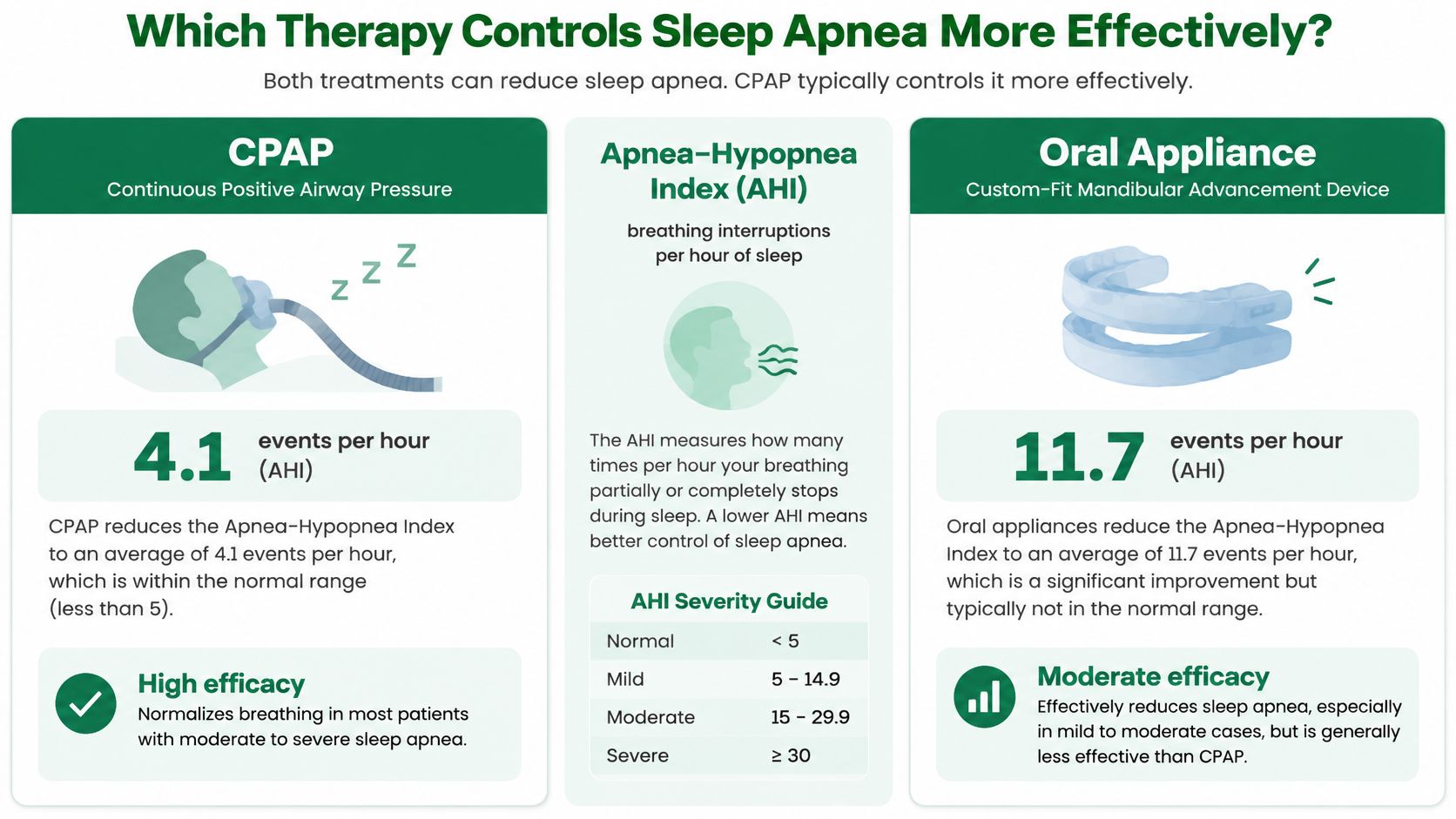
A meta-analysis summarized for the AASM found that CPAP reduced AHI by an additional mean of 6.24 events per hour versus oral appliances (95% confidence interval, 4.34 to 8.14). In crossover studies, where the same people tried both treatments, CPAP brought AHI down to low levels in nearly all participants. Oral appliances didn't reach comparable control in at least one-third of patients.
What stronger event control means
CPAP also tends to improve oxygen saturation, the oxygen level in the blood, and the arousal index, which counts sleep disruptions. That gap matters most when OSA is moderate to severe, when oxygen drops are marked, or when heart and metabolic risk is already on the chart. In those situations, steady control is usually the priority, and CPAP is the more reliable tool when a person can use it.
A review of seven randomized crossover trials found that mandibular advancement appliances improved OSA, yet CPAP still produced a larger AHI drop in the same patients. Custom, titratable appliances, devices a clinician can adjust in small steps, perform better than non-custom appliances at lowering AHI, the oxygen desaturation index, and the arousal index. A boil-and-bite snoring guard isn't in that category.
Sleep position and the bed can change how loud the night sounds. Some households read mattress advice from Lott's Furniture for that reason. Position habits may ease snoring. They don't replace a treatment that has been checked with a sleep study.
CPAP is the benchmark for physiological control. An oral appliance may help selected patients, especially in mild-to-moderate disease, but it shouldn't be described as equal in AHI control.
Comfort, Noise, and Adherence in Everyday Life
Lab results assume the device is on the face. Bedrooms are less tidy than a study protocol.
What the night actually feels like
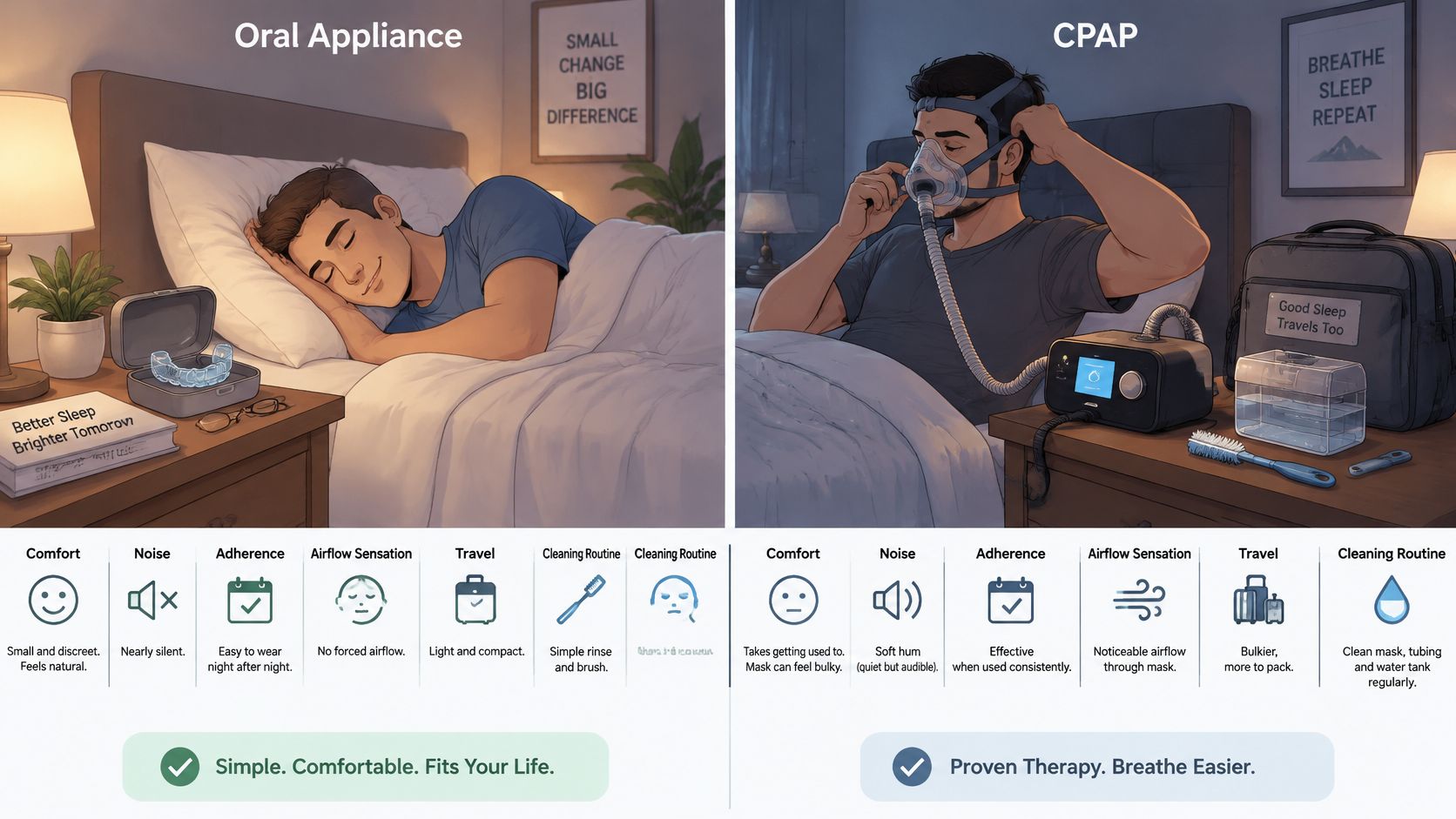
CPAP means a mask seal, tubing, and the feeling of airflow. Some people notice machine hum, a cleaning routine, and extra bulk in a suitcase. Others settle in and sleep well once the fit is right. Both experiences are real, and neither one makes someone difficult.
A custom oral appliance is small, silent, and easy to pack. There's no mask and no power cord. Morning cleaning is closer to caring for a retainer. Jaw awareness can still show up, which is a separate question from noise.
Use time is part of the result
AASM and AADSM guideline evidence found that objective adherence averaged about 0.70 hours per night higher with oral appliances than with CPAP (95% confidence interval, 0.11 to 1.30). Adherence was better overall among adult appliance users. Measurement methods differ, and many studies rely partly on self-report.
A therapy only helps on the nights it's worn. Higher use doesn't erase the gap in how well each device stops breathing events.
That's why a follow-up sleep test still matters after a comfortable device is fitted. Quieter nights and a calmer bed partner are encouraging. They aren't proof that breathing events are controlled. The same guideline evidence is clear that oral appliances are generally less effective than CPAP at reducing those events.
Partners sometimes start with the bed itself. Vinson Fine Furniture's snoring tips cover mattress choices that may ease snoring noise. Those tips sit beside treatment, not instead of it.
Side Effects and Long-Term Risks to Consider
Both treatments can cause annoyances. Neither should be described as risk-free, and neither should be dropped without a plan.
Common CPAP complaints
People often report mask pressure on the nose or cheeks, dry nasal passages, and the sensation of swallowing air. A different mask, added humidity, or a pressure review with the sleep team may help. Those issues are usually about comfort and fit, not about moving teeth.
The jaw story most comparisons skip
Oral appliances hold the lower jaw forward for hours every night. Early temporomandibular disorder pain, pain in the jaw joint and chewing muscles, often called TMD, may increase during the first two months and then decline. Some studies find no meaningful difference from CPAP after one year, according to a review of jaw and bite effects.
Longer-term observational evidence in that same research reports average reductions of about 1.2 mm in overbite and 1.5 mm in overjet. Overbite is how much the upper front teeth overlap the lower ones. Overjet is how far the upper front teeth sit ahead of the lower ones. Reviews also describe progressive changes in overbite, overjet, and how back teeth meet among long-term users.
Who should ask extra questions first
These bite shifts matter more when someone already has TMJ pain, nighttime grinding (bruxism), an unstable bite, or many crowns and bridges. A custom, titratable mandibular advancement device starts with a baseline jaw and dental exam, advances gradually, and includes periodic bite checks. A store-bought anti-snoring product doesn't offer that monitoring.
Questions worth raising before a choice:
- Baseline jaw exam: Is there joint pain, locking, or a bite that is already shifting?
- Pace of advancement: Can the jaw move forward in small steps instead of all at once?
- Occlusal review: Who will look at tooth contacts over the years of use?
- Sleep retest: How will leftover breathing events be measured, not just how the jaw feels?
Who Is a Better Candidate for Each Treatment
The joint AASM and AADSM guideline states that CPAP is generally superior for improving oxygen saturation and for reducing both the AHI and the arousal index. It also recommends that sleep physicians consider a prescription oral appliance for adults with OSA who can't tolerate CPAP or who prefer an alternative.
Profiles that usually point one way
Reliable control comes first. Moderate-to-severe OSA, deep oxygen drops, or substantial heart and metabolic risk usually favors CPAP when the person can wear it. The goal is steady event control.
The machine already lost the night. Someone who stopped CPAP after a real trial, with mask troubleshooting already tried, may be a candidate for a prescription appliance. The sleep physician stays involved. Leaving OSA untreated is the outcome to avoid.
Bags get packed often. A pocket-size appliance may help frequent travelers who otherwise skip therapy on the road. A retest still has to show that the airway is controlled on ordinary nights at home, not only that the device was easy to pack.
The jaw needs a look, not an automatic no. Existing TMJ pain doesn't by itself rule an appliance out, and it doesn't make one a casual first pick. A craniofacial pain evaluation can sort out whether gradual advancement is reasonable. A dentist trained in dental sleep medicine can explain that path, including what a sleep apnea mouth guard visit involves before any device is made.
Oral Appliance vs CPAP at a Glance
| Factor | CPAP | Oral Appliance |
|---|---|---|
| Mechanism | Pressurized air splints the airway | Lower jaw and nearby tissue held slightly forward |
| Strength of control | Generally stronger for breathing events, oxygen, and arousals | May help selected patients, often mild to moderate, with uneven results |
| Nightly pattern | Can be harder for some people to wear all night | Often easier to keep using, and still must be verified |
| Follow-up | Mask, pressure, and use reviews with the sleep team | Jaw checks plus a repeat sleep study for leftover events |
Mild-to-moderate OSA is where an appliance is most often discussed as a reasonable option. Severe disease isn't an automatic exclusion if CPAP truly can't be used. Expectations should stay modest until a retest shows what changed.
How to Choose the Right Therapy for You
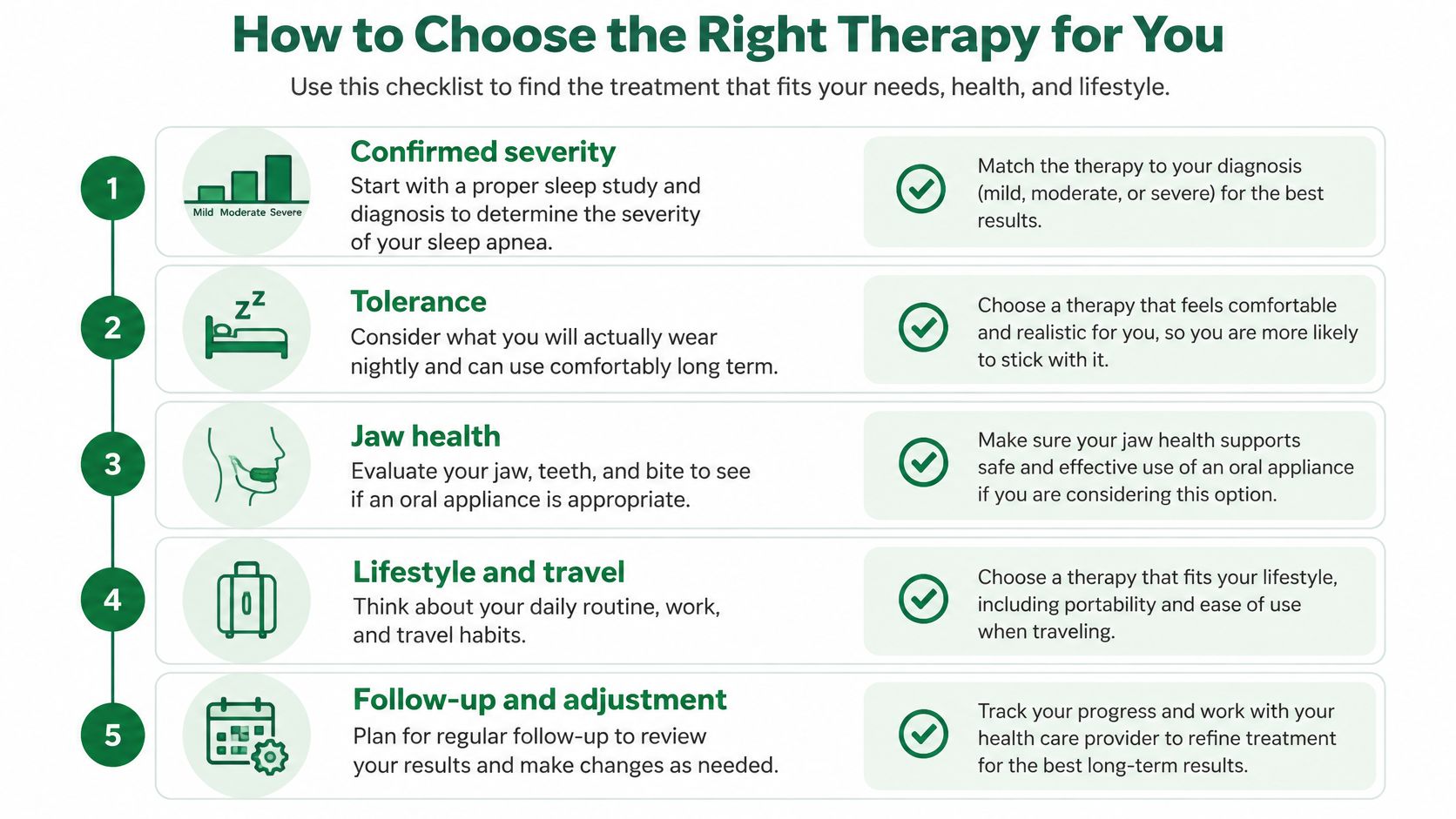
The fitting choice matches confirmed severity, what a person will wear, and whether the jaw can tolerate forward positioning. It isn't a permanent verdict. Plans can be revisited with the physician and the dental sleep team.
A practical sequence
- Confirm the diagnosis. A physician orders testing and reviews severity, oxygen levels, and other health risks. Guessing from snoring isn't enough.
- Give CPAP a fair look. If a machine is already prescribed, mask style, humidity, and pressure comfort deserve a real trial before it's written off.
- Check the jaw and the bite. Tooth support, joint pain, grinding, and dental work should be examined before an appliance is planned.
- Match the device to real nights. Travel, side sleeping, and bedroom noise matter because unused equipment doesn't treat OSA.
- Retest whichever option is chosen. A follow-up sleep study checks leftover breathing events and oxygen, not just whether snoring got quieter.
For readers comparing an oral appliance vs CPAP, coordinated care keeps those steps from splitting apart. At Pain and Sleep Therapy Center, Dr. Ryan Robinson, triple board-certified in craniofacial pain and dental sleep medicine, provides custom oral appliance therapy as a CPAP alternative, help arranging at-home sleep testing, and a TMJ-informed exam. Offices in Newark and Bryn Mawr serve people in Newark and Wilmington, Delaware, and in Bryn Mawr and the Philadelphia Main Line. That work sits alongside the reader's physician. It doesn't replace medical care, and it doesn't promise a cure.
Home testing, when a clinician offers it, can lower the barrier to getting started. It's still only appropriate in the situations a diagnostic guideline allows. Conservative care, including a well-fitted device and habit changes, is usually explored before anyone talks about surgery.
Common Questions About Oral Appliances and CPAP
Can someone switch from CPAP to an oral appliance?
Yes, many adults do, but not by ordering a device on their own. A sleep physician can consider a prescription appliance when CPAP isn't tolerated or when the patient prefers an alternative. A dental sleep provider fits and adjusts it. The physician remains part of follow-up.
Does a custom appliance need a prescription?
A therapeutic mandibular advancement device for diagnosed OSA should come through that medical and dental pathway, not from a pharmacy shelf. Over-the-counter snoring guards are a different product. They aren't titrated to a jaw exam, and they aren't checked against a sleep study.
Can an appliance help snoring without a sleep apnea diagnosis?
Snoring can be simple, or it can be a sign of OSA. An evaluation and, when indicated, a sleep study should come first. Treating assumed apnea without testing can miss the condition's severity. Quieter breathing isn't the same as safe oxygen levels through the night.
How does a patient know the appliance is working?
A follow-up sleep test is the check. Feeling more rested, or hearing less snoring from a partner, may help morale, and those changes are worth reporting. They don't replace measurements of breathing events and oxygen. If the retest still shows a high event rate, the jaw position may be adjusted, or CPAP may be reconsidered with the care team.
Adults weighing an oral appliance vs CPAP can sort the next step with a team that looks at both the airway and the jaw. Pain and Sleep Therapy Center offers custom oral appliance therapy, TMJ-informed evaluation, and coordination of sleep testing for people who want a conservative option before surgery. Request an Appointment or take the Sleep Quiz, call the Newark office at (302) 239-1757, or visit Pain and Sleep Therapy Center.