A yawn at the breakfast table, a bite of toast, or an attempt to brush back teeth suddenly stops short. The jaw feels stuck, sore, or unable to close. That moment doesn't always mean the same problem. Knowing what to do if your jaw locks starts with noticing the jaw's position, then checking breathing, swallowing, swelling, fever, and recent injury before trying any relief step.
Table of Contents
- Recognize the First Signs of a Locked Jaw
- Check for Emergency Warning Signs
- Choose the Right Response for Your Jaw
- Ease Mild Locking at Home
- Avoid Actions That Can Make Locking Worse
- Understand What Professional Treatment May Involve
- Know When to Arrange Ongoing Care
Recognize the First Signs of a Locked Jaw
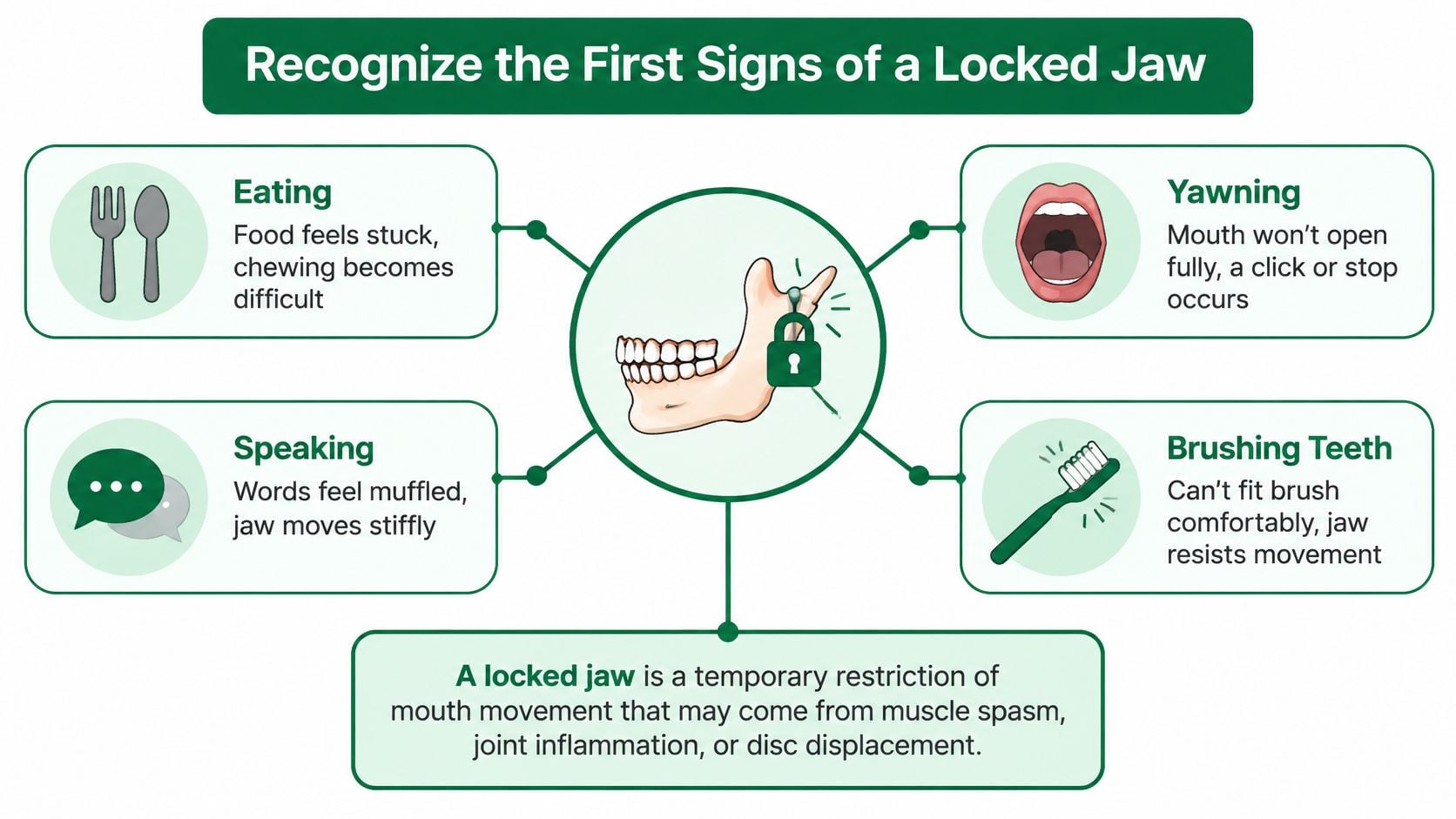
Waking with a jaw that won't move normally feels unsettling, especially when speaking sounds muffled or a toothbrush won't fit comfortably. A locked jaw means mouth movement is restricted. The limit may come from the temporomandibular joint, the joint connecting the lower jaw to the skull, or from the muscles used for chewing.
Position Matters More Than a Click
The mouth may be stuck open, partly open but unable to open wider, or closed tightly enough that eating becomes hard. A click alone isn't locking. Clicking describes a sound, while locking describes lost movement or a jaw that can't return to its usual position.
Temporomandibular disorder, often shortened to TMD, isn't one single diagnosis. It's a group of conditions affecting the jaw joint and surrounding tissues, and a locked jaw can occur when the mouth cannot open or close normally. That definition matters because muscle spasm, joint inflammation, disc displacement, dental problems, infection, and injury don't call for identical next steps.
Readers who want broader background on ongoing symptoms may find a resource on lasting jaw pain treatment helpful, but information gathering shouldn't delay assessment during a sudden episode. The first useful questions are simple. Can the person breathe and swallow comfortably? Did trauma happen? Is swelling or fever present? Is the jaw stuck open, stuck closed, or only painful and restricted?
Those answers guide urgency far better than guessing a diagnosis from pain alone. A jaw that moved normally yesterday and now feels completely immobile deserves prompt professional review, even if discomfort seems mild.
Check for Emergency Warning Signs
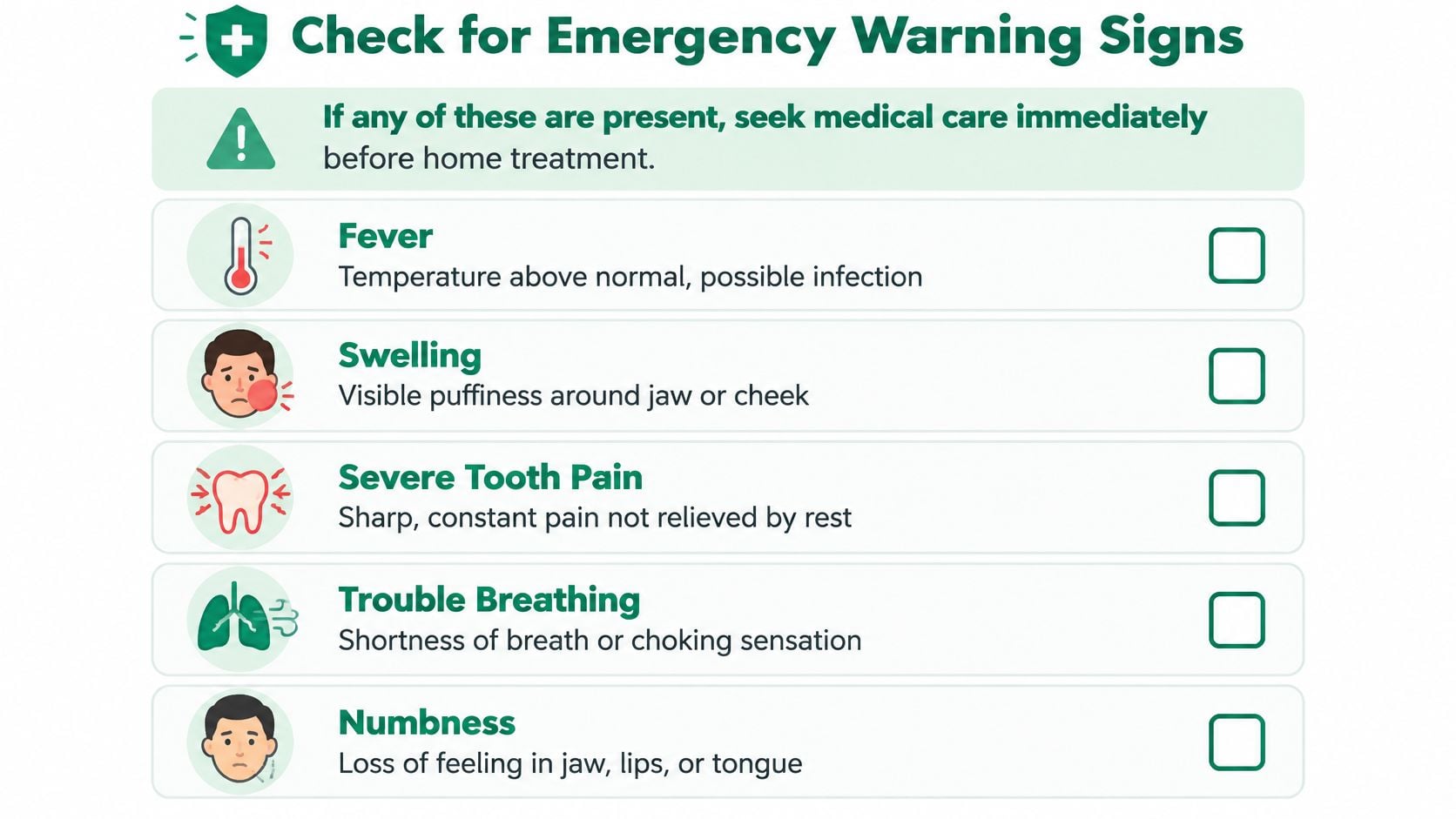
Home care comes second. A locked jaw can reflect a routine joint or muscle flare, but it can also accompany injury, a dental or deep neck infection, or another medical problem. A short screening sequence helps separate those situations.
Stop and Seek Emergency Care for These Signs
- Breathing difficulty: Any struggle to breathe needs emergency help right away.
- Swallowing trouble or drooling: Inability to swallow liquids can signal a serious throat, dental, or neck problem.
- Rapid swelling: Increasing facial or neck swelling needs urgent assessment, especially with fever.
- Voice change or severe throat pain: A muffled voice with restricted opening shouldn't be managed with stretching.
- Recent trauma or bite change: A blow to the face, a fall, or teeth that suddenly don't meet normally warrants prompt evaluation.
- Worsening restriction with fever: This combination raises concern for infection rather than simple muscle tightness.
If breathing, swallowing, or consciousness seems affected, emergency services come before heat packs, exercises, or routine appointments.
Tetanus adds an important distinction. Lockjaw doesn't automatically mean tetanus. Still, a stiff jaw with trouble swallowing, breathing difficulty, widespread spasms, fever, sweating, or a rapid heartbeat after a contaminated wound may indicate tetanus and requires emergency treatment. A large or deep wound, bite, burn, or scratch makes that history especially relevant.
People with those warning signs shouldn't try to stretch the jaw open. They should seek emergency care so clinicians can assess the airway, wound, vaccination history, and need for further treatment. For people without emergency signs but with ongoing aches, learning about common reasons a jaw hurts may help prepare questions for an appointment. It doesn't replace an examination when movement is suddenly lost.
Choose the Right Response for Your Jaw
Different jaw positions call for different actions. Treating every episode as the same TMJ problem can lead to the wrong move, such as pushing on a jaw that may be displaced or stretching muscles that are guarding an injury.
Consider two examples. A jaw that locks during a wide yawn and stays open is not the same as gradual morning stiffness after nighttime clenching. The first may involve dislocation, meaning the jaw has moved out of its normal joint position. The second may reflect irritated chewing muscles, although only an evaluation can clarify the cause.
Quick Decisions for Common Jaw Positions
| What you notice | What to do now | When to seek care |
|---|---|---|
| Mouth stuck open | Support the jaw gently, avoid wide movement, and don't push it back | Emergency or prompt dental care, especially if closing isn't possible |
| Mouth won't open enough | Stop hard chewing, use soft foods, and keep the jaw relaxed | Urgent dental or medical review if eating, drinking, or speaking is affected |
| Jaw closes but movement hurts | Rest the jaw, choose softer meals, and avoid repeatedly testing opening | Prompt review if pain persists, returns, or opening keeps shrinking |
| Bite suddenly feels different | Don't force teeth together or try to realign the jaw | Same day assessment, particularly after trauma |
A suspected dislocation needs careful handling because a dislocated jaw may remain stuck open or displaced, and a suspected dislocation should be supported without attempting to push the jaw back into place. Emergency clinicians can check for associated injury and manage repositioning safely.
When the jaw won't open and red flags have been excluded, soft foods and jaw rest may be reasonable while arranging care. That pause is protective, not diagnostic. Complete immobility, sudden onset, worsening pain, drainage, or inability to eat moves the situation out of watchful waiting.
Ease Mild Locking at Home
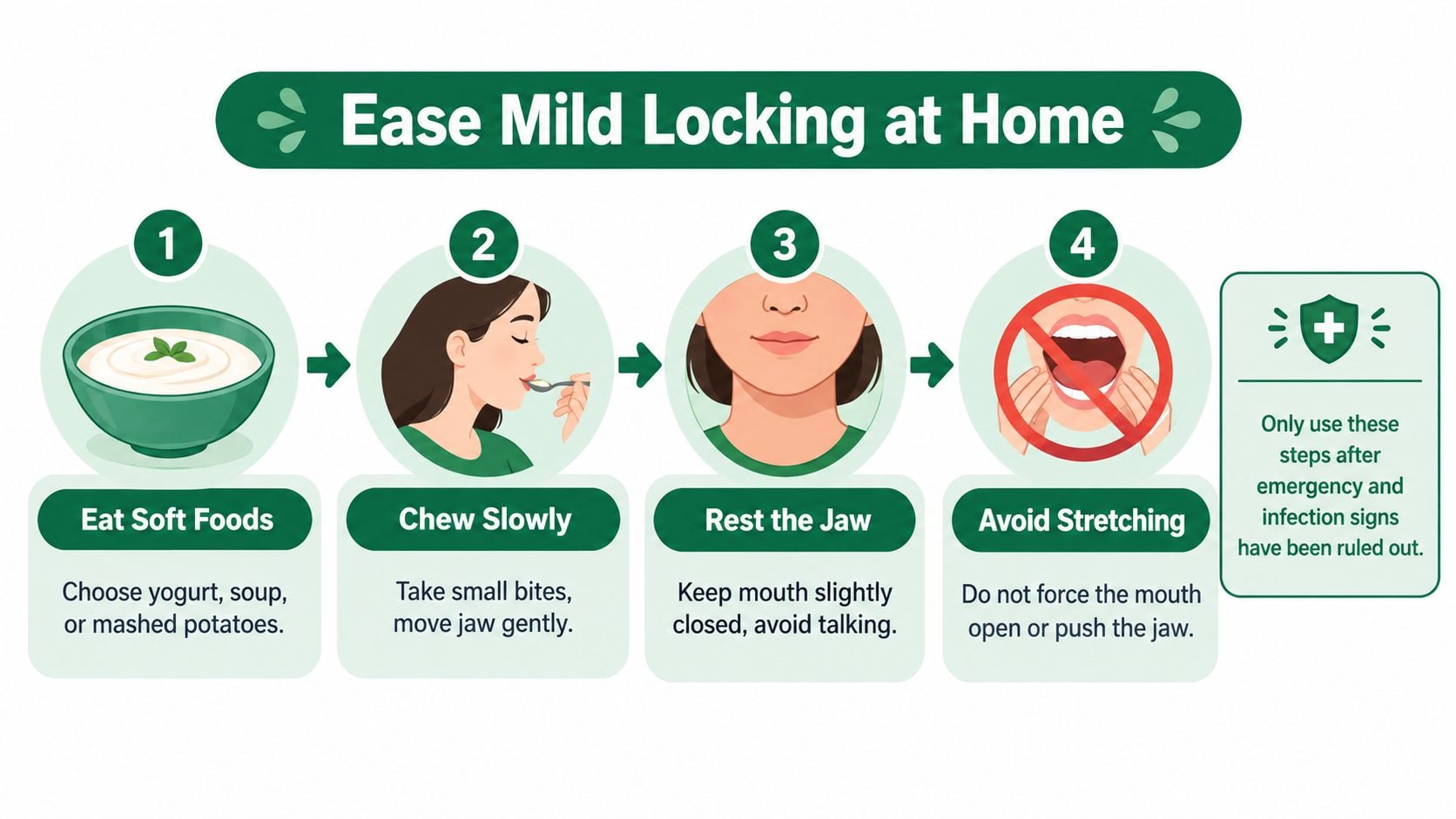
Mild, uncomplicated locking means emergency and infection signs aren't present, the person can breathe and swallow, and there's no recent major trauma or suspected dislocation. Only then does conservative home care make sense.
A Conservative First Aid Routine
- Rest the jaw: Limit talking, yawning, gum chewing, and wide opening so irritated muscles and joint tissues can settle.
- Choose soft foods: Soup, yogurt, eggs, and mashed foods reduce chewing load. Small bites and slow chewing help further.
- Apply moist heat or cold: Use whichever feels comfortable on the face, with a barrier over the skin and breaks between applications.
- Move only within comfort: Gentle opening may be appropriate for some people, but movement should stop before sharp pain.
- Use medication cautiously: An over the counter anti-inflammatory medicine may help some people when it's medically appropriate, the label is followed, and contraindications are checked.
These steps match guidance that, for uncomplicated transient muscle-related trismus after serious causes are excluded, describes moist heat, a soft diet, an appropriately selected medicine when safe, and gentle pain-limited opening while avoiding aggressive stretching. Trismus means restricted mouth opening, often involving tight jaw muscles.
Muscle relaxants and sedating medicines shouldn't be started without clinician assessment because sedation, interactions, and dependence risks may apply. Readers interested in muscle focused self care can review ways to relax the masseter muscle, the main chewing muscle at the angle of the jaw, while keeping pressure gentle.
Practical rule: Protect the joint and get checked rather than trying to force the lock away.
Improvement at home doesn't identify the cause. Symptoms that ease and then return still deserve clinical review, particularly when episodes interfere with meals, work, sleep, or dental care.
Avoid Actions That Can Make Locking Worse
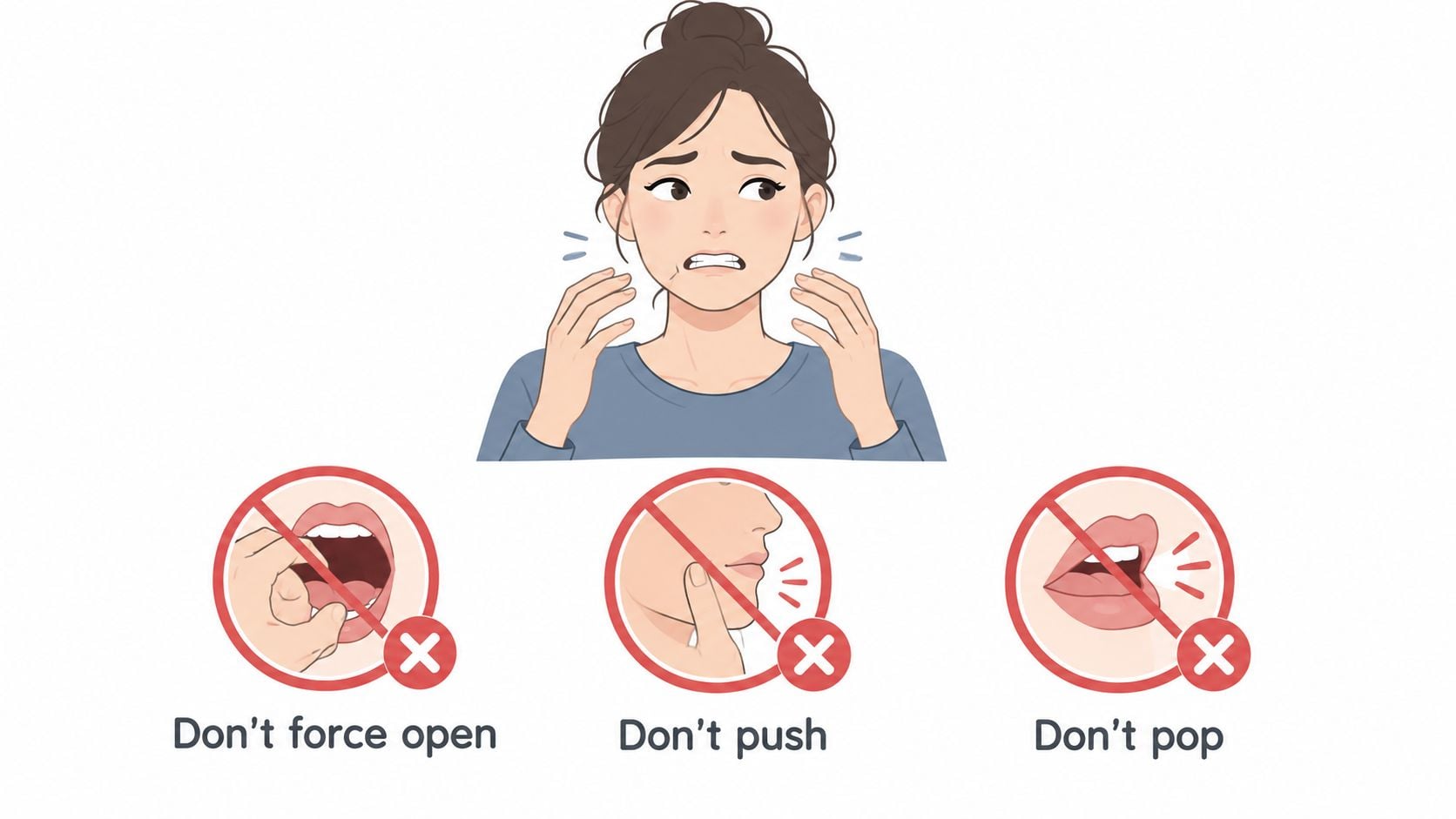
Frustration makes force tempting. A person may try to pry the mouth open, push a shifted jaw back, or keep moving it side to side hoping for a pop. Those efforts can increase muscle guarding and may aggravate an injured joint, capsule, disc, or fracture.
Habits to Pause During an Episode
Avoid hard or chewy foods, ice chewing, gum, nail biting, and unsupported wide yawns. Cutting food into small pieces reduces the need for wide opening. Repeatedly testing maximum opening every few minutes also keeps irritated tissues working instead of resting.
Clicking needs context. It's easy to assume every click proves joint damage, yet TMJ sounds and internal imaging findings have poor correlation with pain, disability, function, and prognosis, and recurrent locking and clear functional impairment are more meaningful concerns than clicking alone. A painless click without lost movement is different from repeated locking that prevents eating.
Tracking an episode turns confusion into useful clinical information. Notes can include whether the jaw was open or closed, how long it lasted, which side felt affected, and whether the bite changed. Triggers such as yawning, chewing, dental treatment, morning clenching, headaches, sleep quality, swelling, fever, or trauma also matter.
That record shouldn't become self diagnosis. Patterns help a clinician distinguish episodic muscle guarding from recurrent closed lock or another cause. They also show whether episodes are becoming longer, more frequent, or harder to manage.
Understand What Professional Treatment May Involve
A professional evaluation starts with the story and the examination, not with a predetermined treatment. The clinician may ask when locking began, how often it happens, what position the jaw held, and whether pain, swelling, trauma, dental symptoms, headaches, or sleep problems occur.
Examination may include measuring mouth opening, checking jaw deviation, assessing whether teeth meet normally, listening for joint sounds, and feeling the jaw muscles and joint for tenderness. Medication use, recent dental work, injury history, and signs of infection can change the next step.
Why Imaging Isn't Automatic
Imaging is chosen for the suspected problem rather than ordered the same way for everyone. An evaluation can document mouth opening, bite changes, tenderness, and other findings, and CT may be useful for fractures, while MRI may help assess disc, soft tissue, or space occupying abnormalities. CT means computed tomography. MRI means magnetic resonance imaging.
Treatment usually begins with reversible, conservative care when the diagnosis allows. Options may include education, temporary jaw rest, soft foods, physical therapy, gentle exercises, thermal therapy, selected medication, behavioral strategies for clenching, or a stabilization appliance when appropriate. Readers can explore non-surgical treatment options for TMJ symptoms to understand that surgery isn't the automatic first response.
Referral paths vary. A dentist may address dental or bite related contributors, a medical clinician may evaluate infection or systemic symptoms, and an oral and maxillofacial specialist may assess dislocation, fracture, or persistent mechanical restriction. Some patients need coordinated care across those roles.
Sleep deserves separate clarity. Snoring or poor sleep alongside jaw pain doesn't prove sleep apnea. Sleep apnea is diagnosed via a sleep study and physician involvement, not from jaw symptoms alone. When a sleep disorder is confirmed, oral appliance therapy may be one option discussed within medical care, alongside other physician directed choices.
Know When to Arrange Ongoing Care
The memorable plan is short. Screen for danger, protect the jaw, and seek assessment when severity or cause is unclear. Persistent pain, repeated locking, extreme restriction, inability to eat or drink, or a bite that feels wrong shouldn't be managed with endless home treatment.
For uncomplicated transient trismus, improvement within roughly 48 hours after treating the cause is a useful benchmark, not a guarantee. Worsening swelling, fever, neurologic or visual symptoms, dehydration risk, or lack of improvement after 2 to 3 days warrants earlier reassessment and possible oral and maxillofacial referral.
Pain and Sleep Therapy Center serves patients in Newark and Wilmington, Delaware and Bryn Mawr and the Philadelphia Main Line with TMJ, craniofacial pain, and dental sleep medicine care led by Dr. Ryan Robinson. Its approach emphasizes finding root causes and considering conservative, non-invasive options before surgery, while an evaluation is still needed before any diagnosis. Readers ready for that next step can Request an Appointment in Newark at (302) 239-1757.
If jaw locking, facial pain, snoring, or poor sleep keeps interfering with daily life, Pain and Sleep Therapy Center offers root cause focused evaluations for TMJ and sleep related concerns in Newark, DE and Bryn Mawr, PA. Visit the site to request an appointment or take the sleep quiz and start a clearer, clinician guided plan.