A familiar pressure may be spreading across both temples as the day begins. The jaw may feel stiff, the chewing muscles tender, and sleep may have felt restless rather than restorative. That combination can be confusing, especially when people describe the pain as a “tension headache” while also noticing clenching, clicking, facial soreness, or pain near the ears.
Jaw symptoms and headaches can overlap, but they aren't interchangeable diagnoses. Temporomandibular disorders, or TMD, affect the jaw joints, chewing muscles, or related structures. A tension-type headache is a primary headache pattern that commonly causes bilateral, pressing or tightening pain. Sometimes TMD contributes to a headache. Sometimes a primary headache disorder exists alongside jaw symptoms. A careful evaluation helps separate those possibilities without dismissing either one.
Table of Contents
- When Jaw Tension Meets Headache
- Understanding the Headache Connection
- Is Your Headache Linked to TMD or Something Else
- Sleep, Anxiety, and Central Pain Processing
- Conservative Treatment Options for Jaw and Head Pain
- Common Misconceptions About TMJ and Headaches
- When to Seek Evaluation and Next Steps
When Jaw Tension Meets Headache
The jaw, temples, face, neck, and sleep system work together throughout the day and night. Speaking, chewing, swallowing, yawning, clenching, and grinding all load the jaw muscles. Poor sleep, prolonged stress, or an irritated joint may increase that loading, while persistent pain may make the nervous system more sensitive to normal sensations.
TMD isn't just a “bad bite.” It can involve pain in the temporomandibular joint, tenderness in the masseter or temporalis muscles, limited jaw movement, painful chewing, or a combination of these findings. Clicking or popping may occur, but a sound without pain doesn't automatically identify the jaw as the source of head pain.
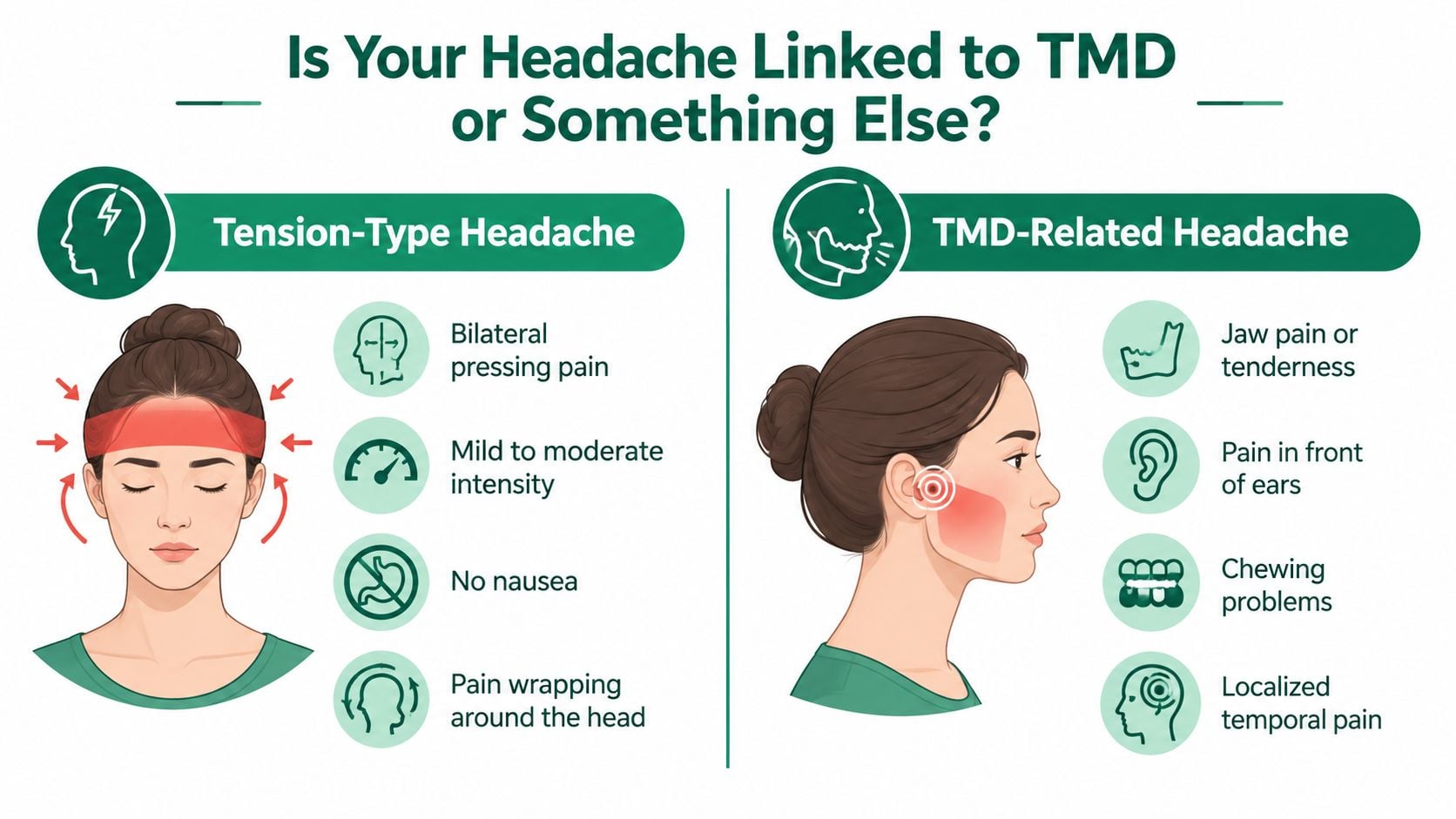
A tension-type headache usually feels like steady pressure, tightness, or a band around the head. The pain is generally bilateral, mild to moderate, and not made worse by ordinary physical activity. TMD-related pain may be felt in the temple, cheek, jaw, or area in front of the ear, with symptoms that become more noticeable during chewing, clenching, prolonged talking, or wide opening.
A useful starting point: the question isn't only “Where does the head hurt?” It's also “What changes the pain, and can a jaw examination reproduce the familiar headache?”
The connection can feel especially strong in the morning. A person may wake with temple pressure, jaw fatigue, tooth sensitivity, or facial tightness after an unsettled night. That pattern may point toward nighttime jaw activity or sleep disruption, but it doesn't prove that clenching caused the headache. Sleep quality, anxiety, neck tension, medication use, migraine features, and other medical factors may also shape the pattern.
People in Newark and Wilmington, Delaware, and Bryn Mawr and the Philadelphia Main Line often seek jaw-focused care after trying to manage recurring headaches as stress alone. A compassionate evaluation should validate the symptoms while avoiding a single-cause explanation.
Understanding the Headache Connection
Tension-type headache is one of the most prevalent neurological disorders worldwide. An analysis from the Global Burden of Disease 2016 study estimated a global age-standardized prevalence of 26.1%, with 30.8% among women and 21.4% among men. After adjusting for population age structures, that represents roughly one in four people globally during the measured period, according to the Global Burden of Disease analysis of tension-type headache30322-3/fulltext).
That figure describes population burden, not the cause of an individual person's pain. A common headache disorder will naturally appear in many people who also have jaw tenderness, sleep problems, neck discomfort, or medication patterns that can influence symptoms. The overlap supports screening, but it doesn't show that every tension-type headache comes from TMD.
What the pattern can suggest
A tension-type headache is generally characterized by bilateral pressing or tightening pain that is mild to moderate and not worsened by routine physical activity. A clinician may also ask about associated symptoms, headache duration, frequency, nausea, light sensitivity, and whether another disorder better explains the symptoms.
TMD becomes more relevant when head pain appears alongside painful jaw function, tenderness in the chewing muscles, limited movement, or a consistent relationship with clenching and chewing. Pain in front of the ear, temple tenderness, morning jaw fatigue, and a headache that changes during a controlled jaw movement can provide useful clues. None of these signs should be interpreted in isolation.
The number of headache days matters. Chronic tension-type headache requires headache on at least 15 days per month for more than 3 months, equivalent to at least 180 headache days per year, under the diagnostic framework summarized in the neurological review of tension-type headache criteria. That threshold doesn't mean every frequent headache is TMD-related. It means recurring symptoms deserve structured assessment instead of automatic attribution to stress.
A useful headache record includes the date, duration, location, quality, jaw activity, sleep quality, medication use, and any neurological or systemic symptoms. This information helps a provider compare the headache pattern with jaw findings and identify when medical, neurological, sleep, physical-therapy, or dental collaboration may be appropriate.
Is Your Headache Linked to TMD or Something Else
A tension-type headache isn't automatically a headache caused by TMD. The International Classification of Headache Disorders criteria for headache attributed to TMD require objective evidence of a painful TMD involving the joint, masticatory muscles, or related structures, along with at least two causal indicators.
Those indicators make the distinction more practical:
- Timing: The headache began with, or revealed, the painful TMD.
- Jaw provocation: Chewing, jaw movement, or parafunction such as bruxism aggravates the headache.
- Pain reproduction: Palpation of the temporalis muscle or passive jaw movement reproduces the patient's familiar headache.
The third point is especially important. General tenderness isn't the same as reproducing the exact pain the patient recognizes. A clinician may ask whether the pressure in the temple, behind the eye, or across the head feels familiar when the temporalis or jaw is examined. The response becomes one part of the diagnosis, not a stand-alone test.
What an evaluation should document
A focused assessment usually maps both symptom clusters rather than treating every head pain as a jaw problem. Important details include:
- Headache timing: morning, afternoon, after meals, during work, or at random
- Pain location: temples, forehead, behind the eyes, jaw, face, or neck
- Jaw triggers: chewing, clenching, speaking, yawning, or prolonged mouth opening
- Jaw function: range of motion, locking, painful movement, and changes in chewing
- Muscle findings: temporalis and masseter tenderness, including whether palpation reproduces familiar head pain
- Joint findings: pain, swelling, movement changes, or sounds with other symptoms
- Associated factors: sleep quality, snoring, fatigue, anxiety, medication use, and migraine-like symptoms
A painless click can be incidental. A painful joint sound may deserve attention, but the sound itself doesn't establish that it caused the headache. The more useful question is whether painful jaw dysfunction, jaw activity, and examination findings match the headache timeline.
Why multiple explanations can be correct
A person can have TMD and a primary tension-type headache at the same time. A person can also have jaw muscle guarding because a headache disorder has increased sensitivity around the face. This bidirectional relationship explains why treating one symptom may not resolve every symptom.
The goal isn't to force the pain into one label. The goal is to identify which findings are active, which factors amplify symptoms, and whether another provider should evaluate a non-mechanical or changing headache pattern.
Sleep, Anxiety, and Central Pain Processing
Nighttime clenching often becomes the suspected culprit, but persistent jaw-associated headaches rarely have a single confirmed driver. A systematic review reported bruxism in 45–87% of patients with TMD, poor sleep quality in 40–75%, anxiety disorders in 30–60%, and coexisting tension-type headache in 25–65%. The studies were heterogeneous, and that variation prevented a meta-analysis, as described in the systematic review of sleep, anxiety, bruxism, and TMD.
These ranges show coexistence, not a universal chain of cause and effect. Clenching may increase muscle loading, but it may also reflect pain, stress, disrupted sleep, or heightened nervous-system activity. A splint may be appropriate for selected patients, yet a splint alone isn't guaranteed to resolve a persistent headache pattern.
Central sensitization in plain language
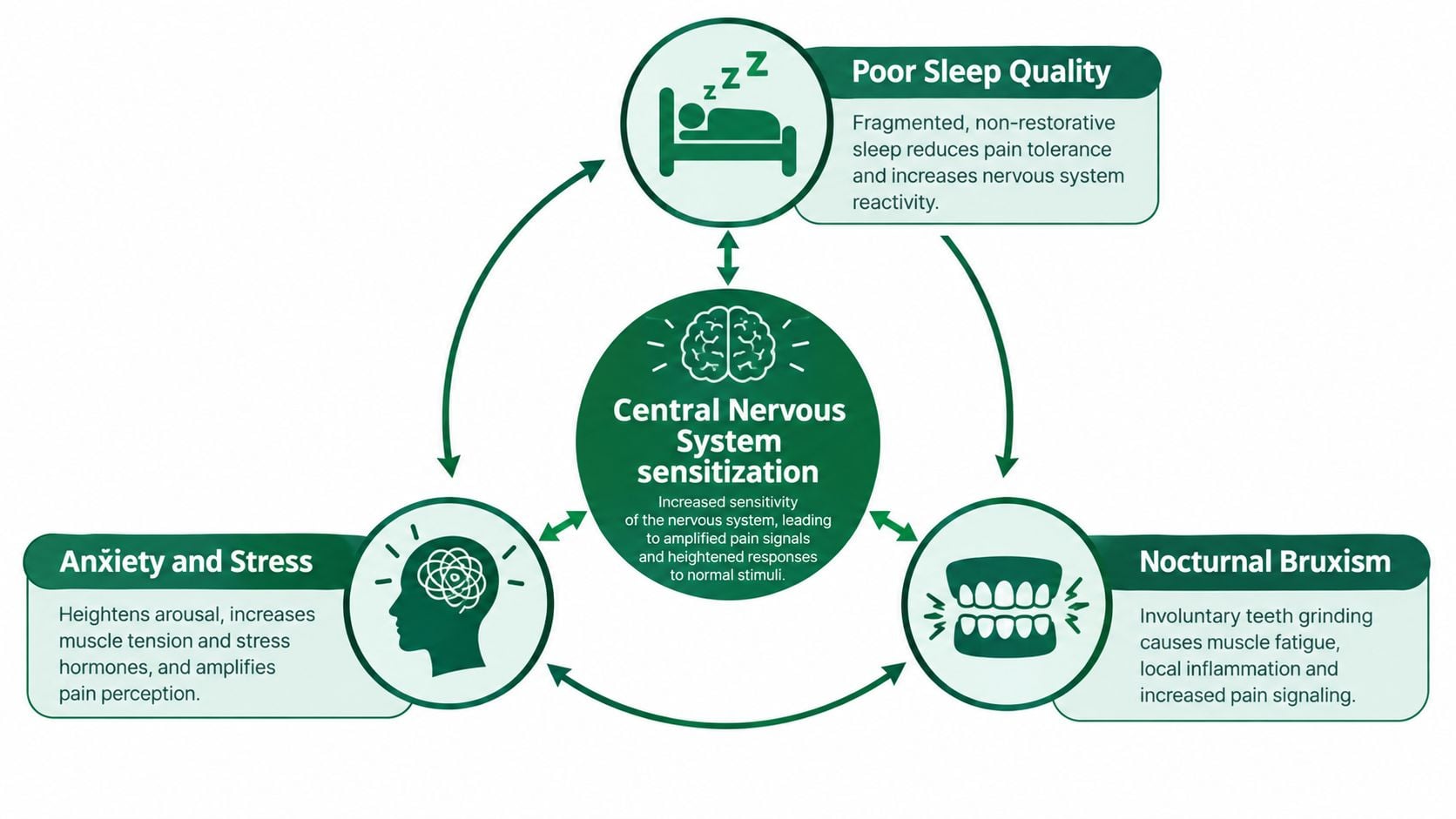
Central sensitization describes a nervous system that has become unusually responsive to pain signals. When this occurs, ordinary pressure or muscle activity may feel more painful, and symptoms may continue after local jaw loading has decreased. This doesn't mean the pain is imaginary. It means the brain and spinal cord may be helping maintain a pain response alongside local joint or muscle findings.
Poor sleep can reduce a person's ability to tolerate discomfort. Anxiety can increase muscle guarding and attention to symptoms without making the symptoms unreal. Nighttime jaw activity can add physical load. These influences may reinforce one another, which is why care often needs to address sleep, habits, movement, and pain sensitivity together.
A headache and sleep diary can make these relationships easier to see. Useful entries include:
- Headache days: frequency, intensity, duration, and location
- Jaw function: chewing tolerance, morning stiffness, locking, and familiar pain during movement
- Sleep: awakenings, snoring, fatigue, and perceived sleep quality
- Habits: daytime tooth contact, clenching during concentration, and suspected nighttime grinding
- Medication use: what was taken and how often, reviewed with a qualified clinician
An anxiety assessment should be presented as part of whole-person care, not as a dismissal of physical symptoms. Similarly, sleep screening shouldn't be used to diagnose sleep apnea by symptoms alone. If sleep-disordered breathing is suspected, a physician must establish the diagnosis with clinical evaluation and objective testing.
Conservative Treatment Options for Jaw and Head Pain
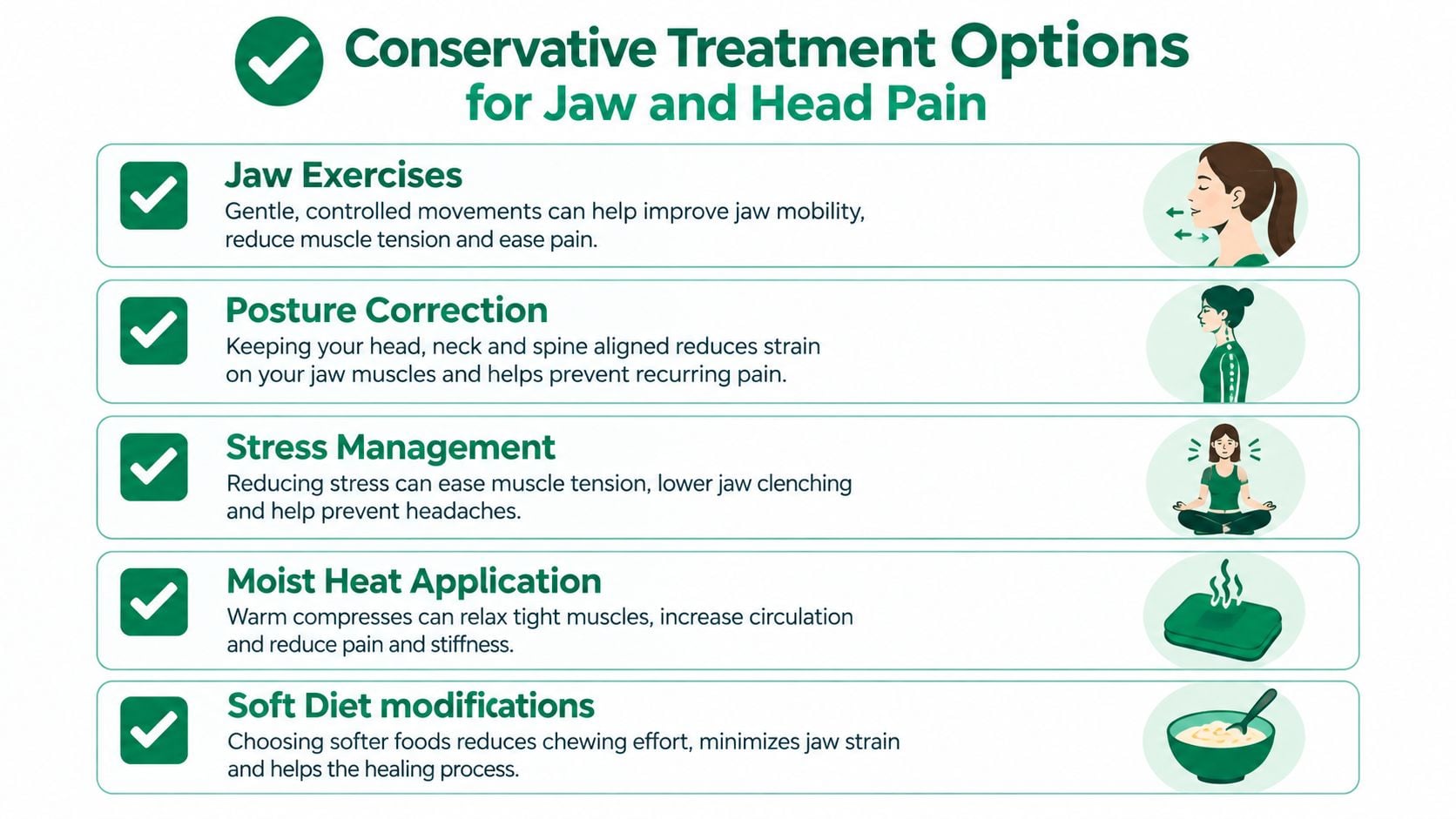
Conservative care is usually the starting point for many TMD problems, and surgery is rarely needed. The American Academy of Orofacial Pain guidance on TMD disorders includes measures such as softer foods, ice or moist heat, avoiding extreme jaw movements and gum chewing, physical therapy, jaw exercises, stress-management strategies, and medication when clinically appropriate.
Reduce loading first
During a painful flare, softer foods can reduce chewing demand. Avoiding gum, very chewy foods, extreme opening, and repeated wide yawning may also limit aggravation while the jaw settles. Moist heat may relax sore muscles, while cold may feel more comfortable after an acute aggravation. A provider can help determine which approach fits the findings.
Gentle jaw exercises should be selected carefully. Stretching or strengthening an irritated joint without guidance may increase symptoms, so physical therapy can help improve movement, coordination, posture, and muscle control. The right program depends on whether the main issue involves muscle pain, joint pain, restricted movement, or a broader head and neck pattern.
Consider appliances and adjunctive care thoughtfully
A custom oral appliance may help selected patients, particularly when it forms part of a broader plan. It isn't automatically suitable for every person with jaw pain or headache, and a device should be monitored for comfort, function, bite changes, and symptom response. An over-the-counter guard also shouldn't be treated as a diagnostic test.
A root-cause evaluation may examine jaw movement, muscle loading, bite-related factors, daytime clenching, sleep quality, and related medical concerns before invasive care is considered. At Pain and Sleep Therapy Center, care may include TMJ and facial-pain assessment, orthotic therapy, cold laser therapy as an adjunct, lifestyle guidance, sleep evaluation, and coordinated referrals. These options are individualized and don't guarantee a specific outcome.
Track function, not only pain
Pain intensity can fluctuate for reasons unrelated to jaw treatment. A more useful follow-up may include headache-day frequency, chewing ability, jaw range of motion, sleep quality, morning symptoms, and medication use. Tracking several outcomes helps a clinician decide whether the plan is helping and whether another diagnosis or referral needs attention.
Conservative care works best as a monitored process: the plan should change when the symptoms, examination, or functional goals change.
Common Misconceptions About TMJ and Headaches
Misconception one, every headache with jaw tension is a TMD headache. Jaw tension may occur during a primary headache disorder, and a primary headache may lead to protective muscle guarding. The diagnosis depends on the documented relationship between painful TMD, jaw activity, examination findings, and the familiar headache.
Misconception two, a click proves the jaw causes the pain. A joint sound without pain may not have the same clinical relationship as painful TMD. More useful clues include pain in the jaw or temple, chewing-muscle tenderness, painful chewing, restricted movement, and worsening with clenching or prolonged jaw activity, as discussed in the systematic review of painful TMD and headache associations.
Misconception three, nighttime clenching is always the root cause. Bruxism may amplify muscle loading, but it can also appear alongside poor sleep, anxiety, and increased pain sensitivity. Treating clenching alone may leave other drivers unaddressed, particularly when the headache pattern doesn't consistently change with jaw activity.
Misconception four, bite correction or an appliance will resolve every headache. A device may help in a carefully selected case, but headaches can have neurological, cervical, sleep-related, medication-related, and other contributors. A treatment plan should match the diagnosis rather than promise that one intervention will eliminate all head pain.
A review of TMD and primary headaches found a moderate association between mixed TMD and episodic tension-type headache, while also emphasizing that association doesn't prove that TMD causes every headache. The review reported that among linked headache types, migraine accounted for 61.5% and episodic tension-type headache for 38.5%, as detailed in the systematic review of TMD and primary headaches. Those findings support screening, not automatic attribution.
Medical referral matters when symptoms don't follow a mechanical jaw pattern. A sudden new headache, neurological symptoms, fever, visual changes, or a substantially changed pattern requires appropriate medical assessment rather than a dental explanation alone.
When to Seek Evaluation and Next Steps
A person with familiar, intermittent pressure and mild jaw soreness may begin by recording symptoms and arranging a non-urgent evaluation. A person who wakes repeatedly with head pain, has painful chewing, notices restricted opening, or finds that clenching reproduces temple pain may benefit from a focused TMD and headache assessment. The evaluation should connect the timeline to examination findings instead of relying on a click, a tender muscle, or a single symptom.
Prepare useful information
A brief diary can help a provider see patterns that are difficult to recall during an appointment. It can include:
- Headache frequency: headache days, duration, intensity, and location
- Jaw relationship: pain with chewing, speaking, yawning, clenching, or waking
- Sleep observations: snoring, restless sleep, morning fatigue, and nighttime awakenings
- Functional changes: limited opening, locking, altered chewing, or facial fatigue
- Safety concerns: new neurological symptoms, fever, visual changes, or a sudden change in pattern
Snoring and fatigue alone don't diagnose obstructive sleep apnea. The American Academy of Sleep Medicine guidance on oral appliances and sleep testing states that obstructive sleep apnea must be established through clinical evaluation and objective sleep testing before oral-appliance treatment begins. Polysomnography is the standard diagnostic test, while an appropriate attended or home cardiorespiratory study may be used in selected adults. Follow-up testing helps confirm effectiveness when an oral appliance is prescribed.
People in Newark, Wilmington, Bryn Mawr, and the Philadelphia Main Line can seek coordinated care when jaw symptoms, facial pain, headaches, snoring, or unrestful sleep overlap. Pain and Sleep Therapy Center, led by Dr. Ryan Robinson, a triple board-certified provider in craniofacial pain and dental sleep medicine, offers evaluation of TMJ and craniofacial pain, conservative treatment planning, dental sleep medicine services, and coordinated referrals when another clinician should be involved.
The most reassuring next step is often a clearer diagnosis. A structured assessment can show whether the jaw contributes to the headache, whether a primary headache disorder needs medical care, and which conservative measures may support function and sleep.
Pain and Sleep Therapy Center evaluates TMJ, facial pain, tension-type headache patterns, snoring, and sleep-disordered breathing with a root-cause, conservative approach. Readers can Request an Appointment with Pain and Sleep Therapy Center or call Newark at (302) 239-1757 to discuss symptoms and appropriate next steps.