
Jaw pain can start as a dull ache after chewing, then turn into something sharper when talking, yawning, or brushing teeth. Facial pain like that leaves people stuck between TMJ disorder and trigeminal neuralgia, two conditions that can overlap in location but not in cause. The safest path is not guessing, it's learning the pattern and getting a focused evaluation.
| Feature | TMJ Disorder | Trigeminal Neuralgia |
|---|---|---|
| Pain quality | Often dull, aching, pressure-like | Usually sudden, severe, electric-shock or stabbing |
| Common location | Jaw joint, temples, nearby muscles | One side of the face along a trigeminal nerve branch |
| Typical triggers | Chewing, clenching, jaw strain, stress | Light touch, talking, brushing teeth, cold air |
| Timing | Can linger or flare with use | Often comes in brief attacks |
| Main question to answer | Is the joint or muscle driving the pain? | Is the nerve driving the pain? |
A careful review matters because the next step is different for each condition. TMJ pain often leads toward conservative jaw care, while trigeminal neuralgia may need a nerve-focused workup and treatment plan. For readers who also notice tooth sensitivity or pain while chewing, sensitive teeth while chewing can be part of the picture, but it doesn't replace a real exam.
Table of Contents
- Why Facial Pain Diagnosis Is So Confusing
- What TMJ Disorders and Trigeminal Neuralgia Have in Common
- Pain Quality, Location, and Triggers Compared
- How Clinicians Evaluate Facial Pain
- Treatment Paths and Conservative Care Options
- When to Seek Care and How to Choose Next Steps
Why Facial Pain Diagnosis Is So Confusing
A person may sit in a chair and say, “It hurts here,” while pointing to the jaw, cheek, ear, or temple. The pain might change with chewing one day, then flare with brushing teeth the next. That is why tmj or trigeminal neuralgia becomes such a common search, the symptoms can feel close enough to blur together at first.
The confusion is not just frustrating, it can delay the right care. Trigeminal neuralgia is uncommon but well defined, with incidence and prevalence estimates reported in a global synthesis, while TMJ disorders are much more common, with a worldwide prevalence estimated at 29.5% and a U.S. adult burden around 5%. That contrast matters, because common pain can still be misunderstood, and rare pain can be missed.
Practical rule: if the pain story keeps changing, the diagnosis probably isn't obvious from one bad day.
The goal is not to self-diagnose from a symptom list. It is to notice whether the pain behaves more like a joint and muscle problem, or more like a nerve problem, then bring that pattern to a clinician who can map it properly. For a closer look at how jaw-related pain is sorted out, see is TMD causing your facial pain.
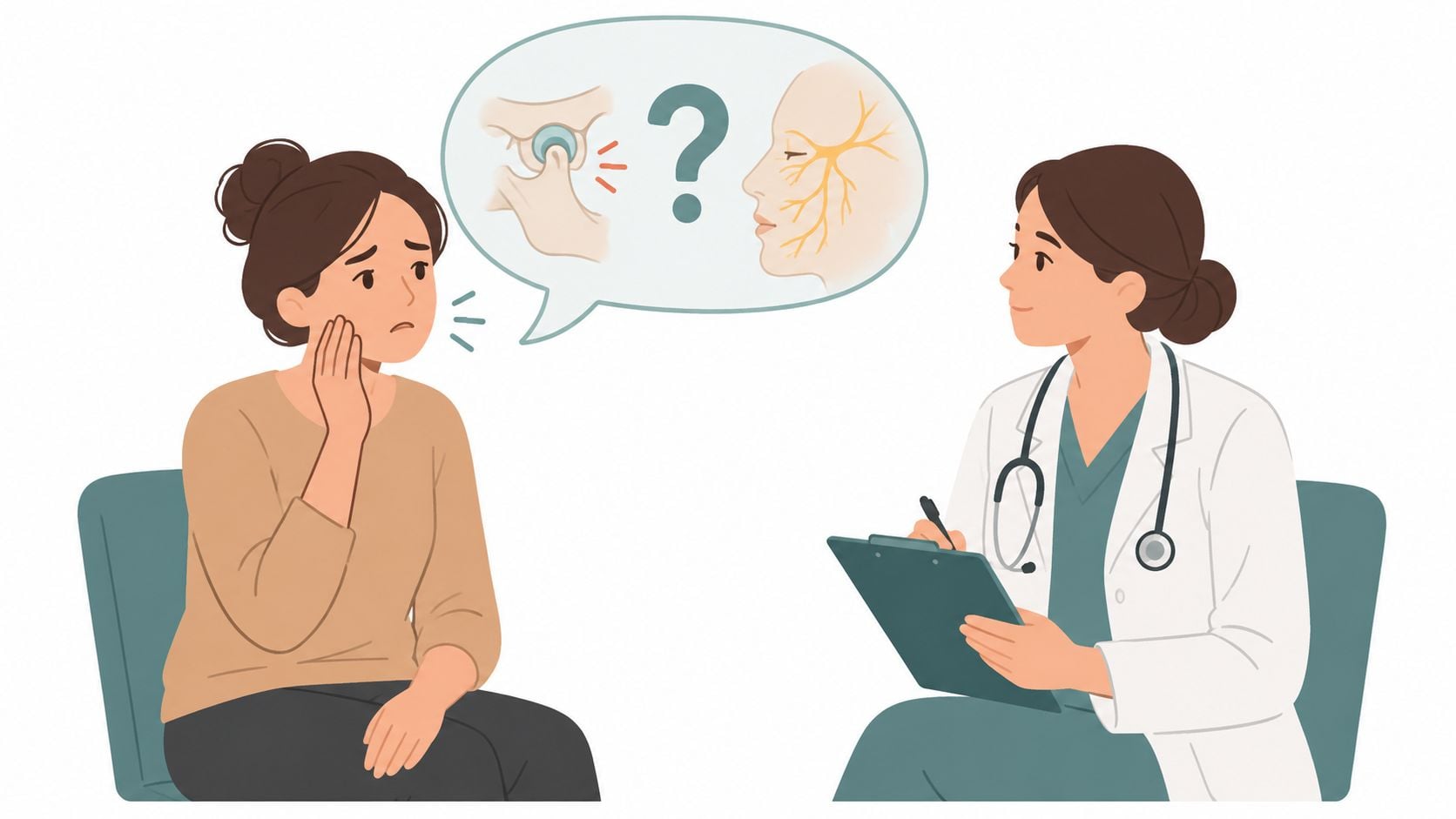
Families often spend months trying different mouth guards, pain relievers, or dental fixes before anyone pauses to ask whether the pain fits a nerve pattern at all. That trial-and-error cycle adds stress and can make people doubt their own descriptions. A better approach starts with the story of the pain, not with a guess.
What TMJ Disorders and Trigeminal Neuralgia Have in Common
Both conditions can show up as pain in the face, jaw, cheek, temple, or around the ear. Both can also interfere with speaking, eating, and sleep, which is why the person living with the pain may feel worn down long before the cause is clear. Shared anatomy makes the overlap real, not imagined.
Why self-assessment breaks down
The jaw moves close to the muscles of chewing, the teeth, and the nerves that carry facial sensation. Stress can also tighten jaw muscles and make either condition feel worse, which adds another layer of confusion. A person may think the trigger proves the diagnosis, when it only shows that the system is irritated.
TMJ disorders are common enough that many adults will encounter them at some point, while trigeminal neuralgia is much less common but still clinically important because of the severity of the pain episodes. A 2026 synthesis estimated trigeminal neuralgia at 25.33 cases per 100,000 person-years for incidence and 108.43 per 100,000 inhabitants for lifetime prevalence, with a separate NIH review describing an annual incidence of 4 to 13 per 100,000 people and lifetime prevalence of 0.16% to 0.3% (global trigeminal neuralgia review). Those numbers are not the whole story, but they show why the condition deserves careful attention even though it's uncommon.
Facial pain that overlaps in location does not overlap in cause.
That's why symptom checkers often fall short. They can list common features, but they can't tell whether the pain is coming from the jaw joint, the chewing muscles, or a facial nerve. A clinician has to sort out the sequence, the triggers, and the quality over time.
Pain Quality, Location, and Triggers Compared
TMJ pain and trigeminal neuralgia pain can both be intense, but they usually feel different. TMJ-related pain is often aching, tight, sore, or pressure-like, especially after clenching, chewing tough food, or holding the jaw in one position for too long. Trigeminal neuralgia usually has a different signature, with sudden bursts that people describe as electric, stabbing, or shock-like.
The pain story tells the truth
TMJ disorders usually involve the jaw joint and the muscles around it. The pain may sit near the ear, under the cheekbone, along the jawline, or in the temples, and it can feel worse after a long meal or a day of stress-related clenching. Some people also notice clicking, stiffness, or trouble opening wide, which fits the joint-and-muscle pattern.
Trigeminal neuralgia usually follows a nerve branch on one side of the face. A light touch, a sip of cold air, speaking, or brushing teeth can provoke a sudden attack, then the pain may disappear just as quickly. That stop-start pattern is one of the biggest clues that the problem is nerve-driven rather than joint-driven.
| Feature | TMJ Disorder | Trigeminal Neuralgia |
|---|---|---|
| Pain quality | Aching, pressure, soreness | Electric-shock, stabbing, severe |
| Location | Jaw joint, jaw muscles, temples | One-sided facial nerve distribution |
| Common triggers | Chewing, clenching, jaw strain | Touch, talking, brushing teeth, cold air |
| Duration | Often longer lasting or activity-linked | Often brief attacks with quiet periods |
| Movement effect | Jaw use often worsens symptoms | Even light facial stimulation can trigger pain |
A useful comparison is the experience of jaw pain versus facial nerve pain after eating. Someone with TMJ disorder may feel progressively sore through the meal and afterward. Someone with trigeminal neuralgia may feel a sudden bolt of pain during a very ordinary action, then be left guarding the face the rest of the day.
A related clue is that TMJ pain can feel similar to a mouth or tooth problem without being one. For readers trying to sort out jaw pain from tooth pain, the difference often comes down to whether the pain follows chewing and muscle use, or whether it fires in sudden jolts from light touch and simple daily actions.
For a broader jaw-pain perspective, the discussion at TMJ facial pain can help readers think in terms of patterns rather than isolated symptoms. That kind of pattern review is especially important when the pain doesn't fit neatly into one box.
How Clinicians Evaluate Facial Pain
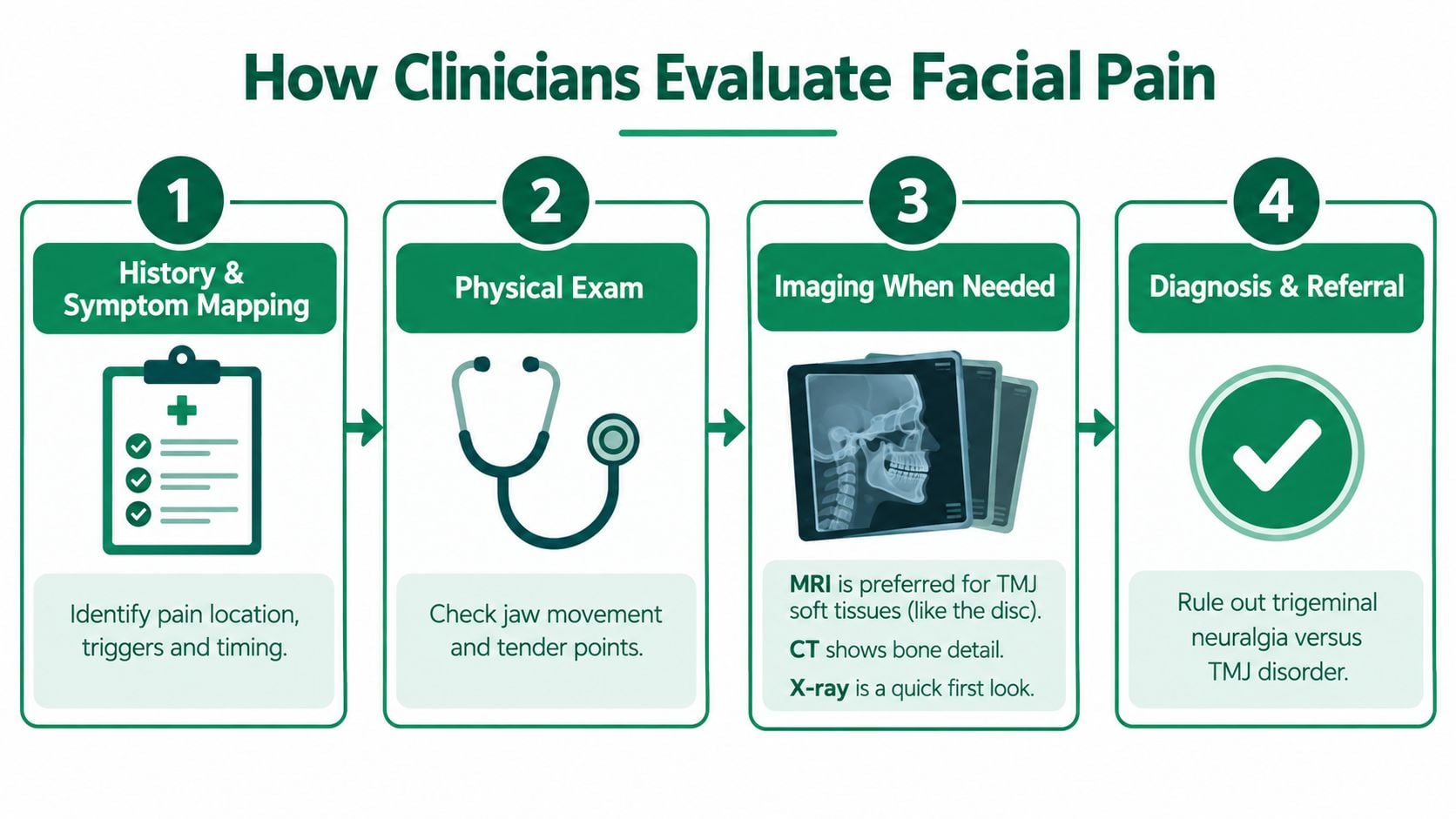
The evaluation usually starts with history, not imaging. A clinician asks where the pain starts, how long it lasts, what sets it off, what makes it worse, and whether there are jaw sounds, locking, numbness, or neurologic changes. That story often points toward either a joint-and-muscle problem or a nerve problem before any scan is ordered.
Imaging has a role, but not the same role in both conditions
For TMJ disorders, imaging can help when the question is disc displacement or internal derangement. MRI is the reference standard for articular disc assessment, while CT is most efficient for bony change, condylar remodeling, or osteoarthritic change. A 2025 meta-analysis comparing MRI with ultrasound also favored MRI for diagnostic accuracy, with a summary odds ratio of 0.64 and a summary relative risk of 0.80, which points to fewer misdiagnoses or false negatives when MRI is used for TMJ disorder identification (TMJ imaging review).
For trigeminal neuralgia, the diagnosis is mainly clinical. MRI is used to rule out secondary causes, not to prove the diagnosis by itself. That distinction matters because neurovascular contact on imaging does not automatically mean trigeminal neuralgia, and a scan can mislead if it's treated like a simple yes-or-no test.
The 2025 guidance on facial pain also supports an approach that looks beyond quick answers and checks whether the pain pattern, jaw function, and nerve distribution match the suspected condition. If the pain is severe, one-sided, electric-shock like, or tied to touch and brushing, specialist evaluation is warranted. The same is true when jaw pain persists, function is limited, or conservative steps haven't clarified the cause.
Treatment Paths and Conservative Care Options
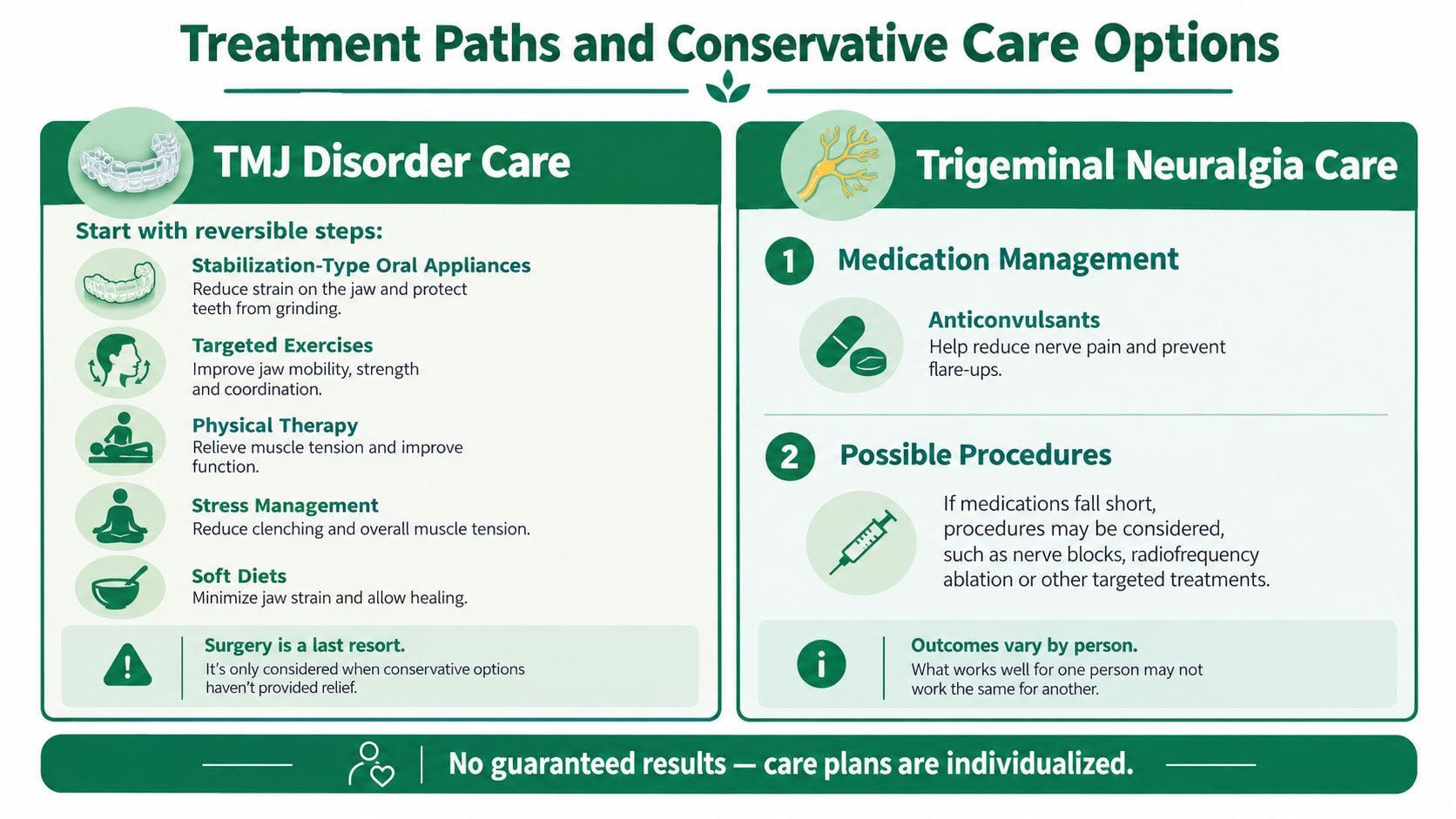
TMJ disorders usually start with reversible care. The recent clinical guidance continues to support mouth-opening exercises, stabilization-type oral appliances, physiotherapy, and cognitive-behavioral strategies, while routine occlusal adjustment, surgery, and other irreversible procedures are generally not recommended for most patients. That conservative approach fits the root-cause mindset, because jaw pain often improves more safely when the joint and muscles are calmed before anything is made permanent.
Conservative care first, then reassess
A structured TMJ plan may include a custom oral appliance, targeted exercises to restore opening and reduce guarding, physical therapy for jaw and neck mechanics, and habits that reduce clenching during the day. Some clinics also use adjunctive therapies such as cold laser as part of a broader pain-modulation plan, but the core idea stays the same, protect the joint, reduce strain, and avoid irreversible moves too early.
For readers wanting a practical way to think about appliance selection, patient selection for NTI therapy is a useful reminder that oral devices aren't one-size-fits-all. The right appliance depends on the pain pattern, jaw mechanics, and whether the problem is more likely to be muscular, joint-related, or something else entirely.
Plain-language takeaway: if a plan sounds permanent before the diagnosis is clear, it deserves a second look.
Trigeminal neuralgia follows a different path. Mayo Clinic notes that treatment may include medicines, surgery, injections, or other procedures, and that if another disease such as multiple sclerosis is causing the pain, that underlying condition may also need treatment. The main point is not that everyone needs procedures, it's that nerve pain is managed according to severity, cause, and response over time.
For medically refractory trigeminal neuralgia, microvascular decompression has shown the strongest durability in comparative reviews, with short-term pain relief reported in 85% to 96.6% of cases and long-term pain relief in 64% to 79% of cases, while longer-horizon estimates reported cure rates of 89.3% at 1 year, 80.5% at 3 years, and 71.2% at 8 years (surgical review). Those figures help explain why surgery is considered for selected patients, not as a first guess.
When to Seek Care and How to Choose Next Steps
Sudden, severe facial pain deserves prompt evaluation, especially when it comes with numbness, weakness, vision changes, or pain that follows a one-sided nerve pattern. Facial pain that keeps interrupting eating, speaking, sleep, or work also needs a structured assessment, even if it comes and goes. Waiting usually only extends the uncertainty.
People in Newark, Wilmington, Bryn Mawr, and along the Philadelphia Main Line can start with a focused exam that looks for the root cause instead of jumping straight to irreversible treatment. That matters when the pain is mixed, because jaw tension, sleep disruption, and facial pain can all feed each other. A careful workup can separate TMJ disorder from trigeminal neuralgia, and it can also flag when sleep-related issues are part of the picture.
The TMJ pain quiz can help organize symptoms before a visit, but it doesn't replace an evaluation. Sleep apnea, if it's part of the story, is diagnosed through a sleep study and a physician-led review, not by guesswork. If a person already knows the pain is disrupting sleep, that's another reason to bring the whole picture together in one place.
Pain and Sleep Therapy Center in Newark, DE and Bryn Mawr, PA focuses on TMJ and craniofacial pain, sleep apnea and snoring care, and tongue-tie evaluation with conservative, coordinated treatment options. For readers who want a calm, root-cause approach to jaw or facial pain, that kind of structured assessment can make the next step clearer. Request an Appointment or Take our Sleep Quiz when it's time to move from guessing to a real plan.
Pain and Sleep Therapy Center helps patients sort out TMJ, facial pain, sleep-disordered breathing, and related concerns with a conservative, root-cause approach. If jaw pain, facial pain, or suspected trigeminal neuralgia has made daily life harder, visit Pain and Sleep Therapy Center to explore evaluation and care options in Newark and Bryn Mawr.