A custom oral appliance for obstructive sleep apnea commonly costs about $2,000 to $4,000 before insurance in the United States, according to Consumer Reports' consumer-health reporting. The device price is only one part of the bill. Testing, custom fabrication, fitting, adjustments over time, and a later check of breathing may be included in the quote or billed separately. A low headline price may cover only the appliance, while a higher quote may include several steps of care. Comparing estimates means checking what each one covers, rather than comparing device prices alone. Testing before treatment, adjustments after fitting, follow-up testing, and eventual replacement can also affect the total cost.
Table of Contents
- Typical Oral Appliance Therapy Costs in the United States
- What Each Part of Oral Appliance Care Includes
- How Medical Insurance and Medicare Change the Bill
- Oral Appliance Cost Compared with CPAP and Surgery
- Replacement Visits and a Longer Budget
- When the Appliance May Be Worth the Price
- Financing and Paying Over Time
- Request an Appointment to Review Your Estimate
Typical Oral Appliance Therapy Costs in the United States
A custom oral appliance's price depends partly on which parts of care the quote includes. Consumer Reports' 2024 consumer-health reporting puts the typical U.S. cost of a custom device for obstructive sleep apnea at about $2,000 to $4,000 before insurance. Evaluation, impressions or digital scans, device fabrication, fitting, titration, and follow-up may be included together or billed separately. Titration means moving the lower jaw forward in small steps and checking comfort and breathing as the position changes.
Other published ranges describe different packages. The Daybreak gives a range of $1,500 to $3,000 for custom-fitted oral appliances. The Sleep Foundation reports roughly $1,500 to $4,500 for a dentist-fitted appliance, typically including consultation, impressions or scans, fabrication, and follow-up visits. These ranges overlap, but their included services may differ.
Why Older and Smaller Numbers Mislead
Some online prices are far below the cost of a full course of custom care because they refer to older totals, laboratory work alone, or ready-made devices. A laboratory fee pays for making the device. It does not cover a dental exam, fitting, adjustment visits, or follow-up testing.
A prefabricated, or ready-made, appliance is not made for a person's teeth and bite, and it may not allow small, measured changes in jaw position. Its price is not directly comparable with a custom mandibular advancement device, which holds the lower jaw slightly forward. A shelf-bought brace and a clinician-fitted brace serve different purposes and include different levels of care.
| Cost figure | Published range | What the number represents | How to read it |
|---|---|---|---|
| Custom appliance before insurance | about $2,000 to $4,000 | Common U.S. price for a custom device for obstructive sleep apnea | Consumer Reports' 2024 consumer-health reporting; the price may include more than the device |
| Custom-fitted appliance | about $1,500 to $3,000 | Custom-fitted range in a consumer insurance resource | The Daybreak; a published range, not a guaranteed clinic fee |
| Dentist-fitted bundle | about $1,500 to $4,500 | May include consultation, scans or impressions, fabrication, and follow-up | Sleep Foundation; compare only when quotes list similar services |
| Older total treatment cost | average $933; range $400 to $2,450 | Historical total treatment cost in an AASM review | Historical pricing, not a current quote for full custom care |
| Laboratory fabrication alone | about $100 to more than $600 | Laboratory fee for a custom device in that older review | Does not include the patient's visits, fitting, or follow-up |
| Prefabricated appliance | about $45 to more than $100 | Non-custom piece in that older review | A different product from a custom titratable device |
How to Use the Table
Read each row by its included services, not just by its dollar amount. The older treatment total, laboratory fee, and prefabricated-device price help explain why some advertised figures look much lower than a dentist-fitted custom appliance. They are not interchangeable costs.
Pain and Sleep Therapy Center provides dental sleep medicine services, including at-home sleep testing and oral appliance therapy. For any provider, ask for a written estimate that separates the appliance from testing and visits. It should state what the quote covers, including consultation, records, laboratory work, delivery, follow-up, and replacement terms.
Practical rule: Compare quotes only after each office lists the same parts in writing.
A clearly itemized estimate makes it easier to see whether a lower figure covers only the device or a broader course of care. That difference matters more than the headline price alone.
What Each Part of Oral Appliance Care Includes
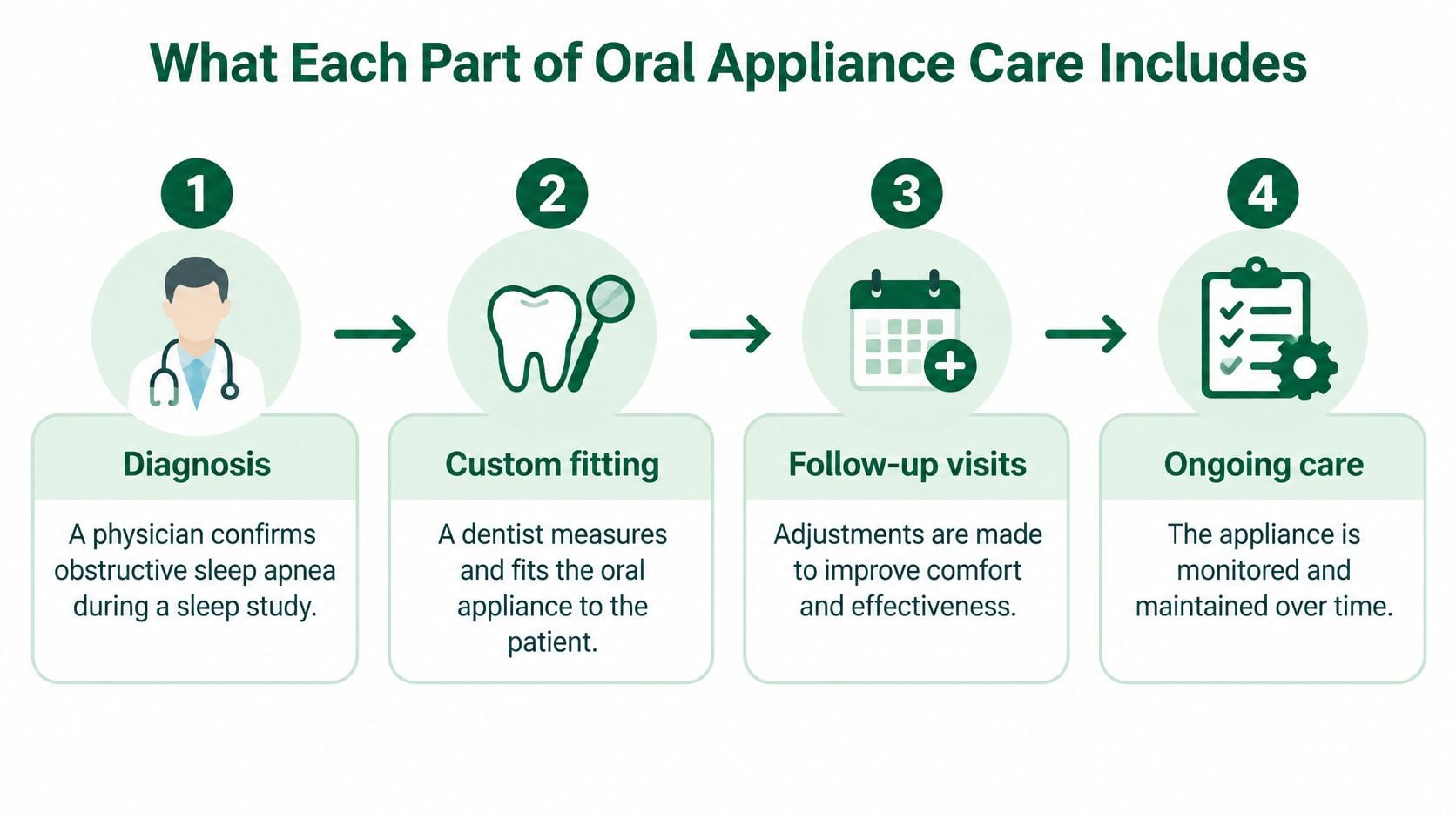
Oral appliance therapy begins with a diagnosis, not with a purchase. A physician diagnoses OSA with a sleep study. One option is polysomnography, an overnight study in a sleep lab. Another is a home sleep apnea test, done with a small recorder worn in bed at home.
A home sleep study costs less than an in-lab sleep study, but it can sometimes under-diagnose sleep apnea. With severe symptoms and a negative home sleep test, an in-lab sleep study is occasionally recommended as a follow-up. That order matters for cost, because a second study may be needed before any device is made. It also matters for safety, since treatment should match the true severity of the condition.
After OSA is confirmed, care moves to a qualified dentist. The American Academy of Sleep Medicine guideline recommends a custom, titratable oral appliance rather than a non-custom device. Titratable means the jaw position can be changed in small steps instead of locked in one place on day one.
From Scan to a Working Jaw Position
Say a patient arrives with a sleep study that confirms OSA. The dental visit checks teeth, gums, bite, and jaw joints, because the device must hold onto healthy teeth without straining the jaw. The dentist then takes impressions or a digital scan, and a lab builds the appliance to fit that mouth.
Delivery is not the finish line. Simple tests are run to determine the amount of advancement needed to prevent snoring. Adjusting the appliance to its best position can sometimes take a period of time. Moving too far, too fast, can cause soreness, so steps stay small.
- Consultation and records: Review of the sleep study, dental exam, and imaging only when it's needed
- Fabrication: Lab work based on impressions or a digital scan
- Delivery and titration: Fitting, home instructions, and gradual jaw adjustments
- Follow-up testing: A repeat sleep study to check whether breathing events fell
What Store-Bought Guards Leave Out
An over-the-counter snoring guard skips most of that pathway. There's no sleep study review, no custom lab fit, and no planned recheck of breathing. It may cost far less, but it isn't the same treatment and can't show whether apnea is controlled.
The pathway above serves as a checklist. When a quote arrives, each line can be matched against diagnosis, fitting, adjustments, and follow-up testing. Missing lines are not savings yet. They may appear later as separate bills.
How Medical Insurance and Medicare Change the Bill
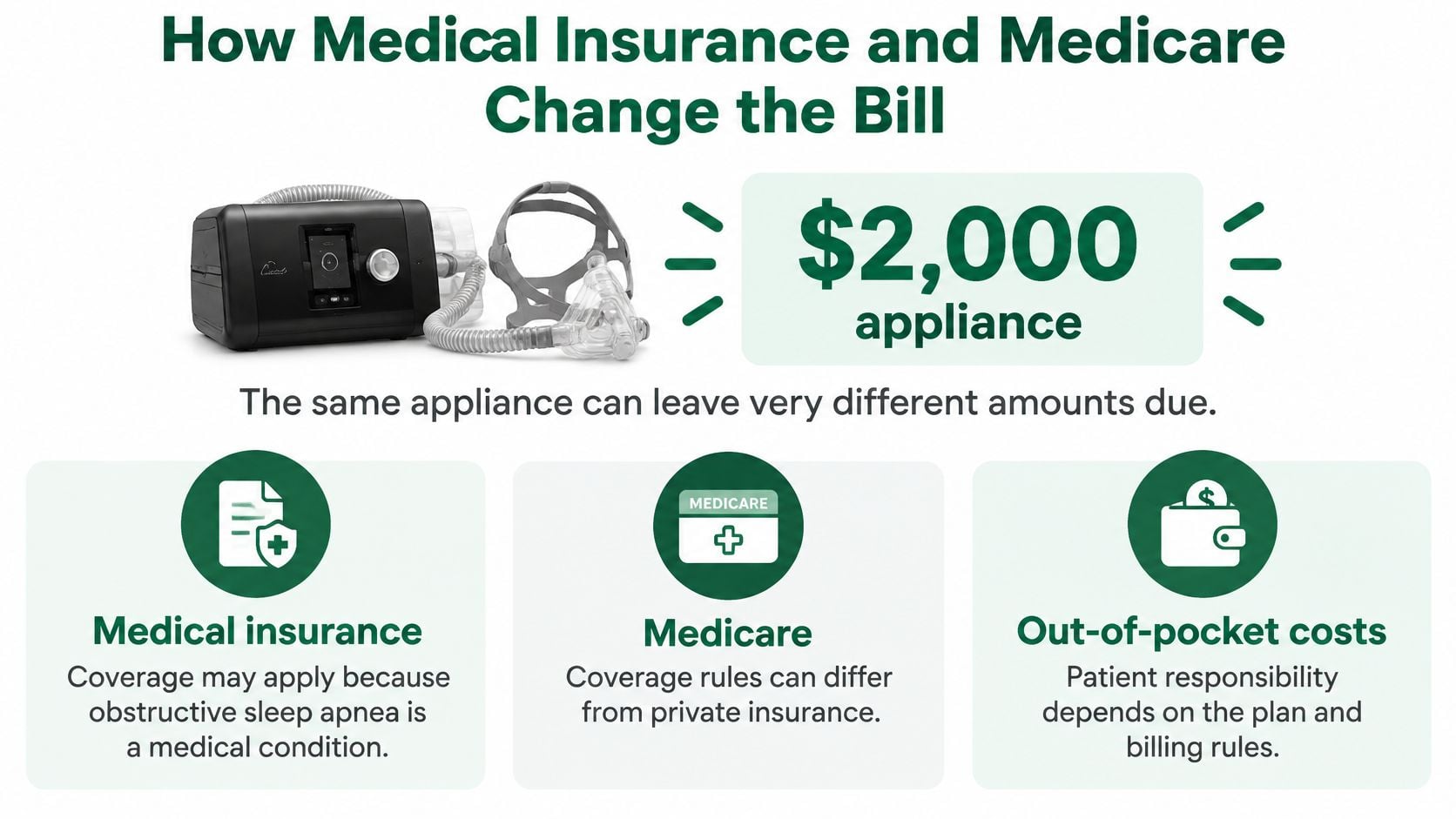
The same custom device can lead to different patient bills because coverage depends on the plan and the timing of care. A deductible is the amount a patient pays each year before insurance starts sharing costs. After it is met, a plan may charge coinsurance, a percentage of the allowed cost paid by the patient.
Obstructive sleep apnea is a medical condition, so only medical insurance covers its treatment with a dental device. The cost is subject to the patient's annual medical insurance deductible. A routine dental plan for cleanings and fillings is not the usual route for this treatment.
The American Academy of Dental Sleep Medicine gives an example using a $2,000 oral appliance and a hypothetical plan with a $1,700 deductible, 20% coinsurance, and a $6,000 out-of-pocket maximum. If the deductible has not been met, the patient could owe about $1,940. If it has already been met, the 20% coinsurance could leave the patient paying about $400. The device is the same; the point in the insurance year changes the estimate.
| Situation | Assumptions | Estimated patient share | What still must be checked |
|---|---|---|---|
| Deductible not met | $2,000 appliance, $1,700 deductible, 20% coinsurance | About $1,940 | Whether other claims this year have reduced the deductible |
| Deductible already met | 20% coinsurance on a $2,000 allowed amount | About $400 | Whether the plan allows the full $2,000 and the provider is in network |
| Medicare custom device | Custom device billed as durable medical equipment | Set by Medicare cost-sharing rules | Qualifying records and the plan's payment rules |
Paperwork That Plans Commonly Want
Plans may ask for records before deciding whether to pay. These can include a sleep-study diagnosis, a physician's prescription, and notes showing why the device is medically needed. Some commercial plans also ask whether continuous positive airway pressure, or CPAP, was tried and not tolerated. CPAP uses gentle air pressure delivered through a mask to help keep the airway open, and it helps many patients.
Durable medical equipment means medical equipment intended for repeated use at home. Medicare has specific rules for qualifying custom devices, so patients should confirm which records and billing details it requires.
A coverage approval does not necessarily mean insurance will pay the full charge. Prior authorization, network status, the deductible, and the plan's allowed amount can all affect the patient's share. The center's guide to navigating insurance for care can help patients prepare questions for their insurer.
Before care begins, ask the plan what is authorized and what costs may remain. Then compare the answer with the estimate: a low device price may not include every billed part of care, while a bundled quote may combine several costs. Confirm what the quote includes and what insurance may cover, so the expected bill is easier to understand.
Oral Appliance Cost Compared with CPAP and Surgery
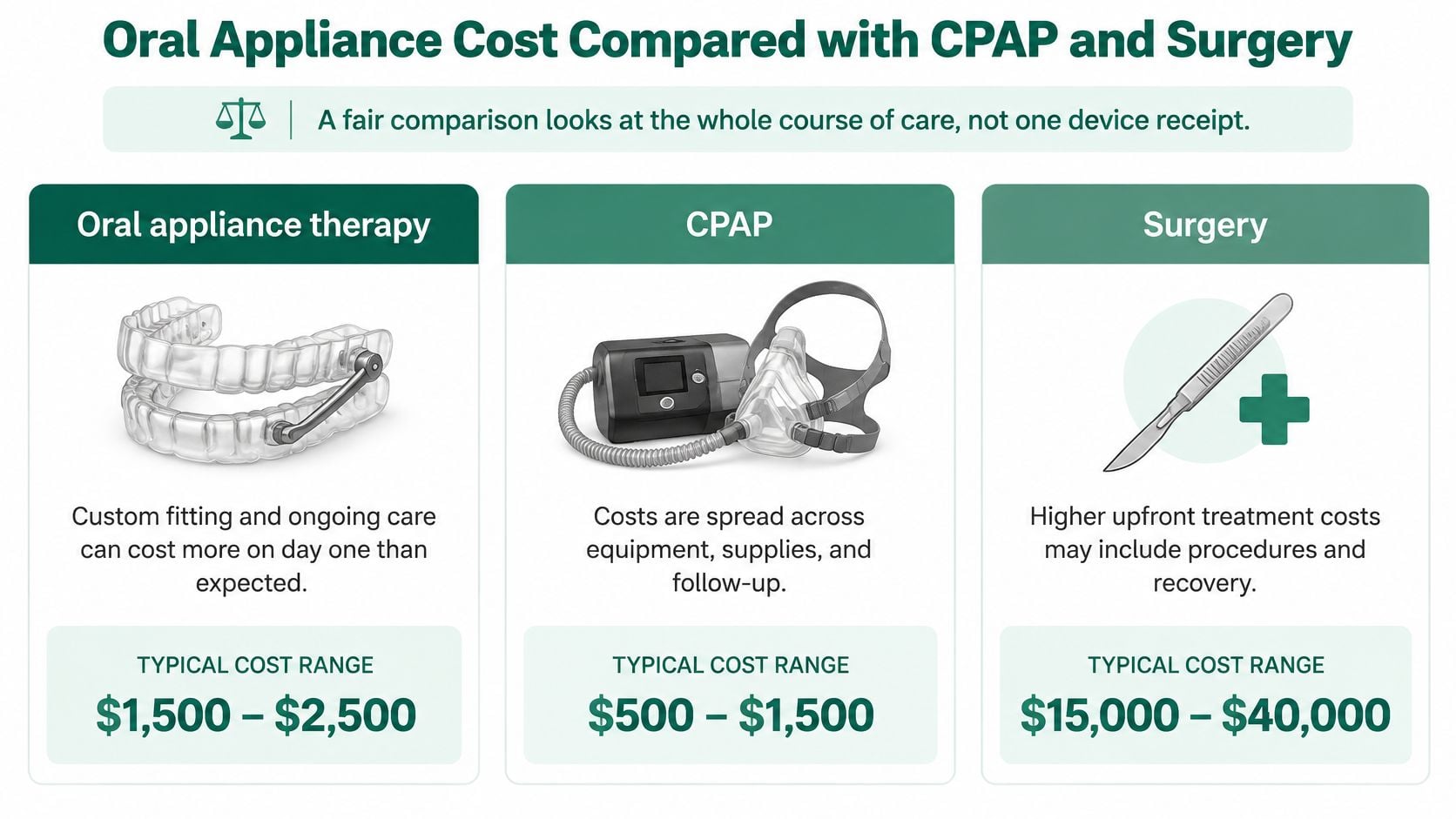
A fair comparison looks at the whole course of care, not one receipt. A custom appliance often costs more on day one than people expect from a mouthpiece. CPAP costs are spread across a machine, masks, tubing, filters, and follow-up. Surgery concentrates cost around a procedure, a facility, and recovery care.
Visit patterns also differ. A healthcare-use analysis summarized by Sunbit's sleep apnea financing guide found oral appliance patients averaged 4.5 visits before treatment started versus 3.5 visits for positive airway pressure patients, then 4.1 visits after initiation versus 5.5 visits. Dental visits in that analysis were estimated to cost less than specialized PAP-related visits. More visits early can still lead to fewer visits later, so timing matters as much as totals.
| Path | Upfront cost pattern | Visits around the start of care | When it may fit |
|---|---|---|---|
| Custom oral appliance | Often about $2,000 to $4,000 before insurance for the device and related dental care | About 4.5 visits before start and 4.1 after in one analysis | Mild to moderate OSA, or an adult who cannot tolerate or prefers an alternative to CPAP |
| CPAP or other positive airway pressure | Machine and supplies billed as medical equipment; patient share set by the plan | About 3.5 visits before start and 5.5 after in the same analysis | Many patients, and often the stronger choice for severe OSA |
| Airway surgery | Set by procedure, hospital, and insurance; no single national fee | Preoperative, hospital, and recovery visits set by the surgeon | When a physician finds a physical blockage that devices cannot overcome |
Where Each Path Tends to Fit
CPAP remains an important and effective treatment, especially when apnea is severe. Many patients do well with it and should not feel pushed away from care that's working. An appliance may be considered when an adult prefers an alternative or cannot stay with CPAP, and the physician and dentist agree it's a sound option. Readers comparing the two paths in more detail can see the center's guide to oral appliance therapy versus CPAP.
Surgery enters the picture for a different reason. When physical barriers in the airway prevent CPAP and oral appliances from helping, the center works with the appropriate physician to create a plan for the best possible outcome. That step follows careful evaluation, since the practice looks for the root cause and favors conservative care before surgery.
A cheaper way to make a device does not guarantee a cheaper total bill, because fitting, follow-up, and testing still have to happen.
Early reports about lower-cost fabrication, including 3D printing, should be read with that point in mind. Lower production cost doesn't remove the need for diagnosis, titration, or proof that breathing improved. Severity and tolerance point to the right path first. The plan's own numbers then confirm the dollars.
Replacement Visits and a Longer Budget
The first invoice is rarely the last cost of care. A device worn nightly will wear, and teeth and bites can change over the years. Planning for replacement at the start keeps that later bill from feeling like a surprise.
The longer view is documented in reimbursement research. The American Academy of Sleep Medicine review reported historical total treatment costs averaging $933, with a range of $400 to $2,450 before reimbursement, while contemporary analyses place medical-insurance reimbursement around $2,000 to $2,500 and a 10-year model estimated $4,000 to $5,000 for delivery of two appliances. That model reflects replacement over time, not a second diagnosis. It also shows why a one-year budget understates the cost of a therapy meant to be used for years.
Two Plausible Paths Over a Decade
Consider a first patient who cleans the device daily, stores it dry, and keeps routine checks. That patient may need minor adjustments and one replacement later in the decade. Total spending stays closer to the two-appliance model, spread across many years.
Consider a second patient who clenches hard at night. Extra titration visits may be needed, parts may wear sooner, and replacement may come earlier. The appliance is anticipated to need replacement in 5 to 7 years, sooner for heavy bruxers and clenchers or for people who do not take care of their appliance. Bruxism means grinding or clenching the teeth, often during sleep.
Nightly use explains much of the wear. The sleep appliance is used every night for 6 to 8 hours. A device under that load should be checked for cracks, loose fit, and bite changes on a regular schedule.
- Adjustment visits: Small jaw-position changes and sore-spot relief
- Bite and tooth checks: Monitoring for tooth movement or jaw strain
- Cleaning supplies and repairs: Daily care products and fixes for worn parts
- Repeat sleep testing: A new study if snoring or daytime tiredness returns
Questions That Protect the Budget
Ask how repairs are billed. Ask whether early follow-up visits are bundled or charged one at a time, and ask what a replacement device costs when scans are already on file. Ask who pays for repeat testing if symptoms return.
A low price with no adjustment visits can cost more later if breathing is never verified. A higher bundled quote may already include delivery and early follow-up that another office bills separately. Requesting a written list of included services, plus the replacement terms, turns a vague worry into a plan with dates and numbers.
When the Appliance May Be Worth the Price
A treatment's value depends on whether it is used and whether breathing improves. For oral appliance therapy, those questions connect the nightly routine to a measurable result: changes in the apnea-hypopnea index, or AHI, which counts breathing interruptions or reductions per hour of sleep.
Research summarized in the National Institutes of Health database reports that mandibular advancement devices generally lower AHI less than CPAP. The same review reports average oral-appliance compliance of 71% through 12 months, with study results ranging from 64% to 83%. In studies lasting at least 12 months, average compliance was 79%, ranging from 68% to 90%.
Effectiveness Per Hour Versus Use Across the Night
CPAP usually lowers AHI more while it is being used. Some patients wear an oral appliance more consistently, which may narrow the difference in everyday use. For example, a patient who wears an appliance five nights out of seven may have less benefit across the whole week than someone who uses it nightly. A follow-up sleep test can show whether breathing improves with the patient's actual pattern of use.
Severity also matters. Oral appliances are generally less effective at reducing AHI in severe obstructive sleep apnea, so a physician may recommend CPAP or another treatment. That difference affects what a device can reasonably be expected to do, and belongs in a cost discussion.
A nighttime appliance is also a hallmark maintenance therapy for temporomandibular joint (TMJ) problems. A guard made only for jaw soreness is not designed to treat sleep apnea. If it is not made to control sleep apnea, it can double the severity of a patient's sleep apnea. Similar-looking devices can serve different purposes, so the intended use matters.
Value check: Consider whether the treatment plan includes a custom fit, adjustments, and objective follow-up testing. These help show what the fee covers and whether the appliance is helping.
Diagnosis, severity, dental health, and a plan to recheck results shape the value of treatment. An appliance may help snoring and sleep-disordered breathing, but the benefit should be measured rather than assumed. A bundled quote is easier to judge when it states which parts of care are included, not just the device price.
Financing and Paying Over Time
Cost questions often become payment questions. The first step stays the same. Get a written, itemized estimate that separates testing, fabrication, adjustments, and follow-up, since a payment plan is only as clear as the amount it covers.
Questions to Ask Before Signing
- Plan terms: What down payment, schedule, fees, and interest apply, and what happens if treatment stops early?
- Third-party lending: What is the annual percentage rate, what late fees apply, and what is the total repaid over the full term?
- Account funds: Can a health savings account or flexible spending account be used for a prescribed appliance?
Comparing the total repaid matters more than comparing the monthly amount alone. A lower monthly payment across a longer term can cost more in the end. Readers weighing credit options can review neutral guidance on borrowing for dental treatment costs before committing to any lender.
Tax-advantaged accounts need a quick check too. An appliance prescribed for diagnosed sleep apnea may qualify as a medical expense, but eligibility should be confirmed with the plan administrator or a tax professional. The center's page on financing solutions for patients outlines how to start that conversation with the office.
Timing can help. Testing, fabrication, and follow-up may be scheduled in stages so each payment matches a documented step. Signing a plan before the diagnosis is confirmed puts the cart before the horse. If cost is a barrier, saying so at the consultation lets the team explain which steps are required first and which can wait.
Request an Appointment to Review Your Estimate
An oral appliance quote is easier to compare when it shows more than the device price. Ask what the estimate includes, from testing and fabrication to adjustments and follow-up. A dentist with advanced training in sleep apnea treatment can explain how these steps fit your care.
Pain and Sleep Therapy Center provides care in Newark, Delaware, and Bryn Mawr, Pennsylvania. Led by Dr. Ryan Robinson, the center focuses on identifying causes of pain and sleep problems and considering non-invasive options. An oral appliance is one treatment option, and it may not meet every patient's goals. If it does not, the center supports patients in obtaining other effective therapies.
What to Bring to the Visit
- Sleep study report: Bring the latest home or in-lab results, if available. A home test may sometimes underestimate sleep apnea, so the clinician can discuss whether further testing is appropriate.
- CPAP notes: If you have tried CPAP, list what was difficult to use.
- Insurance card: Obstructive sleep apnea (OSA) is a medical condition, so treatment with a dental device is covered only through medical insurance and is subject to your annual medical deductible.
- Cost questions: Ask whether the estimate includes testing, appliance fabrication, adjustments, follow-up testing, and future replacement.
Bring questions, too. Ask how the appliance will be adjusted and how treatment progress will be checked. The device is worn nightly, and its fit may need adjustment to reach the intended position. No treatment can promise a cure, so ask what other options may be considered if the appliance does not meet your goals.
To request an appointment or take the sleep quiz, visit Pain and Sleep Therapy Center. A written estimate should separate the expected charges by care step and make clear what insurance may cover, what you may owe toward your deductible, and which services are not included. That makes it easier to compare a bundled estimate with a lower device-only price.